
 Lesson 6.3
Lesson 6.3 · Setting Up
Food & the Breakfast Question
A hotel chain can copy your mattress, your wifi plan and even your welcome tray — it cannot copy your mother-in-law's appam-and-stew recipe, and that is exactly why food is the one unfair advantage a homestay keeps forever.
Breakfast is the one thing a guest will remember after they have forgotten what the room looked like.
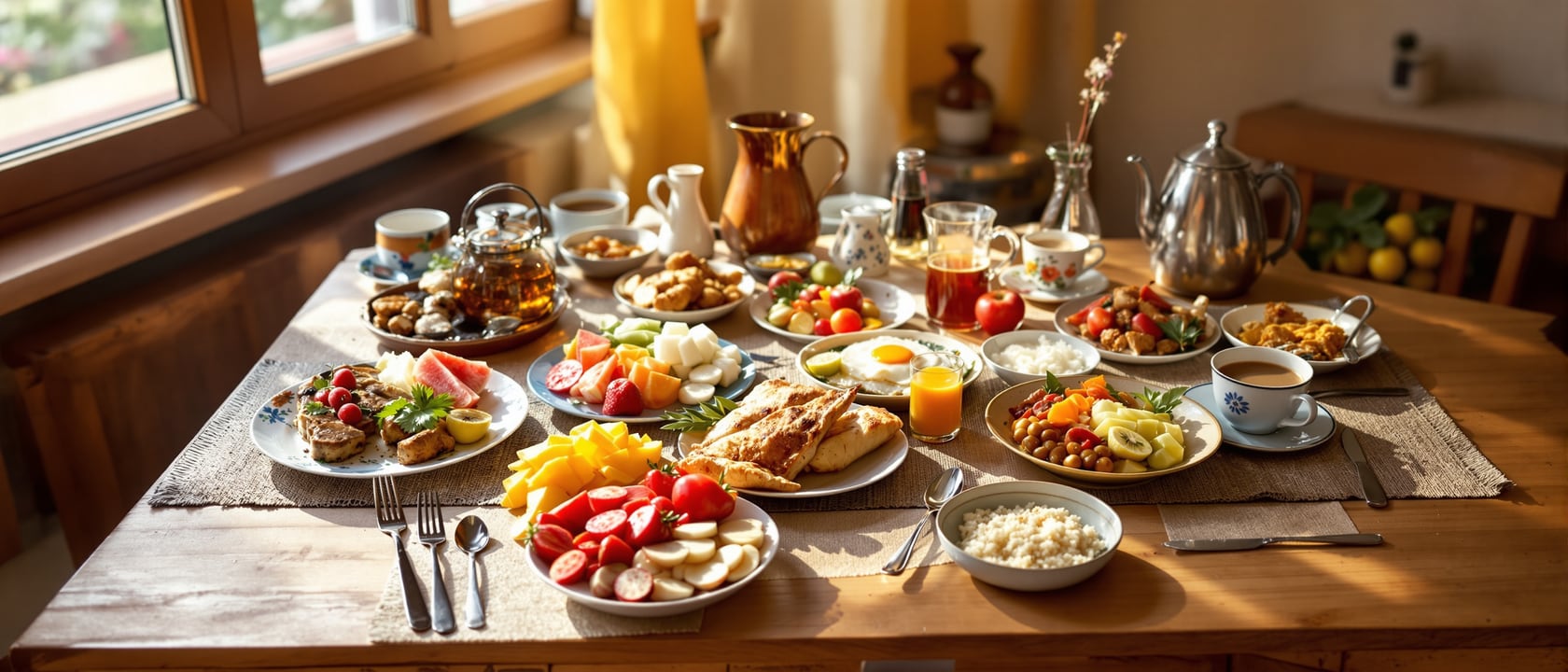
Ask a traveller to describe a homestay they loved five years ago and the room details fade fast — but ask about the food, and the answer comes instantly: the Keralite host who made appam and stew every single morning without being asked twice, the Himachali grandmother who insisted on siddu even though it was not on any menu, the Rajasthani family that served besan chilla with a chutney nobody could quite place but everybody asked about. Food lodges in memory in a way decor rarely does, and it is also the one part of the homestay experience a hotel chain, with its standardised central kitchen and buffet line, genuinely cannot replicate — a regional home-cooked breakfast made by the person whose home it actually is.
This lesson walks through the practical decisions every homestay host eventually has to make about food: which breakfast model to run, how to handle the real variety of dietary needs Indian and international guests arrive with, how much food to actually prepare so you neither run short nor waste money, the FSSAI registration basics that apply even to a small home kitchen, and how to price meals beyond the included breakfast without either losing money or overcharging a guest who expected something closer to a home-cooked gesture than a restaurant bill.
Breakfast is the review's best friend or its worst enemy - never its afterthought.
Food is the homestay's unfair advantage
Every advantage covered so far in this course — a welcome tray, a well-chosen local craft piece, a genuinely warm greeting — is replicable in principle, even if a hotel chain rarely bothers. Regional home cooking is different: it cannot be centrally standardised without ceasing to be what it is. A Kerala homestay serving appam with a coconut-milk vegetable stew or a simple fish moilee, a Himachal or Uttarakhand homestay offering siddu (a steamed, filled bread specific to the hills) or a bowl of rajma-chawal made the way the host's own family has made it for decades, a Rajasthani haveli homestay serving besan chilla, bajre ki roti or a simple ker sangri on request — none of this scales into a hotel buffet line without losing exactly the quality that made it worth eating in the first place.
This is worth treating as a deliberate strategic choice rather than an afterthought squeezed in after the room is sorted. Decide, early, whether food is going to be a core part of your homestay's identity — the reason a guest chooses you over the homestay two doors down — or a competent but secondary offering. Either choice is legitimate, but the hosts who treat food as an afterthought (a packaged bread-and-jam breakfast with instant coffee, identical to what any budget lodge offers) are leaving their single most defensible competitive advantage completely unused. A regional, home-cooked breakfast, even a simple one, done consistently and made from what is actually local and in season, is very hard for a competitor to copy and very easy for a guest to remember and recommend.
A regional home breakfast is the one thing competitors cannot copy by buying better furniture.
Choosing your breakfast model
Most Indian homestays settle into one of three broad breakfast models, and the right choice depends mainly on your own time, your room count, and the kind of guest you attract.
The included set breakfast — a fixed regional menu, or a short rotation of two or three dishes, included in the room tariff and cooked fresh for each morning's guests — delivers the most personal and most memorable guest experience, and is the natural fit for a one-to-four-room homestay where the host (or a dedicated cook) is genuinely cooking rather than managing a larger operation. It costs the host the most time per guest but the most goodwill per rupee spent, roughly Rs 150 to Rs 300 of ingredient cost per guest depending on the dishes and region.
The à la carte or short menu model — a printed or verbally offered list of three to six breakfast items guests choose from and pay for either as part of a half-board tariff or separately — suits homestays with a mixed, larger or more varied guest base, particularly where dietary needs vary widely within one group (vegetarian, vegan, Jain, gluten-sensitive, international guests wanting something simpler). It costs roughly Rs 100 to Rs 350 per guest depending on what is ordered, priced per dish, and gives guests more control at the cost of some of the set-menu's personal touch.
The self-service or continental model — a simple spread of bread, eggs to order, fruit, cereal and tea or coffee, laid out once rather than cooked to order per guest — suits homestays where the host has limited cooking time, guests check out early, or the property runs closer to a bed-and-breakfast-lite model. It is the least distinctive option but also the lowest in host time and cost, roughly Rs 100 to Rs 200 per guest.
Whichever model you choose, decide and communicate it clearly in your listing and at check-in — ambiguity about whether breakfast is included, and what it actually consists of, is a routine and entirely avoidable source of guest disappointment and review friction.
Dietary needs, portions, and how much to actually offer
Indian and international guests arrive with a genuinely wide range of dietary requirements, and asking about them before a guest arrives — at the booking confirmation stage, not at the breakfast table — is both good hospitality and good operational practice. At minimum, ask whether a guest is vegetarian, vegan, Jain (no root vegetables such as onion, garlic or potato), has any food allergies, or follows any religious dietary restriction. This single question, asked once per booking, prevents most of the awkward, wasteful or embarrassing moments that come from guessing wrong at the table.
Portioning is a skill that takes a season or two to calibrate, and the two failure modes run in opposite directions: over-catering wastes food and money on dishes nobody finishes, while under-catering leaves a guest hungry and makes a homestay look stingy regardless of how good the food tasted. A reasonable starting point for a single breakfast guest is one main dish portion (roughly 200 to 300 grams of a cooked dish like appam, dosa or paratha-equivalent), a side or accompaniment, a piece of fruit, and tea or coffee — then adjust within the first few bookings based on what actually comes back untouched versus what guests ask for seconds of. Keep a simple rotating menu across three to five days for longer stays, so returning guests are not served the identical dish every single morning, and lean on what is genuinely in season and local — it is both cheaper and, almost always, better.
As a working estimate for budgeting, ingredient cost for a modest regional breakfast runs roughly Rs 150 to Rs 300 per guest depending on the dish, region and whether ingredients are sourced from your own garden or estate (common in plantation and estate homestays covered in Module 5) versus bought in. Build this into your Module 3 per-guest cost model rather than treating it as a vague, unbudgeted extra.
Hygiene, FSSAI basics, and pricing meals beyond breakfast
Even a small home kitchen serving paying guests falls under the Food Safety and Standards Authority of India's (FSSAI) regulatory umbrella, and this is one compliance step hosts genuinely overlook, assuming a home kitchen is somehow exempt because it is not a commercial restaurant. As a general guide, a homestay with food turnover roughly up to Rs 12 lakh a year typically qualifies for FSSAI Basic Registration — a simple, inexpensive registration rather than a full licence. A homestay serving more than breakfast (lunch and dinner too) or operating at a larger scale may cross into needing a full FSSAI State License instead. The exact threshold and category depend on your specific turnover and offering, and this is a case, like the registration steps in Module 2, where confirming your exact category directly with FSSAI or a consultant is worth the modest time it takes, rather than guessing.
Whichever registration applies, the underlying kitchen hygiene basics are the same and matter regardless of your registration category: a separate, clean prep surface for guest food, verifiably safe drinking water (filtered or boiled, and told to guests honestly if tap water is not potable in your area), a simple daily cleaning log for the kitchen, no cross-contact between raw and cooked food, and basic hand hygiene for the host or any kitchen staff before every service. None of this is onerous for a small kitchen already run with ordinary household care — it mostly means being deliberate and consistent about habits many hosts already have, rather than adding a large new burden.
For pricing meals beyond the included breakfast — lunch, dinner, or a special regional thali on request — price per-cover (per guest, per meal) based on actual ingredient cost plus a reasonable margin for your time, typically landing somewhere between a home-cooked gesture's informality and a restaurant's formal pricing; a useful anchor is comparing your planned price against the cheapest decent local restaurant meal nearby and pricing slightly below it, since guests are choosing a home-cooked meal partly for its informality and should not feel they are being charged restaurant rates for it. State these prices clearly in advance — a verbally offered 'I'll cook you dinner too' that turns into a surprising bill at checkout damages trust far more than the amount of money involved would suggest.
FSSAI applies to a home kitchen serving guests too - check your category, do not assume exemption.
FSSAI Basic Registration
A simplified food-business registration for smaller-turnover food operations, typically up to roughly Rs 12 lakh a year
The category most small, breakfast-only homestay kitchens fall into; confirm your exact threshold with FSSAI directly.
FSSAI State License
A fuller food-business licence required above the Basic Registration turnover threshold, or for larger or more complex food operations
Applies to homestays serving more than breakfast, or operating at larger scale.
Per-cover cost
The hospitality-industry term for the ingredient cost of feeding one guest, one meal
The basic unit to calculate before pricing any meal beyond the included breakfast.
Workshop — design your breakfast menu and check your kitchen
Food decisions are easy to leave vague until a guest actually arrives. This exercise has you commit to a concrete breakfast model, draft an actual rotating menu, and confirm where your kitchen stands on FSSAI registration.
Your own kitchen, FSSAI's registration information, and your Module 3 per-guest cost numbers.
Goal: a chosen breakfast model, a drafted menu rotation, and a confirmed FSSAI registration plan
Inputs: your own kitchen, roughly 45 minutes, internet access to check FSSAI's current registration process
Time: ~45 to 60 minutes
- 1Choose one breakfast model — included set breakfast, à la carte, or self-service — based honestly on how much cooking time you actually have each morning.
- 2Draft a three-to-five-day rotating breakfast menu using genuinely local, seasonal ingredients, including at least one vegetarian and one no-onion-no-garlic (Jain-friendly) option.
- 3Estimate the per-guest ingredient cost for your planned menu and compare it against the indicative Rs 150 to Rs 300 range in this lesson.
- 4Check FSSAI's current registration categories and confirm which one applies to your expected turnover and offering — Basic Registration or State License.
- 5Write down your kitchen's current hygiene routine against the basics in this lesson (separate prep surface, safe water, cleaning log, no cross-contact) and note any gaps.
- 6Decide and write out your pricing for any meal beyond the included breakfast, anchored against a nearby restaurant's prices.
You’ll walk away with
A chosen breakfast model, a drafted multi-day menu with dietary options, a confirmed FSSAI registration category, and a written pricing plan for any extra meals.
Three altitudes on the same idea
Read the band that fits you — or all three.
As the owner-host, decide early whether food is a core identity for your homestay or a competent secondary offering, and confirm your FSSAI registration category directly rather than assuming a home kitchen is exempt. Build your actual per-guest food cost into your Module 3 numbers, and ask every guest about dietary needs at booking confirmation, not at the breakfast table.
If you are designing or renovating a homestay's kitchen, check it can genuinely support the breakfast model the client intends to run — a set-menu cooked-breakfast model needs more usable prep counter and ventilation than a self-service continental spread, and a kitchen sized only for the family's own cooking may need modest upgrades once guest meals are added to its daily load.
If this is new to you, the simplest starting point is: pick one breakfast model, ask about dietary needs before the guest arrives, and register with FSSAI even though it is a home kitchen. Food is genuinely the easiest, cheapest way to make a small, simple homestay memorable — do not skip it in favour of only focusing on the room.
“Since it's just a home kitchen cooking for a few guests, FSSAI rules and registration don't really apply to a homestay.”
Do it yourself
Reason it through using the models and rules in this lesson.
- 1Why is regional home-cooked food described as the one homestay advantage a hotel chain structurally cannot copy?
- 2Compare the included set breakfast and self-service continental models on host time, guest experience and cost.
- 3What should a host ask a guest before they arrive, and why is asking at booking confirmation better than asking at the breakfast table?
- 4Roughly what food turnover threshold typically separates FSSAI Basic Registration from needing a State License?
- 5A homestay has started serving dinner on request but has only ever registered for breakfast-level FSSAI Basic Registration. What should the host check?
The one line to carry out
Peer-reviewed journals & authoritative standards
- 01Food Safety and Standards Authority of India (FSSAI) — Government of India, 2026.
- 02Goods and Services Tax (GST), India — Government of India, 2026.
- 03Homestay Profitability — Studio Matrx — Studio Matrx, 2026.
- 04Homestays guide hub — Studio Matrx — Studio Matrx, 2026.
With the room and the food both settled, the last piece of setting up is making sure the name, the story and the voice around all of it are consistent — which is exactly what the next lesson covers.
The author
Amogh N P
Architect, interior designer, and creative polymath. Studio Matrx began in his notebooks — his vision of design made honest, useful, and open to everyone. Its Academy is written and taught in his memory, and free, forever.
More about Amogh →