
 Lesson 5.3
Lesson 5.3 · Lumion & D5 Render
Weather, Seasons & Effects
Rain, snow, fog, wind and the seasons - mood without overdoing it
Weather is the fastest way to change how an image feels - and the fastest way to ruin it.
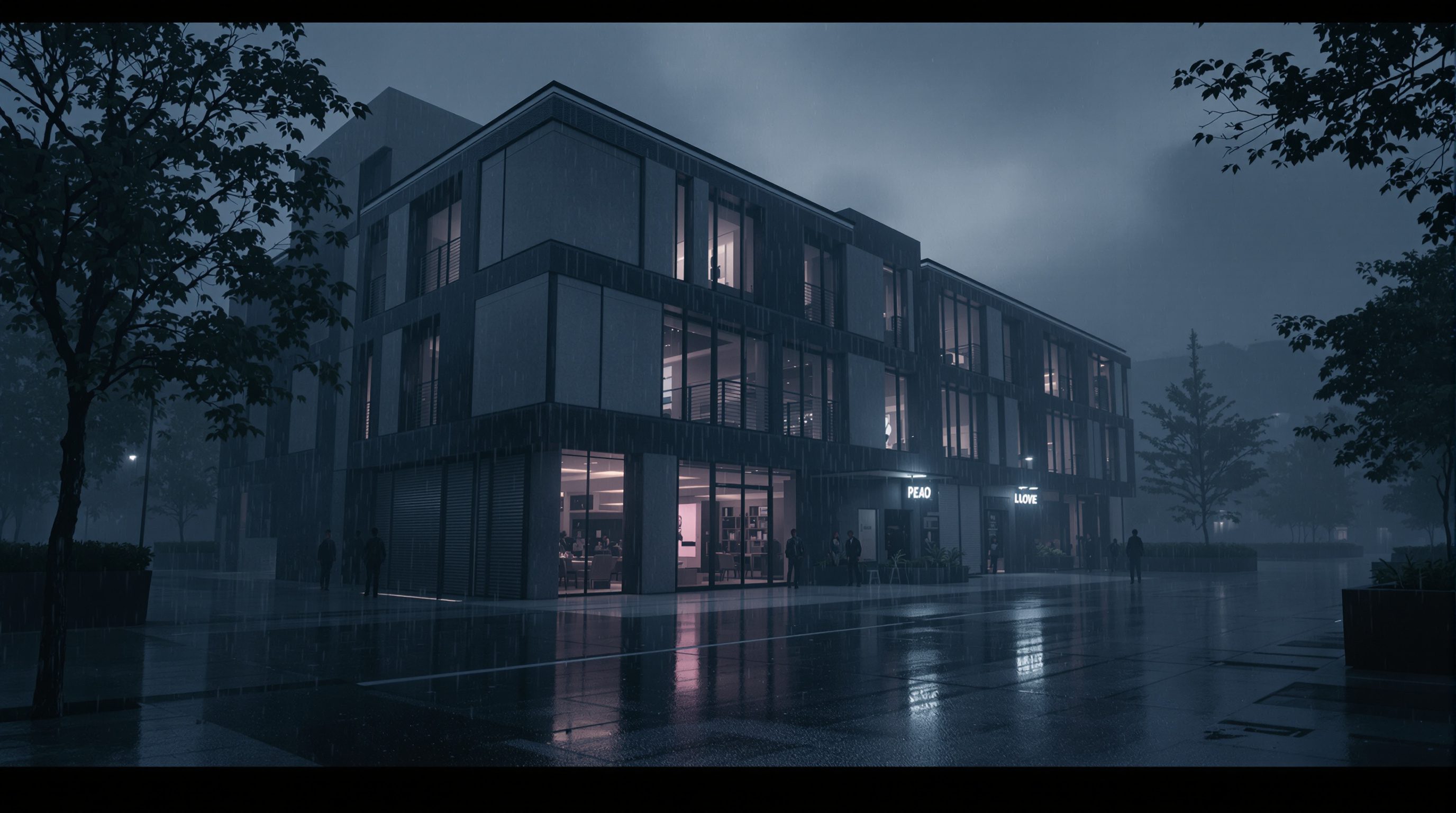
Add rain to a street and it turns cinematic; wet asphalt reflects the lights and the whole scene gains drama. Add fog to a valley and the building emerges from mystery. Turn a summer render to autumn and it warms into nostalgia. Weather and season are the most powerful, fastest mood tools you have - a single setting can change the entire emotional register of an image.
But that same power cuts the other way. Push any effect too far and the image tips from evocative into obviously fake - fog becomes soup, rain becomes a screen wash, bloom swallows the building. So this lesson is really about two things at once: what each effect does, and the restraint that lets it work.
Weather = the fastest mood dial and the fastest way to ruin an image. Pick one, keep it modest, match the light.
Rain, fog, snow and wind: what each effect does
Each weather effect changes an image in a characteristic way, and knowing the mechanism lets you use it on purpose. Rain does most of its work on the ground: the sky darkens and diffuses, but the drama comes from wet surfaces - asphalt, stone and pavement turn glossy and start reflecting lights, windows and sky, so a rainy street reads far more cinematic than a dry one. The falling drops themselves are secondary; the wetness is the effect. Fog and haze work in depth. They fade distant objects toward the sky colour, so they separate foreground from background, add a sense of scale and distance, and can make a building emerge dramatically from a soft ground. Even a whisper of haze adds air to a scene that would otherwise feel flat and cut-out.
Snow transforms both the palette and the forms: it brightens everything, simplifies the landscape into white masses, sits on horizontal surfaces and rooflines, and completely changes the season and mood. It is a strong, committing effect - a snow render is unmistakably a winter story. Wind is subtler and often overlooked: in engines with animated vegetation, wind moves grass, leaves and water, and even in a still it justifies the way foliage bends and water ripples. A touch of wind is what stops a landscape looking eerily frozen, and it is one of those small effects whose absence you feel more than its presence - a still render of a windy-looking tree quietly reads as wrong. Understanding these mechanisms - rain wets, fog fades with depth, snow whitens and simplifies, wind animates - lets you pick the effect that actually serves the story rather than reaching for a preset.
Rain wets the ground. Fog fades with depth. Snow whitens and simplifies. Wind stops the scene freezing.
Seasons as storytelling
Season is to the year what time of day is to the hour: a decision about mood and story that you make deliberately, not a default you accept. The same site reads completely differently across the four seasons, and because good engines let you change season with vegetation presets and environment settings, you can choose the one that best serves the image. Spring brings fresh light green, blossom and a sense of newness and optimism - often the right choice for a hopeful, forward-looking scheme. Summer is full, deep green, long days and generous light - lush and established, the default for showing a landscape at its most abundant. Autumn turns foliage gold, orange and red, casts warm low light, and reads as nostalgic, mature, richly atmospheric - a favourite for evocative hero images. Winter strips the trees bare or blankets them in snow, cools the palette, and reads as quiet, stark or dramatic.
Choosing among these is a genuine design-communication decision. A residential scheme sold on warmth and belonging might be shown in autumn's golden light; a crisp modern building whose lines you want to celebrate might read best against bare winter trees; a landscape-led project usually wants summer's abundance. The professional habit is to ask what the image should make the viewer feel and let the season serve that, rather than defaulting to summer green every time. And as with a sun study, showing a scheme across seasons can itself be informative - proving the design works and looks considered in every one. Season, like light, is a lever you pull on purpose.
The one rule: restraint, because effects compound
If there is a single discipline that separates atmospheric renders from over-cooked ones, it is restraint - and it matters because effects compound. Each one seems reasonable alone: a little fog for depth, a touch of bloom on the lights, a bump of saturation, some depth of field, a colour grade, a hint of rain. Stack them all at moderate strength and they multiply into an image that is hazy, glowing, over-saturated and soft all at once - the unmistakable over-processed look that reads instantly as fake. The eye forgives one strong effect used with intent; it rejects six competing ones.
The fix is a working rule: decide what the shot needs, pick the fewest effects that deliver it, and keep each one modest. If the story is a rainy evening street, wet ground and reflected light do the work - you do not also need fog, heavy bloom and a teal grade fighting them. If the story is a misty morning, a single restrained haze carries it. A good test is to build the effect up from zero and stop at the first point where it reads as believable, rather than pushing until it looks obviously atmospheric - by then you have gone too far. Another is to compare against a real photograph in similar conditions: real weather is subtler than beginners expect. The architecture is the subject; weather and effects are the lighting and the score, there to support it, never to bury it. Master restraint and modest, well-chosen effects will make your images feel real; ignore it and the most powerful tools in the engine will make them feel fake.
Effects compound. Build up from zero, stop at 'believable', not at 'obviously atmospheric'. Fewer, modest, chosen.
Matching weather to light, engine and story
Weather does not act alone - it works with the light you have already set and the engine you are in, and the best images treat all three as one decision. Weather and time of day are partners: fog reads most beautifully in the low, warm light of early morning; a rainy scene comes alive at dusk when wet surfaces catch the last light and the first lamps; snow can look flat at noon but luminous under a low winter sun. So set your light and your weather together, not in isolation - a golden-hour haze or a blue-hour rain is far stronger than either effect on default midday light.
The engine shapes how you get there. Lumion, from the previous lessons, offers a deep, fast effects stack - rain, snow, fog, volumetric light, season presets - all layered on per shot, which is a large part of why it suits atmospheric context work; the risk, as noted, is that ease invites excess. D5 and the ray-traced engines give you accurate fog and volumetric light that interact correctly with the traced illumination, so atmosphere reads physically right, especially indoors where a shaft of light through haze can be exquisite. Whatever the tool, the thinking is the same: start from the story you want to tell, choose the season and weather that serve it, set them together with the light, and hold every effect with restraint. Do that and the atmosphere becomes invisible in the best way - the viewer simply believes the place is real.
A final habit ties it all to your other tools. Some atmosphere is best set live in the engine, and some is best finished in post-production - a subtle haze, a colour grade, a touch of bloom often read more naturally when added lightly at the grading stage, where you can dial them against the finished image rather than committing in the render. That is a Module 7 conversation, but flag it now: you do not have to force every gram of mood through the engine's effects. Set the weather and season that genuinely belong to the scene - the wet ground, the real snow, the season's planting - in the render, and leave the final, gentle tonal atmosphere for the grade. Splitting the work that way is another form of the same discipline: build the real conditions honestly, and add the polish with a light hand.
Rain / wet surfaces
Precipitation plus glossy, reflective ground
The drama is in the wetness, not the drops - wet asphalt reflecting light reads cinematic. Best at dusk or with warm lamps.
Fog / haze (volumetric)
Depth fade and atmospheric air
Separates foreground from background and adds scale; a whisper adds air, too much becomes soup. Loveliest in low, warm light.
Season presets
Vegetation and environment by season
Spring/summer/autumn/winter each set a distinct mood; choose the one that serves the story rather than defaulting to summer.
Wind (animated vegetation)
Movement in grass, leaves and water
Stops a landscape looking frozen; justifies bending foliage and rippling water even in a still. Keep it gentle.
Workshop - one scene, three weathers, strict restraint
You will take a single scene and tell three different stories with weather and season alone, holding to a strict rule of the fewest, most modest effects - training both the mood-setting and the discipline that makes it read as real.
Lumion or D5 (free tier) and one exterior scene. Any engine with weather, fog and season controls works; the discipline matters more than the tool.
Goal: set mood with weather and season, without overdoing it
Inputs: Lumion or D5 (either free tier) + one exterior scene with some vegetation and a paved area
Time: ~55 minutes
- 1Set a low, warm light on your scene (golden hour) as a baseline, exactly as in a sun study. Render this clean version first - no weather yet.
- 2Version A - misty morning: add ONLY a restrained haze, built up from zero until it just reads as atmospheric, then stop. Match it to soft morning light. Render.
- 3Version B - rainy dusk: move to a dusk light, make the ground wet and reflective, add a little rain if you like, and add some warm lamp light catching the wet surface. Keep other effects off. Render.
- 4Version C - autumn or winter: change the season (autumn colour, or bare/snowy winter) and let the palette carry the mood. Add at most one supporting effect. Render.
- 5Line up the clean baseline and the three versions. Write a sentence on each: what story does it tell, and did you keep the architecture leading? Note any version where you were tempted to add one effect too many.
You’ll walk away with
A clean baseline plus three weather/season variants of one scene - misty morning, rainy dusk, and autumn or winter - each made with the fewest, most modest effects, and a short written reading of the mood each achieves.
Three altitudes on the same idea
Read the band that fits you — or all three.
Weather and season are communication choices, so make them on purpose. Show a scheme in the season and conditions that tell its story - autumn warmth for a home, crisp winter light for a sharp modern form - and keep the effects restrained so the architecture leads. A tasteful atmosphere persuades; an over-processed one undermines the credibility of the whole image.
For interiors, weather is what you glimpse through the glass - and it sets the indoor mood. Rain against a window with warm lamps inside, soft snow beyond a fireside room, golden autumn light spilling across a floor: the exterior condition frames the interior feeling. Use it with restraint, matched to your interior light, and it makes a room feel lived-in and real.
Weather is a fast way to lift a project - and a fast way to over-cook it. A single well-judged effect (a little haze, a wet street at dusk) can transform a render; six at once will sink it. Practise building an effect up from zero and stopping at believable. Learning restraint now is worth more than learning every slider - examiners read over-processing as inexperience.
“Adding lots of atmospheric effects makes a render more dramatic and professional.”
Do it yourself
Reason it through before you render.
- 1Where does rain do most of its work on an image - the drops, or the ground? Why?
- 2What does fog or haze add to a scene, and how does it behave with distance?
- 3How is choosing a season like choosing a time of day?
- 4Why do atmospheric effects so easily make a render look fake?
- 5Describe the working rule for using effects with restraint.
The one line to carry out
Peer-reviewed journals & authoritative standards
- 01Lumion - Support & Documentation — Lumion, 2026.
- 02D5 Render - real-time ray tracing renderer — D5 Render, 2026.
- 03Real-Time Rendering - resources on interactive rendering techniques — Akenine-Moller, Haines et al., 2026.
- 04Poly Haven - free HDRIs, textures and models — Poly Haven, 2026.
Weather sets the sky and the mood; but the ground beneath it - the terrain, water and vegetation that make a place - is its own craft. Next we build believable nature and landscape scenes: terrain, water, and scattering vegetation at scale.
The author
Amogh N P
Architect, interior designer, and creative polymath. Studio Matrx began in his notebooks — his vision of design made honest, useful, and open to everyone. Its Academy is written and taught in his memory, and free, forever.
More about Amogh →