
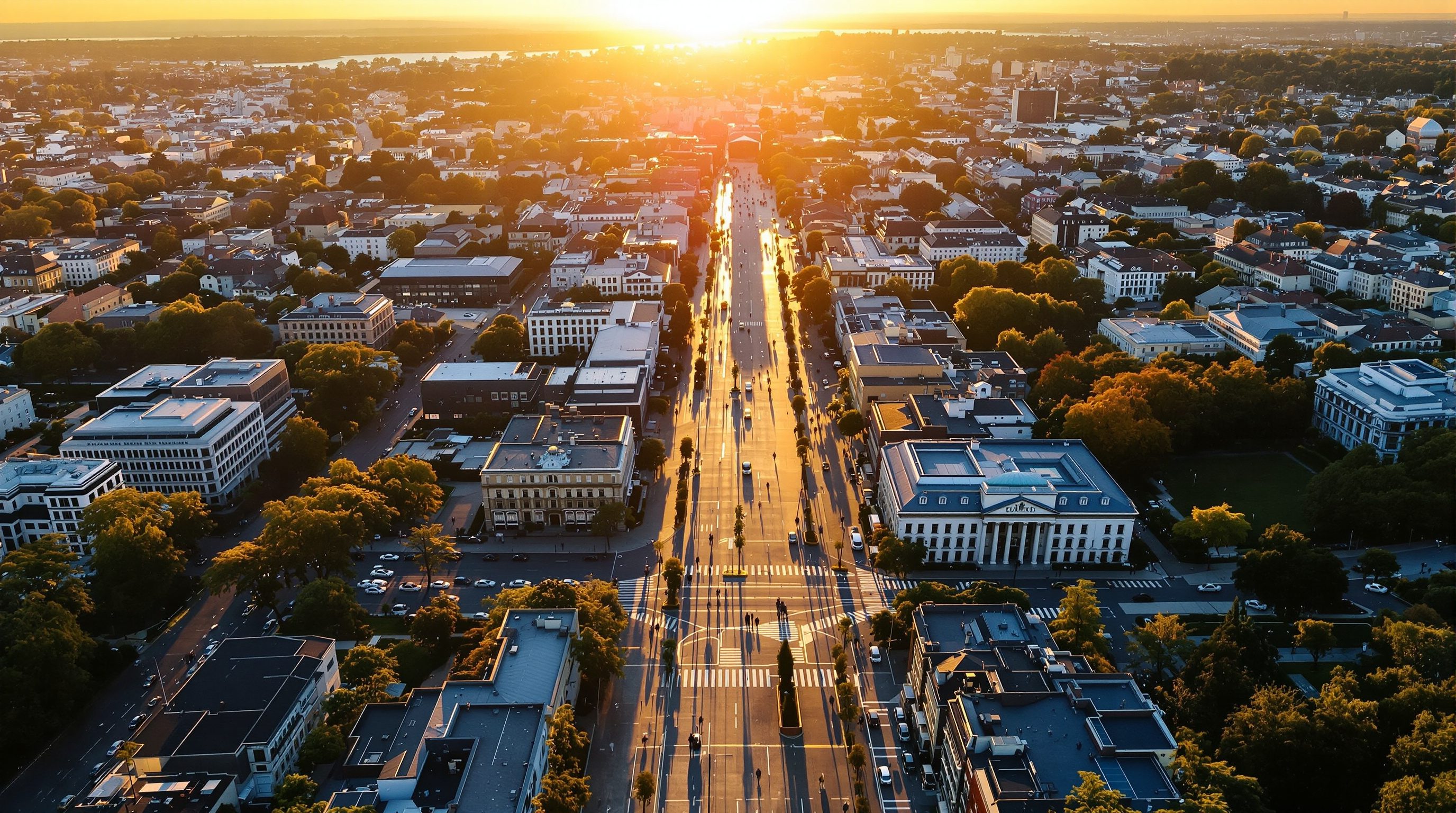
 Lesson 10.4
Lesson 10.4 · Practice, Delivery & Career
The Urban Design Career
The many routes in, where the work lives, and a closing charge to build better cities
No single door into the city
There is no degree stamped 'urban designer' that you are simply awarded. People arrive from architecture, from planning, from landscape, from geography, drawn by the same conviction: that the space between buildings is where life happens, and someone should design it well. This is how you become one of them.
You will not fix a city in one plan. You will improve it in a hundred. That is the job, and it is enough.
Urban design has no single route in
One of the first things to understand about a career in urban design is that it is not a profession you qualify for in the way you become a doctor or a chartered accountant, with one prescribed path and one licensing exam. It is a field of practice that people enter from several adjacent disciplines, each bringing a different gift and a different blind spot. Architects arrive with a trained eye for three-dimensional form and space, and must learn to think at the scale of the block and the network rather than the single building, and to work in the plural over decades. Town planners arrive fluent in policy, statute, land use and process, and must learn to give their policies physical form, to draw as well as regulate. Landscape architects arrive with a deep understanding of the ground plane, ecology, water and the living systems of the city, and often make the finest public-realm designers. Geographers, and increasingly data and transport specialists, arrive with rigour about how cities actually work, how people move, cluster and change, and must learn to translate analysis into design. None of these origins is superior; the strongest teams and the strongest individuals blend them. This plurality is a feature, not a bug: cities are complex enough to need every one of these lenses, and the urban designer's job is precisely to hold them together. For the student choosing a path, the reassurance is that many roads lead in. The usual route is a first degree in one of these parent disciplines followed by a specialist postgraduate qualification in urban design, but the field rewards curiosity and cross-training more than a single pedigree.
Where urban designers actually work
Urban design is practised across four broad settings, and a career often moves among them, which is one of the field's quiet pleasures. The first is private practice: multidisciplinary consultancies and specialist urban design studios that are commissioned to prepare frameworks, masterplans, design codes and public-realm designs for public and private clients. This is where much of the celebrated design work happens, and where a designer builds a portfolio, though it can be at a remove from the power to actually deliver. The second is the public sector: development authorities, municipal corporations, planning departments, and national bodies like the Town and Country Planning Organisation or the National Institute of Urban Affairs in India. Public-sector designers may draw less and negotiate more, but they hold the levers, the plan, the permission, the code, the budget, and can shape a city more durably than any consultant. The third is the developer side: large developers and their in-house design teams, and the special-purpose vehicles that deliver big schemes, where the designer works close to the money and the delivery and learns viscerally how viability and phasing shape what gets built. The fourth, and increasingly vital, is the world of NGOs, think-tanks, research institutes and advocacy organisations, bodies like ITDP, WRI India, and countless local civil-society groups, who shape cities through evidence, pilot projects, capacity-building and campaigning, often championing the poor and the pedestrian against powerful interests. Each setting offers a different mix of creative freedom, delivery power, financial reward and public purpose. A thoughtful career often samples several, and the wisest practitioners understand all four, because a city is shaped by the interplay among them.
The skills and the portfolio
Whatever door you enter by, a recognisable set of skills marks the effective urban designer, and it is worth being honest that they are broader than drawing. You need analytical skills, to read a place through mapping, GIS, morphology and the patient observation of public life that Jan Gehl and William Whyte pioneered. You need design skills, to synthesise that analysis into three-dimensional proposals at the scale of streets, blocks and districts, and to communicate them through plans, sections, diagrams and vivid visualisation. You need technical literacy across transport, drainage, ecology and viability, enough to work fluently with the specialists even if you are not one. And, as the collaboration lesson stressed, you need the human skills that no software teaches: facilitation, negotiation, writing, public speaking, the ability to hold a room of angry residents and a sceptical developer in the same conversation. The portfolio is how you demonstrate this range, and a strong urban design portfolio looks different from an architecture one. It shows thinking, not just objects: the analysis behind a proposal, the options tested, the framework and code, the process of engagement, and how a scheme would actually be delivered, not merely a beautiful final render. Include real or studio projects at the urban scale, show your diagramming and your analytical rigour, and above all show that you understand a place as a system of many hands and many years, not a single designed thing. Employers in every setting are looking for the same thing beneath the graphics: evidence that you can turn a vision into something buildable that serves the public.
Professional bodies and standing
Because urban design sits between established professions, its formal recognition is a patchwork, and it helps to know the landscape rather than expecting a single credential. In India, town planning is the anchoring profession, represented by the Institute of Town Planners, India, and urban designers frequently hold planning or architecture qualifications and register accordingly; the Council of Architecture governs architectural practice, and planning has its own institutional recognition. Internationally, the Royal Town Planning Institute in the United Kingdom recognises urban design within planning, and the Urban Design Group provides a dedicated professional home with its own recognised practitioner standing; in the United States the American Planning Association and, for the broader industry, the Urban Land Institute are the major bodies, alongside the Congress for the New Urbanism as a movement. The Landscape Institute recognises the public-realm work that overlaps heavily with urban design. The practical implication for a career is twofold. First, maintain the professional standing of your parent discipline, planner, architect or landscape architect, because it gives you a recognised licence and a network. Second, engage with the dedicated urban design bodies, publications and networks, because they are where the field defines its standards, shares its knowledge and advances its cause. Membership, conferences, awards and design-review panels are not vanity; they are how a still-consolidating field builds its collective authority and how you build yours within it. The absence of a single gatekeeper is, in the end, liberating: it means the field is open to talent from many directions, and it rewards those who contribute to it rather than merely those who pass through a gate.
The field in India and globally
It is an extraordinary time to enter this field, and nowhere more so than in India. The country is in the midst of the largest, fastest urbanisation in human history, with hundreds of millions of people moving to cities over the coming decades and vast quantities of urban India yet to be built. The missions of the last decade, AMRUT, the Smart Cities Mission, the metro-rail expansion, riverfront and lake rejuvenation programmes, transit-oriented development policy, have created unprecedented demand for people who can shape the physical city well, and an equally unprecedented risk of getting it wrong at scale. The stakes could not be higher: the streets, neighbourhoods and public spaces being laid down now will shape the daily lives, the health, the climate resilience and the dignity of Indians for a century. Globally, the discipline is converging on a shared agenda, the climate emergency, the return to walkable and human-scaled urbanism, the reclaiming of streets from the car, the demand for equitable and inclusive cities, so that a designer trained in Bengaluru or Ahmedabad shares a language with one in Copenhagen, Bogotá or Singapore. Curitiba's bus rapid transit, Barcelona's superblocks, Copenhagen's cycling city, Medellín's social urbanism, these are studied and adapted worldwide, and India both learns from them and increasingly generates its own models worth exporting. For the entrant this means the field is at once local and global: rooted in the specific plot, the specific ward, the specific development plan, yet connected to a worldwide movement of people trying to make cities more humane. Few careers offer that combination of intimate local relevance and global purpose.
A closing charge: go and build better cities
You have travelled the whole arc of this course, from what urban design is, through the scales, the streets, the density and land use, the environment, the systems and governance that shape the city, to this final module on how vision becomes a built place and how a life in the field is made. It is worth ending not with technique but with why any of it matters. Cities are the greatest thing our species makes together. More than half of humanity now lives in them, and in a country like India the urban future is the future, full stop. The quality of that future, whether people live in places that are healthy, walkable, green, fair, dignified and alive, or in places that are choked, unequal, ugly and hostile to life, is not decided by fate or by markets alone. It is decided, in large part, by whether there are enough people who understand how good cities are made and who care enough to fight for them through the long, unglamorous work of appraisal, negotiation and delivery. That is the work you have now begun to learn. You will not do it alone, and you will not do it in a single heroic gesture; you will do it street by street, plan by plan, argument by argument, over a career. There will be compromise and there will be failure, because that is the nature of shaping something as vast and contested as a city. But there is no more consequential creative work available to you. So here is the charge: take what you have learned, keep learning, join the field by whichever door fits you, and give your working life to making the shared spaces of the city more humane. The cities of the coming century are being drawn right now. Pick up the pen.
Institute of Town Planners, India (ITPI)
Professional body for town planning in India
The anchoring institutional home for planning practice, within which much Indian urban design sits; register through your parent discipline.
Urban Design Group (UK) and RTPI
Dedicated urban design recognition and planning professional standing
Provide a professional home, recognised practitioner standing and a knowledge network for urban designers internationally.
American Planning Association / Urban Land Institute / CNU
Major planning, development-industry and new-urbanist bodies
Key global networks for standards, knowledge and career development across the wider urban field.
Design your own route into the field
Turn this lesson into a concrete plan for your own entry into urban design, whatever your starting point.
Pen and paper, the websites of professional bodies and practices you admire
Write down your current or intended parent discipline and one city you care about shaping.
- 1Map your route: the parent degree, a specialist urban design qualification if relevant, and the cross-training you will pursue to cover your discipline's blind spot.
- 2Choose which of the four settings (private practice, public sector, developer, NGO) you would start in and say why, then name one organisation of each type you admire.
- 3Draft the contents page of an urban design portfolio that shows process and delivery, not just renders, listing four pieces you could make or already have.
- 4Identify one professional body to engage with and one concrete skill (facilitation, GIS, viability, visualisation) you will deliberately build this year.
You’ll walk away with
A one-page career map: your route in, your starting setting, your portfolio outline, and one body and one skill to pursue this year.
Three altitudes on the same idea
Read the band that fits you — or all three.
If you come from architecture, urban design asks you to widen your gaze from the object to the field, from the single building to the block, the street and the decades. Keep your gift for form and space, but learn to work in the plural and to love the framework and the code as much as the elevation. Your architectural licence and eye are a strong foundation; add the scale and the patience of the city, and you become rare and valuable.
For the urban designer, this lesson is a mirror and a map. Understand all four settings, private practice, public sector, developer and NGO, because you will be most effective when you grasp how they push and pull on each other, and a rich career often moves among them. Keep your parent-discipline standing, engage the dedicated urban design bodies, and build a portfolio that shows process and delivery, not just renders. Above all, remember your authority comes from serving the place.
The liberating truth for a student is that there is no single door: architecture, planning, landscape or geography can all lead in, usually followed by a specialist urban design masters. Start now by observing your own city like a designer, reading its plans, and building a portfolio that shows how you think, not just what you can render. Pick the parent discipline that excites you most, then cross-train relentlessly toward the city.
“To become an urban designer you must first be a fully qualified architect; there is no other route.”
Do it yourself
Quick checks before you finish the course.
- 1Name the four parent disciplines urban designers commonly come from and the gift each brings.
- 2List the four settings where urban designers work and one strength of each.
- 3State one reason a strong urban design portfolio differs from an architecture portfolio.
Pulling it together
Peer-reviewed journals & authoritative standards
- 01Institute of Town Planners, India, professional resources — Institute of Town Planners, India, 2023.
- 02Urban Design Group, careers and recognition guidance — Urban Design Group (UK), 2023.
- 03American Planning Association, careers in planning and urban design — American Planning Association, 2023.
- 04National Institute of Urban Affairs, urban capacity and the Indian urban agenda — National Institute of Urban Affairs, 2022.
This is the final lesson of the course. Return to the module mastery check to consolidate the whole arc from vision to built city and career, and carry the discipline out into the streets you will spend your life improving.
The author
Amogh N P
Architect, interior designer, and creative polymath. Studio Matrx began in his notebooks — his vision of design made honest, useful, and open to everyone. Its Academy is written and taught in his memory, and free, forever.
More about Amogh →