
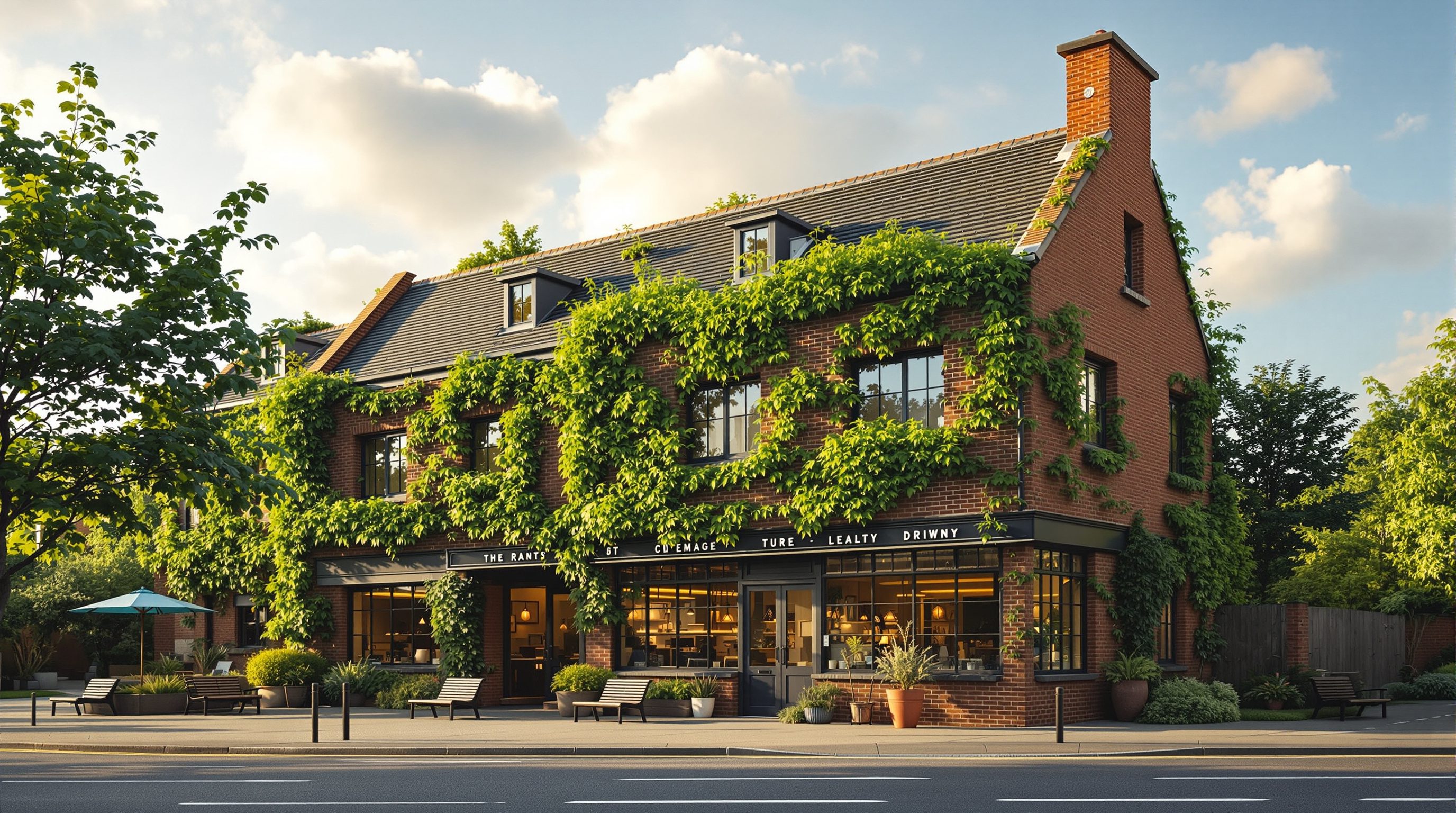
 Lesson 9.1
Lesson 9.1 · Retrofit, Reuse & the Existing Stock
The Existing Building Imperative
The greenest building is often the one that already exists - most of the 2050 stock is already standing, and its carbon is already spent
The most sustainable building on your street may be the ugly one already standing there.
Architecture culture rewards the new: the fresh site, the clean sheet, the finished photograph. But the numbers point somewhere less glamorous. The vast majority of the buildings we will use in 2050 have already been built - which means the single biggest carbon opportunity in the sector is not what we design from scratch, but what we do with what we already have.
Every existing building is a store of carbon that has already been paid for - the concrete poured, the steel rolled, the bricks fired decades ago. Demolish it and you throw that investment away and immediately spend it all again on the replacement. The greenest building is, very often, one that already exists. This lesson makes the case, and sizes the task, before the next three teach how to do it well.
The greenest building is often the one already standing. Don't pay the carbon bill twice.
Most of 2050 is already built
Start with the fact that reframes everything. In mature economies, roughly 80% of the buildings that will be standing in 2050 already exist today - the building stock turns over slowly, at well under 1-2% a year through demolition and replacement. Even globally, once you account for fast-growing regions, well over half of the 2050 stock is already on the ground. You cannot decarbonise the built environment by designing better new buildings alone, because new buildings are a small annual slice of a very large existing pile.
That is why Europe launched a Renovation Wave aiming to at least double annual renovation rates, and why 'retrofit' has moved from a niche specialism to a central climate strategy. The arithmetic is stark: even if every new building from tomorrow were perfectly zero-carbon, the existing stock would keep emitting for decades unless it too is transformed - so new-build excellence alone cannot get the sector to net-zero in time. The existing stock is also, on average, terrible: much of it was built with little or no insulation, single glazing, leaky envelopes and fossil-fuel heating, and it is responsible for the lion's share of the sector's operational carbon right now. The buildings that waste the most energy are not the ones on the drawing board - they are the ones people are already living and working in.
India sits at the other pole of the same argument, and this is where the picture splits. There, a large share of the 2050 stock is yet to be built - by some estimates two-thirds or more - so the priority is to build that new stock low-carbon from the first sketch (the subject of the rest of this course). But the tens of millions of existing buildings still matter: they lock in decades of operational emissions, and as India's stock ages, its retrofit task will grow to look more like Europe's. The imperative is universal; only the balance between retrofit and new-build shifts by place.
Slow turnover: <2% a year. You cannot design your way to net-zero on new buildings alone.
The carbon is already spent - do not pay it twice
Here is the argument that gives the lesson its title. Every building carries embodied carbon - the emissions from making and transporting its materials and putting them together. For a typical structure that is on the order of hundreds of kilograms of CO2 per square metre - very roughly 400-1000+ kgCO2e/m2 for the structure and envelope, depending on how concrete- and steel-heavy it is. That carbon was emitted once, when the building went up, and it is now sunk: whether the building stands for five more years or fifty, that emission has already happened.
Demolish and rebuild, and you do two carbon-costly things at once. You throw the sunk investment away - the concrete becomes rubble, the steel is (at best) recycled at an energy cost - and you spend the whole embodied carbon bill again on the new building, plus the emissions of demolition and hauling waste. Because embodied carbon is emitted up front, that 'carbon spike' lands now, in the critical decade when the atmosphere can least afford it, and it takes many years of operational savings for a more efficient new building to pay it back - if it ever does.
Keep the building and you keep the carbon working. A deep retrofit still costs embodied carbon - insulation, windows, a heat pump - but that is a fraction of a full rebuild, typically a small share of the carbon of new construction for a comparable performance jump. This is not an argument against ever building new; it is an argument for treating demolition as a decision that must be justified, carbon and all, rather than assumed. Construction and demolition waste is already a third or more of all waste in many countries; the existing-building imperative is, at heart, about not adding to that pile without a very good reason.
The stock we already run: operational carbon now
The existing stock is not only a bank of sunk embodied carbon; it is also, today, the sector's single largest source of operational carbon - the emissions from heating, cooling, lighting and powering buildings in daily use. Buildings in operation account for roughly a quarter of all global energy-related CO2, and the overwhelming majority of that comes from buildings that already exist, not from the small annual trickle of new ones. Put simply, the emissions problem is concentrated in the buildings people are already using - and most of them perform badly.
The reason is history. Most of the stock predates meaningful energy codes: solid uninsulated walls, single glazing, leaky envelopes and fossil-fuel heating are the norm across huge swathes of it. A typical un-upgraded home can use several times the energy of a well-retrofitted one for the same comfort. That is a liability, but it is also the opportunity - because a building that wastes a lot of energy has a lot of energy to save. The worst-performing existing buildings are precisely where a retrofit delivers the biggest operational-carbon cut per rupee, pound or dollar spent.
There is a timing advantage too. Operational carbon falls automatically as electricity grids decarbonise - an electrified, efficient building gets cleaner every year without any further work, as the power feeding it gets greener. Embodied carbon does not: once spent on a demolition and rebuild, it is gone. So the strategic logic reinforces the imperative twice over. Cut the existing stock's operational carbon through deep retrofit and electrification (Lesson 9.2), and let a decarbonising grid finish the job - while avoiding the embodied-carbon spike a rebuild would add. In India, where cooling demand is exploding as incomes rise and summers intensify, the operational stakes in the existing stock are rising fast, making efficient, passively-helped retrofit not a luxury but a resilience measure against heat and rising bills.
What 'existing' asks of the designer
Working with the existing stock is a different craft from designing new, and it is one the profession under-teaches. A new building starts with intent; an existing one starts with investigation - surveying what is actually there, how it was built, what condition it is in, how it performs, and what it is worth keeping. The material is given, imperfect and full of surprises, and the design skill is negotiation rather than composition: what to keep, what to change, what to add.
That reframes the value an architect brings. On a new build, the biggest carbon decisions are form, structure and material. On an existing building, the biggest decision is often the very first one - retrofit or rebuild - and after that, how deep to go and in what order. Get that wrong and no amount of clever detailing recovers it; a needless demolition emits more carbon than years of careful specification will ever save. The existing stock also carries value that a spreadsheet misses: embodied craft, character, memory, streets that already work. Reuse is where sustainability, heritage and good placemaking tend to align.
It also changes how the profession should measure its own worth. For a century, architectural culture and the awards that shape it have celebrated the new object on the clean site, and demolition has been the invisible, unquestioned first move. If most of the carbon and most of the buildings are in the existing stock, that value system is pointing the wrong way. The most consequential, creative and responsible work of the coming decades will often be quiet: making a tired building excellent again, or brilliant at something new, without the drama of a blank site. Learning to see that as the ambitious choice - not the fallback - is part of the shift this module asks of you.
The rest of this module follows the logic this lesson sets up. Deep energy retrofit (9.2) tackles the operational-carbon problem in the buildings we keep. Adaptive reuse (9.3) tackles the ones whose original use has gone but whose structure has not. And retrofit versus rebuild (9.4) gives you the honest decision framework for the fork in the road - because 'keep it' is the right default, but not an unconditional rule.
New build: composition. Existing: negotiation. First decide keep-or-not - everything follows.
Embodied carbon
Emissions from making, transporting and building with materials
Sunk the day a building is built; reusing a structure keeps it working instead of spending it again. Detailed in Module 3.
Whole-life carbon
Embodied plus operational carbon over a building's whole life
The right yardstick for retrofit-vs-rebuild; running efficiency alone is not enough. Module 3 covers the accounting.
Renovation Wave
EU policy to roughly double building renovation rates
A recognition that the existing stock, not new build, is the main decarbonisation lever in mature economies.
Construction & demolition waste
Rubble and materials from building and demolishing
A third or more of all waste in many countries; reuse is the most direct way to cut it at source.
Workshop - size the imperative on one real building
Before you can argue for reuse on a project, practise the argument on a building you know. This exercise turns the abstract case into concrete numbers and a defensible instinct.
A tape or pacing, a calculator, and a rough embodied-carbon rate (~500 kgCO2e/m2 as a default). Precise figures come from an LCA - see Module 3 - but the order of magnitude is enough to make the case.
Goal: feel the scale of sunk carbon in a real building
Inputs: an existing building you can visit + its rough floor area
Time: ~30 minutes
- 1Pick an existing building you know (a home, a shop unit, a campus block). Estimate its gross floor area in m2 - pace it out if you must.
- 2Estimate its structure-and-envelope embodied carbon at a rough 500 kgCO2e/m2 (use higher, ~800-1000, if it is concrete- and steel-heavy; lower for timber or masonry). Multiply by the area to get the sunk carbon already in the building.
- 3Now imagine it is demolished and rebuilt to the same size. That number is emitted AGAIN, plus roughly 50-100 kgCO2e/m2 for demolition and waste. Write down the total carbon a rebuild would spend up front.
- 4Contrast a deep retrofit instead: assume it costs on the order of a quarter to a third of new-build embodied carbon. Note the difference between the two paths - this is the carbon you would save by keeping the building.
- 5Finally, ask the honest question: is there any reason (unsafe structure, hopeless geometry, far more space needed) this particular building genuinely could not be kept? Note it - that is the exception Lesson 9.4 tests.
You’ll walk away with
A one-page back-of-envelope for one real building: its sunk embodied carbon, the carbon a rebuild would re-spend up front (plus demolition), the far smaller carbon of a deep retrofit, and an honest note on whether reuse is actually feasible here.
Three altitudes on the same idea
Read the band that fits you — or all three.
Reframe the brief before you sketch. When a client arrives assuming demolition, the highest-value thing you can do is ask whether the existing building can serve the need - and be equipped to answer with a whole-life carbon and cost comparison, not a shrug. Reuse and retrofit are a fast-growing share of practice revenue as regulation and clients turn against needless demolition; the studios that build this capability now win the work.
Most of your work already is reuse - name it and do it well. Fit-outs almost always land inside an existing shell, and the most sustainable move is to keep and refresh rather than strip to the slab. Retain sound partitions, floors and services where you can; specify for a light touch; and treat the existing fabric as a resource with embodied carbon worth protecting, not a blank canvas to be demolished on day one.
Learn to love the awkward existing building - it is where the next decade of work is. Studios lavish attention on the clean-site project, but employers increasingly need designers fluent in survey, assessment, retrofit and adaptive reuse. Seek out a live building to study: measure it, find how it performs, and practise the keep-change-replace judgement. That fluency will distinguish you far more than another pristine new-build scheme.
“A shiny new energy-efficient building is greener than keeping an old, inefficient one.”
Do it yourself
No tools needed - reason it through.
- 1Roughly what share of the 2050 building stock already exists in mature economies - and why does that make retrofit central?
- 2Why is embodied carbon described as 'already spent' in an existing building?
- 3In one sentence, why can a demolish-and-rebuild be worse for the climate than keeping an inefficient building?
- 4How does the retrofit-vs-new-build balance differ between Europe and India, and why?
- 5What is the first design decision that matters most on an existing building?
The one line to carry out
Peer-reviewed journals & authoritative standards
- 01Retrofitting — Wikipedia, 2026.
- 02Embodied carbon — Wikipedia, 2026.
- 03Adaptive reuse — Wikipedia, 2026.
- 04Construction and demolition waste — Wikipedia, 2026.
If keeping buildings is the imperative, the next question is how to make a leaky, fossil-fuelled existing building genuinely low-energy. That is deep energy retrofit - our next lesson.
The author
Amogh N P
Architect, interior designer, and creative polymath. Studio Matrx began in his notebooks — his vision of design made honest, useful, and open to everyone. Its Academy is written and taught in his memory, and free, forever.
More about Amogh →