
 Lesson 2.4
Lesson 2.4 · Energy & Net-Zero
Net-Zero Energy Buildings
What net-zero really means - and its four different definitions - how you actually reach it by driving demand down and renewables up, and where it honestly gets hard.
Net-zero is not a gadget you add - it is what happens when demand falls far enough to meet the energy a site can make.
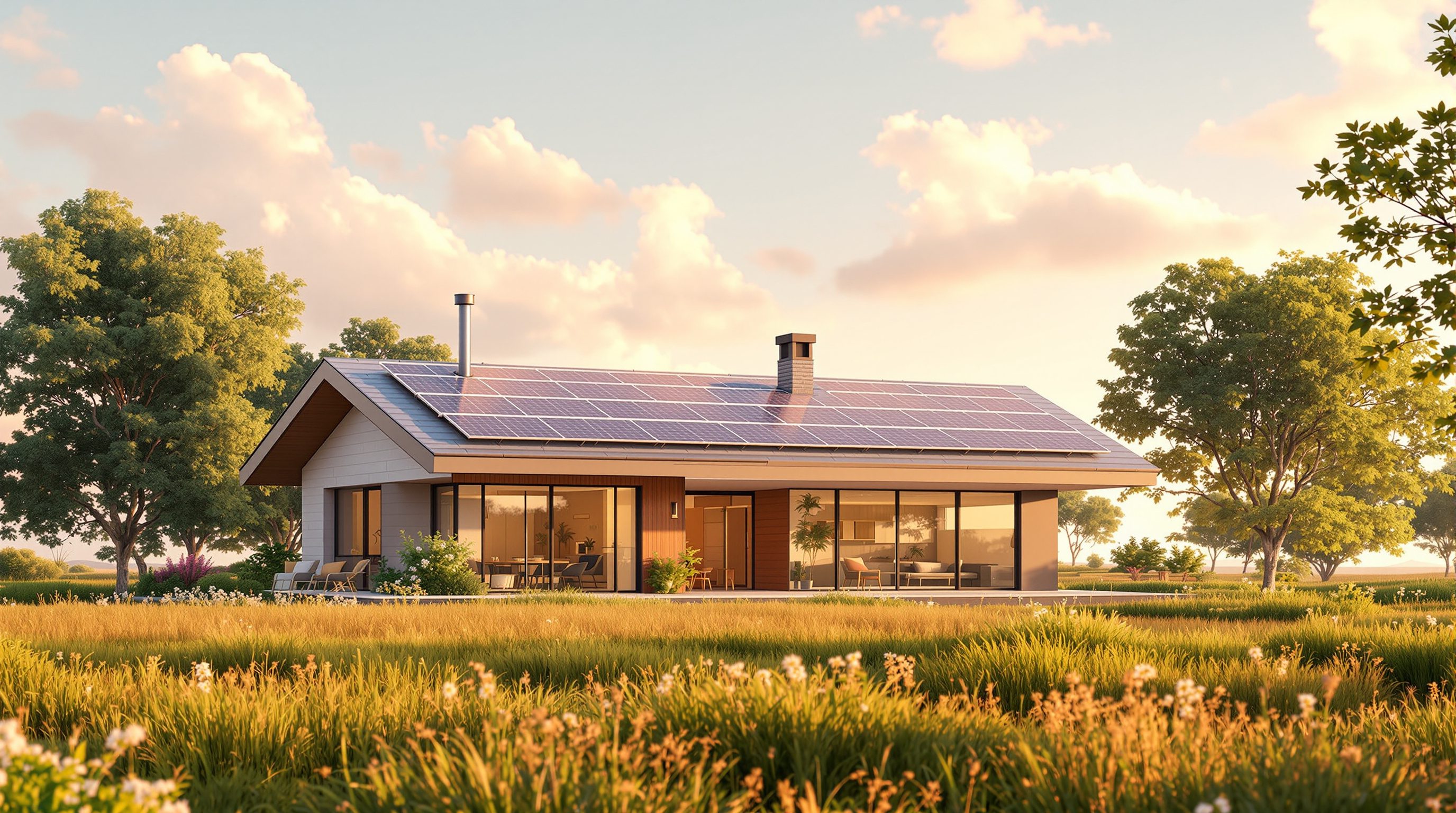
A net-zero energy building produces, over a year, as much energy as it consumes. It is the point where the whole energy hierarchy pays off: demand driven low by lean and clean design, the small remainder met by on-site renewables, and the grid balancing the difference across the seasons.
But the phrase hides more than it reveals. Net-zero measured how? At the meter, or counting the power stations upstream? In energy, cost, or carbon? And is it even reachable on a shaded urban plot or a forty-storey tower? This final lesson pins down what net-zero actually means, how you get there, and - just as important - where it honestly runs into limits.
Demand down + renewables up, until they meet. Then ask: which net-zero? And what about the carbon in the concrete?
What net-zero energy means - and its four definitions
At its simplest, a net-zero energy building balances its books: over a year, the energy it produces (almost always on-site renewables) equals the energy it consumes. Any month it can fall short or run over; the net is the annual balance, which is why net-zero is normally a grid-connected idea - the grid absorbs surplus and covers shortfalls so the building need not store a whole season.
The catch is that energy can be counted four ways, and a building can pass one test while failing another. Site energy counts kilowatt-hours at the meter - simple, but it ignores how that energy was made. Source (or primary) energy counts the fuel burned and losses incurred upstream, applying a site-to-source multiplier of roughly two to three for grid electricity; it is truer, because a kWh of electricity costs the wider system more than a kWh of gas burned on site. Cost net-zero means the annual energy bill nets to zero - it depends entirely on tariffs and export rates. And emissions (or carbon) net-zero means the building's net carbon is zero, time-matched to a grid whose carbon intensity changes hour by hour. These are not pedantic distinctions: a building can be net-zero site energy but not source, or net-zero cost but not carbon. The first question to ask of any net-zero claim is: which one? For the climate, emissions net-zero is the one that ultimately matters - which is why the field is shifting from net-zero energy toward net-zero carbon (the subject of Module 3).
Site / source / cost / emissions - four different net-zeros. Always ask WHICH. Carbon is the one that counts.
How you actually reach it
There is no mystery to the method - it is the whole module in one move: drive demand down and renewables up until they meet. The order is what makes it affordable. Lean first (passive design and a fabric-first envelope), then clean (efficient electrified systems, heat pumps, recovery, controls), and only then green (on-site renewables sized to the now-small demand). A building that leans hard needs a modest array to reach zero; a demand-heavy one needs an array so large that the roof cannot hold it and the budget cannot afford it. Net-zero is reached top-down or not at all.
A simple balance makes it visible. Suppose lean-and-clean design cuts a home to 4,000 kWh a year. A rooftop PV array sized to generate about 4,000 kWh across the year - achievable on a typical roof in sunny climates - brings the annual balance to zero. Push demand lower or the array higher and the building tips into net-positive (energy-plus): it exports more than it imports over the year, the doorway to the regenerative energy ambition of Module 8. The enabling conditions are a low enough demand, enough unshaded, well-oriented collector area (usually roof), a grid connection to balance the seasons, and the discipline to verify performance in use rather than trust the design model. Get those, and net-zero is not exotic - it is arithmetic.
Real examples - and honest limits
Net-zero energy buildings are built and occupied worldwide - detached homes, schools, offices and campuses that generate as much as they use across a year, and certified Living Buildings and energy-positive schemes that export a surplus. They cluster where the conditions are kind: low-to-mid-rise buildings with generous roof area relative to floor area, on unshaded sites, in reasonably sunny climates, designed lean from the outset. In those settings net-zero is now mainstream, not heroic.
The honest limits appear where those conditions fail, and they are structural, not failures of effort. The roof-to-floor-area ratio is the hard constraint. A single-storey building has a whole roof to power one floor; a forty-storey tower has one roof to power forty floors, so on-site generation can only ever cover a small fraction of its demand - a high-rise essentially cannot be net-zero on site energy alone, however lean. Dense urban sites shade each other and offer little roof or facade for collectors. Deep-plan and highly serviced buildings (hospitals, labs, data centres) have intensities no roof can match. And every building faces temporal mismatch - generating by day, demanding by evening - and the performance gap between modelled and measured energy. None of this makes net-zero wrong; it means the definition must widen. For the buildings that cannot get there on their own roof, the honest routes are net-zero at the district or portfolio scale, off-site renewables through power purchase agreements, and - above all - counting carbon rather than only on-site energy, so a lean all-electric tower on a clean grid can be genuinely low-impact even if it is not literally net-zero site-energy.
Roof-to-floor ratio is the wall. A 40-storey tower cannot self-power on one roof - go district / carbon.
Net-zero-ready, and widening the boundary
Two ideas make net-zero practical rather than binary, and both matter on real projects. The first is net-zero-ready. Because the renewable rung is the easiest to add later - and the one whose cost and technology are falling fastest - a sensible strategy on many projects is to do the hard, permanent, architectural work now and leave the panels for when they are cheaper or the budget allows. A net-zero-ready building is leaned to a low demand, fully electrified with no gas to strand, and physically prepared for renewables: roof structure sized for future PV, conduit and plant space left for panels, inverters, a battery and a heat-pump cylinder. It is not net-zero today, but it can become so with a bolt-on step rather than a rebuild - and crucially it does not lock in combustion or waste that would need undoing. This is often the honest, affordable target for a project that cannot fund the full renewable array up front.
The second idea is widening the boundary from the single building to the group. A building that cannot reach net-zero on its own roof may reach it as part of a campus, block or portfolio: shared ground-mounted or car-park solar, a district energy system, or a power purchase agreement that funds off-site renewables dedicated to the development. This is how dense and tall developments credibly pursue net-zero without the impossible arithmetic of self-powering every floor from one roof. It also unlocks efficiencies a single building cannot capture - shared plant, load diversity across mixed uses, and thermal networks that move waste heat from where it is a nuisance to where it is useful. The rule that keeps this honest is the same as ever: define the boundary explicitly, prove demand was minimised first, count carbon as well as energy, and report measured performance. Net-zero at the district scale is a legitimate and often superior target; net-zero claimed vaguely, for a demand-heavy building, with an unstated boundary, is not.
Net-zero-ready = leaned + electrified + prepped for panels later. Or widen the boundary: campus / district / PPA.
Net-zero energy, net-zero carbon, and the honest claim
It is worth being precise about the relationship the whole field is now navigating. Net-zero energy is about kilowatt-hours balanced over a year; net-zero carbon is about emissions, and it splits into operational carbon (from running the building) and embodied carbon (locked into its materials and construction - roughly a quarter to nearly half of a new building's whole-life carbon, and the subject of Module 3). A building can be net-zero operational energy and still carry a huge embodied-carbon debt from the concrete and steel it is made of. This is why net-zero energy, while a real achievement, is not the finish line - it is a milestone on the way to whole-life net-zero carbon, and beyond that to regenerative, net-positive design.
So the honest net-zero claim states four things: which balance is meant (site, source, cost or emissions), that demand was genuinely minimised first rather than buried under a large array, whether embodied carbon is counted or only operational, and whether performance is measured in use, not just modelled. A building that leans hard, electrifies fully, generates what its site reasonably can, connects to a cleaning grid, and reports its real numbers is doing the thing properly - whether or not it hits a literal on-site zero. That honesty, more than the label, is what separates a genuine net-zero building from a marketed one - and it is the mindset the rest of this course, especially the carbon and certification modules, will sharpen.
Net-zero energy is a milestone, not the finish. Whole-life carbon is the real target. State which claim you mean.
Net-zero energy (site / source / cost / emissions)
Four ways to define an annual energy balance
A building can pass one and fail another; always specify which. Source and emissions are truer than site; carbon is what matters for climate.
Net-zero carbon (operational + embodied)
The carbon counterpart the field is moving toward
Broader and stricter than net-zero energy; includes embodied carbon (Module 3). A building can be net-zero energy but not net-zero carbon.
Living Building Challenge - Energy Petal
Net-positive energy requirement
Demands 105% of energy from on-site renewables with no combustion - a regenerative, energy-plus bar. Detailed in Modules 7 and 8.
Passivhaus / net-zero-ready
Low-demand basis for reaching zero
Passivhaus minimises demand so far that on-site renewables can plausibly close the gap; net-zero-ready means leaned and electrified, awaiting renewables. Version-dependent - check current criteria.
Workshop - can this building reach net-zero on its own roof?
The sharpest net-zero skill is a fast, honest feasibility judgement: given a real building, can on-site renewables realistically match its demand, or is a different target the honest one? This exercise builds that instinct.
Rough areas and storey count, an energy estimate or bill, and a calculator. A free solar estimator can refine yields; no full model required.
Goal: judge on-site net-zero feasibility and pick the honest target
Inputs: a real building (or a scheme you are designing) + rough floor area, storeys and roof area
Time: ~30 minutes
- 1Estimate the building's annual energy demand as it is, then as it would be after genuine lean-and-clean design (assume a 40-70% cut) - net-zero is judged against the leaned demand.
- 2Estimate on-site generation potential: usable unshaded roof (and any viable facade) area, converted to kWp and then to annual kWh using a local yield figure. Include the roof-to-floor-area reality - how many floors is one roof being asked to power?
- 3Compare: does plausible on-site generation match the leaned demand over a year? Note the fraction it covers.
- 4State which net-zero you are testing (site energy is the usual first cut) and whether the building passes it, gets close, or clearly cannot.
- 5If it cannot self-power (a tower, a dense or deep-plan building), name the honest alternative target: net-zero at district or portfolio scale, off-site renewables via a power purchase agreement, or net-zero carbon on a cleaning grid. Write the one-line recommendation you would give the client.
You’ll walk away with
A one-page net-zero feasibility note for one real building: leaned annual demand, estimated on-site generation and the fraction it covers, which net-zero definition is being tested, a clear can/cannot verdict, and - if it cannot self-power - the honest alternative target recommended.
Three altitudes on the same idea
Read the band that fits you — or all three.
Net-zero is decided by the massing, not the mechanical schedule. Roof-to-floor-area ratio, orientation, unshaded collector area, envelope and form are set at concept and they determine whether on-site zero is even physically reachable - a truth to bring to the very first sketch and to the client's expectations. Lead the lean-then-clean-then-green sequence, be honest early about whether a tall or dense scheme can self-power or should aim at net-zero carbon and district-scale instead, and design for verified performance, not a model that flatters the drawings.
Your work sets the demand that net-zero has to balance. Every efficient appliance, lighting scheme, control and all-electric specification lowers the load the renewables must match; every plug load you leave unmanaged raises the array the building needs. In deep-plan and highly serviced interiors - where on-site net-zero is hardest - your reductions and your influence on how occupants run the space are often what tips the annual balance. Design interiors that make the leaned, electrified, low-demand building real in daily use.
Be the person in the room who asks which net-zero is meant. Distinguishing site, source, cost and emissions - and knowing that a high-rise cannot self-power on one roof - is exactly the rigour that marks a serious sustainability designer over one repeating a marketing line. Practise the demand-down-plus-renewables-up balance on real buildings, and learn to say honestly when on-site net-zero is not reachable and net-zero carbon at district scale is the right target instead. That judgement is what studios and juries reward.
“Any building can be made net-zero if you just fit enough renewables, and net-zero energy means the building is truly zero-impact.”
Do it yourself
Reason it through - no tools needed.
- 1In one sentence, what is a net-zero energy building?
- 2Name the four definitions of net-zero energy and say which matters most for climate.
- 3Why is net-zero usually judged as a grid-connected annual balance rather than off-grid?
- 4Why can a forty-storey tower not usually reach net-zero on site energy alone?
- 5How can a building be net-zero energy but not net-zero carbon?
The one line to carry out
Peer-reviewed journals & authoritative standards
- 01Zero-energy building — Wikipedia, 2026.
- 02Carbon neutrality — Wikipedia, 2026.
- 03Living Building Challenge — Wikipedia, 2026.
- 04Efficient energy use — Wikipedia, 2026.
Net-zero energy balances the kilowatt-hours, but a building's climate impact also includes the carbon locked into its materials the day it is built. Module 3 opens that up: operational versus embodied carbon, and why whole-life carbon is the truer target.
The author
Amogh N P
Architect, interior designer, and creative polymath. Studio Matrx began in his notebooks — his vision of design made honest, useful, and open to everyone. Its Academy is written and taught in his memory, and free, forever.
More about Amogh →