
 Lesson 2.3
Lesson 2.3 · Energy & Net-Zero
Renewables & Electrification
Meet the demand you could not design away with clean supply: on-site solar, heat pumps, electrified heat and cooking, storage, and a two-way relationship with the grid.
A lean building has a small clean-energy problem left - so solve it with electrons, not combustion.
By now the demand is small. Fabric-first design and efficient systems have cut the load as far as the box and the kit will take it. What remains still has to be supplied - and the goal of this rung is to supply it cleanly: from the sun on the roof, from the heat in the air and ground, and from a grid that is itself getting greener every year.
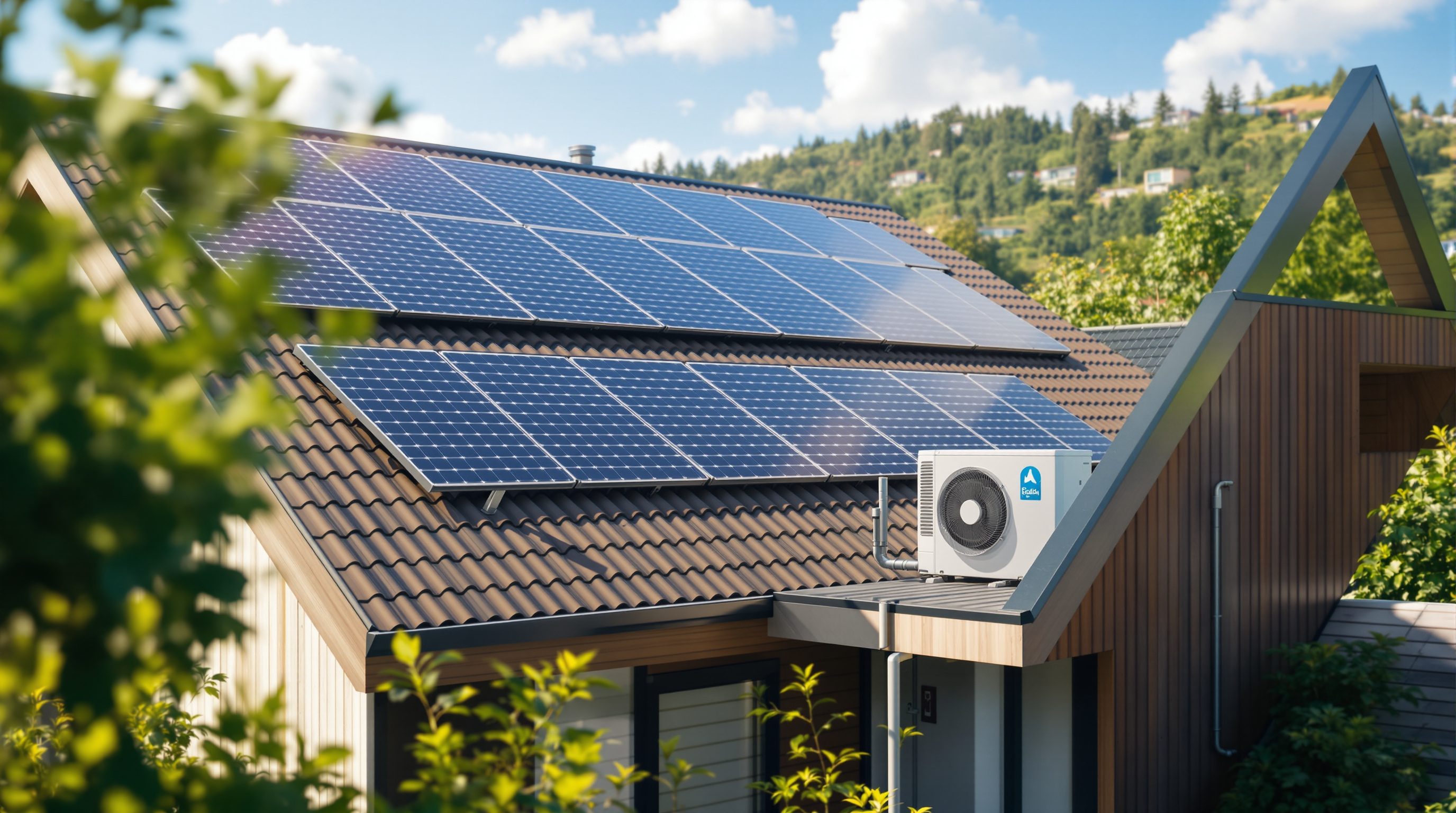
Two moves define modern clean supply. Electrification - running heat, hot water and cooking on electricity instead of burning gas, oil or wood on site - because you cannot clean up combustion, but you can clean up a grid. And renewables - on-site generation and clean grid power to feed that electrified demand. Together they turn a lean building into a clean one.
Roof = power plant. Electrify everything. The grid is your battery - if it is clean.
Why electrify first
Electrification is the strategic move that makes everything else possible, and it is worth understanding before the hardware. The logic is simple: you cannot decarbonise combustion, but you can decarbonise a grid. A gas boiler or a wood stove will emit carbon on site for every year of its life, no matter how clean the world's electricity becomes. An electric heat pump, by contrast, gets cleaner automatically as the grid it draws on adds renewables - a building electrified today keeps decarbonising itself for free as the grid greens. That is why all-electric is now the default ambition for low-carbon buildings.
Electrification touches three loads. Space heating and cooling move from boilers and furnaces to heat pumps, which are three to four times more efficient than combustion because they move heat rather than make it - a seasonal COP of 3-4 means one unit of electricity delivers three to four units of heat or cool. Hot water shifts to heat-pump water heaters or solar thermal. Cooking moves from gas to induction, which is faster, cleaner indoors (no combustion fumes affecting air quality) and easily solar-powered. The honest caveat is that electrification is only as clean as the grid behind it: on a coal-heavy grid an electrified building may not cut carbon much until that grid cleans up - though it still positions the building to benefit the moment it does, and on-site solar closes much of the gap in the meantime.
Cannot clean up combustion; can clean up a grid. Electrify now, decarbonise as the grid greens.
On-site renewables: solar PV and solar thermal
For most buildings the workhorse renewable is rooftop solar PV. A modern panel converts sunlight to electricity at 18-22% efficiency, delivering roughly 150-220 watts per square metre of module; how much energy that yields depends on location, expressed as a capacity factor - the fraction of nameplate power actually delivered over a year. Sun-rich India runs around 17-21%, cloudier northern Europe 10-12%. In practical Indian terms, a kilowatt-peak of well-oriented rooftop PV generates roughly 1,400-1,700 kWh a year. PV needs no fuel, has no moving parts, lasts 25-30 years with slow degradation, and has fallen in cost by around 90% in a decade - which is why it sits first among renewables.
Solar thermal collectors heat water directly and are very efficient at that one job - useful where hot-water demand is steady, as in homes, hostels and hotels; India has a huge installed base of rooftop solar water heaters. The trade-off is that PV is more flexible (electricity can do anything, including run a heat pump for hot water), so on many projects PV plus a heat-pump water heater now out-competes dedicated solar thermal. Beyond the roof, options thin out for individual buildings: small wind is rarely worth it in the turbulent air around buildings, and larger renewables usually make more sense at grid scale. The design instinct is right when it starts with the roof: maximise good south-facing (in the northern hemisphere) unshaded area, coordinate PV with the roof design from the start, and remember the roof must often do double duty - generating power and, elsewhere, harvesting water or hosting greenery.
Storage and the grid
On-site generation has a timing problem: the sun produces most at midday, but a home's demand peaks in the evening. Three tools reconcile supply and demand. Self-consumption - using solar power as it is generated, by shifting flexible loads (water heating, EV charging, pool pumps, some cooling) into sunny hours - is the cheapest and should come first. Batteries store surplus midday generation for evening use, improving self-sufficiency and providing backup in outages; costs have fallen sharply but batteries still carry a price and an embodied-carbon footprint, so size them to genuine need rather than by reflex. And the grid itself is the cheapest, largest battery you have: with net metering or a feed-in arrangement, a building exports surplus by day and imports at night, using the grid to balance its books over a year.
This is why net-zero is usually a grid-connected, annual-balance idea, not an off-grid one: a truly off-grid building needs enormous, expensive storage to survive the worst week of the year, whereas a grid-connected one leans on the grid for balancing and only stores what is worthwhile. The frontier is demand flexibility - buildings that shift and modulate their loads to match when energy is cleanest and cheapest, becoming active, helpful participants in the grid rather than passive drains. A lean, electrified, solar-equipped, flexible building is not just low-carbon; it is a grid asset. The honest limits: net-metering rules, export tariffs and grid-connection terms vary enormously by country and utility and change often, so the economics are always local - check the current local arrangement before promising a payback.
Self-consume first, then battery, then grid. The grid is the cheapest battery - if it is clean.
Cost, payback and the honest limits
Clean supply has to survive a budget, and the economics have moved decisively in its favour - but not uniformly, so it pays to be candid. Rooftop solar PV is now one of the cheapest sources of electricity ever built, with module prices down roughly 90% in a decade; a well-sited residential array often pays back in perhaps 4-8 years and then generates near-free power for the remaining two decades of its life, though the exact payback swings with local tariffs, subsidies (India's rooftop solar schemes among them), install costs and how much of the output you self-consume rather than export cheaply. Heat pumps usually cost more to buy than the boiler they replace but less to run, especially where they also provide cooling a building would otherwise have bought separately; their economics improve as gas prices rise and electricity cleans up. Batteries are the weakest link on pure payback - they still add cost and carry their own embodied carbon and eventual disposal question - so they earn their place through resilience, self-sufficiency or time-of-use arbitrage rather than raw savings, and should be sized to a real need.
The honest limits are worth stating plainly so claims stay credible. On-site renewables are constrained by collector area, orientation and shading - a fact that bites hardest on tall and dense buildings, as the next lesson explores. Their output is intermittent and often mistimed against demand, which storage and flexibility only partly solve. Their carbon benefit depends on the grid they displace and the hours they run, not just the nameplate. And every part of the system carries some embodied carbon and material footprint - panels, inverters, batteries and heat pumps are manufactured things, not free lunches, though their lifetime benefit far outweighs that cost on any reasonable accounting. None of this dims the case for clean supply; it sharpens it. The designer who states the payback range honestly, sizes storage to genuine need, and is clear that the carbon win tracks the grid and the hours is the one whose net-zero claims will hold up.
PV pays back ~4-8 yrs then near-free; heat pumps run cheaper; batteries earn resilience not payback. State the range honestly.
Putting the clean-supply system together
A coherent clean-supply strategy for a lean building reads as a short sequence. Electrify every load - heat, hot water, cooking - so nothing burns fuel on site. Meet it first from on-site solar PV sized to the leaned demand, oriented and unshaded, coordinated with the roof from concept. Use efficient heat pumps as the bridge between electricity and comfort, and consider solar thermal where steady hot-water demand justifies it. Shift flexible loads into generation hours to lift self-consumption, add storage where it genuinely earns its keep, and connect to the grid for balancing and, ideally, two-way trade. And pursue a clean grid supply - a renewable tariff or, at scale, an off-site power purchase agreement - for the electricity you still import.
A rough worked balance shows how it lands. Take a lean home whose demand has been cut to, say, 4,000 kWh a year. A 3 kWp rooftop array in an Indian city might generate around 4,500-5,000 kWh annually - more than the home uses over the year, though not at every hour. With good self-consumption and net metering, that building runs net-zero on an annual balance, exporting by day and importing clean-ish grid power at night, and it keeps getting cleaner as the grid decarbonises. The same array on an un-leaned home using 10,000 kWh covers less than half the load - which is, once more, why be lean comes first. Renewables and electrification are how you close the gap to zero; they are only affordable and effective on a demand you have already made small.
Electrify -> on-site solar -> self-consume + store -> clean grid for the rest. Small demand makes it all work.
Solar photovoltaics (PV)
On-site electricity from sunlight
18-22% module efficiency; capacity factor ~17-21% in India, ~10-12% in cloudy climates. First choice renewable; costs down ~90% in a decade.
Heat pump
Electric heating, cooling and hot water
Seasonal COP 3-4 (moves 3-4 units of heat per unit of electricity). The key to efficient electrified heat; performance drops in extreme cold, so size and select carefully.
Net metering / feed-in
Two-way grid interaction
Lets a building export surplus and import when needed, using the grid to balance over a year. Rules and export rates vary widely by country and utility and change often.
Battery storage / demand flexibility
Time-shifting on-site energy
Batteries store midday surplus for evening use and give backup, but carry cost and embodied carbon; flexibility (shifting loads to clean hours) is often cheaper first.
Workshop - size a rooftop system for a real building
Clean supply becomes concrete when you estimate whether a real roof can actually power a real building. This back-of-envelope exercise builds the instinct to sanity-check any solar or electrification claim.
A tape or plan for roof area, an electricity bill or estimate, and a calculator. A free online solar estimator (such as a PVWatts-style tool) can refine the yield figure but is optional.
Goal: estimate on-site generation and compare it honestly to demand
Inputs: a building with a roof you can see + its rough annual electricity use (a bill helps)
Time: ~30 minutes
- 1Estimate usable roof area for PV - unshaded, well-oriented (south-facing in the northern hemisphere), minus space for plant, walkways and any green roof or rainwater catchment sharing the plane.
- 2Convert to capacity: allow roughly 150-200 watts of panel per square metre of module, so work out the kilowatts-peak (kWp) the roof could hold.
- 3Estimate annual generation: multiply kWp by a local yield figure - roughly 1,400-1,700 kWh per kWp per year in much of India, lower in cloudier climates - to get kWh per year.
- 4Compare generation to the building's annual electricity demand. What fraction does the roof cover? Now imagine the demand had first been cut 40-70% by lean design - how does the fraction change?
- 5Note the timing and grid reality: when does the building actually use energy versus when the sun shines, which loads could shift to sunny hours (self-consumption), and whether local net metering would let it balance over a year. Flag anything that makes the economics local.
You’ll walk away with
A one-page clean-supply estimate for one real building: usable roof area, kWp, estimated annual generation, the fraction of demand it covers now versus after lean design, and a short honest note on timing, self-consumption and local grid rules.
Three altitudes on the same idea
Read the band that fits you — or all three.
The roof is now an energy asset, and it is yours to plan. Orientation, pitch, unshaded area, structural allowance for panels, and the plant space for a heat pump, hot-water cylinder and battery are architectural decisions best made at concept, not bolted on later. Design the roof to generate; coordinate PV with any green roof or rainwater catchment so they share the plane sensibly; and design an all-electric building from the start so there is never gas infrastructure to strand. The building that is lean, electrified and solar-ready is the one that reaches net-zero without a scramble.
Electrification and flexibility run through the equipment and systems you specify. Induction cooking instead of gas (cleaner indoor air as a bonus), heat-pump water heating, efficient all-electric appliances, and controls or smart plugs that let flexible loads shift into solar hours are all fit-out choices. You also shape occupant behaviour - the habits that lift self-consumption and cut evening peaks. Specifying all-electric, flexible interiors is how the clean-supply strategy actually gets used day to day rather than just installed.
Get fluent in the numbers that make or break a renewable claim: capacity factor, kWp, self-consumption, COP and net metering. These let you sanity-check whether a proposed array actually covers a building's load or is marketing. Practise a back-of-envelope solar estimate - roof area, panel wattage, local capacity factor - and compare it to a building's demand. Understanding that electrification only pays off carbon-wise on a cleaning grid, and that storage has its own cost and embodied carbon, will make you a sharper, more honest designer than one who assumes panels equal green.
“Going all-electric and adding solar panels always cuts a building's carbon dramatically.”
Do it yourself
Reason it through - no tools needed.
- 1Why does electrifying heat and cooking matter even before the grid is clean?
- 2Roughly how many units of heat does a heat pump deliver per unit of electricity, and why?
- 3What is a capacity factor, and roughly what is it for solar PV in India versus a cloudy climate?
- 4Put these in the right order for using on-site solar: battery, self-consumption, grid export.
- 5Why is net-zero usually a grid-connected annual balance rather than off-grid?
The one line to carry out
Peer-reviewed journals & authoritative standards
- 01Renewable energy — Wikipedia, 2026.
- 02Solar power — Wikipedia, 2026.
- 03Heat pump — Wikipedia, 2026.
- 04Electrification — Wikipedia, 2026.
Cut the demand, then supply the rest cleanly, and a building can balance its energy books over a year. The final lesson brings it together: what net-zero energy really means, its variants, and its honest limits.
The author
Amogh N P
Architect, interior designer, and creative polymath. Studio Matrx began in his notebooks — his vision of design made honest, useful, and open to everyone. Its Academy is written and taught in his memory, and free, forever.
More about Amogh →