
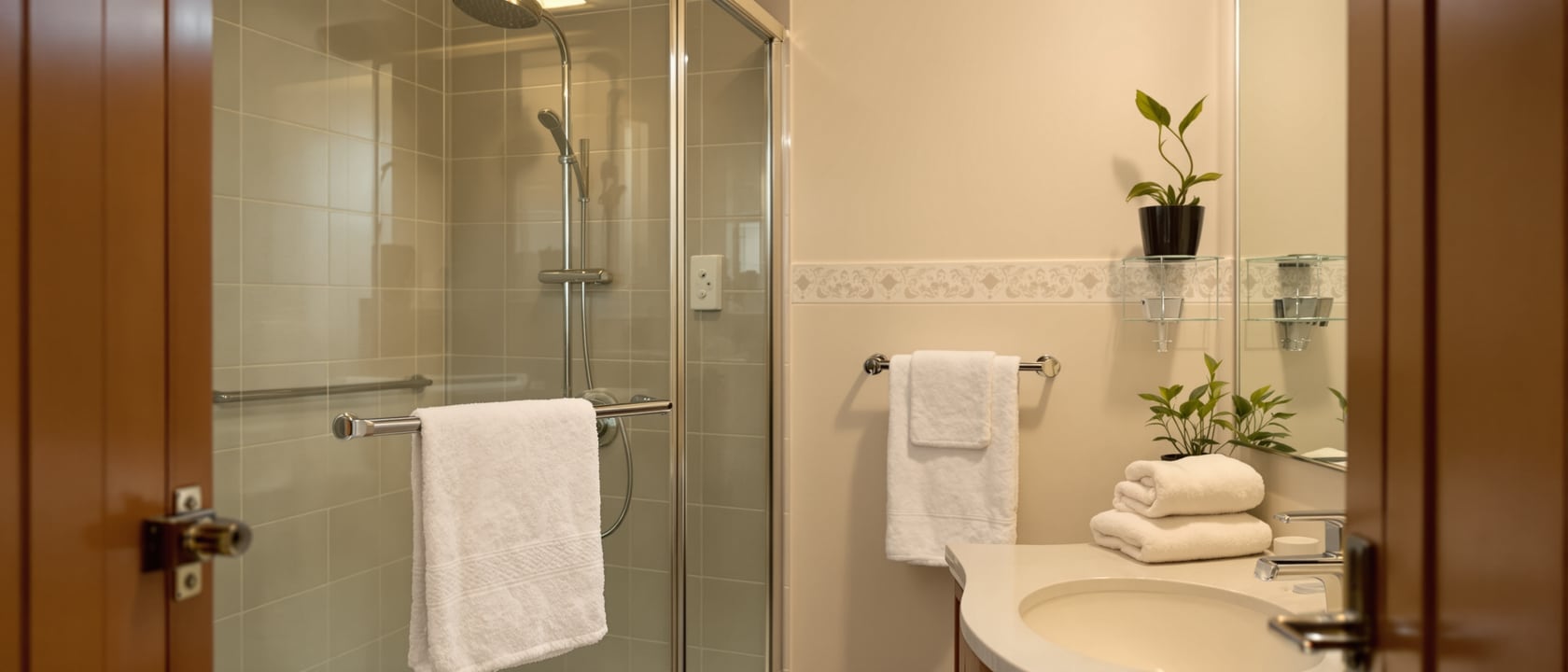
 Lesson 4.3
Lesson 4.3 · Designing the Space
The Guest Bathroom
More five-star reviews are won, or lost, in the bathroom than anywhere else in the house - and it does not need to be large, only clean, dry, well-lit and reliable.
No guest writes a five-star review about a beautiful bedroom and then forgives a bathroom that is damp, dim or out of hot water.
Of every room in a homestay, the bathroom carries an outsized share of the risk. A guest tolerates a slightly plain bedroom far more readily than a bathroom that smells of damp, has weak or absent hot water, or feels unsafe underfoot - because a bathroom failure is personal and immediate in a way a decor choice simply is not. The encouraging part of this truth is that a guest bathroom does not need to be large, expensive or luxurious to earn its five stars; it needs to get seven unglamorous things right, consistently, every single stay.
This lesson sets out those seven non-negotiables, works through the real trade-off between giving each guest room its own dedicated bathroom and sharing one across rooms, and draws a firm line around the one part of this room you should never attempt yourself: the waterproofing and plumbing behind the tiles, which belongs entirely to qualified professionals. Get the visible essentials right and defer the invisible ones to the right hands, and the guest bathroom stops being the risk it so often is for first-time hosts.
Seven unglamorous things, every single stay: clean, dry, lit, hot, ventilated, non-slip, stocked. Waterproofing is not yours to shortcut.
Where stays are actually won or lost
Read a wide enough sample of homestay reviews and a pattern becomes obvious: guests rarely complain in detail about a plain wall colour, but they complain in vivid, specific detail about a bathroom that let them down - a weak shower, a musty smell, a light too dim to see the mirror, a floor that felt dangerously slippery stepping out wet. The bathroom is the one room in a homestay where a problem is not merely inconvenient; it can feel unhygienic or even unsafe, and that register of complaint does far more damage to a listing's rating than an aesthetic one ever would.
The good news is that the fix does not require luxury. A genuinely good guest bathroom rests on seven unglamorous essentials: it must be clean on every single changeover without exception; dry, with no standing water, damp smell or visible mould; well-lit, especially at the mirror; supplied with reliable hot water; properly ventilated to prevent the damp and mould that ruin an otherwise fine bathroom within months; floored in something genuinely non-slip; and equipped with enough storage - a shelf, hooks, a toiletry caddy - that a guest is not left holding their soap in one hand while searching for somewhere to put their towel. None of these seven require a large budget; all seven require consistent attention, every stay, without fail.
Dedicated vs shared: the real trade-off
The single highest-leverage decision in guest-bathroom planning is whether each guest room gets its own ensuite or guests share a bathroom. A dedicated bathroom is, by a wide margin, what guests prefer and what reviews reward most consistently - in the worked [homestay house plan](/house-plans/homestay-house-plan-3-guest-rooms-40x60), giving each of the three guest rooms its own ensuite is explicitly called out as 'the single biggest driver of good reviews,' and shared bathrooms are described as the commonest complaint in budget stays generally.
Converting an existing room to add a basic ensuite typically costs somewhere in the region of ₹1.5-3 lakh in most Indian cities and towns as of 2026, depending on plumbing routing, fittings quality and whether existing walls allow it easily - a real number worth checking against your own [Setup-Cost Estimator](/utilities/homestay-setup-cost-estimator) result before committing. Against that cost sits a real upside: ensuite rooms reliably command a meaningful nightly-rate premium and fill faster than shared-bathroom rooms at comparable quality, often recovering the conversion cost over a realistic number of seasons rather than never.
Sharing a bathroom across rooms remains a legitimate choice where space or budget genuinely cannot stretch to an ensuite - many perfectly good, well-reviewed homestays operate this way - but it carries one firm design condition from Lesson 4.1's circulation test: the shared bathroom's route must never cross a bedroom, whether the family's or another guest's, and its use should be scheduled or signposted clearly enough that guests are never left waiting awkwardly outside a closed door. A shared bathroom planned with this discipline works; one bolted on without it becomes the exact daily friction point that circulation testing exists to catch.
The non-negotiables: water, light, grip
Of the seven essentials, four deserve specific, practical attention because they are the ones most often under-specified by first-time hosts. Hot water needs genuine, reliable capacity, not just a token geyser - for a single guest bathroom, a 15-25 litre storage geyser or a properly sized instant unit is a sensible indicative range, and in regions with reliable sun exposure, a solar water heater is worth evaluating as a running-cost saver over a full season. Ventilation is just as important as hot water and far more often skipped: an exhaust fan rated for the room's size, or a genuine operable window, is what prevents the damp smell and creeping mould that no amount of cleaning fully solves once trapped moisture has nowhere to go.
Non-slip flooring matters for safety as much as comfort - a glazed, highly polished tile that looks elegant dry becomes genuinely hazardous wet, and a slip injury is both a guest-safety failure and a serious liability exposure for a host. Anti-skid-rated tile, or a well-placed, quick-drying non-slip mat over an existing slippery floor, closes this gap cheaply where a full retile is not immediately affordable. Lighting at the mirror deserves its own attention separate from general room lighting - a single dim overhead bulb is not enough for a guest to shave, apply makeup or simply see clearly; a dedicated, bright, moisture-rated fixture near the mirror is a small, inexpensive fix with an outsized effect on how 'finished' the whole room feels.
Storage, the seventh essential, is easy to underestimate because it costs so little relative to the other six - a single shelf, two or three hooks at a sensible height, and a small caddy or tray for soap and shampoo solve most of what a guest needs. The detail that matters more than the fittings themselves is restocking discipline: a bathroom that runs out of toilet paper, soap or a clean towel midway through a stay creates an outsized, entirely avoidable complaint for an almost-zero-cost failure. Build a simple pre-arrival checklist that confirms every consumable is stocked before each guest arrives, and treat it with the same seriousness as the linen changeover in Lesson 4.2 - both are routine, both are easy to skip on a busy day, and both are exactly where guests notice when you do.
Waterproofing and the pro hand-off
Here is the one part of this lesson that carries a firm instruction rather than a judgement call: waterproofing, plumbing and drainage work must be executed by qualified, licensed professionals, to your local building code, every time, with no shortcuts. A bathroom's tiles and fittings can look perfect in photographs while a poorly waterproofed floor slab quietly lets moisture seep into the structure below, surfacing weeks or months later as a musty smell, peeling paint on a ceiling underneath, or visible damp staining that no cosmetic fix actually resolves. Retrofitting proper waterproofing after tiling is complete is dramatically more disruptive and expensive than specifying it correctly before the first tile goes down.
Indicative waterproofing cost for a wet area in most Indian cities runs in the range of a few hundred rupees per square foot for the membrane and application alone, a modest figure set against the cost of ripping out and redoing an entire bathroom floor later - and a trivial figure set against a guest's health, safety or your home's structural health. Treat this guidance, and the [National Building Code of India](https://www.bis.gov.in/) it sits within, as the baseline your contractor or engineer should already be working to, and never accept a shortcut here to save a modest sum, however tempting it feels when the rest of the budget is tight. Everything else in this lesson - cleanliness, lighting, ventilation, storage, the dedicated-versus-shared decision - is yours to manage directly; this one is not.
A practical habit worth adopting regardless of how recently a bathroom was waterproofed: ask your contractor for written confirmation of what membrane or method was used, when, and for what warranty period, and keep that record alongside your other homestay paperwork from Module 2. If you are buying or inheriting a property with an existing bathroom rather than building fresh, do not assume the previous owner waterproofed correctly simply because the tiling looks intact - a professional inspection before your first guest arrives is a modest, worthwhile cost against the alternative of discovering a failure only once a guest has already experienced it.
Waterproofing membrane
A layer applied beneath tiling in wet areas to stop water penetrating the structure
Must be specified and applied by a qualified professional to your local building code - never a shortcut.
Exhaust ventilation
A fan or operable window sized to clear moisture from a bathroom after use
The single most under-specified item in first-time bathroom conversions; prevents damp and mould.
Anti-skid (R) rating
A rating system describing how slip-resistant a tile is when wet
Worth checking before choosing bathroom flooring; a quick-drying non-slip mat is a cheap interim fix.
National Building Code of India
The Bureau of Indian Standards' code covering structural, plumbing, waterproofing and fire-safety practice
The baseline any contractor or engineer working on your bathroom should already be following.
Workshop - the bathroom walk-through
This is a seven-point physical audit of your actual guest bathroom, done as a guest would experience it, so you know exactly which non-negotiable needs attention before your next stay.
Your own guest bathroom, a notebook, and a few minutes of actual hot water and fan use to test properly rather than by eye alone.
Goal: a scored seven-point audit of your guest bathroom
Inputs: the bathroom itself, a notebook, twenty minutes
Time: ~20 minutes
- 1Check cleanliness as a guest would - under the rim, behind fittings, inside cupboards, not just the visible surfaces.
- 2Run the shower or tap for several minutes and time how long it genuinely takes to reach a comfortable hot temperature.
- 3Switch on the mirror light alone, with other lights off, and check whether you can see clearly enough to shave or apply makeup.
- 4Run the exhaust fan or open the window and check whether the room actually clears of steam within a few minutes after a hot shower.
- 5Step onto the floor with wet feet (carefully) and assess genuinely how slip-resistant it feels; note any area that feels risky.
- 6Count the storage available - shelf space, hooks, a toiletry spot - and stock it as you would for an arriving guest.
You’ll walk away with
A scored seven-point checklist (clean, dry, well-lit, hot water, ventilation, non-slip, storage) for your actual guest bathroom, with one concrete fix identified for the weakest point.
Three altitudes on the same idea
Read the band that fits you — or all three.
For you, the owner-host, treat the guest bathroom as the room where your standards can never slip, even on a busy day. Build the seven non-negotiables into your actual changeover routine as a checklist, not a memory, and budget the dedicated-versus-shared decision honestly against your real occupancy numbers rather than your aspirations. Never attempt or accept a shortcut on waterproofing to save money - bring in a qualified professional and get it right once, because the alternative costs far more, in both rupees and reviews, later.
If you are advising on or designing a homestay bathroom, your brief should separate clearly into what you specify and what you hand off. You specify layout, fittings, lighting layout, ventilation strategy, flooring selection and storage - all genuinely important design decisions. You hand off waterproofing membrane specification and application, plumbing routing and drainage falls to a qualified contractor or structural professional working to local code, and you verify it was done, rather than assuming good tiling implies good waterproofing underneath it.
If this is your first bathroom to prepare for guests, work through the seven essentials as a literal checklist before every single stay: clean, dry, well-lit, hot water working, ventilation working, floor genuinely non-slip, storage stocked. You do not need to understand plumbing or waterproofing in technical depth - you need to know, firmly, that those two jobs go to a qualified professional, and that everything else on this checklist is entirely within your own hands to get right, consistently, stay after stay.
“A bathroom mainly needs to look nice in listing photos; what is happening behind the tiles does not matter as much as the visible finish.”
Do it yourself
No tools needed - reason it through for your own bathroom.
- 1Name the seven non-negotiables of a guest bathroom covered in this lesson.
- 2Why do guests tend to complain more sharply about a bad bathroom than about a plain bedroom?
- 3What is the real trade-off between a dedicated ensuite and a shared bathroom, in both cost and guest experience?
- 4If a shared bathroom is your only realistic option, what circulation condition must it still meet?
- 5Why should waterproofing never be treated as an area to save money, even on a tight setup budget?
The one line to carry out
Peer-reviewed journals & authoritative standards
- 01Homestay - the home-based lodging model and guest expectations — Wikipedia, 2026.
- 02National Building Code of India — Bureau of Indian Standards, 2026.
- 03Designing Your Home as a Homestay: Rooms, Privacy & Regional Character — Studio Matrx, 2026.
- 04Hospitality industry - guest expectations and service standards — Wikipedia, 2026.
With the room and the bathroom both right, the course turns to the guest nobody should be designed out of a homestay - and the safety net that protects every guest, regardless of ability.
The author
Amogh N P
Architect, interior designer, and creative polymath. Studio Matrx began in his notebooks — his vision of design made honest, useful, and open to everyone. Its Academy is written and taught in his memory, and free, forever.
More about Amogh →