
 Lesson 6.2
Lesson 6.2 · Setting Up
The Essentials Checklist
Guests rarely remember a room's decor in their review — they remember whether the wifi worked, the water was hot, the bed was comfortable, and whether anyone bothered to leave a torch out for the power cut nobody warned them about.
The review is decided by a short, boring, non-negotiable list — long before your decor gets a vote.
Read a few hundred Indian homestay reviews in a row — the genuinely critical ones, not the polite five-star templates — and a pattern emerges fast. Guests almost never complain that a room was not beautiful enough. They complain that the wifi did not reach the room, that the geyser ran cold halfway through a shower, that the bed sagged in the middle, that there was no way to charge a phone near the bed, that the power cut came and there was no torch anywhere in sight, or that a mosquito kept them up because nobody mentioned a net or a repellent. These are small, specific, entirely preventable failures, and together they decide far more star ratings than any design choice ever does.
This lesson is the checklist version of that pattern — the specific, room-by-room list of things that must be right before you take your first booking, organised around what guests actually judge you on rather than what looks impressive in a listing photograph. It also covers the handful of small, inexpensive, genuinely generous touches — a welcome tray, a torch, an umbrella, a one-page note about the neighbourhood — that create guest delight wildly out of proportion to their cost, and which Module 1 already told you is the real homestay value proposition: not luxury, but care.
Bed, hot water, fast wifi, a safety kit, one small generous touch — in every room, every time.
What guests actually judge you on
If you strip away everything cosmetic, a guest's judgement of a homestay stay rests on a remarkably short list: did I sleep well, was I clean and comfortable, could I get online, was I safe, and did anyone seem to care whether I had a good time. Each of those maps to a handful of concrete, checkable items — a firm, clean bed with good linen; working hot water and clean towels; fast, reliable wifi that actually reaches the room, not just the lobby or common area; visible basic safety provisions; and at least one small gesture that signals a host paying attention rather than running an unattended rental.
The reason this matters more than it might seem is that these items are almost entirely within your control and almost entirely inexpensive to get right, compared to a major renovation or an expensive design overhaul. A homestay with modest, simple furnishings but reliably hot water, genuinely fast wifi, a comfortable bed and a warm welcome will consistently out-review a more lavishly furnished property that gets one or two of these basics wrong. This is good news for a first-time host on a tight budget: the highest-leverage spending in your entire fit-out is not the most expensive item, it is making absolutely certain the short list of non-negotiables never fails.
Treat this list as a pre-flight checklist, not a wishlist — something you walk through, room by room, before every season and ideally before every single booking in the early months, rather than something you set up once and assume will stay correct. A geyser that worked in March can develop a fault by August monsoon season; a wifi router that covered the guest room fine until you added a partition wall may no longer reach it. The checklist habit matters as much as the checklist itself.
Decor is optional. Hot water, fast wifi and a comfortable bed are not.
The non-negotiables, room by room
Organise your own checklist the way guests actually experience the home — bedroom, bathroom, then common areas — rather than by shopping category.
In the bedroom: a firm bed with a good mattress (Lesson 6.1 covers buying this properly); fresh, high-GSM cotton linen changed between every guest, never merely 'freshened'; blackout curtains or blinds heavy enough to actually block streetlight and early dawn light, since many Indian homestays sit in locations where guests want to sleep past sunrise after a long travel day; a working reading light positioned so a guest can actually read in bed, plus charging points within reach of the bed, not only across the room; a wardrobe, hooks or at minimum a few hangers so clothes do not live in a suitcase for the whole stay; and a mirror large enough to actually dress in front of.
In the bathroom: dependable hot water at a decent flow rate and for long enough that a guest does not run cold mid-shower — size your geyser to your actual guest-room count, not to what sufficed for your own family's usage; two clean towels per guest with no visible staining or thinning; basic toiletries (soap, shampoo, a simple toothkit) even if modest, since many Indian and international guests travel light and expect at least this; a bucket and mug alongside any shower, respecting the common Indian bathing habit many domestic guests still prefer; a non-slip mat, since wet bathroom floors and unfamiliar guests are a predictable injury risk; and a covered waste bin, which matters more to guest comfort than its cost suggests.
In the common areas and overall property: wifi that is actually fast and actually reaches every guest room, tested with a phone standing in each room, not assumed from the router's spec sheet; a basic safety kit (next section); and torches, umbrellas and a short local guide note, covered below as the small generous touches. None of this is expensive individually — the discipline is in checking every single item, in every room, rather than assuming because one room has it, all of them do.
The safety kit, and the handful of things guests never forgive missing
A small, visible safety kit is one of the cheapest trust-building investments a homestay can make, and its absence is one of the few things that can turn a minor incident into a genuinely serious review or, worse, a genuinely serious incident. At minimum, keep a fire extinguisher (an ABC-type multipurpose extinguisher suitable for a small residential kitchen and electrical fire, available for a modest cost from any fire-safety supplier and worth having serviced annually), a basic first-aid box stocked with bandages, antiseptic, paracetamol and the essentials rather than left empty after one use, and a clearly posted list of emergency numbers — local police, the nearest hospital, your own number, and the nearest fire service — somewhere a guest can find it without having to ask.
Beyond the strict minimum, think about what your specific region and climate add to this list. Hill and forest-adjacent homestays in Himachal, Uttarakhand, Coorg or the North-East should think about basic torch-and-candle backup for power cuts and, where relevant, simple first-aid for minor scrapes from walks or treks. Warm, humid or coastal regions — Kerala, Goa, coastal Karnataka — should provide mosquito nets or a plug-in repellent as standard rather than only on request. Any homestay hosting older guests or families should keep a grab bar or at least a sturdy stool in the bathroom; Module 4's accessibility and safety lesson goes deeper on designing this in from the start rather than retrofitting it.
What guests genuinely never forgive, in the reviews that do real damage, is less the absence of any single item and more the sense that nobody had thought about their safety at all — a flickering exposed wire never fixed, a balcony rail that wobbles, a well or water tank left unfenced near where children are playing. These are not decor failures; they are the kind of thing a careful walk-through, done honestly rather than defensively, catches before a guest ever does.
The small generous touches that create delight far beyond their cost
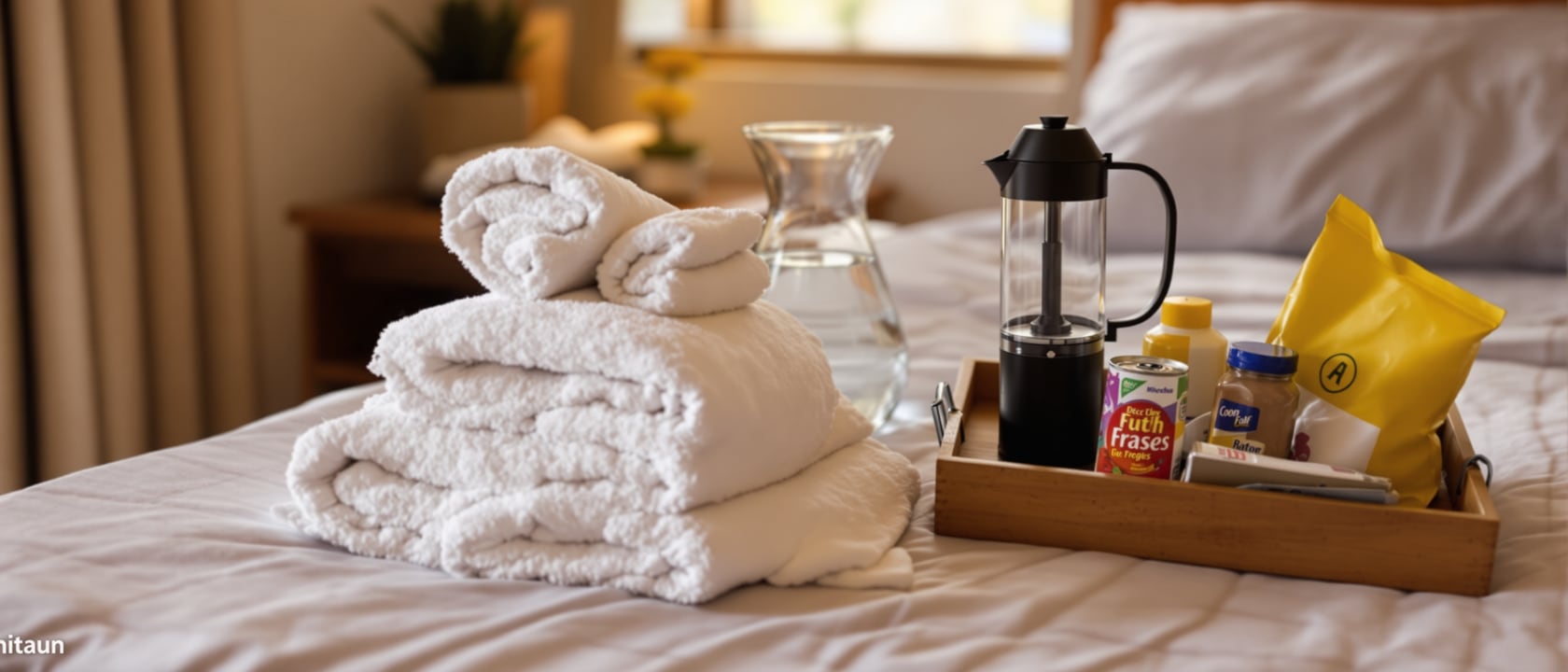
Once the non-negotiables are solid, the highest-return spending left in your entire operation is a short list of small, cheap, genuinely thoughtful gestures — because these are exactly what guests write about in the reviews that bring the next booking. A welcome tray waiting in the room on arrival — local fruit, a packet of regional snacks, a bottle of water, perhaps a small handwritten note — costs a few hundred rupees and reliably appears, by name, in glowing reviews. A torch in every room, charged and checked monthly, turns a power cut from a minor crisis into a non-event, and signals a host who has actually thought about rural or small-town power reliability rather than assuming city-grade supply. Umbrellas left by the door, two or three spares, solve an unplanned monsoon shower at zero ongoing cost after the initial purchase. A one-page local guide — your own honest recommendations for where to eat, what to see, which auto driver to call, written in your own voice rather than copied from a tourism brochure — is something no OTA listing or search engine can replicate, and it is the single clearest expression of the 'host, not just a room' value proposition Module 1 identified as the whole point of choosing a homestay over a hotel.
The pattern across all of these is the same: low cost, low ongoing effort once set up, and a return in guest delight and reviews that is wildly disproportionate to what you spent. This is the actual lever a tight-budget, first-time host has that a hotel chain structurally does not — a hotel's welcome gesture, if it has one at all, is standardised across a thousand rooms and feels like it; yours can be genuinely, locally, personally yours, and guests can tell the difference immediately.
Welcome tray, torch, umbrellas, a one-page local note: minutes of effort, disproportionate delight.
GSM
Grams per square metre — the weight/density measure on good bed linen and towel packaging
Higher GSM generally means a thicker, longer-lasting textile; worth checking rather than guessing by touch when buying linen in bulk.
ABC-type fire extinguisher
A multipurpose extinguisher rated for ordinary combustibles, flammable liquids and electrical fires
The right general-purpose choice for a small residential kitchen and guest-room setting; have it serviced annually.
Blackout lining
A dense, light-blocking fabric layer behind or built into a curtain
The difference between a curtain that merely looks heavy and one that actually blocks early light and streetlight.
Turnaround kit
The standard set of linen, toiletries and safety checks run between every guest departure and the next arrival
Covered in depth in Module 8's housekeeping-and-turnarounds lesson; this lesson sets what the kit must contain.
Workshop — run your own essentials audit
A checklist only works once it has been run against your actual rooms, not read and nodded along to. This exercise has you walk your own property, room by room, and mark each essential present, missing, or needing an upgrade.
Your own property, a smartphone for wifi testing, and this lesson's checklist.
Goal: an honest, room-by-room audit of every essential in this lesson
Inputs: your own property, a phone to test wifi, 30 to 45 minutes
Time: ~45 minutes
- 1Walk into each guest bedroom with your phone and test the wifi signal strength and speed standing exactly where a guest would sit or lie down.
- 2Run the shower in each guest bathroom for a full five minutes and note whether the hot water held up for the whole time.
- 3Check every bed's mattress firmness and every linen set's condition — genuinely sit and lie on each bed as if you were the guest.
- 4Locate, check the batteries of, and test every torch; check the extinguisher's pressure gauge and service date; confirm the first-aid box is stocked, not just present.
- 5Confirm an emergency-numbers list is physically visible in every room or a common area, not only known to you personally.
- 6Draft your own one-page local guide note in your own words, and decide what goes on your welcome tray.
You’ll walk away with
A completed room-by-room checklist marking every essential present, missing or needing an upgrade, plus a drafted local guide note and welcome-tray plan.
Three altitudes on the same idea
Read the band that fits you — or all three.
As the owner-host, physically walk through every guest room and bathroom with this checklist in hand before your first booking, and repeat it every season. Test the wifi standing in the room with your phone, run the shower long enough to feel if the hot water lasts, and check the torch actually has working batteries — assuming an item works because it did last year is how a checklist fails exactly when a guest needs it.
If you are briefing a homestay client, build this checklist into your handover walkthrough as a signed-off list, not a verbal reminder. Clients focused on the visual outcome of a renovation can genuinely overlook that nobody specified geyser capacity for the final room count, or that the new partition wall killed the wifi signal to one bedroom — catch these before the client's first guest does.
If this is new to you, memorise the short version: bed, hot water, fast wifi, a safety kit, and one small generous touch. Everything else is genuinely optional in the early stages — get these five right in every single room before worrying about anything decorative at all.
“A homestay is a budget option, so guests don't really expect hotel-level amenities like fast wifi or reliable hot water.”
Do it yourself
Reason it through using the priorities in this lesson.
- 1Name the five non-negotiables that most consistently decide a homestay review, according to this lesson.
- 2Why should a host test wifi standing in the guest room, rather than trusting the router's advertised range?
- 3What goes in a minimal but genuine homestay safety kit, and why does each item matter?
- 4Why do small, cheap gestures like a welcome tray or a local guide note create guest delight out of proportion to their cost?
- 5A guest's bathroom runs out of hot water two minutes into a shower, for the third time this month. What should the host actually check, and why might it have nothing to do with the geyser being broken?
The one line to carry out
Peer-reviewed journals & authoritative standards
- 01Homestay Design & Guest Rooms — Studio Matrx — Studio Matrx, 2026.
- 02Accessibility — Wikipedia, 2026.
- 03Universal design — Wikipedia, 2026.
- 04Bureau of Indian Standards (BIS) — Government of India, 2026.
With the room itself sorted, the next lesson turns to the other thing guests remember just as vividly — the food — and the breakfast question every homestay host eventually has to answer.
The author
Amogh N P
Architect, interior designer, and creative polymath. Studio Matrx began in his notebooks — his vision of design made honest, useful, and open to everyone. Its Academy is written and taught in his memory, and free, forever.
More about Amogh →