
 Lesson 7.2
Lesson 7.2 · Robotic Fabrication
Robotic Assembly
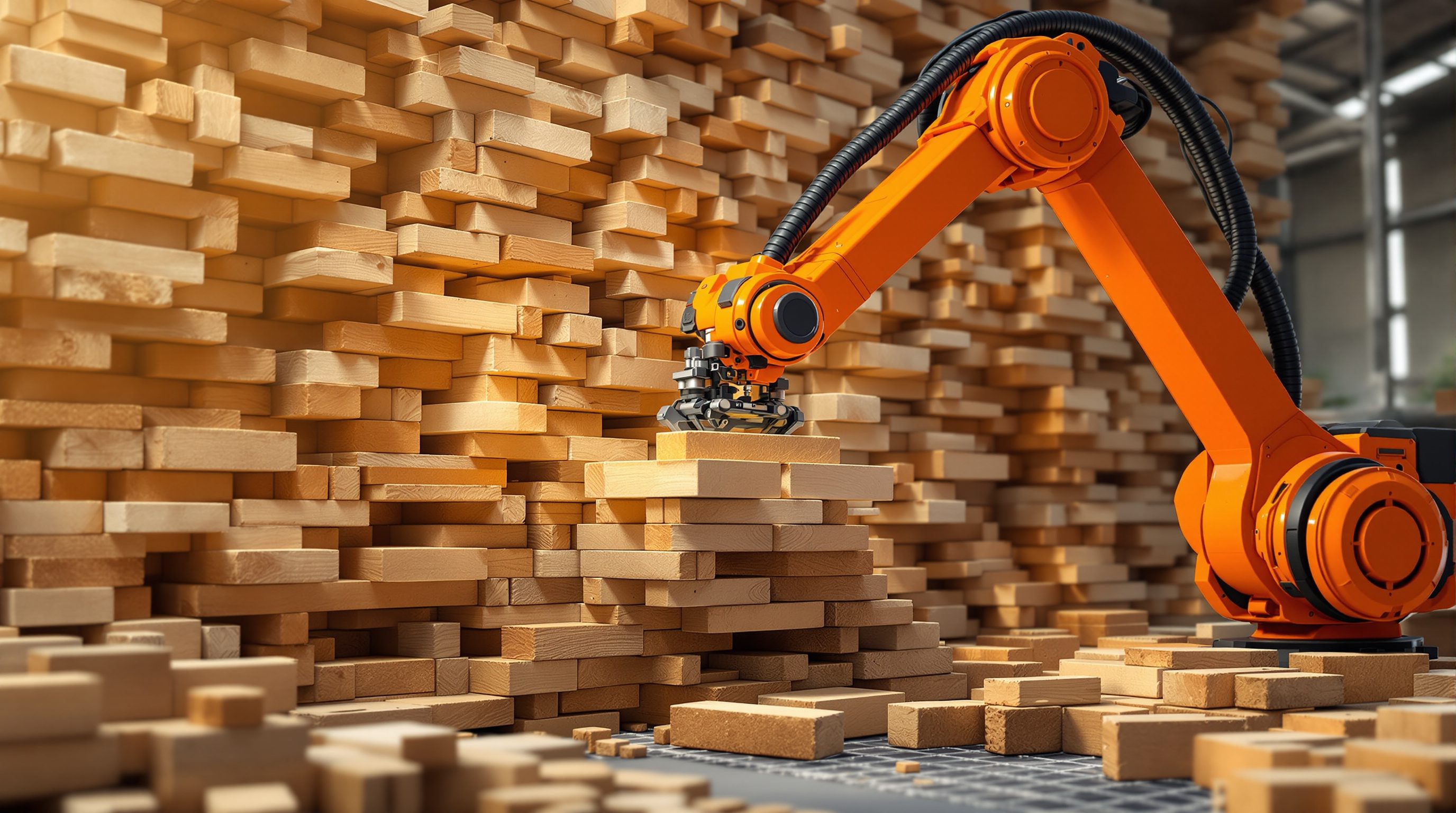
Pick, place and stack - where robots may matter most in construction
The arm that shines in construction is not the one that carves - it is the one that places each brick in a slightly different spot, without ever getting bored.
Cutting and printing get the headlines, but the thing an industrial arm does most naturally is put a part exactly where the model says. Pick a brick, rotate it precisely, set it down at a computed position and angle, repeat a thousand times without drift or fatigue. That is assembly, and it may be where robots change building most.
The pioneering work - Gramazio Kohler Research at ETH Zurich stacking non-standard brick walls, the ICD in Stuttgart weaving and stacking timber - showed something conventional construction cannot match: every element in a differentiated, non-repetitive assembly placed to the millimetre straight from a digital model, at no extra cost for making each one unique. This lesson is about that quiet superpower: precise, tireless, data-driven placement.
Placement, not carving, is the arm's superpower. Differentiation is free. Position is not structure.
Pick-and-place: the fundamental move
Every assembly robot, however sophisticated, is built on one motion: pick-and-place. The arm's end-effector - now a gripper, a vacuum cup, a magnet or a custom clamp - closes on a part at a known pick location, the arm carries it along a planned path, and it releases the part at a computed place position and orientation. In industry this is the most common robot job in the world, sorting and packing millions of items an hour.
What makes it powerful for construction is precision under variation. A human bricklayer working to a standard bond places every brick the same way by muscle memory; ask them to give each course a slightly different angle to make a curving, patterned wall and the job becomes slow and error-prone. A robot does not care. It reads a different target for every single element - position X, Y, Z and rotation - from the digital model, and places each one just as accurately as the last. The repeatability that limits nothing here (unlike milling, there is no cutting force to flex the arm) is exactly the strength: sub-millimetre placement, element after element.
The hard parts are the ones humans do without thinking: gripping an irregular part reliably, knowing where the part actually is (feeders, jigs and increasingly vision systems solve this), and planning a collision-free path to set it down among the parts already placed. Assembly is less about brute force than about spatial bookkeeping - and that is precisely what software is good at.
It helps to see why placement suits a robot so much better than cutting does. In milling, the tool pushes hard against solid material, and that force flexes the arm - the very compliance that hurts a robot's accuracy. In pick-and-place there is no cutting force: the arm carries a part and sets it down, so its weakness never gets exercised and its greatest strength, repeatability, comes fully into play. An arm that returns to the same taught point within a tenth of a millimetre, over and over, tirelessly, is close to ideal for placing parts. The machine that struggles to mill steel accurately can position a brick beautifully. That asymmetry is the single best reason to expect assembly, not cutting or printing, to be where robots first earn their keep in real construction.
Grip - move - place, a thousand times, each target different. No fatigue, no drift.
Robotic bricklaying and non-standard masonry
The landmark demonstration was masonry. Gramazio Kohler's early work took an ordinary brick - the oldest modular building unit there is - and let a robot place each one at a computed angle and offset. The result was walls no mason would build by hand: gently twisting surfaces, walls that read as woven or perforated, patterns where the rotation of each brick modulates light and shadow across a facade. Because the robot places from a model, a wall of two thousand all-different bricks costs no more effort to lay than two thousand identical ones - the file simply carries two thousand targets.
Mechanically, robotic bricklaying is pick-and-place plus adhesive: the arm picks a brick, often dips or receives a bead of glue or mortar, and sets it precisely onto the course below. Prefabricated in a shop, whole wall panels arrive on site ready to hang. Commercial systems now also lay brick on site at pace for standard walls, taking the repetitive lifting off human masons. Two lessons matter here. First, robots make differentiation free, so the design value is in geometry a hand cannot economically achieve. Second, real masonry needs the mortar to cure and the wall to stand and carry load - structural adequacy is always an engineer's sign-off, robot or not; the arm guarantees position, not that the wall is sound.
Timber stacking and larger parts
Bricks are small and forgiving; timber scales the idea up. The ICD in Stuttgart and others have used arms to stack, position and fasten timber elements - laths, slats, beams, plates - into structures a carpenter could not economically set out by hand. A robot holds each stick at the exact computed angle while a fastener goes in, or nails and glues layered assemblies where every layer is slightly rotated, building up differentiated timber plates and shells. The same logic reaches steel nodes, precast blocks and dry-stacked components.
With bigger parts, three things change. Grippers get bespoke: a vacuum cup that lifts a brick will not hold a two-metre beam, so end-effectors are designed per element, sometimes with sensors to confirm the grip. Payload and reach become real limits - an arm has a rated payload (a few kilograms to a tonne-plus for the biggest) and a finite reach, so heavy or long members may need a gantry-mounted robot, a robot on a track, or two arms sharing the load (the next lesson). And tolerance stacks up: place forty parts each a fraction of a millimetre off and the errors accumulate, so real cells use jigs, datums and sometimes vision to re-reference against the growing structure. Assembly, unlike cutting, is where the robot's precision and tirelessness translate most directly into buildings.
A further shift with larger parts is the growing need for sensing. When elements are small and delivered by a precise feeder, the robot can place blind - it trusts that the part is exactly where the program says. As parts get bigger, heavier and less perfectly presented, that trust breaks down: a beam may sit a few millimetres off in the rack, or the structure may settle slightly under its own weight as it grows. So advanced cells add vision (cameras that locate the part and the work), force sensing (feeling when a part seats or jams), and touch probing to re-reference against reality rather than the ideal model. This is the difference between a robot that follows a script and one that closes the loop - measuring, comparing, and correcting. Construction, being full of real-world variation, pushes assembly robotics steadily toward that sensor-rich, adaptive end.
Small part, standard gripper. Big part, bespoke gripper - and watch the payload and the error stack.
Working alongside people - safely
Most assembly robots today live in fenced cells: a fast, powerful industrial arm carrying a heavy part is dangerous, so it works behind guarding with interlocks that stop it the instant a gate opens. But the frontier of construction is human-robot collaboration - people and machines sharing a task, because buildings are big, messy and unpredictable in ways a fully-automated line is not.
Two models are emerging. In one, a collaborative robot (a cobot) is built to work near people: force-limited, speed-limited, with sensors that stop it on contact, so a person can hand it parts or work beside it. Cobots trade speed and payload for that safety. In the other, the human and a full industrial robot share a job but not the same instant of space - the robot places heavy elements while a person does the dexterous fastening, choreographed so they are never in the same zone at once. The division of labour plays to each side: the robot brings tireless precision and lifting, the human brings judgement, dexterity and dealing with the unexpected. This partnership - not full automation - is the realistic near future of robots on the building site, and it only works when safety is engineered in from the start, never improvised.
Economically, the case for assembly robotics is strongest wherever the work is repetitive, precise and physically punishing at once - lifting and setting heavy units to exact positions all day. Those are the tasks that injure human bodies and drift in quality as people tire, and they are exactly what a tireless, sub-millimetre arm does best. Freed from them, skilled workers move up to the judgement-rich work machines cannot do. Seen this way, the robot is less a replacement than a power tool at building scale.
Pick-and-place
Grip a part, move it, release it at a target pose
The fundamental assembly motion; the whole skill is reliable gripping, knowing where the part is, and a collision-free path.
Gripper / end-effector
The vacuum cup, jaw, magnet or custom clamp that holds the part
Standard for bricks, bespoke for beams; it must hold the part securely and, ideally, sense that it has.
Payload & reach
The weight an arm can carry and how far it can extend
Real limits - heavy or long members need a bigger arm, a track, a gantry mount, or two arms sharing the load.
Collaborative robot (cobot)
A force- and speed-limited arm built to work near people
Trades speed and payload for safety so a person can work alongside it; still needs a proper risk assessment.
Workshop — plan a differentiated brick or block wall
Assembly is spatial bookkeeping. This exercise makes you the software: define a rule that gives every element a different target, then confront the practical limits a real robot would hit.
Blocks, a protractor and a notebook. A cobot or fenced industrial cell in a lab shows it for real, but only supervised - industrial arms carrying parts are fenced and interlocked, and even cobots need a risk assessment before anyone works beside them.
Goal: turn a design rule into per-element placement targets
Inputs: a strip of at least 20 identical blocks (Lego, wood offcuts, sugar cubes), a protractor and a notebook
Time: ~30 minutes
- 1Write a simple parametric rule for a wall - for example, rotate each brick by an angle that grows and shrinks along the course so the wall reads as a gentle wave of light and shadow.
- 2By hand, lay one course following your rule, recording each element as a target: position and rotation angle. You are producing exactly the list a robot would read from the model - notice that each target is different but the placing action is identical.
- 3Deliberately introduce the robot's constraints: mark which placements a straight-down gripper could not manage (too much overhang, a brick that needs support until glue sets) and note where you would add a temporary support or change the rule.
- 4Estimate tolerance stack-up: if each placement is 0.5 mm off, how far out is the top of a forty-course wall? Decide where you would re-reference against the built structure with a datum or vision check.
- 5Write two lines: which parts of this a robot does better than you (tireless precise repetition of different targets) and which a human still does better (adapting when a brick sticks, judging when the glue has set).
You’ll walk away with
A hand-built differentiated course plus a written target list, a note of where a real robot would need support jigs or re-referencing, and a tolerance-stack estimate - the assembly logic a robot cell runs on.
Three altitudes on the same idea
Read the band that fits you — or all three.
Robotic assembly makes non-repetition a design freedom, not a cost. A brick wall where every unit turns a little to weave light, a timber shell of hundreds of differentiated members - these become buildable because the robot places each element to the millimetre from your model at no premium for uniqueness. Design the differentiation where it earns its keep, prefabricate where you can, and remember the robot guarantees position, never structural adequacy - that stays with the engineer.
This is how a feature wall or screen stops being modular and starts being sculptural. A robotically-laid brick or block feature, a stacked-timber ceiling or partition where each slat shifts by degrees - patterned assemblies that a hand would find tedious and imprecise become crisp and exact. Specify the pattern parametrically and let placement be the robot's job; the value you add is the rule that makes every element different for a reason.
Assembly is the quiet giant of construction robotics - learn it as pick-and-place plus bookkeeping. Grip, move, place, repeat, each target read from the model. The famous ETH brick walls and ICD timber structures are that one move done thousands of times with different targets. Understand grippers, payload, reach, tolerance stack-up and safe collaboration, and you understand where robots realistically help build - which is a strong thing to show you grasp.
“Robots are about to automate construction sites and replace human builders wholesale.”
Do it yourself
No machine - reason it through.
- 1What is the one fundamental motion every assembly robot is built on?
- 2Why does robotic bricklaying make a wall of all-different bricks cost no more than all-identical ones?
- 3Name two things about assembly that are harder than they look for a robot.
- 4What changes when you move from stacking bricks to stacking two-metre timber beams?
- 5What does a cobot trade away in exchange for being safe to work beside?
The one line to carry out
Peer-reviewed journals & authoritative standards
- 01Gramazio Kohler Research - Digital fabrication in architecture — ETH Zurich, 2026.
- 02ICD - Institute for Computational Design and Construction — University of Stuttgart, 2026.
- 03Construction robot — Wikipedia, 2026.
- 04Industrial robot — Wikipedia, 2026.
So far the arm removes material or moves solid parts. What if the end-effector could add material in mid-air - drawing structure directly in three-dimensional space instead of stacking flat layers? That is spatial printing, next.
The author
Amogh N P
Architect, interior designer, and creative polymath. Studio Matrx began in his notebooks — his vision of design made honest, useful, and open to everyone. Its Academy is written and taught in his memory, and free, forever.
More about Amogh →