
 Lesson 7.4
Lesson 7.4 · Robotic Fabrication
Multi-Robot & Cooperative
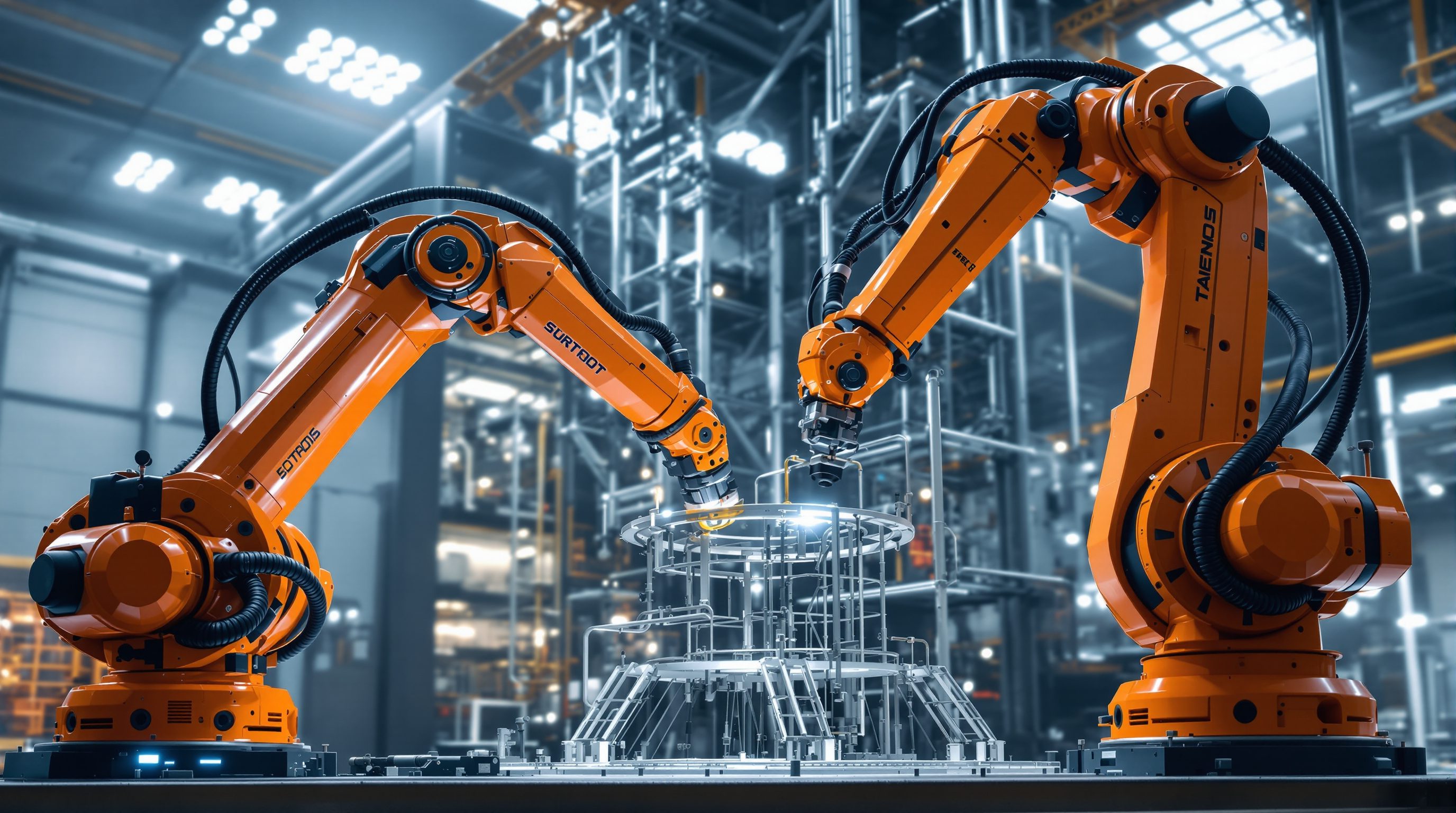
Many arms, one structure - one holds while another works
A carpenter framing a roof wishes for a second pair of hands to hold the beam. Give a robot a partner and that wish comes true - one arm holds while the other works.
A single arm is a marvel, but it has one gripper and one reach. Real structures constantly need what one arm cannot give: something held in place while it is fastened, a member steadied against gravity until it is fixed, two ends of a large part positioned at once. A human team solves this instinctively - one holds, one screws. Multi-robot fabrication gives machines the same teamwork.
Two or more arms working the same structure unlock things a lone arm cannot do: printing without any temporary scaffolding because a second arm is the support, assembling members too big for one gripper, and simply working faster by dividing the job. The prize is real, but so is the difficulty - the moment two powerful arms share a workspace, keeping them from colliding and keeping them coordinated becomes the whole engineering problem. This lesson is about that teamwork, and where it is heading: onto the building site.
One holds, one works. Two arms carry the big member. Coordinate the shared space or they crash.
Why one arm is often not enough
A single six-axis arm is astonishingly capable, but it is fundamentally one hand. Think of the everyday reality of building: a beam has to be held level while it is bolted; a printed strand needs something to land on; a long panel must be steadied at both ends as it is set. A person never does these alone - they ask for help, and a second pair of hands holds while the first fastens. A lone robot has no one to ask, so it falls back on jigs, clamps and temporary supports - physical fixtures that stand in for the missing second hand, and that must be built, positioned and later removed.
Multi-robot fabrication replaces those passive fixtures with active partners. Give the cell a second arm and it becomes the clamp - but an intelligent, repositionable, precise one. The classic division is one holds, one works: one arm grips and steadies a member exactly where the model wants it, while the second drives a screw, welds a joint, or extrudes against it. No temporary scaffolding to build and strip, no re-fixturing between steps, and the holding arm can move the part to present each joint conveniently to the working arm. It is the single most useful thing a second robot brings, and it maps directly onto how skilled human crews have always worked.
The deeper point is that a jig is a frozen decision while a second arm is a live one. A clamp or fixture holds a part in one pose; if the next step needs the part rotated, you build another fixture or stop and re-fix it by hand. A holding arm just moves - it can lift the member, tilt it to bring a joint into the working arm's best reach, hold it there while the fastener goes in, then rotate it for the next joint, all from the same instructions that drive the rest of the build. Fixtures also have to be designed and made for each new part, which is fine for mass production and painful for the one-off, differentiated work that digital fabrication exists to enable. Two arms give you re-fixturing for free, in software, on the fly - which is precisely why cooperation matters most for exactly the bespoke, non-repetitive structures this course keeps returning to.
One arm becomes the clamp - an intelligent, movable, precise one. One holds, one works.
Cooperative assembly of large structures
Scale is the other reason to add arms. A member too long or heavy for one gripper can be carried by two arms at once, one at each end, positioned in perfect coordination - the same way two people carry a ladder. Groups of arms have assembled large spatial timber structures, each robot placing and holding members while others fasten, building frames far bigger than any single arm could reach across. Researchers at ETH Zurich, the ICD and elsewhere have shown multi-arm cells weaving timber lattices and cooperatively erecting structures that would otherwise need heavy temporary works.
Dividing the labour also brings speed and parallelism. Two arms building different regions of the same assembly roughly halve the time, provided their zones do not clash. And cooperation enables genuinely new sequences: one arm can hold a partly-built sub-assembly in the air at the exact pose needed while another adds to it, so gravity and awkward geometry stop dictating the build order. The recurring pattern across all of it is that the second (and third, and fourth) arm turns a rigid, gravity-bound sequence into a flexible one - parts can be supported, rotated and presented at will. As always at this frontier, the structures produced are novel and their performance is validated by testing and signed off by engineers; the robots guarantee precise, coordinated placement, not that the finished frame is sound.
Coordination: the hard problem
Everything good about multiple arms comes with one serious cost: the instant two powerful robots share a workspace, they can hit each other, or the growing structure, or a fixture - at speed, with force. Coordination is no longer a nicety; it is a safety-critical necessity. There are two broad ways to organise it. Time-sharing keeps the arms out of each other's overlapping space by scheduling - arm A works its zone while arm B waits or works elsewhere, and they take turns in the shared region, so they are never in the same place at the same instant. It is simple and safe but leaves arms idle. True cooperation has the arms move in the shared space simultaneously, their motions continuously planned together so trajectories interleave without collision - faster and more fluid, but far harder to compute and to guarantee safe.
This is why multi-robot work lives even more deeply in software than single-arm work. The whole cell - every arm's kinematics, the shared workspace, the build sequence, the collision envelopes - is modelled and simulated together in frameworks like COMPAS or robot-aware Grasshopper tools before anything moves, and often monitored in real time during the build. Add people to the mix and the safety problem multiplies again: a human-plus-multi-robot team needs zones, speed limits and sensing engineered from the outset. Coordination, not raw capability, is the ceiling on how many arms you can usefully point at one structure.
Two arms sharing space can collide - at speed. Time-share (take turns) or truly cooperate (plan together).
The future: multiple robots on site
So far most of this happens in the controlled world of the fabrication shop, where arms are fixed, fenced and the environment is known. The frontier - and the reason it matters for architecture - is taking cooperative robots onto the building site. Fixed arms have limited reach, so the leading idea is mobile fabrication: arms mounted on wheeled or tracked bases, or on cable-suspended and legged platforms, that drive to the work, fabricate a region, and move on. A team of such mobile units could, in principle, cover a whole building the way a crew of trades does, each robot handling a task and coordinating with the rest - a vision sometimes described as swarm or distributed construction.
The honest status is early. Sites are unstructured, weather-exposed, cluttered and full of people - exactly the conditions robots handle worst - so on-site multi-robot fabrication is largely research and pilot projects, not routine practice. The realistic near term is human-robot teams: a few mobile arms doing the heavy, repetitive, precise placement and holding, while skilled people supply judgement, dexterity and adaptation, all under carefully engineered safety. What ties this final lesson back to the whole module is the thread you have followed: an arm can cut, it can place, it can print in space, and - with partners - it can hold, carry and cooperate. That versatility, coordinated by computation and married to human skill, is what makes robotic fabrication the open frontier of digital making.
If you take one thing from this module into practice, let it be a way of asking questions. Faced with a hard piece of making, do not ask which machine; ask what the tool must do - reach an angle, remove bulk, place a part precisely, draw a member in space, hold something while it is fixed - and let that decide whether an arm helps and in what role. The robot is not a single answer but a versatile pair of hands whose value depends entirely on the job. Knowing when it is the right hands, and when a laser, a router or a human simply beats it, is the judgement this whole course has been building.
One-holds-one-works
One arm steadies a part while a second fastens or prints against it
The core cooperative move; an active, repositionable arm replaces passive jigs and temporary supports.
Time-sharing vs true cooperation
Taking turns in shared space vs moving simultaneously, planned together
Time-sharing is simple and safe but idles arms; true cooperation is fast and fluid but far harder to plan and guarantee safe.
Collision avoidance / shared workspace
Keeping arms from hitting each other, the part or fixtures
Safety-critical the instant workspaces overlap; the cell is simulated before it moves and often monitored live.
Mobile fabrication robot
An arm on a wheeled, tracked, legged or suspended base
Extends reach beyond a fixed arm so robots can cover a whole building; on-site multi-robot work is still largely research and pilots.
Workshop — choreograph a two-arm build
Cooperation is teamwork plus a collision problem. This exercise makes you plan a two-arm sequence and confront exactly the coordination the software must solve.
A small structure, ideally a partner, and a notebook. A real multi-arm cell with COMPAS or robot-aware Grasshopper shows it fully, but only supervised - two powerful arms sharing a workspace are fenced, interlocked, simulated before moving and never shared with people while running unguarded.
Goal: design a one-holds-one-works sequence and find where the arms would clash
Inputs: a structure to assemble (a small frame, a card model, a stack of sticks), a partner if possible, and a notebook
Time: ~30 minutes
- 1Choose an assembly that genuinely needs holding - a beam that must be steadied while it is fixed, or a member set at an awkward angle. Sketch it and mark every step where a second hand would help.
- 2Assign roles per step: which arm holds and where it grips, which arm works and what it does. Notice how the holding arm can rotate the part to present each joint - a freedom a fixed jig does not give.
- 3Draw both arms reaching in. Shade the region where their working spaces overlap - this is the danger zone where they could collide. For each step decide: do they take turns here (time-sharing) or move together (true cooperation)?
- 4With a partner, physically act out the sequence - one holds, one works. Every time you get in each other's way, you have found a collision the planner would have to schedule around; note it and adjust the order or the grip.
- 5Write two lines: what the second arm let you do that one could not (held-in-air, no jig, bigger part, faster) and the price it added (you had to choreograph the shared space so nothing collides).
You’ll walk away with
A step-by-step two-arm choreography with roles, the shaded overlap zone, a time-share-or-cooperate decision per step, and a note of collisions found while acting it out - the coordination a multi-robot cell must solve in simulation.
Three altitudes on the same idea
Read the band that fits you — or all three.
Cooperative robots dissolve the constraint that gravity and one pair of hands impose on how a structure goes up. Members held in mid-air while others are added, large timber frames woven by teams of arms, printing with no temporary scaffolding because a second arm is the support - build sequences you could never draw for a human crew become possible. Treat it as a frontier: powerful, still mostly shop-based, and always validated and engineer-signed for structure, never assumed.
For bespoke feature elements, a two-arm cell means intricate, self-supported assemblies without a forest of temporary jigs. A woven timber screen, a complex layered installation, a sculptural frame held and fastened in one fluid operation - cooperation makes fabrication cleaner and geometry freer. It is specialist, lab-and-shop territory today, so scope it as a made-to-order partnership with a fabrication lab rather than an in-house tool, and design to exploit the holding-and-working teamwork it offers.
Learn the one idea that unlocks the rest: one arm holds while another works. From it flow carrying big members with two arms, printing without scaffolding, and parallel speed - and the single hard cost, coordination, because two strong arms in one space can collide. Grasp time-sharing versus true cooperation, why it lives in simulation, and why on-site multi-robot building is still early, and you understand the genuine frontier of construction robotics.
“Swarms of robots will soon build whole houses on site with no people involved.”
Do it yourself
No machine - reason it through.
- 1Why does a single arm often fall back on jigs and temporary supports, and how does a second arm change that?
- 2Describe the one-holds-one-works move and one thing it makes possible.
- 3How can two arms handle a member that is too big for one gripper?
- 4Contrast time-sharing with true cooperation in a shared workspace.
- 5Why is on-site multi-robot fabrication still mostly research rather than routine?
The one line to carry out
Peer-reviewed journals & authoritative standards
- 01Gramazio Kohler Research - Digital fabrication in architecture — ETH Zurich, 2026.
- 02ICD - Institute for Computational Design and Construction — University of Stuttgart, 2026.
- 03Construction robot — Wikipedia, 2026.
- 04Robot kinematics — Wikipedia, 2026.
- 05Association for Robots in Architecture — Robots in Architecture, 2026.
That completes the robotic fabrication module - the arm as mill, as placer, as spatial printer, and now as one of a cooperating team. From here the course turns to materials and the parametric-to-fabrication workflow that feeds every machine you have met.
The author
Amogh N P
Architect, interior designer, and creative polymath. Studio Matrx began in his notebooks — his vision of design made honest, useful, and open to everyone. Its Academy is written and taught in his memory, and free, forever.
More about Amogh →