
 Lesson 4.2
Lesson 4.2 · Materials & Circularity
Low-Carbon & Bio-Based Materials
Timber, bamboo, hemp, straw and earth can store carbon in the walls; slag, fly ash and calcined clay can strip it out of concrete. The palette that pulls a building's footprint down
Some walls emit carbon. A few of them store it - the tree did the work before you ever cut it.
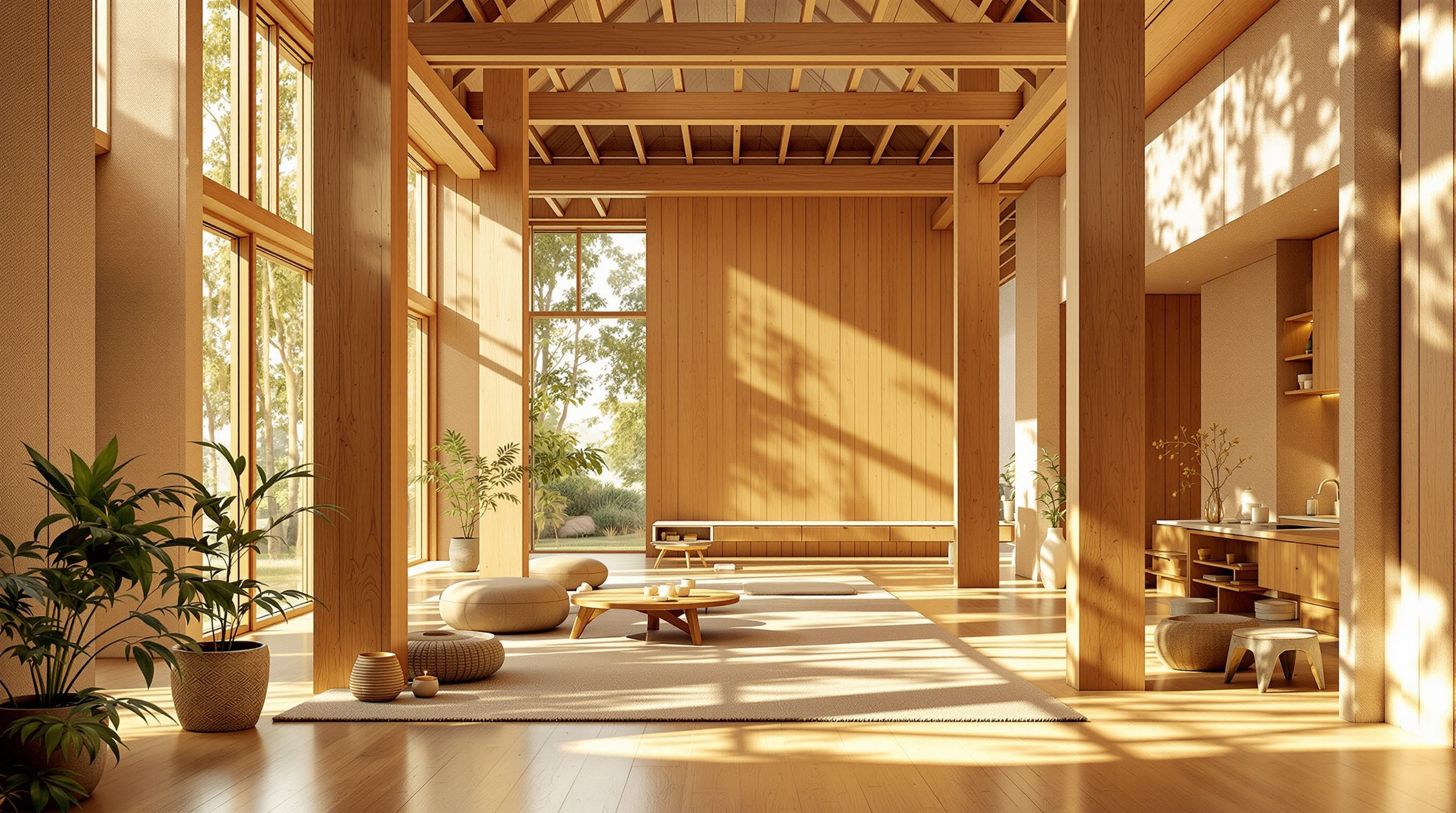
Every material choice moves a building's carbon up or down, but a small family of materials does something remarkable: it holds carbon out of the atmosphere. A tree pulls CO2 from the air as it grows; turn that trunk into a beam or a floor and the carbon stays locked in the fabric for as long as the building - and the timber - lasts. Grow it, build with it, and you have a carbon store standing in the street.
This is the most powerful lever material selection offers: not just less bad, but actively storing carbon. Alongside the bio-based palette - timber, bamboo, hemp, straw, earth - sits a quieter revolution in the most-used material on Earth: concrete, whose carbon can be cut sharply by replacing cement with slag, fly ash or calcined clay. This lesson surveys both, with honest caveats, and with the India-relevant options that suit hot climates and local supply.
Grow it, build it, keep it, reuse it. Break any link and the carbon store leaks.
Mass timber: building with stored carbon
Wood is roughly 50% carbon by dry mass, so a cubic metre of structural timber holds on the order of 0.8-1.0 tonnes of CO2 taken from the air - carbon that stays sequestered as long as the wood is in service. Modern mass timber turns this into a structural system that competes with concrete and steel for mid-rise buildings. Cross-laminated timber (CLT) glues layers of boards at right angles into large, dimensionally stable panels for floors and walls; glue-laminated timber (glulam) builds up beams and columns from bonded laminations. Together they let timber frame apartment blocks, offices and schools of six, twelve, even twenty-plus storeys.
The carbon case is strong but must be argued honestly. Timber's cradle-to-gate emissions are modest, and when the biogenic carbon is counted a mass-timber structure can have a far lower - sometimes near-zero or net-negative at the gate - upfront carbon than its concrete equivalent. But three caveats keep it real. The store only holds if the wood comes from responsibly managed forests (look for FSC or PEFC certification) that regrow; it only stays stored if the building lasts and the timber is reused rather than burnt or landfilled at end of life; and timber demands careful detailing for fire, moisture and acoustics - mass timber chars predictably and can be engineered to meet fire ratings, but it is not a material to specify casually. Done well, it is the clearest example of a building that stores more carbon than its structure emitted.
1 m3 of timber ~ holds 0.8-1.0 t CO2. It stays stored only if the building lasts and the wood is reused.
The wider bio-based palette: bamboo, hemp, straw, earth
Beyond timber sits a rich palette, much of it well suited to India and hot climates. Bamboo is a giant grass that matures in three to five years (versus decades for timber), with tensile strength rivalling steel; it works as structure, screens and flooring, and India runs a National Bamboo Mission to build the supply chain. Its caveats: it needs treatment against insects and moisture, and engineered bamboo products may use adhesives worth checking. Hemp combined with a lime binder makes hempcrete - a non-structural insulating infill that is vapour-open, mould-resistant and carbon-storing, though it needs a structural frame and dries slowly. Straw bale construction uses an agricultural by-product as thick, superbly insulating wall infill; detailed against moisture and rendered, straw-bale walls perform for decades. Rammed earth and compressed stabilised earth blocks (CSEB) use subsoil - often from the site itself - compacted into massive, low-carbon walls with excellent thermal mass for hot-dry climates; India has a deep tradition and institutions like the Auroville Earth Institute refining it.
What unites these is low processing energy, renewability or local abundance, and - for the plant-based ones - stored carbon. What they demand is craft: earth and straw need protection from rain and rising damp, bio-based materials need moisture management, and codes and lending can lag, so early engagement with authorities matters. These are not fringe experiments - they are proven systems that reward designers willing to detail them properly.
The concrete problem - and how to cut its carbon
Concrete is the most-used material on Earth after water, and cement production alone accounts for roughly 7-8% of global CO2 emissions - both from the fuel to heat kilns and from the chemistry of turning limestone into clinker, which releases CO2 directly. You cannot build a modern city without some concrete, so the task is to use less of it and to make what you use far cleaner.
The biggest lever is replacing Portland cement clinker with supplementary cementitious materials (SCMs). GGBS (ground granulated blast-furnace slag, a steel by-product) can replace 30-70% of cement; fly ash (PFA, a coal-power by-product) typically 15-35%; and LC3 (limestone calcined clay cement), developed with major input from Indian research, can cut a cement's CO2 by around 40% using widely available clay. Each can reduce a concrete mix's embodied carbon substantially - a well-designed slag mix can be less than half the carbon of a plain Portland one. The caveats: SCM availability is regional and, as steel and coal decarbonise, slag and fly ash supply will shrink over time, so they are a transition lever, not a permanent free lunch; some slower-gaining mixes need programme allowance. Beyond substitution, cut carbon by using less concrete - efficient structural design, voided or ribbed slabs, right-sizing - and by specifying by performance and 28-plus-day strength rather than over-conservative defaults. Emerging routes (carbon-cured concrete, novel low-clinker cements) are promising but still maturing; treat their claims with the same scrutiny as any other.
Recycled content and building the supply chain
Alongside bio-based materials sits the other great lever for pulling carbon down: recycled content, which reuses material already extracted and processed rather than mining and making it afresh. The standouts are the metals. Recycled steel made in an electric-arc furnace from scrap can be less than half - sometimes a third - of the carbon of virgin blast-furnace steel, and most structural steel already contains substantial recycled content; ask for the figure and the production route on the EPD. Recycled aluminium is even more dramatic, needing roughly a twentieth of the energy of virgin smelting, so recycled stock can be around a tenth of the carbon. Recycled aggregate from crushed concrete can replace virgin stone in many non-structural and some structural applications, and recycled glass (cullet) cuts the energy of new glass and feeds insulation products like foamed glass and glass wool. Plastic waste finds a second life as decking, drainage and some boards, and recycled gypsum can return to plasterboard.
The honest cautions from lesson 4.1 apply in full: recycled content is one input to the weighing, not a trump card. A small recycled fraction advertised on the box means little; what matters is the actual Global Warming Potential on the EPD and whether the product is itself recoverable at end of life rather than a recycled thing headed straight for landfill. Watch, too, for recycling that adds transport or reprocessing energy, or that downgrades quality - true 'closed-loop' recycling (metal back to metal, glass back to glass) is far better than downcycling.
The deeper point is that recycled and reclaimed materials only flow if there is a supply chain to carry them, and this is where designers have real influence. Specifying recycled-content and reclaimed products creates the demand that makes recovery worthwhile - the market signal that builds the chain. India is instructive here: it already has a vast, largely informal materials-recovery economy - scrap metal, salvaged brick, reclaimed timber, doors and fittings, and skilled repair traditions - that many countries are trying to rebuild from scratch. The task is to formalise and raise the quality of that flow (testing, grading, certification) rather than overlook it, and rating systems help: GRIHA and IGBC award credits for recycled content, regional sourcing and construction-waste diversion, nudging manufacturers to disclose and recover. Choosing recycled and local, and asking suppliers for the data, is not just a project decision - it is a vote for the circular supply chain the next two lessons depend on.
Recycled metals are the big win. But ask the EPD, not the box - and specify it to build the supply chain.
Choosing across the palette - honestly
Low-carbon and bio-based materials are powerful, but they are not a free pass, and the biggest risk is swapping one problem for another. Three honest disciplines keep the gains real. First, count the whole life, not just the gate: bio-based carbon storage is only a genuine benefit if the material stays in service and is reused or, at worst, its carbon is not simply released by burning or rotting in landfill - end-of-life assumptions decide whether stored carbon is a real drawdown or a temporary loan. Module 3's whole-life carbon lesson sets out how to account for this properly.
Second, do not sacrifice performance for a carbon headline: a bio-based wall that traps moisture, an earth wall that erodes, or a timber detail that fails on fire is not sustainable at any carbon figure. Detailing and durability are part of the carbon case, because a material replaced early loses its advantage. Third, match material to climate and supply: rammed earth and CSEB shine in hot-dry regions with thermal-mass demand; timber and straw suit temperate and well-detailed humid conditions; slag and fly-ash concrete depend on nearby industry. The regenerative move is to build with less, choose materials that store or embody little carbon, source them locally, detail them to last, and design them to be reused - the whole material strategy this module is assembling.
Stored carbon is a loan until end-of-life. Reuse the timber and it becomes a real drawdown.
Cross-laminated timber (CLT)
Engineered mass-timber panels for floors and walls
Stores carbon and enables mid-rise timber; requires certified sourcing and careful fire/moisture detailing.
Rammed earth / CSEB
Compacted subsoil walls with high thermal mass
Very low-carbon and often site-sourced; excellent for hot-dry climates but needs protection from rain and rising damp.
GGBS / fly ash / LC3
Supplementary cementitious materials replacing Portland clinker
Can roughly halve a concrete mix's embodied carbon; a transition lever - supply shrinks as steel and coal decarbonise.
FSC / PEFC certification
Chain-of-custody certification for responsibly sourced timber
The credibility check that makes timber's carbon-storage claim legitimate; check it is genuine, not just claimed.
Workshop — carbon-store a structure
The clearest way to feel the power of bio-based materials is to compare the upfront carbon of two structural options for a real project - one conventional, one low-carbon - and see the gap for yourself.
A spreadsheet and an embodied-carbon database or EPDs. For rigorous whole-building and whole-life carbon modelling, see the Building Performance Simulation sibling course.
Goal: quantify the carbon swing from a low-carbon structural choice
Inputs: a small building's structural quantities (or a studio project) + embodied-carbon figures
Time: ~45 minutes
- 1Take a simple building - a two-to-four-storey block - and estimate the structural quantities two ways: (a) reinforced concrete frame and slabs; (b) a mass-timber (CLT/glulam) or hybrid frame.
- 2Apply indicative embodied-carbon figures (concrete ~300-450 kgCO2e/m3; mass timber low gate emissions) and, for the timber, add the stored biogenic carbon (~0.8-1.0 t CO2 per m3 of timber). Total the upfront carbon for each option.
- 3Now improve the concrete option: replace 40-60% of cement with GGBS or fly ash, and right-size the members. Recompute - see how much of the gap high-SCM concrete closes.
- 4Write the end-of-life note for each: what happens to the timber's stored carbon if the building is demolished and the wood burnt, versus dismantled and reused? State the assumption your carbon figure relies on.
- 5Summarise: the upfront carbon of each option, the biggest single lever, and the honest caveat (sourcing, durability, fire, or end-of-life) attached to your low-carbon choice.
You’ll walk away with
A one-page comparison of two structural options showing upfront embodied carbon (including timber's stored carbon), the effect of high-SCM concrete, the end-of-life assumption, and the honest caveat on your low-carbon recommendation.
Three altitudes on the same idea
Read the band that fits you — or all three.
Structure is your biggest carbon decision, and mass timber, low-carbon concrete and earth are how you move it. On mid-rise projects, price a mass-timber or hybrid frame against RC early - the embodied-carbon gap can be decisive. Where concrete is unavoidable, specify high-SCM mixes (GGBS, fly ash, LC3) and lean structural design in the tender. Engage fire and building-control authorities early on bio-based and earth systems so code lag never kills a good idea late.
The bio-based palette is your fastest route to low-carbon, healthy interiors. Specify FSC/PEFC timber, bamboo flooring and panelling (checking adhesives), cork, wool and other plant- and animal-based finishes and insulation that store carbon and breathe. Favour solid and mechanically fixed timber over glued composites so it can be reused, and use earth or lime plasters where they suit - low-carbon, humidity-buffering and beautiful.
Learn the carbon-storage argument and the SCM numbers - they are the most quotable facts in sustainable materials. Model a studio project in both RC and mass timber and compare upfront carbon; specify a low-carbon concrete mix and justify the replacement level. Explore India's earth and bamboo traditions as serious low-carbon systems, not folklore - you will be designing in a world that needs them at scale.
“Building with wood is bad for the climate - it means cutting down trees.”
Do it yourself
Reason it through - carbon numbers and honest caveats.
- 1Roughly how much CO2 does a cubic metre of structural timber store, and where did that carbon come from?
- 2Name three supplementary cementitious materials and roughly how much cement each can replace.
- 3Why is timber's stored carbon only a real benefit under certain conditions?
- 4Which bio-based materials suit a hot-dry Indian climate, and why?
- 5Why are slag and fly ash described as a transition lever rather than a permanent solution?
The one line to carry out
Peer-reviewed journals & authoritative standards
- 01Mass timber — Wikipedia, 2026.
- 02Cross-laminated timber — Wikipedia, 2026.
- 03Rammed earth — Wikipedia, 2026.
- 04Bamboo construction — Wikipedia, 2026.
- 05Low-carbon building — Wikipedia, 2026.
Storing carbon in materials is powerful - but only if those materials stay in use. That leads straight to the circular economy: designing so nothing becomes waste in the first place.
The author
Amogh N P
Architect, interior designer, and creative polymath. Studio Matrx began in his notebooks — his vision of design made honest, useful, and open to everyone. Its Academy is written and taught in his memory, and free, forever.
More about Amogh →