
 Lesson 5.4
Lesson 5.4 · Environment & Context
Water, Sky & Atmosphere
Oceans, pools and rivers, volumetric clouds, fog and weather - grounding a design in a real place and a real time of day
Nobody remembers the polygon count. They remember the light on the water and the sky over the roof.
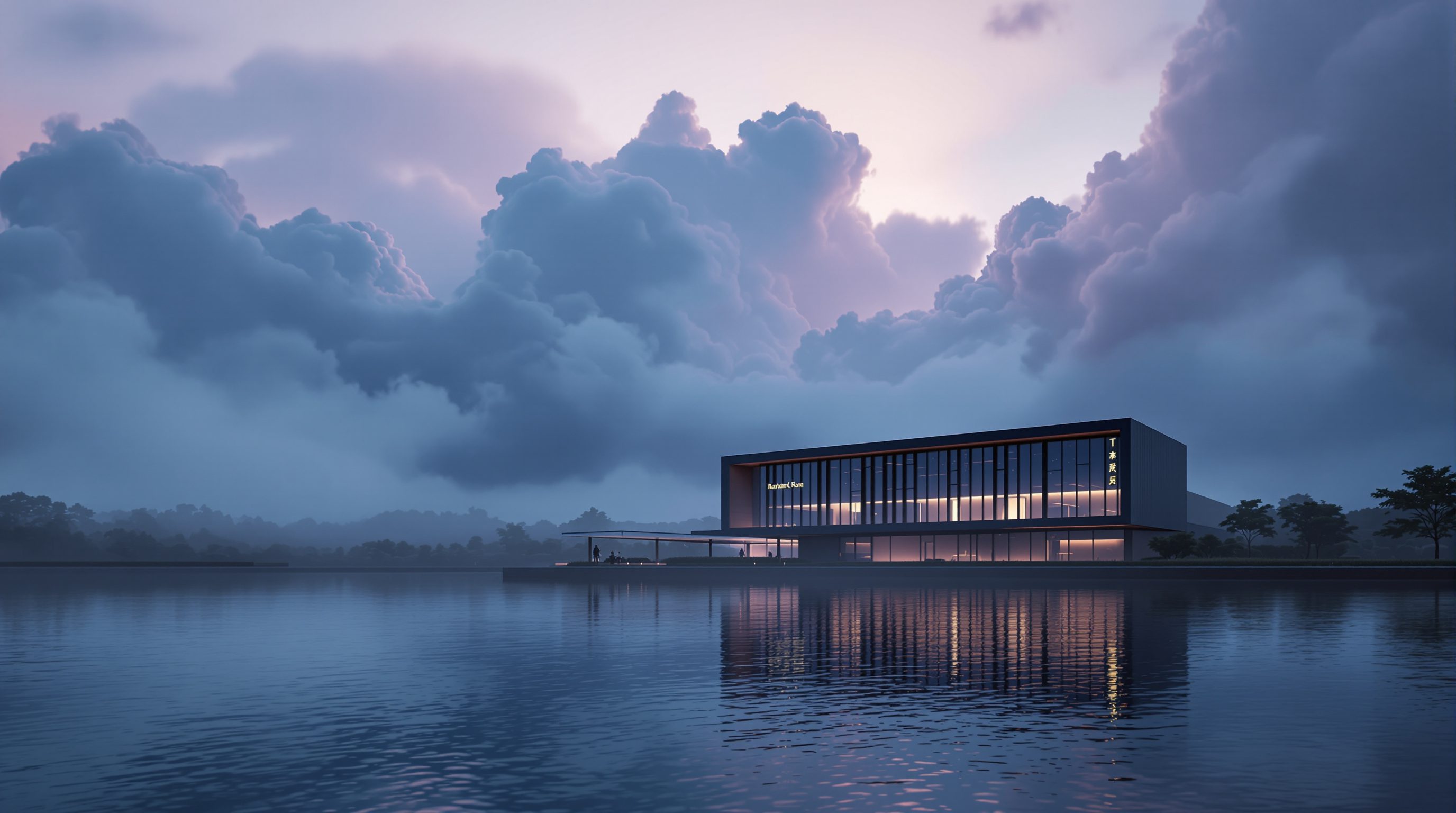
The final layer of context is not on the ground at all - it is the sky above the building and the water within the scene. These are what fix a design to a place and a time: a bright dry midday, a soft monsoon overcast, golden hour bleeding across a pool. Atmosphere is where a technically correct scene becomes an emotionally convincing one.
Unreal Engine 5 gives you a stack of systems for exactly this - a physically based Sky Atmosphere, volumetric clouds, fog, a Sky Light, and a full Water system for oceans, lakes, pools and rivers. Used together with the sun you set in Module 4, they let you dial the mood a design lives in.
Sky + water = mood, place, time. One sun drives the whole sky. Show the honest moment, not just the golden one.
The atmosphere stack: sky, clouds, fog and sun
A convincing sky in UE5 is not a painted backdrop - it is a small stack of systems that respond to the sun together. The base is the Sky Atmosphere component, a physically based model of how sunlight scatters through air (Rayleigh and Mie scattering). It is what makes the sky blue overhead, warm at the horizon, and deep orange at sunset - and crucially, it recomputes as you rotate the sun, so dawn, noon and dusk all come from one continuous system.
On top sit Volumetric Clouds - real, three-dimensional clouds the sun lights and casts through, that drift and can be shaped from thin haze to towering cumulus, rather than a flat cloud texture. Then Exponential Height Fog adds depth and air: haze that thickens with distance and toward the ground, plus volumetric god-rays where sunlight shafts through. Finally the Sky Light captures the sky's colour and bounces it into shadowed areas as soft ambient - the reason shadows outdoors are blue-ish, not black.
The sun tying it all together is a Directional Light - the same sun you set in Module 4's Sun, Sky & Daylight lesson. That is the point: sky and sun are one coupled system. Move the Directional Light and the atmosphere colour, the cloud lighting, the fog and the ambient all shift in concert, so a single rotation carries you from cool morning to golden evening. UE5's Environment Light Mixer panel gathers these actors in one place to set up quickly.
Each layer has a couple of dials worth knowing. On the Directional Light, ticking Atmosphere Sun Light is what links it to the Sky Atmosphere so the sun disc and colour track its angle; its intensity is measured in real lux, so a physically plausible midday sits far brighter than an overcast sky. Volumetric clouds expose coverage and density, letting you go from clear to stormy without swapping assets, though they are one of the heavier features on the frame. Height fog has a density and a start distance, plus an optional volumetric mode for true light shafts. And the Sky Light can be set to real-time capture so that as the sky and clouds change through the day, the ambient bounce it feeds into shadow updates with them rather than freezing at one moment.
Sky Atmosphere + Volumetric Clouds + Height Fog + Sky Light, all driven by ONE Directional Light (the sun from Module 4).
The Water system: oceans, lakes, pools and rivers
Water is one of the hardest things to fake and one of the most rewarding to get right - a reflective pool, a river through a site, the sea beyond a coastal house. UE5 ships a dedicated Water system that handles it as spline-driven bodies you draw directly in the level. There are three types: Water Body Ocean (an effectively infinite sea with waves), Water Body Lake (a closed spline for a pond or swimming pool), and Water Body River (a spline the water flows along, with flow speed and direction).
What makes the system powerful for architecture is that the water is aware of its surroundings. A body can carve the Landscape beneath it, automatically shaping banks, a river channel or a pool floor so land and water meet correctly rather than clipping. Waves, ripples and flow are animated for you, and the shoreline blends softly instead of showing a hard edge. Under the hood water uses a specialised shading model (Single Layer Water) that handles the tricky combination of surface reflection, refraction of what is below, and depth-based colour and opacity - shallow water clear, deep water darker.
Reflections are what sell water, and here the lighting chapter pays off: Lumen (Module 4) gives real-time reflections of the sky and surroundings on the surface, so a pool mirrors the building and the golden sky above it live as you move. Water is also a performance consideration - large reflective bodies are not free - so treat it like any other budget item and profile if a big ocean or many reflective surfaces start to bite.
A few knobs make or break the look. Depth and colour: architectural pools read best with a fairly shallow, clean look - tune the absorption and scattering so the water goes from clear at the edge to a soft blue-green over the floor, rather than an opaque cartoon turquoise. Wave settings: an ocean wants layered Gerstner waves for a believable swell, but a swimming pool should be nearly still - a common mistake is leaving big ocean waves on a domestic pool, which instantly looks wrong. Ripples and interaction: the system supports gentle surface ripples, and you can keep still water genuinely still. Underwater: the system also handles the post-process shift when the camera dips below the surface, which matters for a VR walk that steps down to a water's edge.
Weather and mood: choosing the moment
With sky and water in place you are really choosing a moment - and that choice is a design and communication decision, not just a technical one. Time of day sets emotional register: crisp midday reads as objective and factual, good for a planning submission; golden hour flatters materials and massing, good for a hero client image; overcast is soft, even and honest, good for showing true material colour without dramatic shadows; dusk with interior lights glowing sells warmth and occupancy.
Weather and season locate the building in the real world. A monsoon-heavy overcast with wet, darkened surfaces and reflective ground says something specific about a building in Mumbai; a hard bright dry-season sky says something else. Matching the atmosphere to the site's real climate - and, where it matters, showing more than one condition - is part of representing a design truthfully. Real-time makes this cheap: because sky, sun and fog are one coupled system, you can present the same design at dawn, noon and dusk in the same session, or animate a full day cycle, and let a client feel how their space changes through the day.
A caution on honesty: atmosphere is persuasive, and it is easy to let permanent golden hour and dramatic god-rays flatter a scheme into looking better than it will feel at a grey 3pm in February. Use mood to communicate the design's real character, not to disguise its weaknesses. The most trustworthy presentations show the flattering moment and the ordinary one, so a client makes a decision about the building rather than about the weather you chose for it. Because the whole coupled system switches in a click, offering that honest second view costs you almost nothing and buys a great deal of credibility.
Time of day = emotional register. Midday=factual, golden hour=hero, overcast=honest material, dusk=warmth. Show more than one.
Bringing the environment together
This module has built the world around the building in four layers, and atmosphere is where they fuse. Recall the stack: a Landscape on real contours (5.1), instanced foliage planting it (5.2), Megascans surfaces and props giving it grain (5.3), and now sky, water and fog setting its mood (5.4). None of these is decoration - together they are the difference between a floating object and a building that convincingly stands in a place, at a time, in weather.
A practical order of operations helps. Get the sun and Sky Atmosphere roughly right first, because everything is lit by them and you cannot judge materials or water under placeholder light. Add the Sky Light so shadows read correctly. Bring in clouds and fog to set depth and air. Then place water and let it carve the terrain and pick up Lumen reflections. Finally tune the moment - time of day, cloud cover, fog density - for the story each deliverable needs. Keep half an eye on performance throughout: volumetric clouds, big water bodies and heavy fog all cost frame time, and VR (Module 8) leaves little headroom, so profile as you go (Module 9).
That is the whole environment discipline: not adding effects for their own sake, but assembling a coherent, region-appropriate, honestly-lit context so the design can finally be judged as what it will be - a real thing in a real place. With the world built, the course turns next to directing it: cameras, the Sequencer and the architectural film.
Order: sun + sky first -> sky light -> clouds + fog -> water (carves terrain, takes Lumen reflections) -> tune the moment. Profile as you go.
Sky Atmosphere
Physically based scattering of sunlight through air
Blue overhead, warm horizon, orange sunset - recomputed as you rotate the sun. The base of a believable, time-of-day sky.
Volumetric Clouds & Height Fog
Real 3D clouds the sun lights; distance/ground haze
Clouds drift and cast; fog adds depth and god-rays. Both cost frame time - budget them, especially in VR.
Water system (Single Layer Water)
Spline-drawn ocean, lake/pool and river bodies
Animated waves and flow, carves the Landscape, handles reflection/refraction/depth. Large reflective water is a performance cost.
Directional Light + Sky Light
The one sun that drives the stack, plus ambient sky bounce
Same sun as Module 4. Move it and atmosphere, clouds, fog and ambient all shift together - one coupled time-of-day system.
Workshop - build a mood and a day cycle
You will assemble the full atmosphere stack, add a reflective pool with the Water system, then present the same design at three times of day - proving how much mood is set by sky and water.
Unreal Engine 5 (Sky Atmosphere, Volumetric Clouds, Exponential Height Fog, Sky Light, Water system, Environment Light Mixer). Lumen enabled for water reflections.
Goal: one design, three convincing moments, plus water
Inputs: Unreal Engine 5 with a building and a Landscape from earlier lessons
Time: ~55 minutes
- 1Add a Sky Atmosphere, a Directional Light (sun), a Sky Light and Volumetric Clouds - the Environment Light Mixer sets these up quickly. Rotate the sun and watch the whole sky respond from dawn to dusk.
- 2Add Exponential Height Fog and tune it until the scene has air and depth. Look for god-rays where the sun shafts through, and keep the density subtle.
- 3Using the Water system, draw a Water Body Lake as a swimming pool or a Water Body River across the site. Let it carve the terrain, and check the Lumen reflection of the building and sky on the surface as you move.
- 4Set up three saved conditions: crisp midday, golden hour, and an overcast or dusk mood - changing sun angle, cloud cover and fog. Capture a screenshot of the same view in each.
- 5Judge honestly: which moment flatters the design, which shows it most truthfully, and does the atmosphere match the site's real climate? Note the frame time cost of the clouds, fog and water.
You’ll walk away with
One scene presented at three times of day (midday, golden hour, overcast/dusk) with a working reflective water body, plus a short note on which moment is the honest one, whether the mood suits the real climate, and the frame-time cost of the atmosphere and water.
Three altitudes on the same idea
Read the band that fits you — or all three.
Atmosphere is how you communicate a building's real character - so choose the moment with intent. Midday for a factual planning view, golden hour for the hero image, overcast for honest material colour, a monsoon sky to locate a scheme in its real climate. Because sky and sun are one coupled system, you can walk a client through their design across a full day live. Just resist letting permanent golden hour flatter a scheme into dishonesty.
The sky outside sets the light inside. The colour and softness of daylight coming through the glass - crisp and blue at noon, warm at dusk, flat under overcast - is set by the Sky Atmosphere, Sky Light and fog, and it changes how every interior finish reads. A pool or water feature outside adds shimmering bounced light. Getting the exterior atmosphere right is often the fastest way to make an interior feel real.
Sky and water are where a scene tips from technical to beautiful - and where beginners over-egg it. Learn the coupled sky-and-sun system and the Water bodies, but taste is the skill: one well-judged time of day beats a scene drowning in god-rays and impossible turquoise water. Master a believable full-day cycle and honest weather, keep an eye on the frame cost, and your environment work will stand out for looking real, not gaudy.
“The sky in Unreal is basically a backdrop image, and water is just a shiny blue plane you drop in.”
Do it yourself
Reason these through - or test them in the editor.
- 1Name the four systems that make up a believable UE5 sky, and the one light that drives them all.
- 2Why does rotating a single Directional Light change the colour of the whole sky and the mood of the scene?
- 3What are the three Water Body types, and which would you use for a swimming pool?
- 4Give one way water in UE5 is aware of the terrain and lighting around it.
- 5How can a beautiful atmosphere make a visualization dishonest, and what is the fix?
The one line to carry out
Peer-reviewed journals & authoritative standards
- 01Daylighting — Wikipedia, 2026.
- 02Skybox (video games) — Wikipedia, 2026.
- 03Unreal Engine — Wikipedia, 2026.
- 04Rendering (computer graphics) — Wikipedia, 2026.
The world around the building is complete - ground, planting, surfaces, sky and water. Now the course turns to directing it: cameras, composition and the Sequencer that turn a walkable scene into an architectural film.
The author
Amogh N P
Architect, interior designer, and creative polymath. Studio Matrx began in his notebooks — his vision of design made honest, useful, and open to everyone. Its Academy is written and taught in his memory, and free, forever.
More about Amogh →