
 Lesson 5.3
Lesson 5.3 · Large-Scale Additive
Large-Format Additive
Big-area additive in polymers and composites - pellet extrusion, printed moulds and formwork, and the print-then-mill hybrid
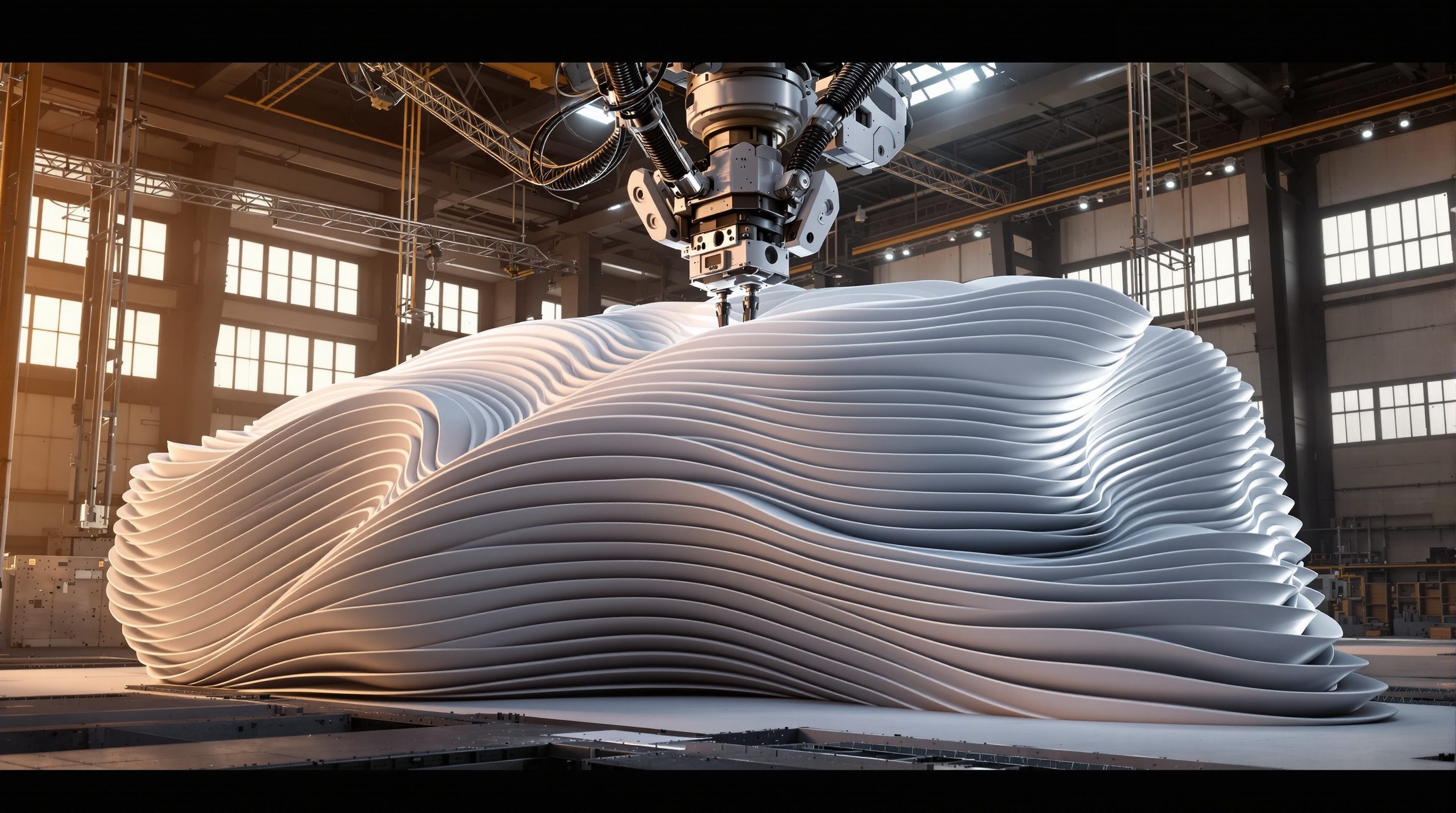
Forget grams of filament - large-format printers lay plastic by the kilogram, printing objects the size of a boat.
Everything so far has been wet - mortar, clay. Large-format additive is the dry, industrial end of the family: printers that extrude molten thermoplastic and composite in big, fast beads to make objects at furniture, mould and architectural scale. Boat hulls, car-body tooling, giant moulds, pavilions and stage sets come off these machines.
The unlock is the feedstock. Instead of thin filament on a spool, these printers melt cheap plastic pellets fed by the sack, so throughput jumps from grams to kilograms per hour. That changes the economics enough that large additive earns a real, if specific, place in a fabrication workflow - often working hand in hand with a milling cutter.
Plastic by the kilogram. The mould is the prize. Print near-net, mill the face. One-offs, not mass production.
Big-area additive in polymers and composites
Large-format additive manufacturing (LFAM, and the well-known BAAM systems from Oak Ridge and Cincinnati) is FDM's logic scaled up: melt a thermoplastic, extrude it in beads, build a part layer by layer - but with a build volume measured in metres and a bead measured in millimetres to centimetres wide. The materials are workaday industrial plastics: ABS, PLA, PETG, polycarbonate and nylon, very often reinforced with chopped carbon or glass fibre.
That fibre matters. A short-fibre composite is far stiffer and more dimensionally stable than neat plastic, and crucially it shrinks and warps less as the big part cools - warping is the enemy at this scale, because a metres-long part that curls as it cools is scrap. The fibre also aligns along the bead as it extrudes, so the printed part is anisotropic: strong along the beads, weaker across the layer lines - a property you design around, orienting the print so the beads run with the main loads. Large additive is not about fine detail; it is about getting a lot of stiff material into an approximate shape, fast. Thermal management is the quiet discipline behind it: a metres-long part cools unevenly, and if a lower region contracts while a fresh upper bead is still hot, the whole part can warp or delaminate. So these machines run in heated enclosures, pace the layers to control cooling, and lean on the fibre reinforcement precisely because it holds dimension while the mass cools. It is a very different feel from a small plastic print - closer to managing a large casting than tending a desktop printer.
FDM scaled to metres. ABS/PC/nylon + chopped carbon or glass. Anisotropic: strong along the bead.
Why pellets, not filament
The defining feature of these machines is the extruder. A desktop printer pulls filament - plastic pre-formed into a precise 1.75 or 2.85 mm strand on a spool - which is convenient but expensive per kilogram and slow to feed. Large-format printers instead use a pellet (granule) extruder: raw plastic pellets, the same cheap feedstock injection moulders buy by the tonne, pour into a hopper, and a turning screw melts and pushes them out through a wide nozzle, exactly like a plastic-extrusion or injection-moulding screw.
Two things follow. First, cost: pellets are a fraction of the price of filament, so printing a big part is affordable in a way it never is on filament. Second, throughput: a pellet screw can push several to tens of kilograms per hour, versus tens of grams on a desktop machine - orders of magnitude faster. The extruder is often mounted on a 6-axis robot arm or a large gantry, giving reach and, on a robot, the freedom to print non-planar. The trade-offs are honest: wide beads mean a coarse surface and low fine detail, and pellet feeding and melt control are fussier than filament. You buy speed and cheap material and pay in resolution - which is exactly why the next step is often a milling cutter.
Pellets: cheap by the sack, kilograms/hour. Pay in surface finish. Screw melt = injection-moulder logic.
Printing formwork and moulds at scale
The single most valuable job for large additive right now is not the final part - it is the tool that makes the final part. Moulds, formwork and jigs are expensive, one-off, geometrically complex objects, which is precisely the territory where additive beats conventional making.
Concrete formwork is the clearest case. A bespoke curved concrete panel traditionally needs a hand-built timber-and-plywood mould that is costly, slow and thrown away after one pour. Printing that formwork from composite - often printed near-net then milled to a smooth face - produces a reusable, dimensionally exact mould for complex geometry at a fraction of the labour, and it is being used for precast facade panels and freeform concrete. The same logic serves GFRC moulds, thermoforming and vacuum-forming tools, composite lay-up moulds, and casting patterns. Because a printed mould can be a hollow, ribbed shell rather than a solid block, it uses far less material and cools evenly. The mental shift is important: large additive frequently earns its place one step back from the visible product, making the tooling that shapes concrete, glass-reinforced composite or thermoset - a quiet but genuinely transformative role. The economics are compelling wherever a shape is complex and needed only a few times: a printed mould can be produced in days instead of the weeks a hand-built pattern takes, revised by editing a model rather than rebuilding a jig, and stored digitally so it can be reprinted if it wears. For a facade of dozens of subtly different curved panels - the kind of geometry parametric design produces easily and traditional formwork prices out - printed moulds can be the difference between the design being buildable and being value-engineered away.
The highest-value print is often the mould, not the part. Hollow ribbed formwork, milled smooth, reused.
The print-then-mill hybrid
Because pellet printing is fast but coarse, and milling is precise but slow (and wasteful cutting from solid), the two combine beautifully. In a print-then-mill hybrid you additively build the part near-net-shape - close to final, deliberately a few millimetres oversize - then switch to a milling spindle and subtractively machine the surfaces that need accuracy and finish to tolerance.
This is the best of both families and directly recalls the subtractive/additive framing from Module 0. Additive gets a lot of material into roughly the right shape quickly and cheaply, wasting almost nothing; milling then delivers the flatness, smoothness and dimensional tolerance additive cannot reach on its own. On the most integrated machines a single 6-axis robot swaps end-effectors - print head, then spindle - and does both in one setup, so the part never loses its reference position. It is the standard workflow for printed moulds and tooling, where the working face must be milled smooth to leave a good surface on the cast part. The lesson generalises: additive and subtractive are not rivals; the strongest large-scale workflows sequence them, each doing what it is best at.
Print near-net (fast, no waste) -> mill the faces that matter (accurate). One robot can do both.
Where large additive fits - and where it does not
Be clear-eyed about the niche. Large additive wins for one-offs and very short runs of big, geometrically complex objects: bespoke moulds and formwork, tooling and jigs, patterns, exhibition and stage pieces, furniture-to-architectural sculpture, boat and automotive prototypes. Its advantages are no tooling cost, freeform geometry, fast material deposition, and the ability to print with recycled and reinforced plastics.
It loses to conventional processes the moment quantity or finish dominates. For thousands of identical parts, injection moulding is vastly faster and cheaper per unit. For a smooth cosmetic surface straight off the machine, additive cannot match a moulded or machined finish without post-work. For pure strength-to-cost in a simple shape, cut or moulded stock wins. And the printed part is anisotropic and only as good as its inter-layer bond, so load-bearing use needs testing and engineering sign-off. The honest summary: large additive is a tooling-and-one-off technology that most powerfully makes the moulds, formwork and prototypes for other processes - not a replacement for mass production. Match it to that job and it is transformative; expect it to replace the factory and it disappoints. There is a sustainability angle worth naming honestly too: many LFAM systems run recycled and reclaimed thermoplastic, and some parts can be shredded and reprinted at end of life, which is a real circular-economy advantage over thermoset composites that cannot be remelted. But that only holds for the thermoplastics; fibre-filled and cross-linked materials are far harder to recycle, so the green claim, like everywhere in this module, depends on the specific material choice rather than the process alone.
Great for one-offs, moulds, tooling. Beaten by injection moulding on quantity, by milling on finish.
LFAM / BAAM
Large-format / big-area additive manufacturing
FDM scaled to metres; BAAM (Oak Ridge/Cincinnati) is the best-known system. Build volumes in metres, beads in centimetres.
Pellet (granule) extruder
Screw that melts raw plastic pellets
Cheap feedstock, kilograms per hour - the reason large additive is affordable and fast. Fussier melt control than filament.
Chopped-fibre composite
Plastic reinforced with short carbon or glass
Stiffer and lower-warp than neat plastic; makes the part anisotropic - strong along the beads, weaker across layers.
Near-net-shape
Printed close to final, deliberately oversize
The additive half of the hybrid - fast material deposition to roughly the shape, left for milling to finish.
Print-then-mill hybrid
Additive build, then subtractive finishing
Sequences the two families - fast cheap material, then milled accuracy and surface. Standard for moulds and tooling.
Workshop - specify a printed mould workflow
Most people never touch an LFAM machine, but any designer can reason about when large additive earns its place. This is a decision exercise: take a real complex object and plan whether and how large additive should make it - or its mould.
Notebook or sketch software - no machine required. (An LFAM printer, robot pellet extruder or hybrid mill-print cell in an advanced fablab or maker studio lets you build it for real, under supervision.)
Goal: decide where large additive fits versus conventional making, and design a print-then-mill plan
Inputs: a chosen complex object (a curved precast panel, a bespoke bench, a facade tile run), notebook or sketch tool
Time: ~35 minutes
- 1Pick an object and state its quantity, size, required surface finish and tolerance. These four numbers decide almost everything.
- 2Decide: print the part directly, print a reusable mould and cast/press many parts from it, or use a conventional process (injection moulding, timber formwork, machining from stock)? Justify the choice from your four numbers.
- 3If additive is right, sketch it as a hollow, ribbed shell rather than a solid block - and mark which faces are coarse-as-printed and which must be milled smooth (the print-then-mill split).
- 4Choose a bead orientation so the beads run along the main loads or the mould's working face, and note the anisotropy risk if they do not.
- 5Write a two-line honest verdict: what large additive buys you here (cost, geometry, speed) and what you give up (surface, tolerance, strength across layers) versus the conventional alternative.
You’ll walk away with
A one-page process decision: the four numbers, the make-versus-mould choice with justification, an annotated sketch showing the hollow-ribbed shell and the print-then-mill split, and an honest two-line verdict against the conventional alternative.
Three altitudes on the same idea
Read the band that fits you — or all three.
Large additive most likely reaches your project as formwork and moulds, not the finished surface. It makes reusable, dimensionally exact moulds for complex precast concrete and GFRC panels - freeform facade geometry that hand-built timber shuttering could never justify - often printed near-net then milled smooth. It also prints pavilions, installations and one-off elements directly. Design for anisotropy and coarse surfaces, and keep structural and cladding sign-off with your engineers and specialists.
This is how you get big, seamless, sculptural pieces in one shot - a reception desk, a bar front, a curved bench, a feature wall, a bespoke light sculpture - printed in metres of composite, often from recycled plastic. Expect a coarse, ribbed surface that is milled, filled, sanded or coated to finish, and design the form to run its beads with the loads. For anything visible and premium, budget for the post-processing that turns a rough print into a finished object.
Large additive is where the subtractive-plus-additive idea becomes a real workflow, so it is a great thing to understand even without access to a machine. Learn why pellets change the economics (kilograms per hour, cheap feedstock), why the highest-value print is often a mould rather than a product, and why print-then-mill beats either alone. Explaining that sequencing - and anisotropy, and when injection moulding wins - marks you out as someone who thinks in processes, not gadgets.
“Large-format 3D printing will replace conventional manufacturing - just print the big part directly.”
Do it yourself
No machine needed - reason it through.
- 1Why do pellet extruders make large additive affordable and fast where filament does not?
- 2What does chopped fibre do for a big print, and what does anisotropic mean here?
- 3Why is a mould often a more valuable thing to print than the final part?
- 4Explain the print-then-mill hybrid and what each step contributes.
- 5Name one job large additive wins and one where injection moulding or milling beats it.
The one line to carry out
Peer-reviewed journals & authoritative standards
- 013D printing / additive manufacturing — Wikipedia, 2026.
- 02Composite material — Wikipedia, 2026.
- 03Molding (process) — Wikipedia, 2026.
- 04Gramazio Kohler Research - Digital fabrication in architecture — ETH Zurich, 2026.
Concrete, clay and polymer all share one deep constraint we have kept circling: everything is built up in layers, and the layer decides what is possible. The final lesson makes that constraint the subject - how layer logic limits and shapes what you can print, and how to design with it rather than against it.
The author
Amogh N P
Architect, interior designer, and creative polymath. Studio Matrx began in his notebooks — his vision of design made honest, useful, and open to everyone. Its Academy is written and taught in his memory, and free, forever.
More about Amogh →