
 Lesson 10.2
Lesson 10.2 · Practice, Ethics & Career
Industry 4.0 & Construction Robotics
The same technologies at the scale of a whole economy and a whole building site
The laser cutter and the robot arm are not just fablab toys. They are the small end of a shift reshaping how everything gets built.
Everything this course has taught - files driving machines, robots as general-purpose tools, mass customisation - is also happening at the scale of whole industries. Economists call the broad wave Industry 4.0: the fusion of digital models, automation, sensing and data across manufacturing. Construction, the biggest and slowest-moving of the physical industries, is being pulled into it too.
This lesson zooms out from the workshop to the economy. It is also the course being honest with you: there is real, exciting progress in prefabrication and construction robotics - and there is a great deal of hype. Knowing the difference is part of being a serious maker.
Off-site is winning; on-site is hard. DfMA is the skill; hype is the trap.
What Industry 4.0 means
Industry 4.0 - the so-called Fourth Industrial Revolution - is shorthand for the current wave of industrial change, in which physical production fuses with digital models, automation, connected sensors and data. If the first revolution was steam, the second mass production, and the third early computers and automation, the fourth is the one where the model, the machine and the data close into a loop: designs are digital end to end, machines are connected and instrumented, and the data they produce feeds back to improve the next run. Its building blocks are exactly the things this course has covered - digital models (BIM and parametric design), CNC and robotic automation, sensors and the Internet of Things, and data, analytics and digital twins.
The term itself was coined in Germany around 2011 as a manufacturing strategy, and the framing is useful precisely because it is honest about what is new. Nothing in the list - models, robots, sensors, data - is individually novel; what is new is the integration, the closing of the loop so that a design, the machines that make it, the sensors that watch them and the data that improves the next run all speak to each other. That integration is the whole game, and it is exactly the direction every earlier module of this course has been pointing: from the file-to-factory chain, through CAM and toolpaths, to sensing and adaptive fabrication and digital twins.
The reason it matters for a designer is that digital fabrication is Industry 4.0 at human scale. The laser cutter you book in a fablab and the instrumented robot cell in a car factory are the same idea at different sizes: a file drives a machine, and increasingly the machine reports back. When you understand the file-to-factory chain, you already understand the core of Industry 4.0. What changes at industrial scale is the stakes - the capital, the volumes, the consequences of getting it wrong - and, in construction specifically, the difficulty, because unlike a car plant a building is a one-off, made outdoors, at enormous scale, by many trades at once.
Industry 4.0 = model + automation + sensing + data, closed into a loop.
Prefabrication and DfMA - designing to be assembled
The most consequential idea construction has borrowed from manufacturing is DfMA - Design for Manufacture and Assembly: designing a building from the outset so its parts can be efficiently made in a factory and efficiently put together on site. It is the building-scale sibling of the design-for-fabrication thinking from Module 1 - the same discipline of designing with the production process in mind, scaled up from a component to a whole building. Instead of drawing a building and then working out how to build it, you design it as a kit of manufacturable, assemblable parts.
That kit gets made through prefabrication, along a spectrum. At the light end, components - trusses, wall panels, bathroom pods - are made in a factory and delivered. At the heavy end, volumetric modular construction builds whole finished room-boxes, complete with services and finishes, that are craned into place and stitched together. The advantages are real: factory conditions are dry, lit, level and repeatable, so quality is higher and more consistent, waste is lower, and much of the programme runs in parallel - the factory builds modules while the site pours foundations. The trade-offs are equally real: heavy transport and craneage, less design flexibility once the kit is fixed, and the need to decide the whole system very early.
The design consequence is that DfMA pushes decisions forward. In conventional practice a lot gets resolved late, on site, by negotiation; in a prefabricated project the module has to be fully worked out before the factory tools up, because a change after that is expensive or impossible. That rewards buildings with repetition - hotels, student housing, hospital wards, apartment blocks, where the same room recurs hundreds of times - and it rewards a designer who thinks in grids, tolerances, connections and assembly sequence from the first sketch. It is less forgiving of the highly bespoke one-off, though the mass-customisation logic of Module 9 is steadily softening even that limit, letting a prefabricated kit carry controlled variation instead of dumb repetition.
DfMA is design-for-fabrication at building scale: kit of parts, made then assembled.
Off-site and on-site robots - two very different jobs
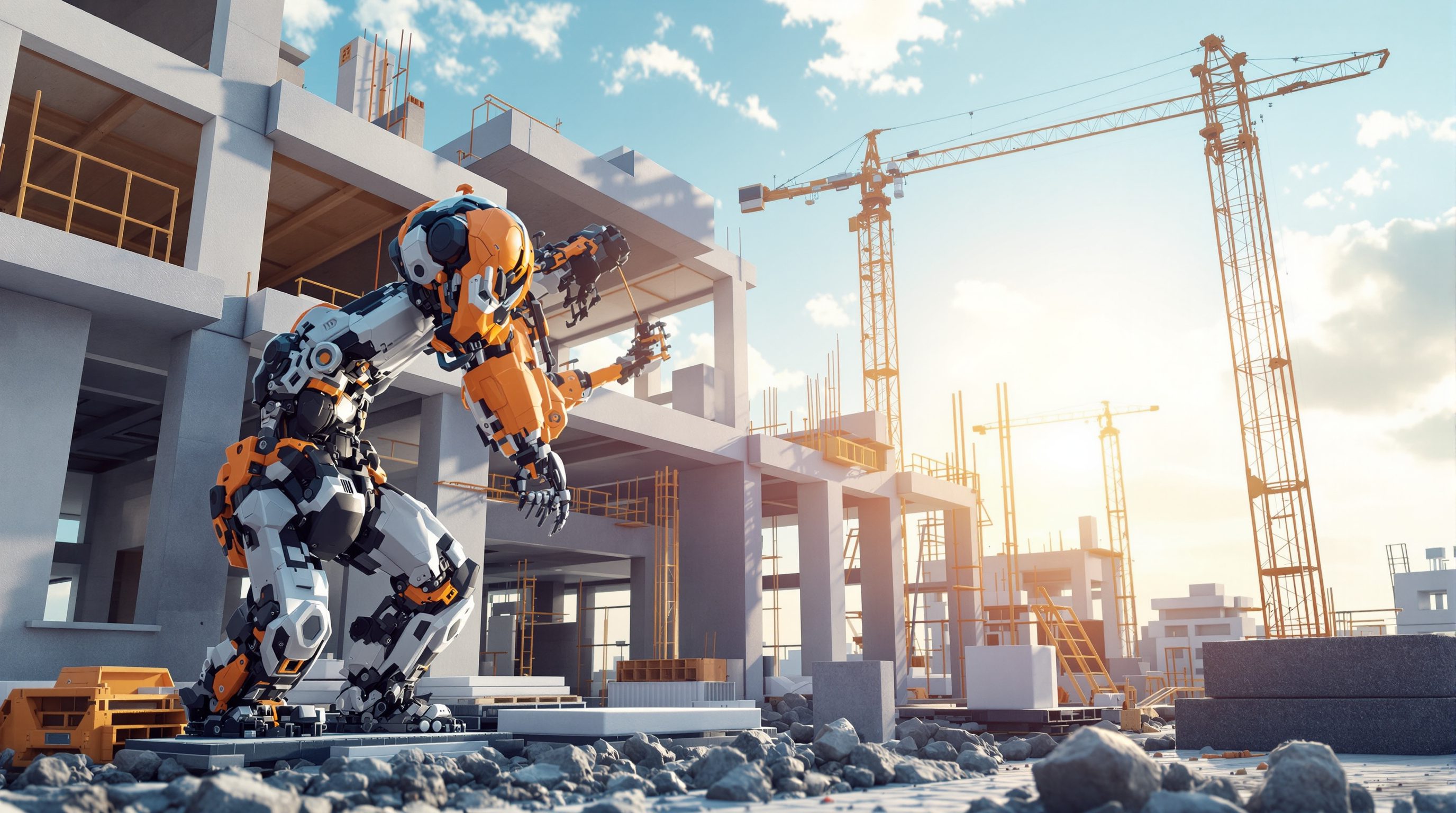
Construction robotics splits cleanly by where the robot works, and the two places are worlds apart. Off-site, in a factory, is where robots do best: it is a controlled, repeatable, indoor environment - essentially a manufacturing plant - so robot cells can weld steel, nail timber frames, place panels and run DfMA lines with the precision and consistency they show in any factory. This is where most real construction automation genuinely lives today, and it is advancing steadily.
On-site is the hard problem. A building site is open, messy, weather-exposed, cluttered and constantly changing - close to the opposite of the tidy, known world a robot wants. On-site machines therefore tend to be either specialised (a bricklaying arm that lays courses faster than by hand, an autonomous rover that prints layout lines on a slab, a rebar-tying or drilling robot) or large-format additive (the concrete 3D printers from Module 5, extruding walls in place). Even the best of these mostly assist human crews on narrow, repetitive tasks rather than replacing them; people still lead the site. The honest summary: off-site automation is maturing fast; general on-site robots remain genuinely difficult and largely experimental.
There is a third category worth naming: robots that measure and monitor rather than build. Autonomous rovers and drones that scan a site, compare it against the BIM model and flag deviations are among the most useful and most deployable construction robots today, precisely because sensing is easier than manipulation in a chaotic environment. This is the digital-twin idea from Module 9 arriving on the building site - the physical work stays largely human, but the data layer becomes automated and continuous. It is a reminder that automation in construction is not only about a machine doing the lifting; often the highest-value robot is the one that simply keeps the model and the reality honestly in sync.
Factory = robot-friendly. Site = robot-hostile. That gap explains almost everything.
Where the building industry is actually heading
The honest state, stripped of both hype and cynicism: construction is the least-digitised of the world's major industries, and its productivity has barely moved in decades - which is precisely why Industry 4.0 has so much room to change it, and precisely why change is slow. The direction of travel is fairly clear. More work moves off-site, into factories where automation pays off, and the building site becomes more of an assembly yard for prefabricated parts. BIM and digital models become the connective tissue, so the same data drives design, factory machines and logistics. On-site robots grow task by task - layout, bricklaying, demolition, inspection drones - rather than arriving as a single humanoid that builds a house.
Be sceptical of the headline version. "Robots will build our houses" and "we will just 3D-print cities" are, for now, marketing. The reality is less cinematic and more valuable: incremental, industry-wide digitisation that slowly makes building more precise, less wasteful, safer and more predictable. As a designer, your leverage is upstream - in DfMA thinking, in designing buildings that are genuinely manufacturable, and in understanding the factory and the robot well enough to design for them. That is a real and growing skill set. Believing the hype is not.
Hold both truths at once and you will read this field correctly for the rest of your career: construction genuinely is digitising, and it genuinely is slow, and neither the boosters nor the cynics have it right. The mistake to avoid is treating a lab demo or a single printed house as the industry - and the opposite mistake is dismissing a real, if gradual, structural shift. Somewhere between the render and the shrug is the honest picture, and a designer who can hold it is worth listening to.
Not robots-build-houses. More off-site, more data, more precision, slowly. That is the real story.
Industry 4.0
The current fusion of digital models, automation, sensing and data
The Fourth Industrial Revolution; digital fabrication is its human-scale version. Construction is the slowest major industry to adopt it.
DfMA (Design for Manufacture and Assembly)
Designing a building to be efficiently made and assembled
Design-for-fabrication at building scale; the discipline of designing a building as a kit of manufacturable, assemblable parts from the outset.
Prefabrication / volumetric modular
Making building parts, up to whole rooms, off-site
Spans from panels and pods to finished room-boxes craned into place; buys quality and speed, costs flexibility and transport.
On-site construction robot
A machine performing a task on the building site itself
Bricklaying arms, layout rovers, rebar and concrete-printing robots; mostly specialised and assistive - the site is a hostile environment for automation.
Workshop — separate the progress from the hype
The professional skill this lesson builds is calibrated judgement about construction automation. You are going to interrogate one real technology and one hyped claim, and learn to tell them apart with evidence.
Internet and a notebook. No machine required - this is a judgement exercise, and judgement is the deliverable.
Goal: build an honest, evidence-based read on construction robotics
Inputs: internet, a notebook, this lesson
Time: ~35 minutes
- 1Pick one on-site construction technology that genuinely exists - a bricklaying robot, an autonomous layout rover, a rebar-tying robot, or a concrete 3D printer. Find two real projects that used it and note what it actually did versus what humans still did around it.
- 2Now take one hyped headline you can find (a 'robots will build all our houses' or 'we will 3D-print cities' claim). List what it promises and what it quietly leaves out - cost, scale, materials, code approval, the site environment.
- 3For your real technology, write down the honest trade-offs: where it helped (speed, safety, precision) and where it struggled (setup, flexibility, the messy site). Off-site or on-site - which was it, and why does that matter?
- 4Draw the off-site/on-site line for a small building you know: which parts could sensibly be prefabricated in a factory, and which must be built in place? Justify each split.
- 5Write a two-sentence honest verdict a client could trust: what construction robotics can do for their project today, and what is still a promise.
You’ll walk away with
A one-page honest brief: one real on-site technology with two projects and its trade-offs, one hyped claim debunked, and a two-sentence verdict you would give a client.
Three altitudes on the same idea
Read the band that fits you — or all three.
DfMA is becoming a core design competency, not a contractor afterthought. If more of your building is made off-site as a kit of parts, the assembly logic has to be in the design from day one - grids, tolerances, connections, sequence. Understanding prefabrication and construction robotics lets you design for them deliberately, and to tell a client the honest difference between what a factory can deliver now and what is still a render.
Prefabrication is already reshaping fit-out. Bathroom pods, prefabricated service walls, factory-made joinery runs and modular partitions arrive on site finished, on the same DfMA logic as the structure. Knowing how off-site manufacture works - its precision, its early-decision demands, its transport limits - lets you specify prefabricated interior elements confidently and coordinate them with what still gets built in place.
This is the industry you are about to enter, so read it clearly. The exciting frontier is real but narrow; the durable, employable skill is DfMA thinking and understanding off-site manufacture. Learn to separate genuine progress (off-site automation, BIM-driven data, task-specific site robots) from hype (humanoids building houses tomorrow). Graduates who can talk about construction automation honestly, not breathlessly, stand out to serious practices.
“Robots and 3D printers are about to take over construction - soon whole houses and even cities will just be printed and built by machines.”
Do it yourself
No machine - think like an economist and a maker.
- 1What are the four building blocks of Industry 4.0, and how is digital fabrication related to it?
- 2What does DfMA stand for, and how does it relate to design-for-fabrication?
- 3Why is off-site (factory) work so much more robot-friendly than on-site work?
- 4Give two honest advantages and two honest trade-offs of volumetric modular construction.
- 5In one honest sentence, where is the building industry actually heading?
The one line to carry out
Peer-reviewed journals & authoritative standards
- 01Fourth Industrial Revolution (Industry 4.0) — Wikipedia, 2026.
- 02Construction robot — Wikipedia, 2026.
- 03Design for manufacturability — Wikipedia, 2026.
- 04Construction 3D printing — Wikipedia, 2026.
You now see digital fabrication from the fablab bench to the building site. The last question of the course is personal: how do you show what you can do, and build a life around it? Next, the fabrication portfolio.
The author
Amogh N P
Architect, interior designer, and creative polymath. Studio Matrx began in his notebooks — his vision of design made honest, useful, and open to everyone. Its Academy is written and taught in his memory, and free, forever.
More about Amogh →