
 Lesson 4.4
Lesson 4.4 · Twinmotion & Enscape
Entourage: Vegetation & People
Asset libraries, believable scale, and the 'fewer and quieter' rule
An empty render reads as a model. Add two well-placed people and it reads as a place.
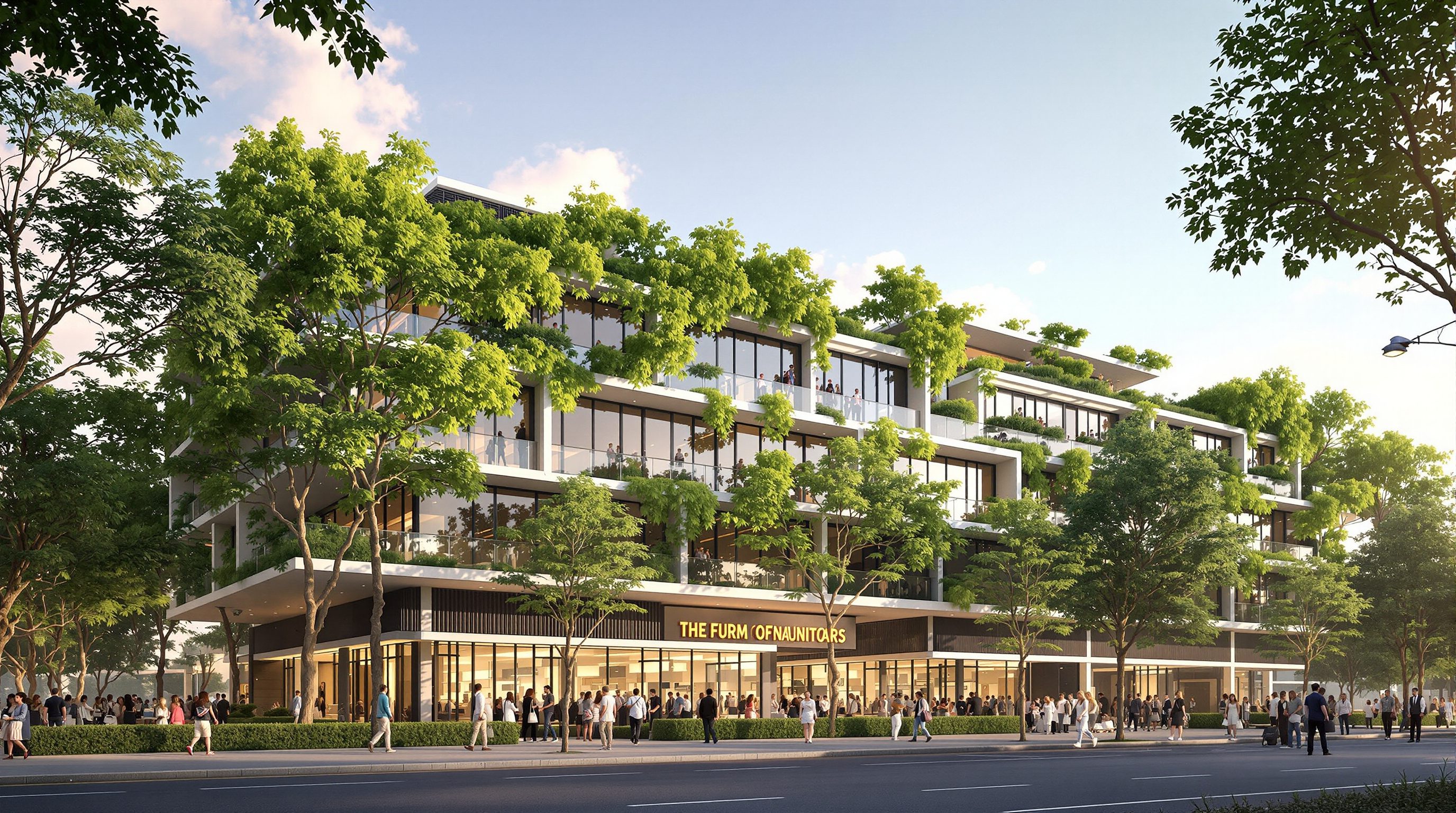
Entourage - the people, plants, cars and props you add around a design - is what turns a lit, materialised model into a believable inhabited world. It gives the eye scale, tells a story about how the space is used, and adds the small imperfections and life that read as real.
But entourage is also where a good render most often goes wrong. Wrong scale, people staring at the camera, a jungle of plants, or a crowd that buries the building - each undoes the work of everything before it. The craft is restraint and rightness, not quantity.
Entourage is seasoning, not the meal. Enough to bring out the architecture - never so much you taste only it.
What entourage is, and where it comes from
Entourage is the collective name for everything you place around and inside a design to bring it to life: people, trees, shrubs, grass, cars, furniture, and small props like cups, books and bicycles. None of it is the architecture, and that is exactly the point - entourage is the context that makes the architecture legible as a place people use rather than an abstract object floating in a void.
It does three jobs at once. It gives scale: a single person tells you instantly how tall a door is, how wide a corridor runs, how big a plaza feels - information a bare model cannot convey. It tells a story: a coffee cup and an open laptop say 'someone works here'; children and a dog say 'this is a family home'; a busy pavement says 'this is a lively street'. And it adds life and imperfection, the messy human traces that separate a photograph of a real place from a sterile CG model.
The good news is you rarely have to make any of it. Real-time engines ship with large built-in asset libraries - Twinmotion's is extensive and boosted by Epic's game content, and Enscape provides its own asset library too - full of drag-and-drop people, plants, vehicles and props, many already animated or posed. Beyond the built-ins there are dedicated entourage libraries and free sources for models and textures. The skill, then, is almost never sourcing the assets - it is choosing and placing them well. The rest of this lesson is about exactly that judgement, because the same library can produce a believable scene or a ruined one depending entirely on how it is used.
Entourage = people, plants, cars, props. Not the building - the context that proves it's a place.
Scale is everything
If entourage has one non-negotiable rule, it is correct scale. The entire reason a person or a car reads as believable is that your eye knows how big those things are in the real world and uses them to measure the space. Get the scale right and the whole image snaps into a readable size; get it wrong and you break the illusion instantly, no matter how good everything else is. A person who is subtly too tall, a car that is toy-sized, a tree that dwarfs a three-storey building - each is a jarring tell that something is off, even to a viewer who cannot say why.
The anchors are worth carrying in your head. An adult stands roughly 1.7 metres tall; a door is about 2 metres; a car is around 1.5 metres tall and 4 to 5 metres long; a mature street tree might reach 6 to 12 metres. Because the well-made assets in a good library are already modelled to real-world size, most scale errors do not come from the asset - they come from placement: dropping a person onto the wrong level so they appear to float or sink, or importing a model at the wrong units so it arrives ten times too big or too small. So the discipline is to trust correctly-scaled library assets, place them on the actual ground plane, and sanity-check every addition against a known reference - usually a standing figure. If a person next to your object looks wrong, either the person or the object is the wrong size, and you have caught a scale bug before it reaches a client. Scale is also why a single human figure is the most valuable entourage element of all: it is both life and a ruler.
Placing people and cars believably
People are the highest-risk, highest-reward entourage, because human viewers are exquisitely sensitive to other humans and notice instantly when one looks wrong. A few principles keep them convincing. Never let a person stare straight at the camera - real people in a candid photograph are absorbed in what they are doing, so pose figures walking, sitting, talking, looking at the view, working; a row of figures facing the lens looks like a catalogue and destroys the documentary feel. Match people to the programme: office workers in an office, families in a home, students on a campus, shoppers on a high street - the wrong crowd tells the wrong story. Vary them - different ages, heights, clothing, poses - because repeated identical figures read as clones and instantly signal 'CG'. And mind the render style: photoreal 3D people suit a photoreal render, while cut-out or stylised silhouette figures can suit a more conceptual or diagrammatic image; mixing the two jarringly usually backfires.
Cars follow the same logic. Use them to show that a street or driveway is used, but keep them appropriate and understated - a sensible mix of ordinary vehicles rather than a showroom of supercars that pulls the eye away from the building. Park them plausibly, in bays and along kerbs, not scattered at odd angles. Consider the region and era so the cars belong to the place. And as with people, a little motion helps - a car mid-turn, a cyclist mid-pedal - because real streets are rarely frozen. The unifying idea is that people and cars should feel incidental, caught rather than posed: the moment they look arranged for the render, they stop selling the place and start advertising the software.
Vegetation: real plants for a real place
Vegetation does an enormous amount of work in exterior renders - it softens hard architecture, adds colour and life, and grounds a building in a landscape - but it is also easy to overdo or get subtly wrong. The first rule is appropriateness: use plant species that actually belong to the building's climate and region. Palms in a temperate courtyard, or lush tropical planting around a desert house, read as false to anyone who knows the place, and increasingly to everyone. A good library lets you pick real species; choosing ones native or plausible to the site is a small effort that pays off in credibility.
Beyond species, a few habits keep planting believable. Vary size, type and health - real planting is a mix of mature and young, tall and low, and never a uniform wall of identical bushes; monotony is the giveaway. Mind the season and colour: a render is a moment in time, so a spring-green tree, an autumn one, or a bare winter branch each set a different mood and should match the story and the light you have chosen. Avoid the too-green, too-perfect look - real foliage has variation, some brown, some gaps, and a slightly de-saturated, less-than-neon green almost always reads as more real. Let planting behave naturally: a gentle wind animation, plants growing from beds and verges rather than hovering, and grass that meets paving at a believable edge. And use vegetation compositionally - a tree can frame a view, soften a harsh corner, or lead the eye - but keep it in service of the architecture. Which brings us to the rule that governs all entourage.
Right species, right season, not-too-green. A few varied plants beat a wall of identical perfect bushes.
The 'fewer and quieter' rule
The single most useful principle for entourage is one of restraint: fewer and quieter almost always beats more and louder. The purpose of entourage is to support the architecture - to give it scale, life and story - not to compete with it. The moment a render is crowded with people, packed with props and choked with planting, the eye no longer knows where to look, the building recedes behind the clutter, and the image reads as busy and amateur. A handful of well-chosen, well-placed elements does the job better than a crowd.
Concretely, restraint means several things. Use the fewest elements that tell the story: two or three people can make a plaza feel used far more elegantly than fifty. Keep entourage quiet in tone - understated clothing, ordinary cars, calm planting - so nothing shouts for attention or dates the image with a loud fashion or a flashy vehicle. Respect the focal point: place entourage to lead the eye toward the architecture and the shot's subject, not away from it, and keep the hero areas of the composition relatively clear. And remember that empty is sometimes right - a pure, unpeopled architectural shot can be exactly the correct choice for a certain mood, and is far better than one cluttered with awkward figures. The professional instinct is to add the minimum that makes the space feel inhabited, then stop. Entourage is seasoning, not the meal: enough to bring out the flavour of the architecture, never so much that you taste only the seasoning. Master that restraint and your renders will look considered and confident - which, in the end, is what makes them believable.
Asset library (Twinmotion / Enscape)
Built-in people, vegetation, vehicles and props
Drag-and-drop, mostly real-world scaled and often animated. Sourcing is rarely the problem - choosing and placing well is the skill.
Human figure as scale reference
A ~1.7m person used to gauge and check size
The most valuable single entourage element: both life and a ruler. Use one to sanity-check the scale of everything else.
Species-appropriate vegetation
Plants matched to the climate and region
Wrong-climate planting reads as false; vary size, type, health and season, and avoid the too-green, too-perfect look.
Posed / animated people
Figures walking, sitting, working - not facing the camera
Candid, varied, on-programme figures sell the place; camera-staring clones destroy it.
The fewer-and-quieter rule
Restraint as the governing principle of entourage
The fewest, quietest elements that tell the story; entourage supports the architecture and must never bury it.
Workshop - populate a scene with restraint
You will dress one scene twice - once over-populated, once with restraint - to feel exactly how 'fewer and quieter' beats 'more and louder', and to lock in scale and placement habits.
Twinmotion or Enscape with its asset library, and one lit scene from a linked host model. Optional extra assets from a free entourage source. No paid content required.
Goal: learn entourage judgement by comparing too-much with just-enough
Inputs: Twinmotion or Enscape + a lit exterior or interior scene, and access to the asset library
Time: ~50 minutes
- 1Take your lit scene and first OVER-populate it on purpose: many people (some facing the camera), lots of cars, dense planting, piles of props. Render a still - this is your 'too much' control.
- 2Now strip it right back. Keep only the fewest elements that tell the story - two or three people, one or two vehicles if needed, a few varied plants. Pose every person doing something, none staring at the lens.
- 3Fix scale deliberately: place a 1.7m figure and check every object against it. Make sure people stand on the ground plane, plants grow from the ground, and nothing floats or sinks.
- 4Check appropriateness: are the people right for the programme, the cars sensible and regional, the plants plausible for the climate and season? Adjust anything that tells the wrong story.
- 5Render the restrained version from the same camera and compare the two side by side. Write three lines on what the restrained image gained by having less.
You’ll walk away with
Two renders of one scene from the same camera - an over-populated version and a restrained one - with a short written comparison showing why 'fewer and quieter' won on scale, story and focus.
Three altitudes on the same idea
Read the band that fits you — or all three.
Entourage is how you show a building being used, not just standing there. Choose people and activity that match the brief - workers in the workplace, families in the housing, a plausible street life - so the render argues that the design works socially, not only formally. Keep it restrained and on-programme; a quiet, well-peopled scene reads as considered, while a crowd reads as a stock-photo pile-up.
In interiors, entourage is the styling that makes a room feel lived-in. A throw, a couple of books, a coffee cup, a single figure reading by the window - these props tell the story of the life the room is designed for, exactly as staging sells a home. Use the fewer-and-quieter rule ruthlessly: an interior is easily over-propped, and one considered vignette beats a cluttered set.
Good entourage is one of the fastest ways to lift student renders, and bad entourage one of the fastest ways to sink them. Nail scale first - one correctly-placed 1.7m figure - then pose people naturally, choose plausible plants, and above all keep it minimal. Examiners immediately spot clone-people, camera-starers and jungle planting; a restrained, believable scene signals real judgement.
“The more people, plants and props I add, the more alive and realistic my render will look.”
Do it yourself
Think it through before you place a single asset.
- 1What three jobs does entourage do for a render?
- 2Roughly how tall is an adult figure, and why is that number so useful?
- 3Give two rules for placing people so they read as believable.
- 4Why should vegetation be chosen to suit the building's climate and region?
- 5State the 'fewer and quieter' rule in your own words.
The one line to carry out
Peer-reviewed journals & authoritative standards
- 01Twinmotion - Official Documentation — Epic Games, 2026.
- 02Enscape - Documentation & Knowledge Base — Enscape (Chaos), 2026.
- 03Poly Haven - free HDRIs, textures and models — Poly Haven, 2026.
- 04ambientCG - free PBR materials — ambientCG, 2026.
You can now take a model into a real-time engine, keep it honestly linked, light it and bring it to life. That completes the real-time core - next, the atmosphere-and-speed specialists Lumion and D5 push the same ideas further.
The author
Amogh N P
Architect, interior designer, and creative polymath. Studio Matrx began in his notebooks — his vision of design made honest, useful, and open to everyone. Its Academy is written and taught in his memory, and free, forever.
More about Amogh →