
 Lesson 10.2
Lesson 10.2 · Practice & Portfolio
Developing a Visual Signature
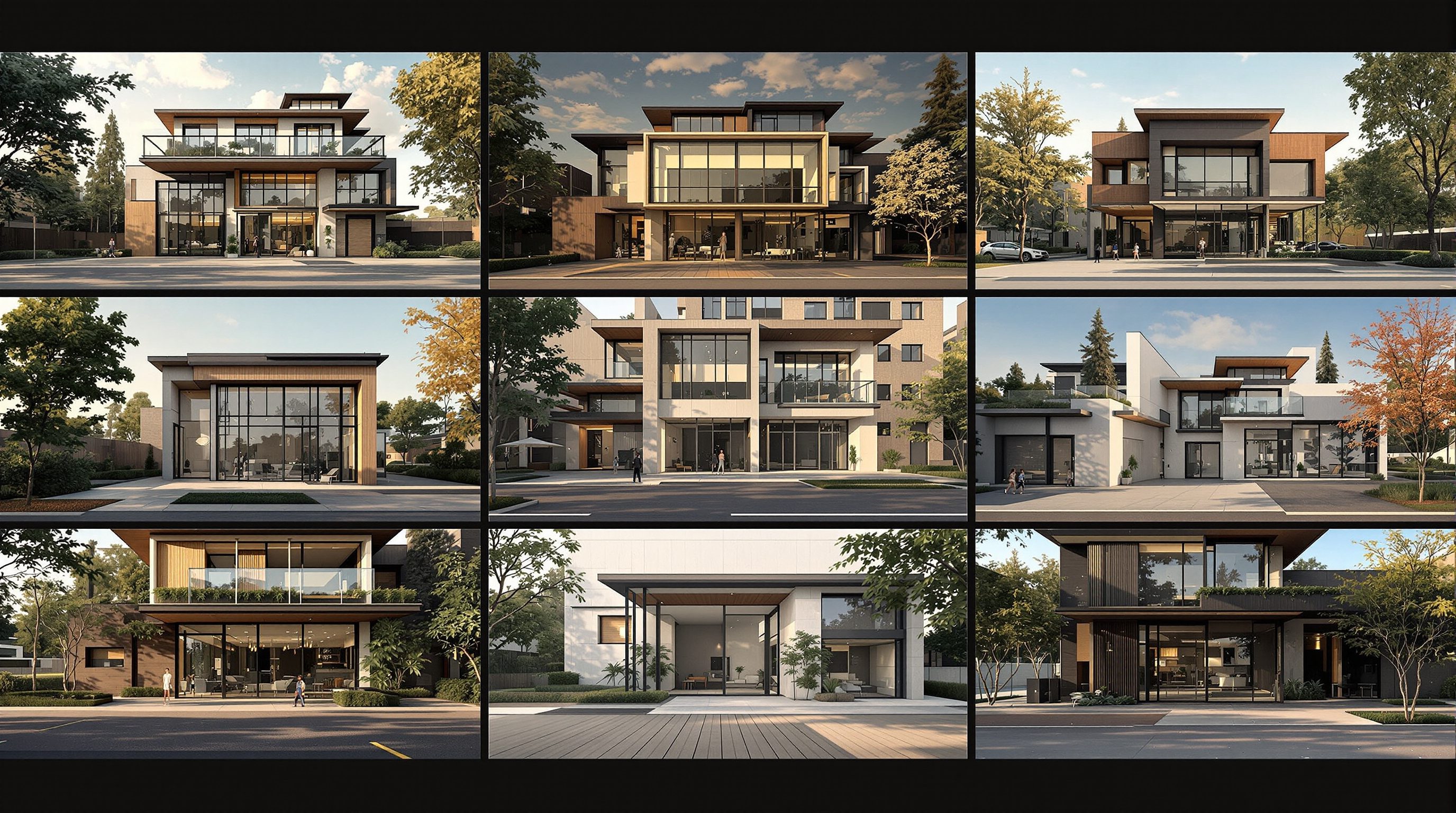
Consistency as a fingerprint - palette, light, framing, mood and post held steady until people recognise your work
Anyone can make one good image. A signature is when someone can name your work before they see your name.
You can now light, texture, frame and finish a believable render. The next thing that separates a working visualizer from a competent one is a visual signature - a look that is recognisably yours across every image you make.
A signature is not a preset or a filter. It is the accumulation of consistent choices: the palette you keep reaching for, the light you love, the way you frame, the mood you return to, the grade you apply. Held steady long enough, those choices stop being decisions and become a fingerprint - and that fingerprint is what wins repeat clients and a studio's attention.
Notice what you keep reaching for. Sharpen it. Repeat it. That is your signature - not a filter you downloaded.
A signature is consistency, not novelty
The word 'style' misleads beginners into chasing novelty - a wild new look for every image, a different filter each time. Real signatures work the opposite way. They come from consistency: the same small set of choices, made the same way, across a whole body of work, until a viewer can recognise the hand behind it. Think of a photographer whose images you can spot instantly - it is almost never because each one is surprising, but because the palette, the light and the framing are unmistakably theirs, image after image.
What actually carries a signature is five repeatable dials, all of which this course has already taught you individually. Palette - the colours you gravitate to, the warmth or coolness, the muted or saturated register. Light - do you love low raking golden hour, flat overcast calm, or dramatic low-key contrast? Framing - your habitual focal length, height, symmetry or looseness. Mood - the emotional register you return to, whether serene, cinematic, warm-domestic or austere-modern. And post - the grade, the contrast curve, the grain and atmosphere you finish with. A signature is simply these five held steady while the subject changes.
The practical consequence is liberating: you do not need to invent a style, you need to notice and commit to your leanings. Most people already have preferences pulling at every project - a warmth they keep adding, a frame they keep choosing. The amateur fights these, treating each image as a blank slate; the professional recognises them, sharpens them, and applies them on purpose until they cohere. Consistency is not a limitation on creativity. It is the thing that makes a collection of images read as a single authored voice rather than a pile of unrelated experiments.
Five dials - palette, light, framing, mood, post. Hold them steady across many images. That steadiness IS the style.
References and study: how a signature is trained
No signature appears from nowhere - every distinctive visualizer built theirs by absorbing the work they admired, then metabolising it into something their own. The engine for this is a deliberate study loop, and it is worth building as a lifelong habit rather than a one-off exercise.
It starts with collecting references, not passively scrolling but building a curated board of images that genuinely move you - photographs, films, paintings and renders alike. Over time patterns emerge from what you saved, and those patterns are the first honest sketch of your own taste: you will notice you keep saving warm interiors, or high-contrast exteriors, or a particular kind of quiet. The board is a mirror. Then comes the crucial step most people skip - dissection. Take a single reference you love and take it apart with the language this course gave you: where is the light coming from and how soft is it, what focal length and height is the camera, what is the palette doing, how is it graded, what is the mood and how is it built? You are reverse-engineering the choices, not admiring the result.
Next you rebuild - recreate that look in your own scene, with your own model, chasing the same light and grade until you can produce the feeling on demand. This is where understanding turns into ability. Finally you keep what is yours: after rebuilding a dozen references you will find some choices feel natural and others feel borrowed, and the natural ones - the warmth you always push a little further, the framing you always tighten - are the seeds of your signature. Study broadly to learn the choices; the goal is never to copy a picture but to expand the vocabulary from which your own voice will eventually speak. As the old maxim has it, you study many so you end up sounding like none of them - and unmistakably like yourself.
Constraint is the fastest route to a signature
The counter-intuitive truth about developing a style is that limiting your options accelerates it. When every choice is open on every image, nothing repeats, and without repetition there is no recognisable thread. Deliberate constraint forces the consistency that a signature is made of.
The practical technique is to pick a small set of constraints and hold them across a series of images. Restrict yourself to a single palette - three or four colours you commit to for a whole project - and your images immediately start to feel related. Commit to one kind of light across a series - say, always golden hour, or always soft overcast - and a mood congeals. Lock a focal length and a camera height and your framing gains a fingerprint. Build one post preset - a specific grade and contrast curve - and apply it consistently, so the finish becomes yours. None of these constraints makes any single image better in isolation; what they do is make the collection cohere, and coherence is what a signature is.
Constraint also does something quietly important for your growth: it moves the effort from deciding to refining. When the palette and light are fixed, all your attention goes into executing them beautifully rather than re-choosing them from scratch each time, and that concentrated practice is how a look matures from a rough tendency into a polished stamp. The professional move is to treat constraints as a temporary discipline - a series, a season of work, a project - not a permanent cage. You hold them until the consistency is trained into your hands, then you can loosen and evolve. But every visualizer with a recognisable body of work got there by choosing, at some point, to do less variety and more repetition. A signature is what remains when you stop chasing every option and commit to a few.
Fewer choices, held longer, cohere faster. Lock the palette, lock the light, lock the grade - THEN the style shows up.
Mood as the emotional core of your fingerprint
Of the five dials, mood is the deepest, because it is the one people feel before they can name. Palette, light, framing and post are the means; mood is the end they serve. Two visualizers can use the same golden light and the same lens and still produce unmistakably different work because one is chasing serene stillness and the other restless drama. The emotional register you keep returning to is the truest part of your signature, and it is worth naming out loud.
Mood in a render is not a single setting - it is the agreement of all the others, the same lesson from the very first module writ large across a career. A warm, low sun plus a tight domestic frame plus a soft grade reads as intimate; a cool overcast sky plus a wide symmetrical frame plus high contrast reads as austere and monumental. Your signature mood is whichever of these agreements you find yourself building over and over, and the practical work is to make it more deliberate: to notice, for instance, that your best images are always quiet and a little melancholic, and then to light and frame and grade towards that quiet on purpose rather than stumbling into it.
There is a discipline here too. A signature mood must not become a straitjacket that makes every image the same regardless of what the project needs - a warm domestic mood forced onto a stark civic building is a signature misapplied. The mature move is to let your mood be a default you return to and a lens you see through, while still serving the brief in front of you. The best visualizers are recognisable and appropriate at once: you can tell it is their work, and it is also right for this building. That balance - a consistent emotional fingerprint applied with judgement - is the mark of a developed style, and it is the thing that, over years, turns a competent renderer into an artist whose work people seek out by name.
Reference board
A curated collection of images you admire
A mirror of your taste - the patterns in what you save are the first honest sketch of your own style.
The study loop
Collect -> dissect -> rebuild -> keep
The engine of style: reverse-engineer references with this course's vocabulary, rebuild in your own scenes, keep what feels yours.
Constraint / limited palette
Deliberately restricting choices across a series
Forces the repetition a signature is made of; lock palette, light, focal length and grade to make a collection cohere.
Post preset / LUT
A saved grade and contrast curve
The last 5% of a signature - useful only once the upstream choices are already consistent.
Workshop - render one scene in three moods, then commit to one
You will find the beginning of your signature by feeling the difference between moods in your own hands, then choosing the one that is most _you_ and refining it into a repeatable look.
Any renderer you use, an image editor for grading (Photoshop or Lightroom), and a reference board (a folder or a Design Ideas collection).
Goal: discover and commit to a personal look
Inputs: one model you already have + any renderer + an image editor + a reference board of 10-15 images you love
Time: ~60 minutes
- 1Build a reference board FIRST: gather 10-15 images (renders, photos, film stills) that genuinely move you, and write down the pattern you notice - warm or cool, calm or dramatic, tight or wide.
- 2Take ONE model and render it three ways, each a distinct mood: for example serene golden-hour, austere overcast, and cinematic low-key. Keep the camera identical so only palette, light and grade change.
- 3Grade each in post towards its mood, and give each a one-word name. Notice which one you enjoyed making most and which best matches your reference board - that overlap is your signature direction.
- 4Now define your look explicitly: write down your palette (3-4 colours), your preferred light, your focal length, your mood word, and your grade. This is your first signature spec.
- 5Apply that exact spec to a SECOND, different model. If the two images feel like they belong to the same author, you have the start of a signature - hold it across your next several pieces.
You’ll walk away with
One scene rendered in three named moods, a written one-line signature spec (palette, light, framing, mood, grade), and a second image proving the spec transfers - the seed of a recognisable style.
Three altitudes on the same idea
Read the band that fits you — or all three.
A consistent visual voice makes your practice's work instantly recognisable - a quiet form of brand. When every image from your office shares a palette, a light and a grade, clients and juries read authorship and confidence. Decide the house look deliberately: the mood that suits your architecture, and hold it across every render the practice ships.
Your signature and your design sensibility are almost the same thing. The warmth, palette and mood you bring to a room are also what should carry through your renders, so a consistent look reinforces the taste clients are hiring you for. Build one post preset and one lighting register that say 'this is how my spaces feel', and apply them everywhere.
A signature is what makes a student portfolio look professional rather than assembled from tutorials. Reviewers can instantly tell whether a body of work has a point of view. Pick a palette, a light and a grade, hold them across your best images, and your portfolio will read as one authored voice - which signals maturity far beyond your years.
“A visual style is a filter or preset I can apply to make my work look distinctive.”
Do it yourself
Reason it through before you render.
- 1In one sentence, what actually makes a visual signature - novelty or consistency?
- 2Name the five dials that, held steady, form a recognisable style.
- 3What are the four steps of the study loop, and what is the goal of dissecting a reference?
- 4Why does deliberately constraining your choices speed up developing a style?
- 5Why is mood described as the deepest of the five dials?
The one line to carry out
Peer-reviewed journals & authoritative standards
- 01Architectural Photography - overview of style, framing and light — Wikipedia, 2026.
- 02Rule of Thirds - composition and framing overview — Wikipedia, 2026.
- 03Adobe Lightroom - colour and tone (grading a consistent look) — Adobe, 2026.
- 04Tone Mapping - shaping the tonal character of an image — Wikipedia, 2026.
A signature only matters when someone sees it - and the place it earns you work is a portfolio. Next: how to build one that studios actually want to see, where a consistent voice becomes your strongest asset.
The author
Amogh N P
Architect, interior designer, and creative polymath. Studio Matrx began in his notebooks — his vision of design made honest, useful, and open to everyone. Its Academy is written and taught in his memory, and free, forever.
More about Amogh →