
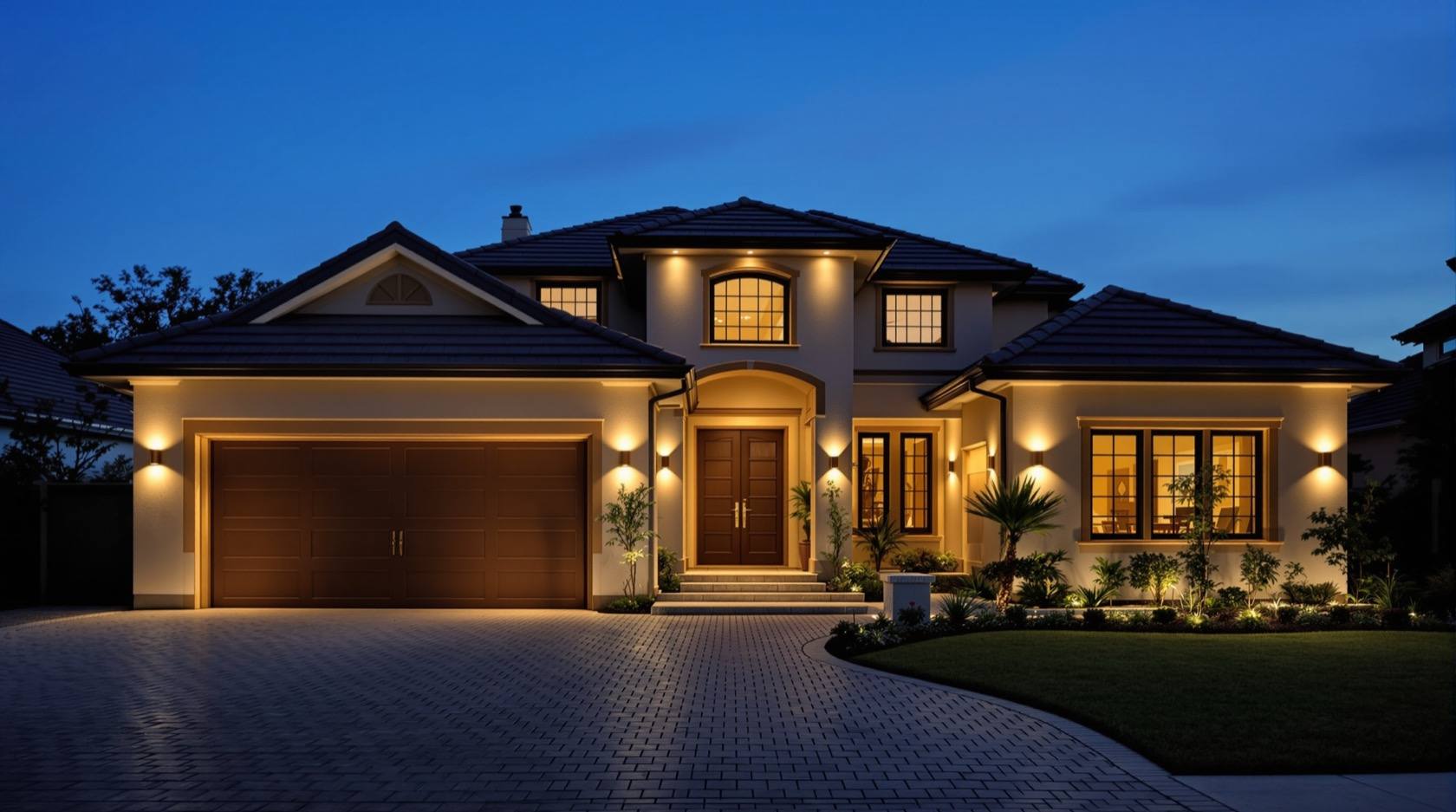
Security Lighting Design for the Whole Property (India 2026): The Principles, the Zones and the Library Map
How to light an entire property as a security layer that deters and lets cameras see — the four design principles, the zones to cover, and where every deeper guide fits, done without dazzling your own CCTV or the neighbour.
Most homes in India buy security lighting one fixture at a time. A floodlight goes up over the gate after a scare; a bulb is added to the stair; a solar lamp is stuck on the compound wall because it needed no wiring. Each was bought to feel safer, and together they do almost nothing useful — half the plot is still dark, the gate flood dazzles the very camera it was meant to help, and the whole lot dies the moment the power does. Security lighting works when it is designed as one system for the whole property, not accumulated as a pile of separate lamps.
That is what this guide is: the umbrella for the whole Studio Matrx lighting library. It sets out the security lighting design principles that apply everywhere on the plot, maps the zones you need to cover, and points you to the deeper guide for each. It is deliberately broad. If you have already lit the boundary and want the specifics of the wall and the gate, that is a separate, focused piece — the perimeter / boundary lighting guide — and this pillar links to it rather than repeating it. Think of this page as the map; the spokes are the streets.
Scope & safety. You plan, choose and coordinate the design here — where light goes, how it is aimed, how it switches, what it is for. A licensed electrician installs the mains, the circuits and any fixture mounted at height, to the wiring rules; a lighting designer sets the actual illuminance and uniformity to the applicable code. This guidance is strictly defensive — how to deter and how to let a camera see — never how to defeat someone else's lighting. Never let a security light block an escape route, an exit door or a stair egress. Verify every standard's current edition and your local municipal bye-laws before relying on any figure. Educational guidance, not legal or engineering advice.
Why light is a security layer
Light earns its place in a security plan because it works on all three things protection is supposed to do — deter, detect, respond.
- It deters. An intruder wants an easy, quiet, unseen target. A property that is evenly lit — or where a light snaps on the instant someone approaches — signals that they have been seen. Much of the value is paid before anyone enters: an opportunist reads a lit, cared-for home and simply moves on.
- It lets cameras see. This is the part people forget. Most cameras need light. A standard CCTV camera in a dark corner records grain and noise, not a face; even a good low-light camera does far better with adequate, even illumination — and the two are designed together, because the camera's low-light performance is only as good as the scene you give it. A lighting plan and a camera plan are two halves of one drawing.
- It aids response. When a light comes on with motion or an alarm, it startles the intruder, lights the scene for whoever verifies the alert, and makes the person easy to follow and to describe. Light turns a detection into a visible event.
The honest caveat that runs through the whole library: light on its own catches nobody. A lit compound with no camera and no one watching is just a well-lit place. Light is a force-multiplier for the compound wall, the cameras and the people — never a substitute. For a structured way to find where your property is dark and where light would matter most, run the lighting and visibility security assessment and the site perimeter security assessment tool.
The four design principles
Everything else in this library is an application of four principles. Get these right and the individual fixtures almost choose themselves; get them wrong and no amount of wattage will save the design.
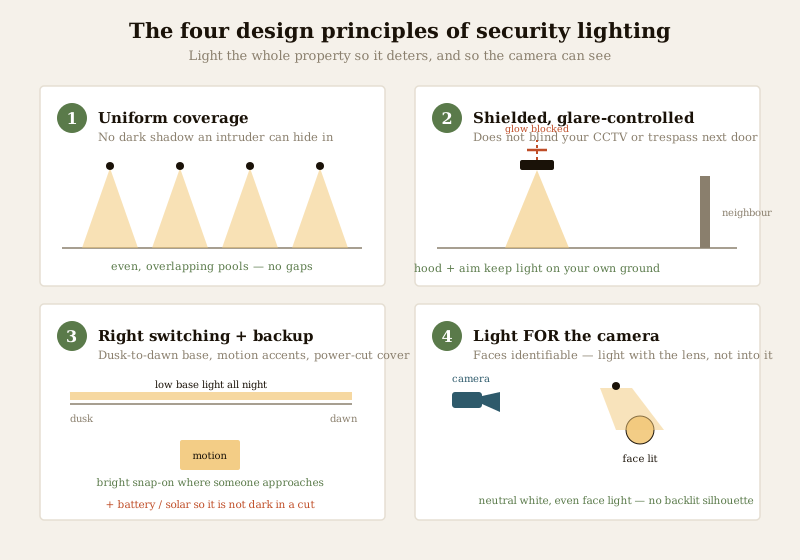
Principle 1 — Uniform coverage, no dark shadows
The goal is not brightness; it is evenness. One brilliant floodlight surrounded by black is far worse than several moderate fixtures that overlap into a continuous, gentle pool. Bright-then-dark forces a camera's exposure to chase the hotspot and lose everything else, and it hands an intruder a deep shadow to work in right beside the light. Aim for coverage where the pools of light overlap so there is no gap a person can cross unseen, and no single spot so bright it kills the eye's and the camera's adaptation to the rest. Uniformity, not peak lux, is the number a lighting designer will actually work to.
Principle 2 — Shielded and glare-controlled
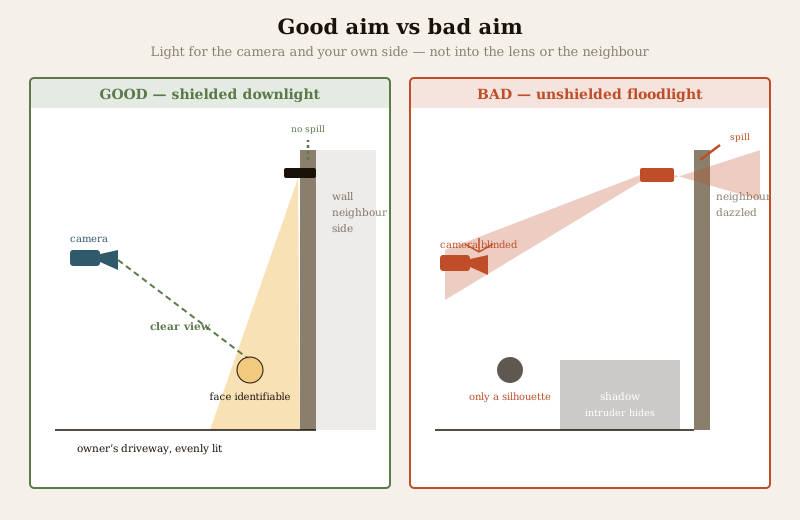
A security light should light the ground and the scene, not shine into eyes and lenses. An unshielded fixture does three kinds of harm at once: it glares into your own CCTV (the classic own-goal that blinds the camera it was bought to serve), it throws hard shadows, and it trespasses light across the wall into a neighbour's window or out onto the public road. Light trespass is not a minor courtesy issue in India — it becomes an RWA complaint and a genuine nuisance dispute, and municipal bye-laws increasingly treat it, and sky-glow generally, as pollution to be controlled. Choose hooded, full-cut-off or well-louvred fixtures, mount and angle them to put light down onto your own property, and check from the neighbour's side and the camera's seat that nothing spills or dazzles.
Principle 3 — The right switching, and power-cut backup
Two switching strategies, used together, cover a property well:
- a low, continuous dusk-to-dawn base on the boundary and entries the camera watches, so there is always enough to see and record by — covered in the dusk-to-dawn security lighting guide;
- motion-activated brights on approaches and side-returns, where a sudden snap-on both deters and alerts while saving energy the rest of the night — covered in the motion-activated security lighting guide.
And the India-specific third leg: backup. A security light wired mains-only is dark exactly when it matters — a cut, whether accidental or arranged, takes the lights, the camera and the confidence together. Plan for it with battery backup, an inverter circuit, or well-sized solar security lighting that actually survives monsoon and short winter days rather than the cheap panel that fades by December.
Principle 4 — Light FOR the camera, not against it
The most valuable footage answers one question: who was that? That needs the light to fall on faces and to reach the lens with the camera, never into it. A subject lit from behind is a black silhouette on camera however bright the scene; a lens pointed into a floodlight sees a starburst and nothing else. Design so the useful light lands where a face will be, at the height a face will be, from roughly the camera's side. This is important enough to have its own two spokes: CCTV-compatible lighting, which pairs the lighting plan to the camera plan and treats the low-light illumination minimums honestly, and lighting for facial identification, which is specifically about getting recognisable faces at the gate and entry.
The property zones, and where each spoke lives
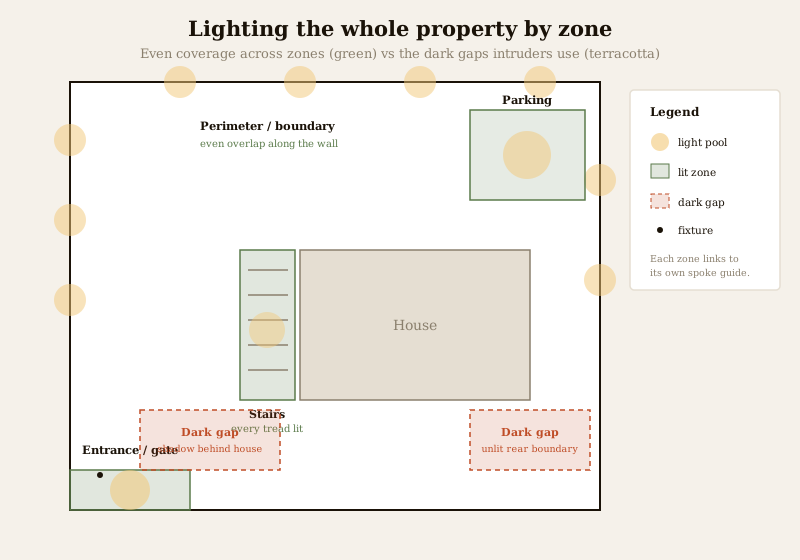
A whole-property plan lights distinct zones, each with its own job and its own deeper guide. Below is the map; treat the perimeter as a fully separate, focused guide rather than something restated here.
| Zone | What it must do | Deeper guide |
|---|---|---|
| Entrance / gate | Identify who arrives; light faces at the gate and door, no dazzle | Entrance lighting |
| Perimeter / boundary | Even, shielded light along the wall; no dark stretch to climb in | Perimeter / boundary lighting |
| Parking / driveway | Cover vehicles and the space between them; read number plates and people | Parking security lighting |
| Stairs / corridors | Every tread and turn lit for safe movement and clear view; never block egress | Staircase & corridor lighting |
Each zone hands off to the others. The gate light and the perimeter run should overlap so there is no seam of darkness at the corner; the parking flood and the boundary should not fight each other for the camera's exposure. Where the whole property is inside a society, boundary lighting is shared infrastructure planned once for everyone — the gated-communities security guide and the parking access-control guide cover that coordination, and the whole picture sits inside the complete perimeter security guide and the building security systems guide.
Colour, layers and the honest bits
Colour temperature and rendering, qualitatively
You do not need a kelvin figure to get this right, and you should not trust one printed on a cheap fixture's box. The rule of thumb that serves security well: neutral white usually reads best on cameras and lets a person judge colours (a red bag, a green shirt) that matter to any description. Avoid very cool, blue-heavy light — many cameras render it harshly, it can look clinical and glary, and it worsens sky-glow and trespass. Warm-to-neutral, even, well-shielded light with decent colour rendering is the target; leave the exact colour temperature and colour-rendering index to the CCTV-compatible lighting guidance and to a lighting designer working to the code.
Layers, not floodlights
The instinct after a scare is to bolt on the brightest floodlight available. Resist it. Good security lighting is layered — a quiet base wash for the always-on scene, task light where people move (gate, stairs, parking), and motion accents that lift the level only where and when something approaches. Layers give even coverage and let you save energy; a single mega-flood gives you a hotspot, a shadow and a dazzled camera. The same layering logic underlies ordinary architectural lighting design and landscape lighting — security is that discipline pointed at a different goal.
Energy and light pollution, honestly
Do not flood-light everything all night. It is expensive, it annoys neighbours, it harms wildlife and the night sky, and it does not even help — a wall of constant glare is easy for eyes to adapt to and hard for a camera to expose for. The efficient design is a low dusk-to-dawn base plus motion accents plus zoning, so full brightness happens only where and when it is needed. That is both the greener and the more secure choice, and it is worked through in the security lighting energy-use guide. Glare control belongs here too: the glare-free security lighting guide is the detailed companion to Principle 2.
The India texture to plan around
| Failure you will actually see | Why it happens | Design answer |
|---|---|---|
| Gate floodlight dazzles its own camera | Bright, unshielded, aimed roughly outward at lens height | Shield, aim down, light with the camera (Principle 2 & 4) |
| Everything dark in a power cut | Security lights wired mains-only | Battery / inverter / sized solar backup (Principle 3) |
| Solar lights die by December / in monsoon | Undersized panel and battery, no reserve | Size for the worst month, or keep a wired base |
| Motion light triggers all night, then gets disabled | Sensor aimed at road / trees; cat, auto, wind trip it | Aim across your own ground, tune zone and sensitivity, not just raise it |
| Neighbour's bedroom lit up — RWA dispute | Light trespass over the wall | Full-cut-off fixtures, angle down, verify from their side |
When to bring in the professionals
You can and should own the design thinking on this page — the zones, the principles, what each light is for. Hand over the parts that are genuinely someone else's craft:
- A licensed electrician for every bit of mains wiring, circuits, load, earthing, weatherproofing and any fixture mounted at height — route it through the electrical hub. Do not treat outdoor security wiring as a DIY job.
- A lighting designer to set the actual illuminance, uniformity ratios and glare limits to the applicable code, and to specify fixtures and optics. They turn "even, shielded, no dark gaps" into numbers that will pass.
- A security integrator to marry the lighting plan to the perimeter CCTV and outdoor CCTV design, so light and camera are planned on one drawing rather than fighting each other on site.
For the emergency and egress side — lights and signage that keep an escape route visible in a failure or evacuation — that is a separate, life-safety topic covered by the emergency lighting guide and the exit signage guide; do not fold it into the security design here, and never let a security fixture obstruct an exit. Keep the whole installation working over time with the security lighting maintenance guide — a clouded lens, a dead sensor or a failed panel quietly undoes a good design.
Key takeaways
- Design for the whole property as one system, not fixture by fixture. A pile of separate lamps leaves gaps, dazzles the camera and dies in a power cut; a single plan across the zones does not.
- The four principles carry everything: uniform coverage with no dark shadow; shielded and glare-controlled so you neither blind your CCTV nor trespass next door; the right switching (dusk-to-dawn base + motion accents) with power-cut backup; and light aimed for the camera so faces are identifiable.
- Light every zone and link the seams — entrance, perimeter, parking and stairs each need cover, and the pools should overlap so there is no dark corner between them.
- Colour and layers matter: neutral white usually reads best on cameras and avoid harsh blue-heavy light; build in layers, never one mega-floodlight; light only where and when needed to save energy and spare the night sky.
- Own the design, hire the craft: you decide the zones and principles; a licensed electrician does the mains and work at height, a lighting designer sets the code-compliant numbers, and an integrator ties it to the cameras. Verify every standard's current edition first.
Where to go next
- Light for the camera — CCTV-compatible lighting, low-light camera illumination and lighting for facial identification.
- By zone — entrance, perimeter / boundary, parking and stairs & corridors.
- How it switches and powers — dusk-to-dawn, motion-activated, solar and energy use.
- Getting it clean — glare-free security lighting and security lighting maintenance.
- The wider security picture — the lighting sub-hub, the security hub, the ultimate home security guide, and the home security risk scorecard tool.
References
- SP 72 : 2025 — National Lighting Code of India (Bureau of Indian Standards) — the primary reference for illuminance, uniformity and glare across indoor and outdoor lighting; treat specific lux levels and ratios as figures a qualified lighting designer sets to this code. Verify the current edition via the BIS catalogue: https://www.services.bis.gov.in/
- National Building Code of India, SP 7 : 2026, Part 8 Section 1 (Lighting & Ventilation) — for the lighting and electrical provisions of the building and its services, read with local municipal bye-laws and any light-nuisance / light-pollution provisions. Verify the current edition via the BIS catalogue: https://www.services.bis.gov.in/
- IS 3646 (Part 1) : 2025 — Code of Practice for Interior Illumination (Bureau of Indian Standards) — for working interiors such as lobbies, corridors and stair halls where security and amenity lighting overlap. Verify current status; do not rely on the withdrawn Parts 2 and 3.
- Digital Personal Data Protection Act, 2023 — where security lighting supports cameras overlooking a neighbouring property or a public road, the footage is personal data; agree access, storage and privacy handling, and keep credentials private.
This is an educational overview, not legal or engineering advice. It is strictly about using light defensively to deter intrusion and help cameras see, never about defeating any security measure. Setting illuminance levels, mains wiring, circuit work and any fixture mounted at height are qualified professional tasks — engage a licensed electrician and a lighting designer, never block an egress route, and verify any standard's current edition via the BIS catalogue before relying on it.
Export this guide
Related Guides — Deep-dive reading
Security Lighting in India (2026): Lighting the Boundary Without Dazzling the Camera or the Neighbour
How to use light as a security layer that deters intruders and lets your cameras see, done well with uniform shielded downlight, no glare, no neighbour trespass and a power-cut backup.
SecurityParking Security Lighting in India (2026): Lighting Basement, Stilt and Open Parking So Nothing Hides in the Dark
How to light apartment and commercial parking so vehicles, people and number plates are clearly seen, cameras can actually read the scene, and the space stops being a soft spot for theft and lurking, without ever compromising the emergency lighting on the escape route.
SecurityStaircase and Corridor Security Lighting in India (2026): Even Light, No Dark Half-Landings, Never Switched Off Mid-Flight
How to light the shared stairs, lobbies, corridors and passages of an apartment building so they are safe to move through and never a place someone can wait unseen, without ever compromising the code emergency lighting on the escape stair.
SecurityRelated Tools — Try Free
Home Security Risk Scorecard
Score your home across six security layers — perimeter, entry points, lighting, detection, alarm and habits — and get a prioritised action plan.
Security ScorecardSecurity Backup Power Calculator
Size a UPS/inverter and battery to keep CCTV, NVR, router and alarm running through a power cut — load, Ah, VA and cost.
Backup PowerAccess-Control Battery-Backup Calculator
Size the standby battery so an access system keeps running through a power cut, with an egress life-safety note.
Battery Backup