
Perimeter CCTV in India (2026): Watching the Boundary and Verifying the Alarm
How cameras earn their place on the perimeter — watching along the fence and wall line, and letting a human confirm a real intruder before response — designed for Indian darkness, weather and neighbour privacy.
A perimeter fence, wall or beam line can DETECT that something crossed the boundary — but a sensor cannot tell you what crossed it. Was it an intruder, or a street dog, a monkey, a gust-blown branch? Perimeter cctv is the answer to that question. On the boundary, cameras do two jobs that no other device does: they watch the fence and wall line so a person at it is seen, and — the job that matters most — they let a human VERIFY a perimeter-sensor alarm and confirm a real intrusion before anyone is dispatched. A wall only delays; detection warns; a camera turns that warning into a decision.
This guide is the boundary-surveillance lens on cameras, part of Studio Matrx's perimeter security library and its complete perimeter security pillar. It does not re-explain what a camera is or how to spec resolution, storage or night vision — the complete CCTV systems guide, the outdoor CCTV guide and the camera placement guide already do that in depth. Here the focus is narrow and specific: how cameras serve the PERIMETER — the boundary line, the alarm-verification chain, and the Indian realities of darkness, weather and the neighbour you must not overlook.
Scope, honesty & verification. This guide is strictly about seeing and verifying an intrusion, never about defeating a camera. Hold onto the central truth of perimeter security: detection is worthless without verification and response. A perimeter camera earns its keep only inside a chain — a sensor alarms, the camera confirms a real person, and a human (guard, monitoring station, resident) responds. India's monitoring reality is mostly self- or guard-monitored, so that human is usually you or a gate guard, not an automatic dispatch. Cameras need light, IR or thermal to see, and the whole chain needs power backup. This is educational guidance, not legal advice.
The perimeter job is different from every other camera job
A camera over your front door is framed to identify a face. A camera on a shop till is framed to read a transaction. A perimeter cctv camera has a different brief entirely: it watches a line — the top of a compound wall, a fence run, the strip just inside the boundary — to catch the moment a person is AT that line, and to give a human enough picture to say "yes, that is an intruder" or "no, that is a dog." Two design consequences follow from that brief.
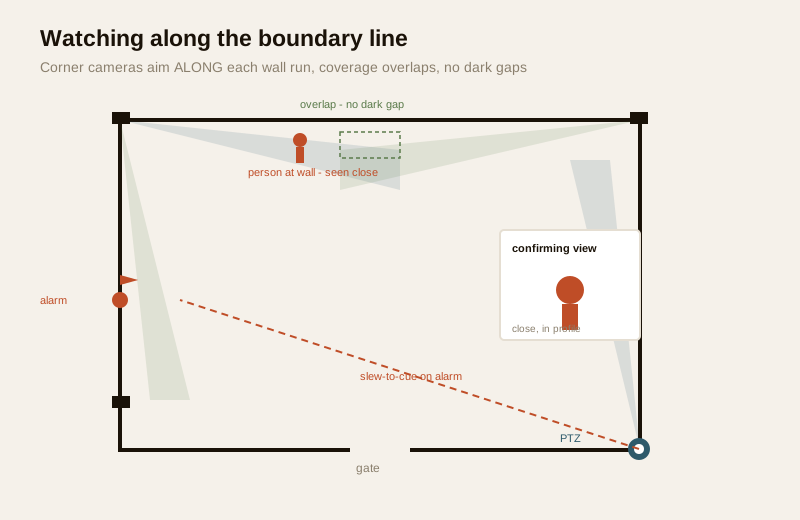
First, perimeter cameras look along the boundary, not across the open ground. A camera aimed straight out from the house toward the wall sees the wall as a thin distant strip and the intruder as a speck; a camera mounted at a corner and aimed down the length of the wall sees anyone standing at it in profile, close and large in frame. Second, perimeter coverage must be continuous — a dark gap between two cameras is exactly where an intruder crosses. The design discipline is overlapping fields of view along the whole boundary line, with each camera's far edge covered by the next camera's near edge, so there is no unwatched metre of fence.
- Look along the line, not across the plot. Corner-mounted cameras aimed down each wall run see people at the boundary in profile and up close, not as distant specks.
- Overlap, no dark gaps. Each camera's coverage should reach into the next camera's zone; the boundary is a chain, and a chain fails at its weakest gap.
- Watch the crossing line, not the whole field. The value is at the fence and wall-top — the place people actually climb — not the empty ground beyond it.
- Frame for the task. A fixed camera holds a stretch of boundary; a PTZ (pan-tilt-zoom) camera is the one that can move to an alarm — more on that below.
The technologies that suit the perimeter
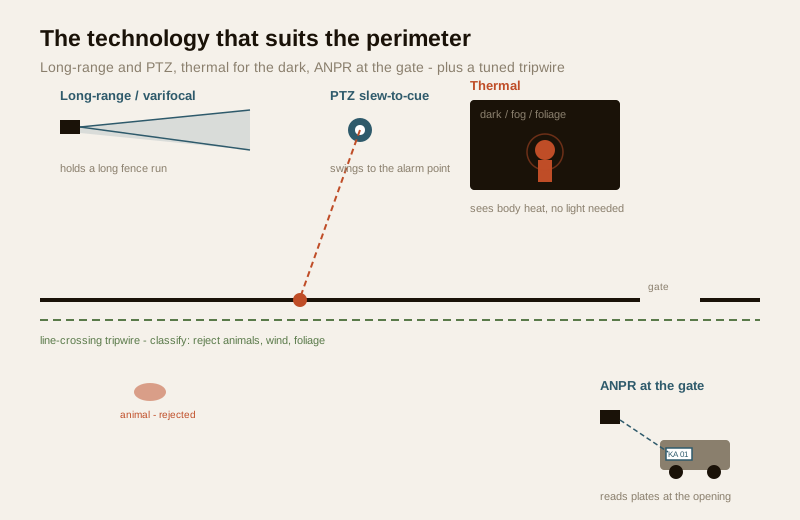
Not every camera type belongs on a boundary. The perimeter has its own demands — long thin runs, darkness, fog, foliage, a gate lane — and a handful of camera technologies answer them. Each has a full Studio Matrx guide; here is only where each earns its place on the boundary.
- Long-range and varifocal fixed cameras hold a long straight wall or fence run in a single frame, adjusted (varifocal) so the boundary line fills the useful part of the image. They are the workhorse that provides the continuous overlapping coverage above.
- PTZ cameras for slew-to-cue. A pan-tilt-zoom camera can be commanded — automatically, on an alarm — to swing and zoom onto the exact point a sensor tripped. This is "slew-to-cue": the beam sensor or fence sensor fires, the PTZ instantly points there, and a human sees a close, confirming view within seconds. One PTZ backs up many fixed cameras, but note it can only look one place at a time — it supplements fixed coverage, never replaces it.
- Thermal cameras are the perimeter's answer to the dark. A thermal CCTV camera sees heat, not light, so it detects a warm human body in total darkness, through light fog, and against foliage where a visible camera sees only a black wall of leaves. On a rural farm boundary, a long unlit factory fence, or a plot with heavy planting, thermal is often the difference between detection and a blind boundary. It confirms presence; you still pair it with a visible camera to see detail.
- ANPR at the gate lane. The one vehicle-facing perimeter camera: an ANPR (automatic number-plate recognition) camera reads plates in the approach lane at the gate, logging every vehicle in and out and flagging watch-listed or unexpected ones. It belongs at the single controlled opening in the boundary, working with the boom barrier and gate systems.
| Perimeter task | Camera technology | Why it suits the boundary |
|---|---|---|
| Hold a long wall/fence run | Long-range / varifocal fixed | Keeps the boundary line filling the frame across distance |
| Confirm an alarm point fast | PTZ (slew-to-cue) | Swings and zooms onto the exact sensor-trip location |
| See in darkness, fog, foliage | Thermal | Detects body heat where visible cameras go blind |
| Read vehicles at the opening | ANPR at gate lane | Logs and flags plates at the one controlled entry |
| Everyday boundary detail | Outdoor visible (IR) | Colour/identity detail when there is light or IR |
Which mix you choose depends on the site: a walled urban villa may need only overlapping varifocal cameras plus one PTZ; a large unlit farm or factory perimeter leans hard on thermal for detection with visible cameras for detail; a gated community adds ANPR at every vehicle gate. The site perimeter security assessment helps size the mix to your boundary, and the broader boundary intrusion detection guide sets cameras alongside the beam and fence sensors they verify.
Analytics: tripwires along the boundary, tuned for the outdoors
A modern perimeter camera does more than record — it can analyse. Two analytics matter most on a boundary: line-crossing, a virtual tripwire drawn along or just inside the fence that fires when something crosses it, and intrusion-zone detection, a drawn area (the strip inside the wall) that fires when something enters and lingers. Used well, these turn a passive camera into an active detector that alarms the instant the boundary line is broken.
But the outdoors is a noisy place, and this is where perimeter analytics live or die. A tripwire tuned too hot fires on every crossing cat, every wind-blown branch, every bird, every sheet of blowing rubbish, every downpour — and a camera that cries wolf gets its alerts ignored or switched off, which is worse than no camera at all. The honest, defensive discipline is not "make it more sensitive" and never "disable it" — it is to tune the analytic to reject nuisance and to VERIFY before anyone responds.
| Outdoor nuisance | Analytics / design response (what to specify) |
|---|---|
| Street dogs, cats, cattle, monkeys | Prefer human/vehicle classification analytics that ignore animal-shaped, ground-level movement; draw the tripwire at the crossing height, not the open ground |
| Wind-blown foliage and branches | Set minimum object size and dwell time; trim vegetation off the camera view and tripwire path each season |
| Blowing rubbish, leaves, plastic | Use object-size and direction filters so only boundary-crossing, person-sized targets alarm |
| Rain, fog, monsoon, insects on lens | Lean on thermal for detection in bad weather; shield and clean lenses; expect visible-camera analytics to degrade in heavy rain and design for it |
| Headlight glare, shadows, IR wash | Aim to avoid direct light into the lens; use classification rather than raw motion; verify every alarm on camera before dispatch |
The single most powerful mitigation is classification — analytics that decide human or vehicle versus animal or object before raising an alarm, so a dog crossing the tripwire is seen and dismissed while a person is flagged. Studio Matrx's CCTV analytics and detection guides cover how these rules are built; on the perimeter the rule is always the same — filter hard, then verify, never chase sensitivity.
The verification chain: sensor to camera to response
This is the reason perimeter cameras exist, and it deserves stating plainly. A perimeter alarm system — beam sensors across the gate, fence vibration sensors along the run, perimeter beam sensors between posts — tells you that the boundary was crossed. It cannot tell you what crossed it. Perimeter cctv closes that gap. The chain runs:
1. A perimeter sensor alarms — a beam breaks, a fence sensor detects a climb, a tripwire fires.
2. The camera confirms — the associated fixed camera's view pops up on the guard's or resident's screen, or a PTZ slews to the exact point, giving a live, close view of the alarm location.
3. A human verifies — a guard, monitoring operator or resident looks and decides: real intruder, or a dog on the wall? This step is what kills false-alarm fatigue and prevents a wasted or dangerous response.
4. Response happens — only on a confirmed intrusion: sound the siren, switch on the security lighting, call the guard patrol, alert neighbours, contact the monitoring service or police. Response is proportionate because it is informed.
Skip the verification step and you have either an alarm that everyone ignores (because it false-fires) or a response dispatched blind (dangerous and often wrong). This is why cameras and sensors are designed together on a serious perimeter, with alarm-to-camera linkage (event pop-up, PTZ slew-to-cue) configured so the confirming view appears automatically the instant a sensor trips. In India's mostly self- and guard-monitored reality, that confirming view is what lets a lone night guard or a sleeping resident make the right call in seconds.
Remember the honest limit: verification and response depend on someone being there to look. An unmonitored recording that nobody watches until after a break-in provides evidence, not protection. Where there is no guard and no monitoring service, app-based alerts with instant camera view are the substitute — the resident becomes the verifier — and the remote-access security of that app link then matters as much as the camera itself.
Light, IR and the dark boundary
A camera is only as good as the light it has. A visible-light perimeter camera in an unlit compound at night sees almost nothing without infrared (IR) illumination, and even IR reaches only so far along a long boundary. This is the most common India failure: perimeter cameras that simply cannot see in the dark — bought, mounted, and then blind for the twelve hours that matter most.
Three honest answers, in order of the site:
- Provide light. Well-designed, glare-controlled perimeter security lighting lets visible cameras see in colour and detail, and deters by itself. But light must be aimed and shielded so it lights the boundary, not the camera lens (glare blinds the very camera it is meant to help) and not the neighbour's window.
- Use IR within its range. Built-in or separate IR illuminators extend a visible camera's night reach, but know the honest range — IR falls off fast, and a camera rated for a short IR distance will not light a long wall run.
- Go thermal where light is impossible. On long unlit rural or industrial boundaries, thermal detection does not need any light at all and is the reliable night detector, paired with visible cameras at the points where you also want identity detail.
A perimeter designed only for daylight is a perimeter that works only when you least need it.
Privacy: the boundary camera almost always overlooks someone
A perimeter camera points outward along the boundary — which means it very often also captures the public road, the footpath, a neighbour's gate, or a neighbour's window. In India this is both a courtesy issue and a legal one under the Digital Personal Data Protection Act, 2023 (DPDP): footage of identifiable people is personal data, and a camera that habitually records a neighbour's private space or a public thoroughfare beyond what your own security needs can become a genuine grievance and a compliance exposure.
The defensive, neighbourly design practice:
- Frame to your own boundary. Aim and zoom so the camera watches your fence and wall line, not into a neighbour's home or across their yard. If the wide view unavoidably includes a public road, that is usually acceptable for security; a lens trained on a neighbour's bedroom is not.
- Use privacy masking. Most perimeter cameras and recorders support privacy masks — blacked-out zones in the image — to permanently blank a neighbour's window or door from the recording. Apply them.
- Signage. Display clear CCTV-in-operation signage at the boundary and gate, as good practice and as expected under a reasonable reading of DPDP for surveillance that captures others.
- Secure the footage and the remote link. Boundary footage is sensitive; store it securely, limit who can access it, and harden any remote/app access — see CCTV remote-access security for the cyber side. A leaked perimeter feed is a privacy breach and a security one.
- Talk to the neighbours. For a shared boundary, an apartment block or a gated community, agree the camera scheme openly; a boundary camera the neighbours know about and accept is far less trouble than one discovered later.
False alarms, neighbourliness & when to bring in a professional. Two failures sink perimeter CCTV in India: analytics tuned so hot they cry wolf on every dog and gust until everyone ignores them, and cameras that overlook a neighbour or a public road without masking or signage. The cure for the first is classification analytics plus human verification before response — never higher sensitivity, never switching it off. The cure for the second is aiming to your own boundary, privacy masks, signage and an open word with the neighbours. Hand the specialist parts to professionals: mounting cameras at height, mains power and lighting, aligning PTZ presets and slew-to-cue linkage, tuning analytics against your site's real nuisance, and configuring secure remote access. For a society, factory or campus, treat it as a designed project with a written spec, a maintenance plan and a DPDP-aware data-handling policy. Route mains-electrical and any monitored-service contracting to licensed professionals.
Key takeaways
- Perimeter CCTV does two boundary jobs: it watches along the fence and wall line with overlapping, gap-free coverage so a person at the boundary is seen, and — more importantly — it lets a human VERIFY a perimeter-sensor alarm before anyone responds.
- Match the technology to the boundary: long-range/varifocal fixed cameras hold the runs, a PTZ slews-to-cue onto an alarm point, thermal sees in darkness/fog/foliage where visible cameras go blind, and ANPR reads plates at the gate lane.
- Analytics must be tuned for the outdoors: line-crossing and intrusion-zone tripwires are powerful, but only with human/vehicle classification to reject dogs, wind, foliage and blowing rubbish — filter hard and verify, never chase sensitivity or disable it.
- The verify chain is the point: sensor alarms, camera confirms (pop-up or PTZ slew), a human decides real-versus-nuisance, and response is only dispatched on a confirmed intrusion — and cameras need light, IR or thermal or they are blind when it matters.
- Respect the overlook: a boundary camera usually catches a public road or a neighbour, so frame to your own line, apply privacy masks, post signage, secure the footage and remote link, and design to the DPDP Act, 2023.
References
- Digital Personal Data Protection Act, 2023 — perimeter footage of identifiable people is personal data; where a boundary camera captures a public road or a neighbour, limit the overlook, apply privacy masking, display signage, and store and access footage securely.
- The applicable BIS/IEC CCTV and video-surveillance standards, and the applicable BIS/IEC/EN intrusion-detection standard — verify camera, analytics and alarm-integration specifications and current edition status via the BIS catalogue rather than relying on a vendor claim: https://www.services.bis.gov.in/
- National Building Code of India (SP 7), Bureau of Indian Standards, local municipal bye-laws and light-nuisance/neighbour considerations for any perimeter lighting, mains power and mounting work; verify the current edition via the BIS catalogue: https://www.services.bis.gov.in/
This is an educational overview, not legal advice. It is strictly about seeing and verifying an intruder at the boundary, never about defeating a camera. Work at height, mains-connected power and lighting, PTZ and analytics tuning, and secure remote-access configuration are qualified professional tasks — engage licensed installers, and verify any standard's current status via the BIS catalogue before relying on it.
Export this guide
Related Guides — Deep-dive reading
Perimeter Alarm Systems in India (2026): Detect an Intruder at the Boundary
How an outer detection layer — outdoor motion sensors, beam barriers, fence and wall-top sensors and gate contacts — warns you the moment someone crosses your compound wall, and how to design it for Indian weather without endless false alarms.
SecurityThermal Cameras for CCTV in India: See Heat, Not Light, Explained
How a thermal camera images the warmth of people, animals and vehicles to detect an intruder across a large dark plot, why it cannot show a face or a number plate, and where it fits on an Indian property.
SecurityHow to Choose a CCTV Camera (2026): The Homeowner's Decision Guide for India
Cut through the spec-sheet noise and choose the right CCTV camera for each spot around an Indian home. What actually matters — sensor and low-light performance, lens and field of view, form factor, IP and IK ratings, honest smart features — and the marketing claims to ignore.
SecurityRelated Tools — Try Free
CCTV Placement Compliance Checker
A quick DPDP-grounded privacy and safety self-check for where a camera is pointed — flags the items to fix.
ComplianceCCTV Camera Coverage & Count Calculator
Estimate how many CCTV cameras you need, the NVR channels, storage in TB for your retention period, and an indicative all-in cost with GST.
CCTV CalculatorCCTV Camera Overlap Calculator
The overlap or blind gap between two adjacent cameras, from coverage width and spacing, plus the spacing for a target overlap.
Overlap