
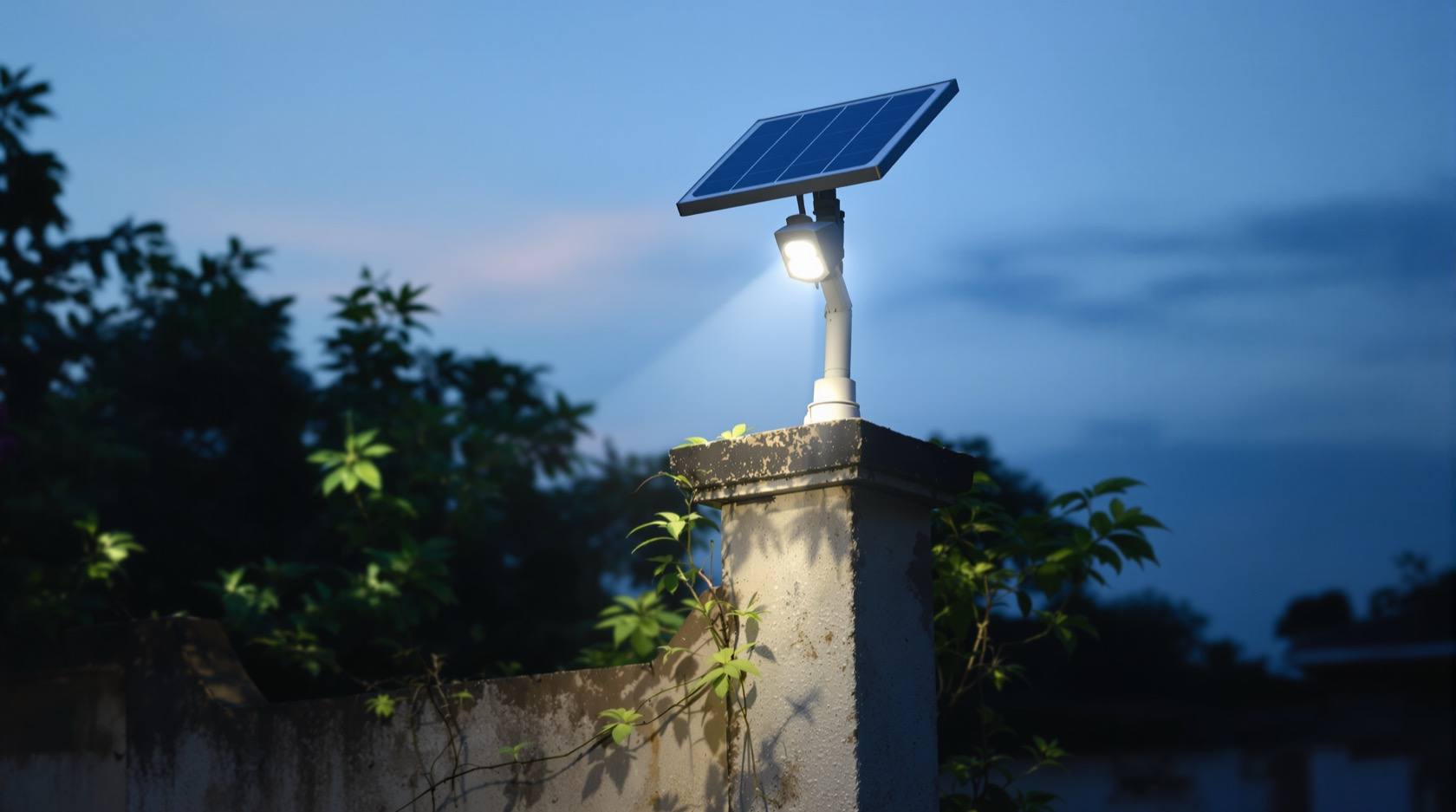
Solar Security Lighting in India (2026): Where It Genuinely Works, and the Honest Reasons It Fades in the Monsoon
An all-in-one solar security light needs no cabling to a far gate and no running cost, which is exactly why it is oversold. This guide shows a homeowner where solar lighting is genuinely the right answer, where wired dusk-to-dawn is safer, and how to buy one that does not die at 2am in July.
There is a genuine, honest appeal to a solar security light, and it is worth saying plainly before anything else, because most of what follows is caution. If your boundary runs a long way from the house, if your gate sits at the far corner of the plot, if there is simply no mains point where you want light, then running a cable and a conduit all the way out there, through a trench or up and over the wall, is expensive, disruptive and sometimes just not worth it. A self-contained solar light needs none of that. You mount it, it charges itself in the day, it lights the spot at night, it costs nothing to run, and, the part people forget to value, it keeps working through a power cut, when your mains security lights have gone dark exactly at the hour they matter most. On an Indian plot with load-shedding and a far boundary, that is a real advantage, not a gimmick.
So this guide is not here to talk you out of solar. It is here to make sure you buy one that actually works, and put it where it can succeed, because the same technology that is genuinely useful at a remote gate is also the most oversold and under-delivered product in home security. A solar light is only ever as good as the charge it gets, and that single sentence is the one most sellers never say out loud. Solar security lighting done honestly is a fine layer; done cheaply and hopefully, it is a light that gives you confidence by day and abandons you at 2am. This guide sits in the Studio Matrx security lighting library under the security lighting design pillar, and it is written for the homeowner deciding where, and whether, solar belongs.
Scope and safety. You plan and decide where solar security lighting fits here, strictly as a defensive measure so you and your cameras can see. A pure all-in-one solar light needs no mains at all, that is the point, but any hybrid solar-plus-mains fixture, any wired tie-in, and any mains work is for a licensed electrician to the wiring rules (see the electrical hub). Setting actual light levels for a task is a lighting designer's job to the current National Lighting Code; treat nothing here as a target figure. And never let a solar light block an escape route or a marked exit, life-safety lighting is a separate, code-governed system covered elsewhere. Verify every standard's current edition and your local bye-laws before relying on it. Educational guidance, not legal or engineering advice.
How an all-in-one solar security light actually works
Before you can judge a solar light you need to know what is inside the small box, because every honesty problem later comes down to one of these five parts being too small or too cheap. An all-in-one unit packs the whole system into a single housing:
- The solar panel, usually on top or as a separate small panel on a short lead, which turns daylight into charge. Its size, its wattage and where you point it decide how much energy the light collects each day. This is the tap that fills the tank.
- The battery, hidden inside, which stores that charge for the night. This is the tank. Its size decides how long the light can run, and its chemistry decides how many years it lasts and how it behaves in heat and cold. This is the single most important part, and the one sellers hide.
- The LED head, which is the actual light. Its draw, how much power it pulls, is the drain on the tank. A big, bright LED empties a small battery fast.
- The controller, the little brain that manages charging, stops the battery from over-draining, and decides the behaviour, always-on dim, bright-on-motion, dusk-to-dawn, timed.
- The PIR motion sensor, the passive-infrared eye that sees a warm body move and tells the controller to go bright. Most solar security lights sit dim or off to save charge, then step up when the sensor triggers, exactly the motion-activated logic used on mains lights, but here motion is not just about deterrence, it is about rationing a limited battery.
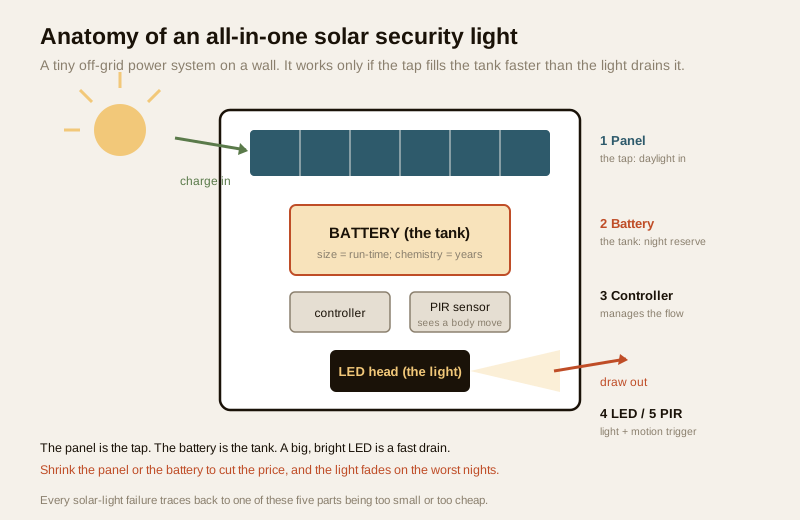
The whole thing is a tiny off-grid power system on a wall. And like any off-grid system, it only works if the tap fills the tank faster than the light drains it, every single day, including the bad ones. Hold that picture, because it explains every failure that follows.
The hard honesty most sellers hide
Here is the part the shop and the online listing will not tell you. A solar security light is only as good as the charge it gets, and in India the charge is not reliable. Two seasons expose every weakness:
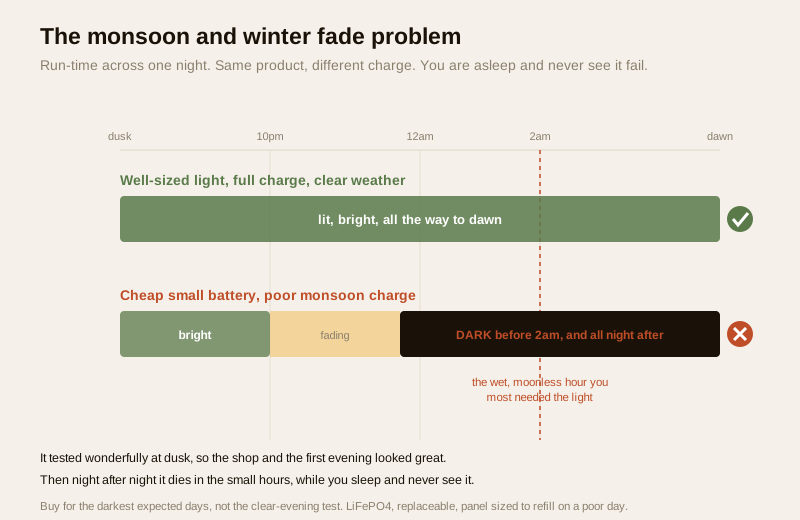
- The monsoon. For weeks the sky is grey, the sun is weak and intermittent, and the panel collects a fraction of what it does in clear sun. A light that ran all night in April can fade to a dim glow, or die entirely before dawn, in July, precisely when a wet, dark night is when you most want it. It has not broken. It simply never got charged.
- Short winter days. In December the day is shorter, the sun is lower and hazier, and the night is longer. The panel has fewer hours to fill a tank that now has to last longer. The same light that coped in summer runs out in the small hours of a winter night.
On top of the seasons sits the cheap-product problem, which is worse and more common. A low-cost solar light is cheap because the two expensive parts, the panel and the battery, have been shrunk. The result is a light with a tiny battery that gives you a bright hour when you test it at dusk, so it looks wonderful in the shop and on the first evening, and then goes dark at 2am night after night once the novelty test is over. You are asleep, so you never see it fail. The false confidence is the danger, which we come back to.
And the deepest issue is battery quality, because the battery is what wears out. Two things matter:
- Chemistry. A cheap lithium-ion or an old lead cell degrades fast, especially baking on a hot Indian wall through summer, and hates the heat. A good lithium iron phosphate (LiFePO4) cell tolerates heat far better and lasts many more charge cycles. You cannot see the difference on night one; you see it two summers later when the runtime has quietly halved.
- Replaceable versus sealed. Every battery dies eventually. In a well-made light the battery is a replaceable pack, so in a few years you swap it and the light lives on. In a cheap sealed unit the battery is glued in, so when it dies the whole light is landfill, and you buy again. A slightly dearer light with a replaceable LiFePO4 battery is very often the cheaper light over five years, and the one still working at your gate when the cheap one is dark.
So the honesty in one line: a solar security light does not fail loudly. It fades, quietly, in the exact conditions, the wet night, the long winter night, the third summer, when you needed it. Buying well is entirely about refusing to let that happen.
Buying honestly: size for the darkest days, ask the right questions
You cannot fix the monsoon, but you can size the light so it survives it, and you do that by buying for the worst expected days, not the best. The trap is judging a solar light by how it performs on a clear evening test; the only test that matters is how it performs after a run of grey days. Since honest numbers depend entirely on your site, your panel, your battery and your usage, do not trust a fabricated figure from a listing. Instead, ask the seller these questions and buy from the ones who can answer:
- What is the run-time on a full charge? A serious product states how long the light runs, at what brightness, from a full battery, and ideally how it behaves after cloudy days. Vague listings that only quote panel and LED wattage and stay silent on run-time are the ones to avoid.
- What is the battery chemistry and capacity? You want to hear LiFePO4 and a stated capacity, not silence or a mystery cell. Heat and cycle life ride on this answer.
- Is the battery replaceable? A yes means the light survives its own battery; a no means you are buying a disposable.
- What is the panel wattage against the light's draw? The panel must be big enough to refill the battery on a poor day, not just a perfect one. A big bright LED on a small panel is a light designed to disappoint. Ask whether the panel is sized for autonomy through cloudy days, meaning the battery has enough reserve to carry the light through one or more days of bad charging.
- What is the warranty, and on the battery specifically? A maker who backs the battery for years believes in the chemistry. A maker who is vague is telling you something.
The right way to think about sizing is autonomy: the battery and panel together should be able to carry the light through the darkest expected days at your site, so a run of monsoon nights does not drain you to black. There is no universal number for this, it depends on where you are, how the light is used, and how bright you run it, so size to the darkest expected days and confirm the run-time and chemistry with the seller rather than trusting a headline figure. If in doubt, buy one size up on the battery and the panel; the cost of over-sizing is money, the cost of under-sizing is a dark gate on the worst night.
| What to check | Good sign (buy) | Red flag (walk away) |
|---|---|---|
| Battery chemistry | LiFePO4 stated, capacity given | Chemistry not stated, or cheap unbranded li-ion |
| Battery replaceable | Removable pack, spares available | Sealed, glued-in, whole unit disposable |
| Run-time claim | Stated hours on a full charge, and after cloudy days | Only panel/LED wattage quoted, run-time silent |
| Panel vs light draw | Panel sized to refill on a poor day, autonomy for cloudy days | Big bright LED on a small panel |
| Warranty | Multi-year, battery specifically covered | Short or vague, battery excluded |
| Seller answers | Can answer all the above plainly | Deflects to brightness and price only |
Panel placement: the tap has to actually fill
A perfectly good solar light will still fail if the panel cannot collect. Placement is not decoration, it is the charging, and it is where DIY installs most often go wrong. Three rules, all qualitative, because the exact angle depends on your site:
- Keep it unshaded. The panel needs open sky and direct sun for as many hours as possible. A panel under a tree canopy, behind a parapet, in the shadow of the very wall it is mounted on, or shaded by the compound's own trees for half the day, will never fill the battery no matter how good the light is. Watch the spot across a full day before you fix the panel, and remember trees grow, a panel in clear sun today can be shaded in two summers.
- Tilt it to catch the sun, do not lay it flat. A panel tilted up towards the sky collects far more than one lying horizontal, which also puddles rainwater and dust. The right tilt is roughly to the site's latitude, angled so it faces the sun's path across the day; do not treat any single angle as correct for everywhere, tilt to your location and face it to get the most sun over the year. A separate panel on a lead, which many better lights offer, is worth it precisely because you can aim the panel at the sky while the light head faces the approach.
- Keep it clean. Dust, bird droppings, monsoon grime and a film of city pollution all cut the charge, and in India they build up fast. A panel wiped every so often collects far more than one left to grey over. This is the single easiest maintenance win and the most neglected.
Get the placement wrong and even the best light underperforms; get it right and a modest light does its job. The panel is the tap, and a tap you have half-closed with shade and grime cannot fill the tank however big it is.
The security trade-off: a light that dies mid-night is worse than none
This is the sentence to sit with, because it is the whole reason solar deserves caution rather than enthusiasm. A solar security light that dies at 2am is worse than no light at all, because it does not just fail, it gives you false confidence. You have a light at the gate, so you stop worrying about the gate. You do not add the wired light, or the camera, or the second layer, because the solar one is there. And then on the wet, moonless night, or the third summer when the battery is spent, the light is dark and you never knew, because you were asleep every time it failed. An honest empty spot at least gets watched; a spot you believe is covered, but is not, is the one that catches you out.
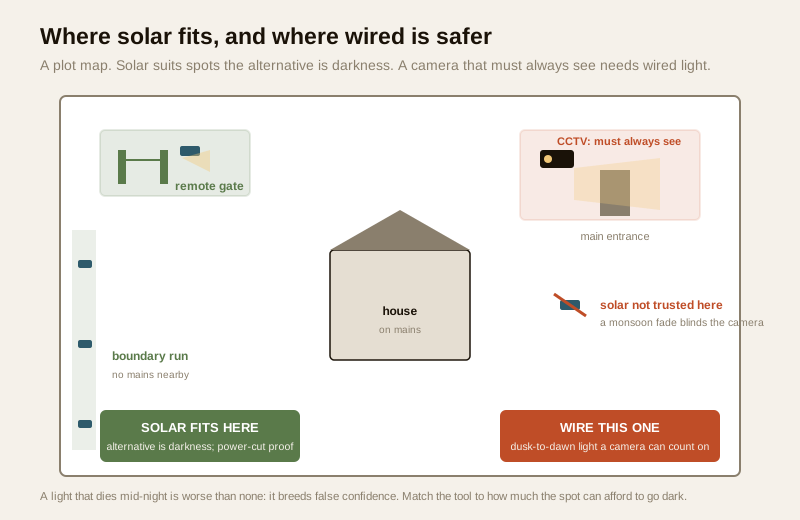
So the decision is not solar-or-nothing. It is honest solar in the right place, or wired light in the place that cannot afford to go dark. The two are different tools:
- Where solar genuinely fits, a remote gate with no mains nearby, a long boundary run, a rarely-used back entrance, a farm or plot corner, and as a power-cut backup layer that keeps a spot lit when load-shedding kills the mains lights. In these places the alternative is often no light at all, and an honestly-sized solar light is a real gain.
- Where wired dusk-to-dawn is safer, anywhere a camera must always see. A CCTV camera that has to record a doorway, a till, an entry every night without exception cannot depend on a battery that fades in the monsoon; it needs reliable, constant light. That is a job for wired dusk-to-dawn lighting that a camera can count on, designed as CCTV-compatible lighting so the colour and evenness suit the lens. Do not put your one critical camera's illumination on solar and hope.
Hybrid solar-plus-mains: the middle path
There is a sensible middle option that gets less attention than it deserves: a hybrid fixture that charges from solar but can also draw from, or fall back to, mains. It gives you the best of both, the solar keeps it running through a power cut and trims the running cost, while the mains connection guarantees the light does not fade in the monsoon or die on the third winter. For a spot that matters but is reachable by a cable, hybrid can be the honest answer, reliability you can count on, with solar as backup rather than the sole lifeline.
The catch is that a hybrid, or any solar light with a wired tie-in, is no longer a plug-and-play DIY job. The moment mains is involved, the wiring, the connection and the fixture are a licensed electrician's work to the wiring rules, exactly as with any wired security light. You still plan and decide where it goes and what it must do; the mains side is qualified work. Do not wire a hybrid yourself to save the electrician's fee.
Maintenance: solar is not fit-and-forget
The myth that sinks more solar lights than the monsoon is that they are maintenance-free. They are not. They are low-maintenance, which is different, and skipping the little that they need is how the light at the far gate quietly dies unnoticed:
- Wipe the panel regularly so it keeps collecting; dust and droppings are the commonest cause of a light that has slowly gone dim.
- Replace the battery every few years, because it wears out, this is why a replaceable pack matters so much, and why a sealed throwaway is a false economy. Budget for it as a routine cost, not a failure.
- Check the far lights actually work, because the whole risk of solar is that it fails silently while you sleep. Walk to the remote gate and the boundary lights now and then, late, and confirm they are still lighting; do not assume. Fold this into a wider security lighting maintenance routine so nothing is left to quietly rot.
A solar light is a small power system, and every power system needs upkeep. The one at the boundary needs it most, precisely because it is the one you never look at.
Bringing in the professionals
Solar security lighting is largely a homeowner decision, which is part of its appeal, but two moments call for the right person:
- A licensed electrician for any hybrid fixture, any mains tie-in, and any wired work, to the wiring rules. A pure all-in-one solar light needs none of this; the moment mains appears, the electrician does.
- A lighting designer or security consultant when the solar light is one piece of a larger scheme, a boundary, a gate, a camera plan, so the light levels, the colour for the cameras and the coverage are set properly to the current National Lighting Code rather than guessed. To map where your own plot is dark and where a light is most needed before you buy anything, the home security risk scorecard and the site perimeter security assessment are useful starting points.
Key takeaways
- The appeal is real. No cabling to a far gate, no running cost, and it works through a power cut, on a plot where mains is hard to reach, an honestly-sized solar light is a genuine security layer, not a gimmick.
- A solar light is only as good as the charge it gets. It does not fail loudly; it fades in the monsoon and on short winter days, and cheap units with tiny batteries give a bright hour then go dark at 2am while you sleep. That is the hard truth sellers hide.
- Battery and panel quality are everything. Insist on LiFePO4 chemistry, a replaceable battery, a stated run-time on a full charge, and a panel sized to refill on a poor day. Size for the darkest expected days, not the clear-evening test; ask the seller the run-time and chemistry rather than trusting a headline figure.
- Placement is the charging. Keep the panel unshaded, tilt it roughly to the site's latitude facing the sun's path, and wipe it clean; a shaded or grimy panel starves even the best light.
- A light that dies mid-night is worse than none, because it breeds false confidence. Use solar at a remote gate, a boundary run or as power-cut backup; put anywhere a camera must always see on wired dusk-to-dawn light, and consider a hybrid, wired by a licensed electrician, for a spot that matters but is reachable. Solar is low-maintenance, not no-maintenance, wipe the panel, swap the battery every few years, and check the far lights actually still work.
Where to go next
- Security lighting design guide the pillar for the whole discipline, and security lighting for the boundary and perimeter spoke where solar often sits.
- Dusk-to-dawn security lighting and motion-activated security lighting for the wired alternatives and the switching logic solar borrows.
- CCTV-compatible lighting for lighting a camera must always be able to trust, the job you should not hand to solar.
- Security lighting energy use for the running-cost picture solar cuts, and security lighting maintenance for keeping the far lights alive.
- Home security risk scorecard and site perimeter security assessment to find where your plot is dark before you buy.
References
- SP 72 : 2025, National Lighting Code of India, Bureau of Indian Standards, the primary reference for illuminance, uniformity and glare in outdoor and boundary lighting; treat all specific light-level figures as design values a qualified lighting designer sets to the current edition, and note that a solar light must still meet the same visual goals as a wired one. Verify status via the BIS catalogue: https://www.services.bis.gov.in/
- National Building Code of India, SP 7 : 2026, Part 8 Section 1 (Lighting and Ventilation), Bureau of Indian Standards, together with your local municipal bye-laws, for the lighting aspects of any fixed install; verify the current edition via the BIS catalogue: https://www.services.bis.gov.in/
- IS 3646 (Part 1) : 2025, Code of Practice for Interior Illumination, Bureau of Indian Standards, for interior-illumination principles where a solar or hybrid light serves an interior or covered space; verify status via the BIS catalogue: https://www.services.bis.gov.in/
- Battery chemistry, run-time, panel sizing and autonomy figures are entirely site- and product-specific; this guide gives qualitative buying guidance only and states no fabricated capacity, wattage or run-time numbers. Confirm the run-time on a full charge, the battery chemistry and the panel-to-load sizing with the seller, and size to the darkest expected days at your location before relying on any product claim.
This is an educational overview, not legal or engineering advice. It is strictly about using light defensively so a home is safer and cameras can see, never about defeating any security measure. A pure all-in-one solar light needs no mains, but any hybrid, wired tie-in or mains work is a licensed electrician's task; setting light levels is a lighting designer's task; never let a fixture block an escape route; and verify every standard's current status via the BIS catalogue before relying on it.
Export this guide
Related Guides — Deep-dive reading
Security Lighting Maintenance in India (2026): Keeping the Whole Scheme Alive, Because a Dark Patch Is a Security Hole
The best-designed security lighting is worthless the day the lamp fuses, the sensor clogs with cobwebs, the solar panel dusts over or the fitting fills with monsoon water. This guide gives a homeowner and a society the simple maintenance routine that keeps every part of the scheme working, so no dark patch quietly opens up on a wall nobody looks at after dark.
SecuritySecurity Lighting Cost in India (2026): What Fixtures, Sensors and Wiring Really Add Up To
A homeowner's honest, indicative-band guide to what security lighting costs in India — the floodlights, wall-packs, bollards and motion lights, plus the sensors, the hidden wiring and the running electricity — with capex-versus-opex thinking, the mains-versus-solar-versus-motion trade-off, and why over-lighting wastes money and annoys the neighbours.
SecurityCCTV-Compatible Lighting for Indian Homes (2026): How to Light a Scene So the Camera Actually Sees It
The bridge between your lighting and your cameras — why a scene that looks fine to your eye can still be useless footage, and how uniformity, no light in the lens, the right white and flicker-free drivers make the difference.
SecurityRelated Tools — Try Free
Solar CCTV Sizing Calculator
Enter cameras, sun-hours and backup days to get the solar panel wattage, battery Ah and an indicative kit cost for an off-grid camera.
Solar SizingCCTV Camera Coverage & Count Calculator
Estimate how many CCTV cameras you need, the NVR channels, storage in TB for your retention period, and an indicative all-in cost with GST.
CCTV CalculatorRainwater Tank Sizer
How big should your rainwater tank be? Computes annual harvest, recommended tank capacity in litres, water-bill savings, and payback — for 10 Indian cities.
RWH Calculator