
Dusk-to-Dawn Security Lighting for Indian Homes (2026): The Photocell, the Low Base and the Motion Boost
How a photocell switches your security light on at dusk and off at dawn on its own — why a steady low base matters for the camera as much as the deterrent, and how to place the sensor so it never cycles all night.
The most common security-light failure in an Indian home is not a broken fixture. It is a switch nobody flipped. The family travels for a wedding and the compound sits dark for four nights; the watchman forgets the porch light; the owner comes home late to a black gate and fumbles for the switch that would have deterred anyone watching. Security lighting only works if it is on when it needs to be, and a human hand is the least reliable way to make that happen. Dusk-to-dawn security lighting takes the decision away from the hand and gives it to a small light-sensing eye — a photocell — that switches the light on the moment the sky darkens and off when it brightens, every single day, whether anyone is home or not.
This guide is about that automation done well: what dusk-to-dawn actually means, why a steady low base of light matters for your camera as much as for the deterrent, how to place the photocell so it does not sabotage itself, and why the smart security scheme pairs a low dusk-to-dawn base with a motion boost rather than choosing one or the other. It is the switching-and-power companion within the Studio Matrx security lighting design guide; read that for the whole-property plan and this for how the light turns itself on.
Scope & safety. You plan, choose and coordinate here — whether a fixture is dusk-to-dawn, where the sensor faces, what the base level is for, how backup is arranged. A licensed electrician installs the mains wiring, the circuits and any fixture mounted at height, to the wiring rules. This guidance is strictly defensive: how to keep your own property lit and your own camera able to see, never how to defeat anyone else's lighting. Never let a security light or its wiring block an escape route, an exit door or a stair egress. Treat any lux, wattage or timing as figures a lighting designer sets to the applicable code — verify every standard's current edition and your local municipal bye-laws before relying on it. Educational guidance, not legal or engineering advice.
What "dusk-to-dawn" actually means
A dusk-to-dawn fixture carries a photocell (also called a photosensor or a light-dependent resistor cell): a small eye that reads how much light is falling on it. When ambient light drops below a threshold — dusk — the cell tells the fixture to switch the lamp on. When ambient light rises past the threshold again — dawn — it switches the lamp off. There is no clock, no app and no schedule involved: the light simply tracks real darkness.
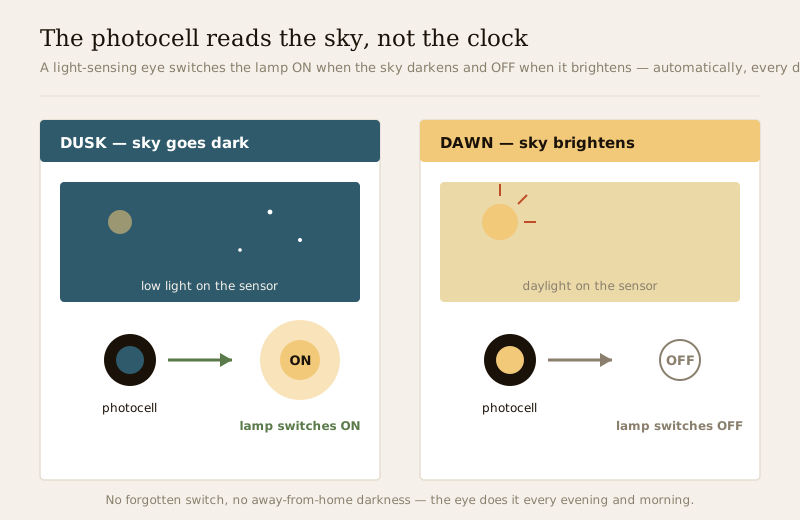
That distinction — tracking darkness rather than the clock — is the whole point, and it is why a photocell beats a timer for security (more on that below). It means the light comes on later in June and earlier in December on its own, comes on early on a heavily overcast monsoon evening, and never leaves the property dark because someone forgot to change a schedule. For a home that is sometimes empty, that is the difference between a security layer and a decoration.
Dusk-to-dawn is a switching strategy, not a fixture type. You can find it built into a bulb, a wall pack, a bollard, a street-style pole light or a solar lamp; you can also add a standalone photocell to an existing circuit so that an ordinary fixture becomes automatic. What matters for security is the behaviour: on at dark, off at light, unattended.
Why a steady low base matters — for security and for the camera
There are two honest reasons to keep a light on all night rather than only when something moves, and the second is the one most homeowners miss.
The deterrent reason. A property that is always lit, evenly and quietly, reads as cared-for and watched. An opportunist scanning a street for an easy target prefers the dark plot to the lit one; a steady base pays much of its value before anyone approaches. A scene that is black until motion snaps a floodlight on can still be probed from the shadow first — the intruder learns exactly where the light will and will not reach.
The camera reason. This is where dusk-to-dawn earns its place decisively. A camera needs a steady, lit scene — not darkness-until-motion. A CCTV camera left staring at a black yard records grain and noise; when a motion light finally fires, the camera's exposure is caught flat-footed, blooming from black to glare, and the crucial first second — the approach, the face — is lost to the adjustment. Even a good low-light camera does far better with a modest, even base than with a violent dark-to-bright swing, because its low-light performance depends on a stable scene it can expose for. A low dusk-to-dawn base gives the camera something to see by all night; the CCTV-compatible lighting guide works through pairing the two on one plan. Put simply: motion-only lighting is designed for the human eye; the camera wants the base.
So the base is not wasted energy — it is the illumination that makes your recording usable. The trick, covered next, is to keep that base low, and let motion do the rest.
The smart move: a low dusk-to-dawn base plus a motion boost
The standard security pattern — the one to design toward — is not "dusk-to-dawn OR motion." It is both, layered:
- a low, continuous dusk-to-dawn base on the boundary, gate and the approaches the camera watches, so there is always enough even light to deter and to record by; plus
- a motion boost on the same approaches, so the level lifts to full brightness the instant someone enters — startling the intruder, alerting anyone watching, and dropping back to the quiet base afterwards.
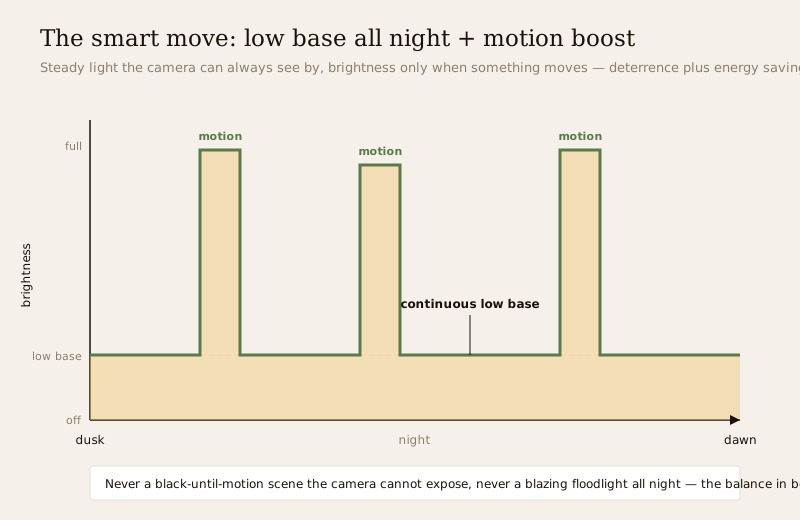
This layered scheme is the best of both worlds. The base gives the steady deterrence and the camera-friendly scene; the boost gives the sharp, energy-saving alert without running full floods all night. It is also the greener choice: a low-wattage base plus occasional boosts uses a fraction of the power of blazing floodlights held on until dawn. The motion half of this pairing — sensor aiming, sensitivity, avoiding the cat-and-auto false-trigger trap — is covered in full in the motion-activated security lighting guide; treat this page and that one as two halves of one switching design.
| The scheme | What runs all night | What lifts on motion | Why it wins |
|---|---|---|---|
| Dusk-to-dawn low base only | Even low light | Nothing | Great for camera, weaker sudden-alert effect |
| Motion-only floods | Nothing (dark) | Full flood | Startles, but camera sees black between events |
| Base + boost (recommended) | Low even base | Full boost | Steady deterrence, camera-ready, energy-lean |
| Floodlights all night | Full flood | Nothing | Wasteful, glary, dazzles the camera, annoys neighbours |
Photocells: types and where to put the eye
A photocell is cheap and reliable, but only if it can actually see the sky. Most dusk-to-dawn failures are placement failures, not component failures.
Types you will meet. The eye may be built into the fixture (a lens on the side of a wall pack or bulb), a separate wall-mounted sensor wired to control one or more fixtures, or a street-light-style cell on a pole head. Solar dusk-to-dawn lamps almost always use their own solar panel doing double duty as the light sensor — when the panel stops generating at dusk, the lamp switches on. The principle is identical across all of them: read the sky, switch accordingly.
The one rule that matters: the sensor must see open sky, and must not see its own lamp. Two placement mistakes cause almost all the grief.
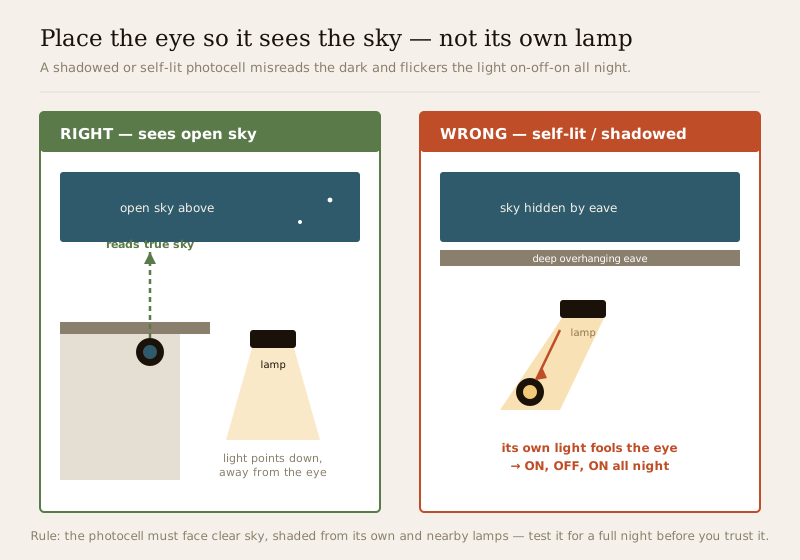
- Shadowed / blocked. A cell tucked under a deep eave, behind a parapet, inside a portico or shaded by a tree may sit in shadow well after real dawn and switch on too early or stay on into the day — or, if a nearby streetlight or a neighbour's flood spills onto it at night, refuse to switch on at all. Give the eye a clear view of the sky, away from foliage that will grow into it.
- Self-lit — the classic cycling fault. If the photocell can see the very lamp it controls, you get a maddening loop: darkness switches the lamp on, the lamp's own light hits the sensor, the sensor reads "daylight" and switches off, darkness returns, it switches on again — on-off-on all night, flickering, buzzing the relay, and shortening the fixture's life. The fix is geometry: position the eye so the lamp's light cannot fall back on it (face the sensor away from and above the lamp, or use a fixture whose sensor is shielded by design), and keep it clear of nearby lights that do the same thing.
The practical test is patience: after fitting, watch the fixture across a full night and a real dawn before trusting it. A photocell that behaves for five minutes at the shop can still cycle at 2 a.m. once its own beam finds the sensor.
Timers versus photocells: prefer the photocell
A timer is the tempting alternative — "just switch on at 6:30 and off at 6:00." For security lighting in India it is the weaker choice, for one simple reason: a timer keeps clock time; the sun does not.
| Timer | Photocell (dusk-to-dawn) | |
|---|---|---|
| Tracks the real sunset | No — fixed clock time | Yes — reads actual darkness |
| Copes with seasonal drift | No — needs resetting through the year | Yes — automatic all year |
| Overcast / storm dusk | Ignores it — stays dark | Switches on early, when it is actually dark |
| Power-cut clock reset | Often loses time, fires at wrong hours | Unaffected — no clock to lose |
| Best security role | Scene / decorative scheduling | The automatic on-at-dark base |
India's sunset swings by well over an hour between June and December, and it varies by longitude across the country, so a fixed timer either leaves the gap of dusk unlit for weeks or burns the light in daylight — and it needs the owner to remember to adjust it. Worse, many cheap timers lose their setting in a power cut and start firing at the wrong hours. A photocell tracks genuine darkness and needs no seasonal minding. Use a timer, if at all, for scene scheduling (a decorative wash you want off after 11 p.m.); use a photocell for the security base. The two can be combined — a photocell to catch real dusk, a timer to trim the deep-night hours — but the dark-sensing job belongs to the cell.
The energy question, honestly
The objection to leaving a light on all night is the electricity bill, and it deserves a straight answer: a low-wattage LED base run dusk-to-dawn is genuinely cheap — modern LED draws little, and a modest even base across a boundary is a small nightly cost for a real security layer. What is not cheap, and what people wrongly picture when they hear "on all night," is blazing high-wattage floodlights held on until dawn. Do not confuse the two. Dusk-to-dawn security lighting is a low base, not a wall of floods.
The efficient, secure and neighbourly design is the layered one from earlier: low dusk-to-dawn base + motion boost + zoning, so full brightness happens only where and when something moves, and the deep-night hours run on the lean base alone. That both saves power and lights better than a permanent glare the eye and the camera simply adapt to. The full arithmetic — wattage choices, running cost, where zoning saves most — is worked through in the security lighting energy-use guide; the honest headline is that automation saves energy against the two bad extremes (lights left on by hand in daylight, or floods blazing all night).
Solar dusk-to-dawn lights, and their limits
Solar dusk-to-dawn lamps are attractive in India: no wiring to the spot, no running cost, and the panel doubles as the dusk sensor so they are automatic by nature. For a boundary run far from a power point, or a wall where trenching a cable is a headache, they earn their place — the solar security lighting guide covers sizing and siting in full.
But be clear-eyed about the season. A solar light is only as good as the worst charging day it must survive, and two Indian realities test it hard:
- Monsoon. Days of thick cloud can leave the panel under-charged; a lamp sized for sunny days fades to a dim glow or dies mid-night exactly through the wet weeks when you most want it.
- Winter's short days. Fewer daylight hours and a low sun mean less charge going in and a longer night to cover — the classic "solar light that quits by December."
The design answers are honest ones: size the panel and battery for the worst month, not the best; keep the panel clean and clear of shade and dust; and for anything genuinely security-critical, do not rely on solar alone — keep a wired dusk-to-dawn base as the dependable layer and let solar supplement it. A solar lamp that dies at 1 a.m. in August is worse than no plan, because it was trusted.
Power-cut backup: the base must survive an outage
The sharpest India-specific point comes last, because it undoes everything else if ignored. A dusk-to-dawn light wired mains-only is dark exactly when it matters most. A power cut — whether an ordinary grid failure or one arranged by someone who does not want to be seen — takes the light, and often the camera and the router with it, in the same instant. The automation that was meant to guarantee light instead guarantees nothing.
Plan the base to ride through an outage:
- Battery or inverter circuit. Put the security base — and the cameras — on the inverter / UPS-backed circuit, sized to hold the low base through a typical cut. A low-wattage base is easy to back up precisely because it is low.
- Solar with a real battery as covered above, which is inherently outage-independent for the fixtures it powers — provided it is sized honestly for the season.
- Confirm the camera has backup too, since a lit scene with a dead recorder catches nothing, and a live recorder in the dark records nothing.
The emergency and egress side of a power failure — keeping an escape route visible during an outage or evacuation — is a separate life-safety subject; that belongs to the emergency lighting guide and must never be conflated with, or obstructed by, the security base here.
Bringing in the professionals
Own the design decisions on this page — that the fixture is dusk-to-dawn, where the sensor faces, that the base is low and layered with a boost, that it is backed up. Hand over the qualified craft:
- A licensed electrician for all mains wiring, the photocell's connection into the circuit, load and earthing, weatherproofing, the inverter tie-in, and any fixture at height — route it through the electrical hub. Outdoor security wiring is not a DIY job.
- A lighting designer to set the actual base illuminance, uniformity and the boost level to the code, and to specify fixtures and optics so the base is even and glare-free rather than a hotspot.
- A security integrator to marry the lighting base and boost to the perimeter CCTV and outdoor CCTV plan, so the light the camera needs and the camera itself are designed on one drawing.
Where the property sits inside a society, the boundary base is shared infrastructure planned once for everyone — see the gated-communities security guide. To find where your own plot goes dark and where an automatic base would matter most, run the lighting and visibility security assessment and the home security risk scorecard tool.
Key takeaways
- Dusk-to-dawn = a photocell, not a clock. A light-sensing eye switches the lamp on at real dusk and off at real dawn, automatically, whether or not anyone is home — so the property is never left dark by a forgotten switch.
- Keep a low steady base all night, mainly for the camera. A camera needs a lit scene to record by, not darkness-until-motion; a low dusk-to-dawn base gives it that and deters at the same time.
- Layer it: low base + motion boost. The standard security scheme runs a lean dusk-to-dawn base and lets motion lift the level only when something approaches — steady deterrence, camera-ready, and energy-lean.
- Place the eye to see the sky, never its own lamp. A shadowed sensor misfires; a self-lit one cycles on-off-on all night — test the fixture across a full night before trusting it.
- Prefer a photocell to a timer, because India's sunset drifts by season and longitude and timers lose their setting in a cut; and back the base up with an inverter, UPS or honestly-sized solar so it survives the power failure that would otherwise take the light, the camera and the confidence together.
Where to go next
- The switching pair — motion-activated security lighting, the boost that partners this base.
- Light for the camera — CCTV-compatible lighting and the low-light CCTV camera and CCTV low-light performance guides.
- Power and cost — solar security lighting and the security lighting energy-use guide.
- The whole plan — the security lighting design guide and the boundary spoke perimeter / security lighting.
- The wider security picture — the lighting sub-hub, the security hub, the gated-communities security guide, and the home security risk scorecard tool.
References
- SP 72 : 2025 — National Lighting Code of India (Bureau of Indian Standards) — the primary reference for illuminance, uniformity and glare across indoor and outdoor lighting; treat the actual base and boost levels as figures a qualified lighting designer sets to this code. Verify the current edition via the BIS catalogue: https://www.services.bis.gov.in/
- IS 3646 (Part 1) : 2025 — Code of Practice for Interior Illumination (Bureau of Indian Standards) — for lobbies, corridors and stair halls where amenity and security lighting overlap. Verify current status; do not rely on the withdrawn Parts 2 and 3.
- National Building Code of India, SP 7 : 2026, Part 8 Section 1 (Lighting & Ventilation) — for the lighting and electrical provisions of the building and its services, read with local municipal bye-laws and any light-nuisance provisions. Verify the current edition via the BIS catalogue: https://www.services.bis.gov.in/
- Digital Personal Data Protection Act, 2023 — where dusk-to-dawn lighting supports cameras overlooking a neighbouring property or a public road, the footage is personal data; agree access, storage and privacy handling, and keep credentials private.
This is an educational overview, not legal or engineering advice. It is strictly about keeping your own property lit defensively so it deters intrusion and lets your cameras see, never about defeating any security measure. Mains wiring, connecting a photocell into a circuit, inverter tie-ins and any fixture mounted at height are qualified professional tasks — engage a licensed electrician and a lighting designer, never block an egress route, and verify any standard's current edition via the BIS catalogue before relying on it.
Export this guide
Related Guides — Deep-dive reading
Motion-Activated Security Lighting in India (2026): Sensor Types, the False-Trigger Problem, and Pairing Motion With a Base Light So Your Camera Never Goes Blind
How PIR, microwave and dual-tech sensors really behave in Indian conditions, how to stop the stray-dog-and-passing-auto false triggers that make owners disable the light, and why a motion-only light leaves a camera dark until it is too late.
SecuritySolar Security Lighting in India (2026): Where It Genuinely Works, and the Honest Reasons It Fades in the Monsoon
An all-in-one solar security light needs no cabling to a far gate and no running cost, which is exactly why it is oversold. This guide shows a homeowner where solar lighting is genuinely the right answer, where wired dusk-to-dawn is safer, and how to buy one that does not die at 2am in July.
SecuritySecurity Lighting Energy Use in India (2026): Keeping Your Home Lit and Safe Without Running Up the Bill
The honest answer to "won't security lighting cost a fortune to run?" It does not have to. Done well, with efficient LEDs and smart switching, a home stays well protected on a fraction of the energy a blazing all-night floodlight burns, and it is safer for it.
SecurityRelated Tools — Try Free
Security Backup Power Calculator
Size a UPS/inverter and battery to keep CCTV, NVR, router and alarm running through a power cut — load, Ah, VA and cost.
Backup PowerAccess-Control Battery-Backup Calculator
Size the standby battery so an access system keeps running through a power cut, with an egress life-safety note.
Battery BackupSolar CCTV Sizing Calculator
Enter cameras, sun-hours and backup days to get the solar panel wattage, battery Ah and an indicative kit cost for an off-grid camera.
Solar Sizing