
Lighting for Facial Identification in India (2026): How Light Turns CCTV Footage From a Hooded Shape Into a Face You Could Name
Detection, recognition, identification: how to light the gate, door or lift lobby so a camera captures a face that is actually identifiable as evidence, not just proof that someone was there.
Play back a break-in on most home or society CCTV and you get the same disappointing clip: a shape crosses the frame, maybe pauses, maybe reaches for something — and you cannot say a single useful thing about who it was. Hood up, face black, gone. The footage proves someone was there. It does not tell you, or the police, who. Almost always the camera was fine. What failed was the lighting for facial identification — there was no light on the face, or the wrong light in the wrong place, so the one detail that matters was never captured.
This guide is part of the Studio Matrx security lighting library and sits under the security lighting design guide pillar. It is written for the person planning or specifying a system — a designer, an integrator, an informed homeowner or an RWA committee — who wants footage that can actually name a face. It is qualitative throughout: no fabricated lux, pixel or colour-temperature figures, just the design decisions that move a camera up from "a hooded shape" to "a face you could give to a station house officer."
Scope, honesty & safety. This guide helps you plan, choose and coordinate lighting so a camera can capture an identifiable face, strictly as a defensive evidence layer — never how to defeat or dazzle anyone else's cameras or lighting. You do the deciding; any mains wiring, and any fixture mounted at height, is licensed-professional work — route it to a licensed electrician (see the electrical hub) and set actual illuminance to the applicable code with a lighting designer. Never let a light or camera fixture block an egress path. Face capture and any facial recognition are personal and biometric data — handle them lawfully (more below). Verify any standard's current status and your local bye-laws before relying on them. This is educational guidance, not legal advice.
The ladder: detection, recognition, identification
The single most useful idea in this whole subject is that CCTV usefulness is a ladder with three rungs, and lighting is what carries footage up it.
- Detection — something moved. The camera registers that an object or person crossed the scene. Motion was there; that is all. A dark shape against a slightly-less-dark background clears this bar.
- Recognition — a person, and maybe someone you know. You can tell it is a human being, guess their build, clothing and gait, and perhaps say "that looks like the meter reader" or "that is not one of ours." But you could not swear to it, and neither could a stranger.
- Identification — a face you could name. The image carries enough facial detail — features, proportions, colouring — that a person could be identified from it, or the still handed to police as evidence. This is the rung that actually protects you after the fact.
Most Indian home and society cameras live permanently on the bottom rung. They detect beautifully and identify almost never, because at the moment a face is in frame, there is no usable light on it. The camera does its part; the lighting never did its part.
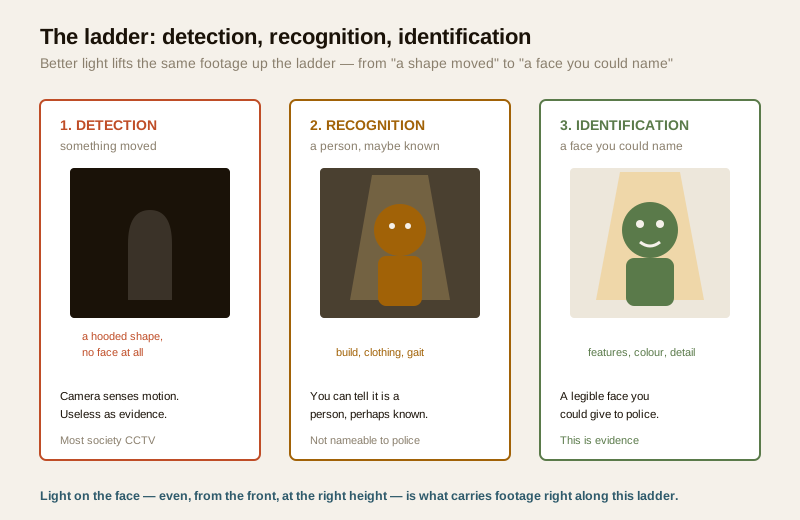
Two things climb this ladder together: the camera and the light. How many pixels land on a face is the camera's job — resolution, lens, how tightly it is framed, how close the subject is (see low-light CCTV cameras for that side). But pixels are only worth having if they are usable, and usable is what lighting delivers. A high-resolution camera pointed at an unlit or backlit face just captures a lot of pixels of black. You need both: the camera to resolve the detail, the light to make that detail exist. This guide is about the light half.
| Rung | What the clip shows | What you can do with it | Where most CCTV sits |
|---|---|---|---|
| Detection | A shape crossed the frame | Confirm an event happened; trigger an alert | Where the light was wrong |
| Recognition | A person, build and clothing legible | Narrow it down; "one of ours" or not | With some light on the scene |
| Identification | A face with nameable detail | Identify a person; hand a still to police | Only where a face was truly lit |
You may reference this detect / recognise / identify ladder conceptually; the exact pixels-on-target thresholds that separate the rungs are a camera-and-lens calculation a designer runs to the applicable standard, not a number to quote from memory.
What an identifiable face actually needs from the light
Lifting footage to the identification rung comes down to a handful of lighting conditions. Miss any one and you fall back down the ladder.
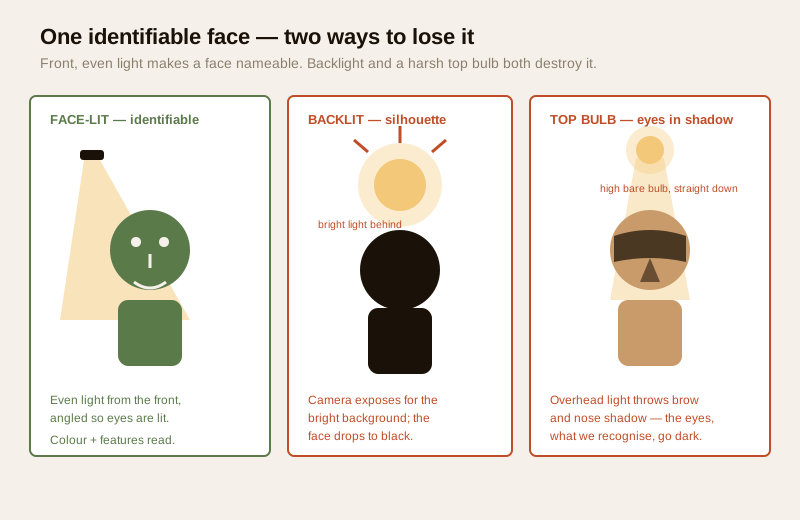
Light must be ON the face, from the front — not behind it. This is the single commonest failure in the country. A bright source behind the subject — a floodlight further out, a street lamp, a bright doorway, the sky itself — makes the camera expose for that bright background and drop the face into pure black. You get a silhouette: a person-shaped hole with no features at all. The fix is a rule you can hold in one sentence: light the face, not the lens. The face-light comes from the camera's side, falling forward onto the person, never from behind them and never straight into the sensor. This backlight discipline is the shared spine of glare-free security lighting and CCTV-compatible lighting.
Light must be even, with no harsh top-shadow hiding the eyes. The eyes and the region around them are what humans and matching alike use to identify a face. A single high bare bulb pointing straight down — the default Indian security fitting — throws a hard shadow from the brow and nose that drops the eyes into darkness exactly when you need them. The face is lit and still not identifiable. Soften the source and angle it so light reaches into the eye sockets: a light coming somewhat from the front and side, rather than straight down from directly overhead, keeps the eyes out of shadow.
There must be enough light for colour, where colour matters. "Male, medium build, dark shirt" is far weaker than "male, medium build, mustard-yellow shirt, fair complexion." Colour is identifying detail — skin tone, clothing, a uniform. Capturing it needs white light, not the camera's infra-red (IR) night mode, which renders everything in greyscale. IR keeps a scene visible and is right for pure detection in the dark, but at a point where you need to describe a person, you need visible white light on them. Prefer a white light with decent colour rendering; avoid a very cool, blue-heavy lamp that many cameras render harshly — a warm-to-neutral white usually reads best on camera without any fabricated kelvin figure. This is the trade covered in low-light camera illumination.
It must happen at a choke-point framed for a face. You cannot light every square metre of a plot to identification quality, and you should not try. Identification happens at a choke-point — a place everyone must pass through, at a controlled range and height: the gate, the front door, the lift lobby, the stairwell entry. Concentrate the identification-grade light and the identification camera there, and let the rest of the site run on ordinary detection lighting. Cross-link entrance lighting for security and perimeter CCTV for how those choke-points sit in the wider scheme.
The identification camera is not the overview camera
Here is the design move most sites miss. The camera that watches the scene and the camera that captures a face are two different cameras doing two different jobs, and they want opposite things.
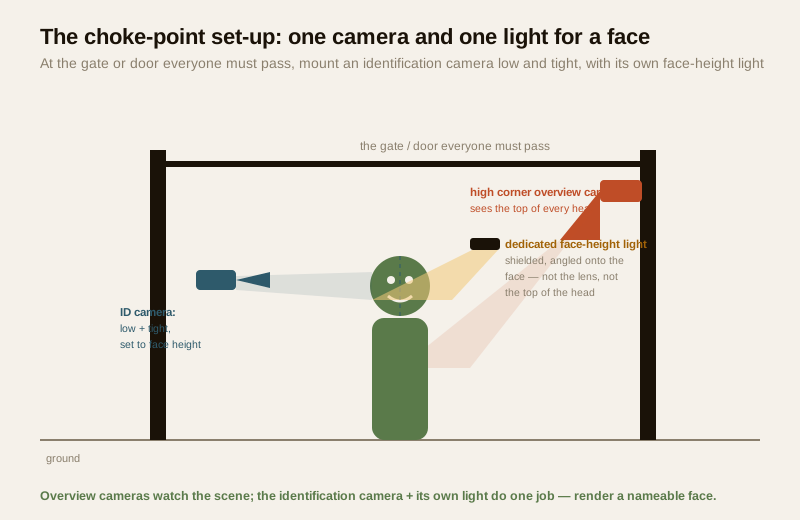
An overview camera sits high in a corner, pulls back to cover as much ground as possible, and answers "what is happening and where." It is a wide, high, detecting eye. The trouble is that a high corner camera looking down at a wide scene mostly captures the tops of people's heads — hair and shoulders, never a face. It is the classic Indian society install: one camera in the corner, lighting and framing the crowns of everyone who passes. Superb for detection. Nearly useless for identification.
An identification camera does the opposite. It is mounted lower and tighter — roughly toward the height a face passes, framed narrow on the choke-point so that when a person comes through, their face fills enough of the frame to carry real detail. It watches one line, not the whole yard. And it gets its own dedicated light, placed to fall on the face from the front at that exact point — not the general area floodlight, which is usually too high, too broad, and aimed at the ground.
- Keep the overview camera doing its wide detecting job; do not ask it to identify.
- Add a dedicated identification camera at each choke-point, mounted lower and framed tighter, toward face height.
- Give that camera its own front, face-height light, shielded so it lands on the face and never glares into the lens.
- Match the light to the camera: white for colour capture at that point, even, no harsh top-shadow.
The Indian reality, and how to fix it cheaply
Walk into most gated societies and you find the same three habits, all of which pin the whole system to the detection rung.
- One high corner camera doing everything. It watches the gate, the drive and the visitors' seating all at once, from up in a corner — and identifies none of them, because it only ever sees the tops of heads. The fix is not a better camera up there; it is a second, lower, tighter camera with its own light at the point where identity actually needs verifying.
- A floodlight that dazzles the very camera it was bought for. A bright unshielded flood aimed roughly across the yard puts glare straight into the camera lens and silhouettes anyone standing between the two. It looks bright to a person standing there and gives the camera nothing. Shield it, aim it onto the face-zone from the camera's side, and the same wattage suddenly helps the camera.
- IR night mode doing the whole job. The system flips to greyscale IR after dusk and every clip is colourless. Fine for the perimeter's detection role; wrong at the one choke-point where you would later want to say what colour the shirt was. Add modest white light at that point so the identification camera captures colour when it matters.
None of these fixes is expensive. Identification is a matter of placement and aim far more than of spend — one well-sited camera and one well-aimed light at the right choke-point beats a dozen high corner cameras washing everyone's scalp. To find where your own site sits on the ladder — where footage would give you a face and where it would give you a shadow — the home security risk scorecard and the site perimeter security assessment are useful starting points, and the lighting and visibility security assessment guide walks the whole site methodically.
Privacy, biometrics and the DPDP Act: capture only what security needs
Lighting a face well is powerful, and power here comes with a legal and ethical duty that you must design in from the start, not bolt on later.
A captured face is personal data. Run any facial-recognition matching on it and you are processing biometric data — a more sensitive category still. Under the Digital Personal Data Protection Act, 2023, footage that identifies people is personal data with real obligations around purpose, security, access and retention. The whole point of this guide — making faces genuinely identifiable — is exactly what raises the stakes, so handle it honestly:
- Capture only what security needs. Point identification cameras at your own choke-points — your gate, your door, your lobby — not into a neighbour's window, a public footpath, or the flat opposite. A camera that identifies faces it has no business identifying is a liability, not a safeguard.
- Do not run ad-hoc facial recognition on neighbours, staff or visitors. Capturing a face for evidence if something happens is one thing; quietly matching every domestic worker, delivery rider and passer-by against a list is another, and it is not the homeowner's or the RWA's job to build. Keep the system to its defensive evidence purpose.
- Secure the footage and control access. Identifiable face footage must be stored securely, with access limited to those who genuinely need it, and retained only as long as the security purpose requires. Loose access to a face archive is its own harm.
- Post clear notice. People are entitled to know a place is under CCTV. A visible notice at monitored entrances is both good practice and part of lawful, transparent handling.
These duties are set out more fully in the building security systems guide and the security guide for gated communities; treat them as inseparable from the lighting design, because better identification lighting means a heavier data-protection responsibility, not a lighter one.
| Design choice | The security gain | The responsibility it creates |
|---|---|---|
| Front, even white light on a choke-point face | Identifiable face; usable evidence | Identifiable footage is personal data under the DPDP Act |
| Dedicated low, tight identification camera | A face, not a scalp; nameable stills | Aim only at your own choke-point, not neighbours |
| Colour capture at the choke-point | "Mustard shirt", not "dark shape" | Secure storage, limited access, defined retention |
| Any facial-recognition matching | Faster known-vs-unknown sorting | Biometric data — higher duty; avoid ad-hoc use on staff / neighbours |
Key takeaways
- Think in three rungs — detection, recognition, identification. Most Indian CCTV sits on detection ("a shape moved"); lighting is what carries footage up to identification ("a face you could name").
- Light the face, not the lens. The commonest failure is a subject silhouetted by a light behind them — put the face-light on the camera's side, front-on, and keep every source out of the lens.
- Even light, no top-shadow, and colour where it matters. Soften and angle the source so the eyes are lit, not shadowed by a bare overhead bulb, and use white light — not IR — at the point where you would want to describe skin or clothing colour.
- Identification is a choke-point job with its own camera and light. Mount an identification camera lower and tighter than the overview camera, toward face height, with a dedicated front light — don't ask one high corner camera to do everything.
- Better identification means heavier privacy duty. Face capture is personal data and any recognition is biometric data under the DPDP Act 2023 — capture only what security needs, aim only at your own choke-points, secure it, post notice, and never run ad-hoc face recognition on neighbours or staff.
Where to go next
- Security lighting design guide — the pillar that frames light as a security system across the whole plot.
- Glare-free security lighting and CCTV-compatible lighting — the backlight and colour discipline that lifts a face onto the identification rung.
- Low-light camera illumination and low-light CCTV cameras — the camera side: pixels, IR versus white light, and colour at night.
- Entrance lighting for security and perimeter CCTV — how the choke-point sits inside the wider scheme.
- Building security systems guide and security guide for gated communities — the privacy, notice and data-handling duties that come with identifiable footage.
- Home security risk scorecard — map where your footage would give you a face and where it would give you a shadow.
References
- SP 72 : 2025 — National Lighting Code of India (Bureau of Indian Standards) — the primary reference for illuminance, uniformity and glare where a face must be legible to a camera; treat specific levels as figures a lighting designer sets to the current edition. Verify status via the BIS catalogue: https://www.services.bis.gov.in/
- IS 3646 (Part 1) : 2025 — Code of Practice for Interior Illumination (Bureau of Indian Standards) — for any covered lobby, lift lobby or vestibule choke-point that reads as a working interior; verify the current edition via the BIS catalogue: https://www.services.bis.gov.in/
- National Building Code of India, SP 7 : 2026, Part 8 Section 1 (Lighting and Ventilation) together with local municipal bye-laws — for the lighting aspects of an outdoor or common-area install; verify the current edition via the BIS catalogue: https://www.services.bis.gov.in/
- Digital Personal Data Protection Act, 2023 — where cameras capture identifiable faces, the resulting footage is personal data, and any facial-recognition matching is biometric-data processing; design purpose, notice, access, security and retention accordingly, and keep the system to its defensive evidence purpose.
This is an educational overview, not legal advice. It is strictly about lighting a scene defensively so a camera can capture an identifiable face as evidence, never about defeating, dazzling or evading any security measure. Mains wiring, work at height, and setting illuminance levels are qualified professional tasks — engage a licensed electrician and a lighting designer, never block an egress path, handle identifiable footage lawfully under the DPDP Act 2023, and verify any standard's current status via the BIS catalogue before relying on it.
Export this guide
Related Guides — Deep-dive reading
CCTV-Compatible Lighting for Indian Homes (2026): How to Light a Scene So the Camera Actually Sees It
The bridge between your lighting and your cameras — why a scene that looks fine to your eye can still be useless footage, and how uniformity, no light in the lens, the right white and flicker-free drivers make the difference.
SecuritySecurity Lighting Design for the Whole Property (India 2026): The Principles, the Zones and the Library Map
How to light an entire property as a security layer that deters and lets cameras see — the four design principles, the zones to cover, and where every deeper guide fits, done without dazzling your own CCTV or the neighbour.
SecurityStaircase and Corridor Security Lighting in India (2026): Even Light, No Dark Half-Landings, Never Switched Off Mid-Flight
How to light the shared stairs, lobbies, corridors and passages of an apartment building so they are safe to move through and never a place someone can wait unseen, without ever compromising the code emergency lighting on the escape stair.
SecurityRelated Tools — Try Free
Circadian Light Meter
Patient-centric circadian lighting visualizer for Indian healthcare design — time-of-day × intensity → CCT, melanopic lux (EML / mEDI), melatonin suppression, and an alertness curve. Calibrated against WELL v2 L03 Circadian Lighting Design, CIE S 026:2018, Brainard 2001, and Lucas et al. 2014.
Circadian ToolHome Security Risk Scorecard
Score your home across six security layers — perimeter, entry points, lighting, detection, alarm and habits — and get a prioritised action plan.
Security ScorecardBefore & After Studio
Generate AI before-and-after renders to preview how your redesign could look.
DesignAI