
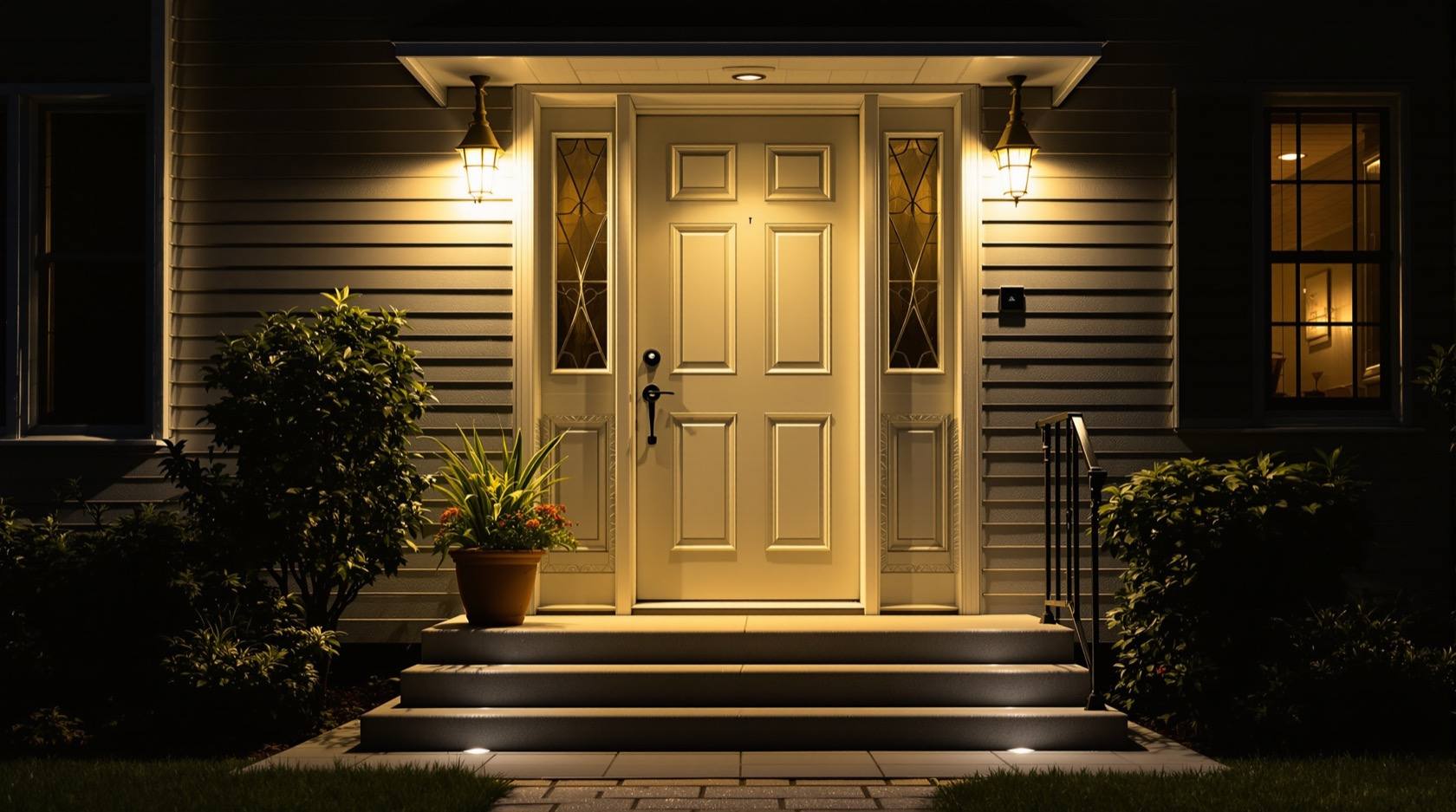
Entrance Lighting for Security in India (2026): Lighting the Gate, Approach and Door So an Arriving Visitor Is Clearly Seen
How to light your front door, gate and approach so a caller's face is legible to you, the door camera and the video door phone, without dazzling the resident, silhouetting the visitor, or spilling glare onto the street.
The entrance is not just another stretch of your boundary to light. It is the one place where a stranger and your household actually meet, and the one place where a single question has to be answered every time: who is this, and do I open the door? Every other light on the plot helps you see movement. The entrance lighting has a harder job — it has to make a face legible, at the gate and again at the door, so that you, the door camera and the video door phone (VDP) can all recognise or record whoever has arrived. Get it right and the entrance is a calm, welcoming, well-watched threshold. Get it wrong and you have the most common Indian doorway failure of all: a caller reduced to a black shape on the VDP screen, and a resident squinting into their own glare while they decide whether to unlock.
This guide is part of the Studio Matrx security lighting library and sits under the security lighting design guide pillar; the security lighting spoke covers the boundary as a whole, while this one zooms in on the entrance — the gate, the approach and the door — where identity is verified. It is written to be qualitative: no fabricated lux or colour-temperature figures, just the design decisions you actually make.
Scope, honesty & safety. This guide helps you plan, choose and coordinate entrance lighting, strictly as a defensive layer that lets people and cameras see. You do the deciding; any mains wiring, and any fixture mounted at height, is licensed-professional work — route it to a licensed electrician (see the electrical hub), and set actual illuminance levels with a lighting designer to the applicable code. Never let a light or its fixture block the door's egress path. Verify any standard's current status and your local bye-laws before relying on them. This is educational guidance, not legal advice.
Why the entrance is a special lighting problem
Everywhere else on the plot, security light does a broad job — deter, and let a camera see movement. At the entrance the job narrows to something much more exact: verify identity. When your VDP chimes at night, you are not asking "is someone there" — you already know that. You are asking "who, and are they who they claim to be." That question can only be answered if the caller's face is genuinely lit and pointed at the light, not away from it.
That makes the entrance the place where lighting and cameras are most tightly coupled. The door camera and the VDP are only as good as the light falling on the face in front of them — the same truth that runs through low-light camera illumination, lighting for facial identification and CCTV-compatible lighting. A camera in a dark porch sees noise; a camera facing a bright light behind the caller sees a silhouette. Entrance lighting is where those two library ideas meet a real front door.
It is also the one security light your guests stand under. Unlike a boundary floodlight, the entrance light is guest-facing and identity-facing at once — it has to be welcoming enough that an invited visitor feels received, and honest enough that an uninvited one is clearly on camera. Holding both at the same time is the whole craft of it.
Two entrance zones: the gate and the door
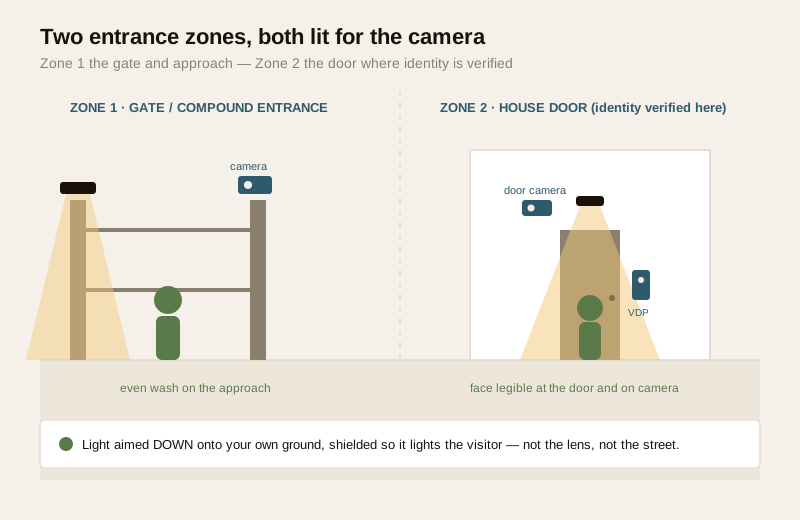
Most Indian homes have not one entrance but two, and they need lighting thought of separately.
The gate / compound entrance. This is the outer threshold — where a visitor first arrives, presses the intercom or calls out, and where a vehicle waits to be let in. It is often watched by a gate camera and served by a gate intercom or VDP. The lighting job here is a legible face at the calling point and an even wash over the gate and the compound wall opening, so the person (and any vehicle) is clearly seen from the moment they arrive. This is the zone most likely to be far from the house and hardest to keep powered, which makes backup planning matter most here.
The house door. This is the inner, final threshold — where the actual decision to open is made, at the closest range, usually with a door camera and a VDP right at the frame. The lighting job here is the most exacting on the whole plot: an even, glare-free wash on the door and the last few steps of the approach, lighting the caller's face square-on without blinding the resident who opens up. If the plot has only one camera-and-VDP point, it is almost always here.
| Entrance zone | What is verified | Typical devices | Lighting priority |
|---|---|---|---|
| Gate / compound entrance | First arrival; vehicle at the gate | Gate camera, gate intercom / VDP | Even wash over the gate + a lit face at the calling point |
| House door | The decision to open, at close range | Door camera, VDP, doorbell | Glare-free even wash on the door + last steps; face lit square-on |
| The approach between them | Movement along the path/driveway | Approach camera, motion light | No dark gap; a lit path from gate to door |
The band between the two — the driveway, path or side passage — is the approach, and it must not be a dark tunnel joining two lit points. Even, continuous light (or a motion light that fills it on demand) keeps a visitor visible the whole way in, so they never disappear into shadow between the gate camera and the door camera.
Light the face, not the lens: the backlight trap
Here is the single most common — and most frustrating — entrance-lighting failure in India, and it is worth its own section because almost everyone gets caught by it at least once.
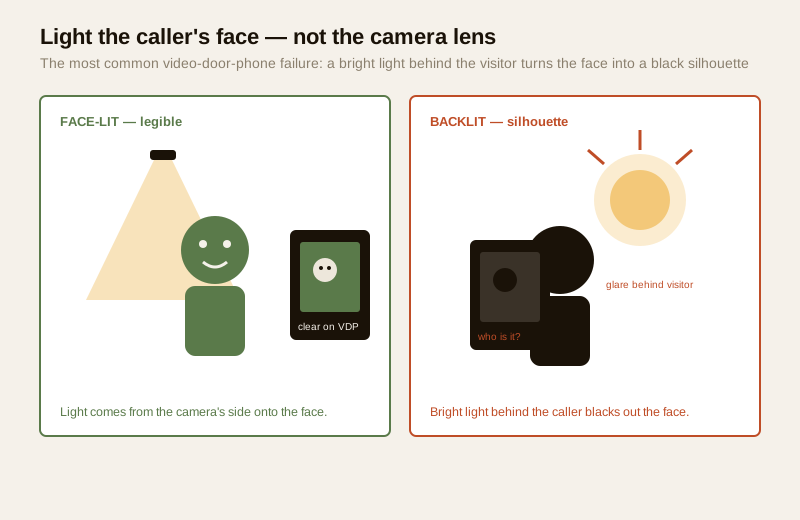
You buy a VDP, mount it beautifully at the door, and it works fine by day. Then at night a caller stands at the door and the screen shows a black shape with no face at all. What went wrong is almost never the camera — it is the light. There is a bright light source behind the visitor (a wall bracket further out, a porch bulb, the street lamp, even the moon over the gate) and the VDP's little sensor exposes for that bright background, dropping everything in front of it — the face — into pure black. This is the classic backlight, or contre-jour, trap.
The fix is a rule you can hold in one sentence: light the visitor's face, not the camera's lens. The light that makes a face legible has to come from the camera's side — from beside or just above the VDP, falling forward onto the person — never from behind them and never straight into the lens. Practically, that means:
- The main face-light at the door sits on the same side as the door camera and VDP, washing the caller from the front.
- Avoid a bright fixture, window, or bright wall directly behind where a caller stands — it is what silhouettes them. If one is unavoidable, add front light strong enough to balance it.
- Keep any light out of the lens's own field of view, so no source glares directly into the sensor. This is the same discipline as CCTV-compatible lighting and lighting for facial identification — position light so it illuminates what the camera looks at while staying out of what the camera sees.
Colour matters here too, but only qualitatively. A white light with reasonable colour rendering lets you read skin tone, clothing and a delivery uniform faithfully; a very cheap, colour-starved lamp makes everyone look the same washed-out grey. Avoid a very cool, blue-heavy light that many cameras render harshly at a doorway — a warm-to-neutral white is usually both kinder to the camera and more welcoming to a guest. Treat any specific colour-temperature number as a selection choice to confirm, not a rule.
An even wash on the door and the last steps
Beyond lighting the face, the entrance needs the door itself and the final approach lit evenly. Uniformity matters more than brightness. One bright spot on the door with the steps below it in shadow is worse than a moderate, even wash over both — because the eye and the camera both adjust to the bright spot and go blind to the dark around it, and the last two steps are exactly where a caller's hands (holding what?) and feet are.
- The door plane should be lit so the whole face-and-torso of a person standing at it is legible, top to bottom, with no harsh shadow slicing across the face from a badly placed fixture above.
- The last few steps of the approach should carry the same even light, so a visitor is fully visible as they arrive and while they wait — not appearing suddenly out of a dark path.
- Overlap, don't spotlight. Where the approach light and the door light meet, they should overlap into a continuous even level, leaving no dark seam between "approach" and "door."
Set the actual illuminance and uniformity to the level a lighting designer works out against the applicable code — SP 72 : 2025, the National Lighting Code, and the interior-illumination practice of IS 3646 (Part 1) : 2025 for any covered porch or lobby that reads as a working interior. These are the references a professional uses; the homeowner's job is to insist on even coverage, no hotspots, a legible face, and let the designer set the numbers.
Glare control: don't blind the resident or the street
A door light aimed carelessly does two kinds of harm at once, and both defeat the security purpose.
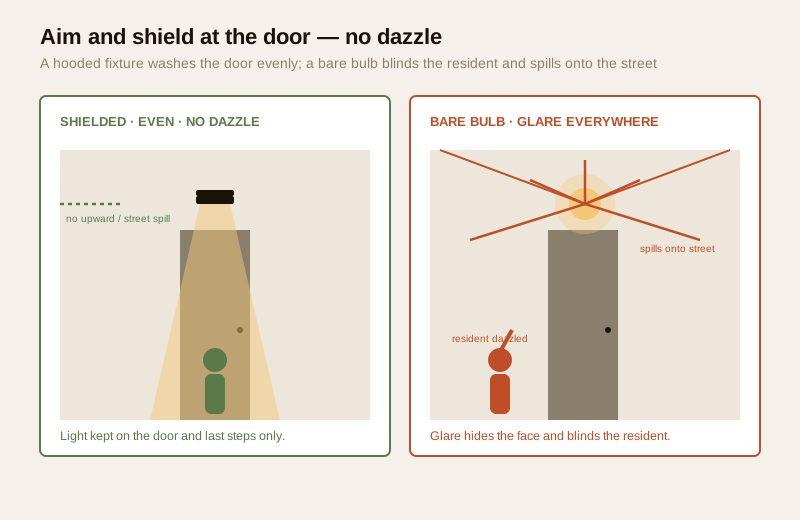
It blinds the resident. If the fixture throws light back toward the person opening the door — a bare bulb at eye level, or an up-facing lamp — the resident stands in glare and cannot actually see the caller's face clearly, which is the whole point. Worse, a caller with a bright light behind their head (from the resident's viewpoint) is again a silhouette. The door light must wash the caller from the resident's side and stay out of the resident's eyes: shielded, aimed down, mounted and hooded so the bright source itself is not in view.
It spills onto the street and next door. An unshielded entrance light throws glare across the public road (a dazzle hazard to passing traffic and pedestrians) and into a neighbour's window (a genuine, common source of RWA and neighbour disputes, and a growing light-pollution concern). Shield and aim so the light lands on your door and your steps, and stops at your boundary.
| Entrance-lighting failure (India reality) | What it causes | The done-well fix |
|---|---|---|
| Bright light behind the caller | Face blacks out on the VDP; you cannot verify who it is | Light the face from the camera's side; kill or balance the backlight |
| Bare bulb / up-lamp at the door | Resident dazzled; caller silhouetted; no legible face | Shielded, hooded, down-aimed fixture out of eye-line |
| One bright spot, dark steps | Eye and camera blind to the shadowed last steps | Even overlapping wash on door and last steps |
| Entrance light spilling to the road / next door | Dazzled traffic; neighbour dispute; light pollution | Shield and aim to contain light within your entrance |
| Very cool blue-heavy lamp | Harsh camera rendering; unwelcoming doorway | Warm-to-neutral white with decent colour rendering |
Switching: a base at the door, motion on the approach
The entrance is the one place a layered switching scheme really pays off, because the door and the approach want different behaviours.
Dusk-to-dawn base at the door. The door and its immediate face-lighting should generally stay on at a modest, steady level all night, switched by a photocell. The entrance is where a late caller, a delivery, or a returning family member arrives at any hour — there should never be a moment where the door is dark and the VDP is blind while a motion light warms up. A steady baseline also gives the door camera something to see all night, and reads as a cared-for, occupied home. This is the dusk-to-dawn security lighting idea, applied where reliability matters most.
Motion accent on the approach. Along the path and driveway up to the door, a motion-activated accent is ideal: it stays low or dark until someone approaches, then brings the approach up bright — startling an unwanted caller, alerting the household, and saving power the rest of the night. The base-plus-motion pairing means the door is never dark, and the approach lights up as a visitor comes in.
The standing caution with any outdoor motion light applies double at an entrance near a road: aim the sensor across your own approach, not out at the street. A sensor pointed at the gate-side traffic and street dogs will trip every few minutes all night, until the household stops noticing it or switches it off — and a motion light that cries wolf protects nobody. Aim it along the path a real visitor walks, and tune range and angle to the site rather than just cranking sensitivity.
Power-cut backup: don't go dark at the door
An entrance light on the mains alone is dark exactly when it matters most — during load-shedding, or when someone deliberately trips the supply before approaching. The entrance is the last place you want blind. Any entrance you rely on for security needs a backup so the door light, the door camera and the VDP all stay alive through a cut:
- Battery-backed door lighting and the camera/VDP on an inverter or UPS line, so the core door zone never blacks out.
- Solar-powered fixtures with their own battery for a far gate or a long approach that is hard to reach with backed-up mains — but chosen honestly: cheap solar entrance lights that die by 10 p.m. in winter, or stay flat through a monsoon week, are worse than useless because you think you are covered. Size the panel and battery for the worst season, and check the light still fires late on a short winter day.
- Confirm the backup covers the whole chain — light and camera and VDP and the gate release — not just the bulb. A lit door with a dead camera has lost half its value.
In a country of routine power cuts, a mains-only entrance is one that goes blind on a schedule an intruder can predict. Backup is not a luxury at the door; it is the difference between a security light and a decoration.
Welcoming but secure: the entrance is guest-facing too
Finally, remember the entrance light is the one security fixture your friends, family and invited guests stand under. It should not feel like an interrogation floodlight. The good news is that everything security wants here — a legible face, an even glow, no glare, no dark steps — is also what makes an entrance feel gracious and safe to an invited visitor. A warm-to-neutral, even, glare-free wash reads as welcome to a guest and as you are clearly seen to a stranger, at the same time. There is no trade-off to manage: do it well for security and it is automatically the better guest-facing light. The only thing to avoid is over-lighting the doorway into a harsh, prison-yard glare in the name of security — that dazzles everyone, guest and camera alike, and is the one way to make the entrance both unwelcoming and less secure.
To see where your own entrance is dark, backlit, or blinding, the home security risk scorecard is a useful starting point, and for the whole boundary the security lighting spoke and the security lighting design guide pillar tie it all together.
Key takeaways
- The entrance is where identity is verified, so it must be lit so a face is legible at the gate, along the approach, and at the door — for you, the door camera and the VDP alike.
- Light the face, not the lens. The commonest VDP failure at night is a caller silhouetted by a light behind them; put the face-light on the camera's side, kill or balance any backlight, and keep every source out of the lens.
- Think of two entrance zones — the gate/compound entrance and the house door — each with its own even wash, and never leave a dark gap on the approach between them.
- Control glare both ways: shield and aim down so the light never blinds the resident opening the door and never spills onto the street or into a neighbour's window.
- Switch it as base-plus-motion, and back it up: a dusk-to-dawn base at the door so it is never dark, a motion accent on the approach, and solar or battery backup so the entrance — light, camera and VDP together — survives a power cut.
Where to go next
- Security lighting design guide — the pillar that frames light as a security system across the whole plot.
- Security lighting — the boundary and perimeter spoke this entrance guide sits beside.
- Lighting for facial identification and low-light camera illumination — the deeper detail on lighting a face for a camera.
- CCTV-compatible lighting — matching colour and glare to what cameras want.
- Dusk-to-dawn security lighting and motion-activated security lighting — the two switching strategies used at the entrance.
- Gate security and compound wall security — the two structures the entrance lighting serves.
- Home security risk scorecard — map where your entrance is dark, backlit or dazzling.
References
- SP 72 : 2025 — National Lighting Code of India (Bureau of Indian Standards) — the primary reference for illuminance, uniformity and glare at an entrance; treat specific levels as figures a lighting designer sets to the current edition. Verify status via the BIS catalogue: https://www.services.bis.gov.in/
- IS 3646 (Part 1) : 2025 — Code of Practice for Interior Illumination (Bureau of Indian Standards) — for any covered porch, entrance lobby or vestibule that reads as a working interior; verify the current edition via the BIS catalogue: https://www.services.bis.gov.in/
- National Building Code of India, SP 7 : 2026, Part 8 Section 1 (Lighting and Ventilation) together with local municipal bye-laws and any light-nuisance / light-pollution provisions — for the lighting and neighbour-amenity aspects of an outdoor entrance install; verify the current edition via the BIS catalogue: https://www.services.bis.gov.in/
- Digital Personal Data Protection Act, 2023 — where entrance cameras and a VDP capture callers, delivery staff or a neighbouring approach, the resulting footage is personal data; agree storage, access and privacy handling, and keep credentials private.
This is an educational overview, not legal advice. It is strictly about lighting an entrance defensively so people and cameras can see an arriving visitor, never about defeating any security measure. Mains wiring, work at height, and setting illuminance levels are qualified professional tasks — engage a licensed electrician and a lighting designer, never block the door's egress path, and verify any standard's current status via the BIS catalogue before relying on it.
Export this guide
Related Guides — Deep-dive reading
CCTV-Compatible Lighting for Indian Homes (2026): How to Light a Scene So the Camera Actually Sees It
The bridge between your lighting and your cameras — why a scene that looks fine to your eye can still be useless footage, and how uniformity, no light in the lens, the right white and flicker-free drivers make the difference.
SecuritySecurity Lighting in India (2026): Lighting the Boundary Without Dazzling the Camera or the Neighbour
How to use light as a security layer that deters intruders and lets your cameras see, done well with uniform shielded downlight, no glare, no neighbour trespass and a power-cut backup.
SecuritySecurity Lighting Design for the Whole Property (India 2026): The Principles, the Zones and the Library Map
How to light an entire property as a security layer that deters and lets cameras see — the four design principles, the zones to cover, and where every deeper guide fits, done without dazzling your own CCTV or the neighbour.
SecurityRelated Tools — Try Free
Security Backup Power Calculator
Size a UPS/inverter and battery to keep CCTV, NVR, router and alarm running through a power cut — load, Ah, VA and cost.
Backup PowerAccess-Control Battery-Backup Calculator
Size the standby battery so an access system keeps running through a power cut, with an egress life-safety note.
Battery BackupCross-Ventilation Analyzer
Estimate airflow and air changes per hour (ACH) from room size, window areas, layout, and local wind — with NBC 2016 Part 8 compliance check.
Ventilation Calculator