
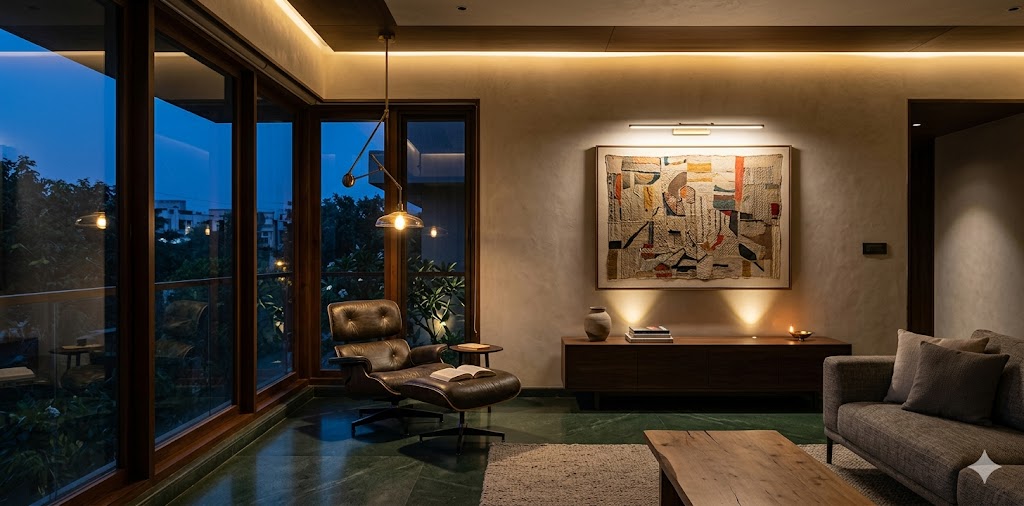
Architectural Lighting Design for Indian Homes
Ambient, Task, Accent — A Working Reference for Residential Lighting in India
Lighting is the most under-designed element of Indian residential architecture. A typical engagement quotes a fee for "lighting layout" but delivers a sprinkling of recessed downlights at 2-metre centres, no scene control, no warm-versus-cool decisions, and a single switch per room. The architect declares the lighting "done." The interior consultant, brought in at Stage 6 to fix it, charges an additional fee that exceeds what the client would have paid for a properly-designed lighting scheme at Stage 4.
This guide is the architect's working reference for residential lighting — the three-layer model that turns rooms into rooms, the BIS lux targets that distinguish a kitchen from a bedroom, the CCT and CRI choices that affect skin tones and food, the beam-angle maths that controls how light falls on surfaces, the dimming protocols that determine which fixtures can be controlled together, and the coordination drawings that lock the lighting design into the working drawings before the electrical contractor wires the chases.
"Light is what consciousness uses for the building of the world." — Julian Jaynes (1920–1997), in The Origin of Consciousness in the Breakdown of the Bicameral Mind (1976)
1. The Three-Layer Model
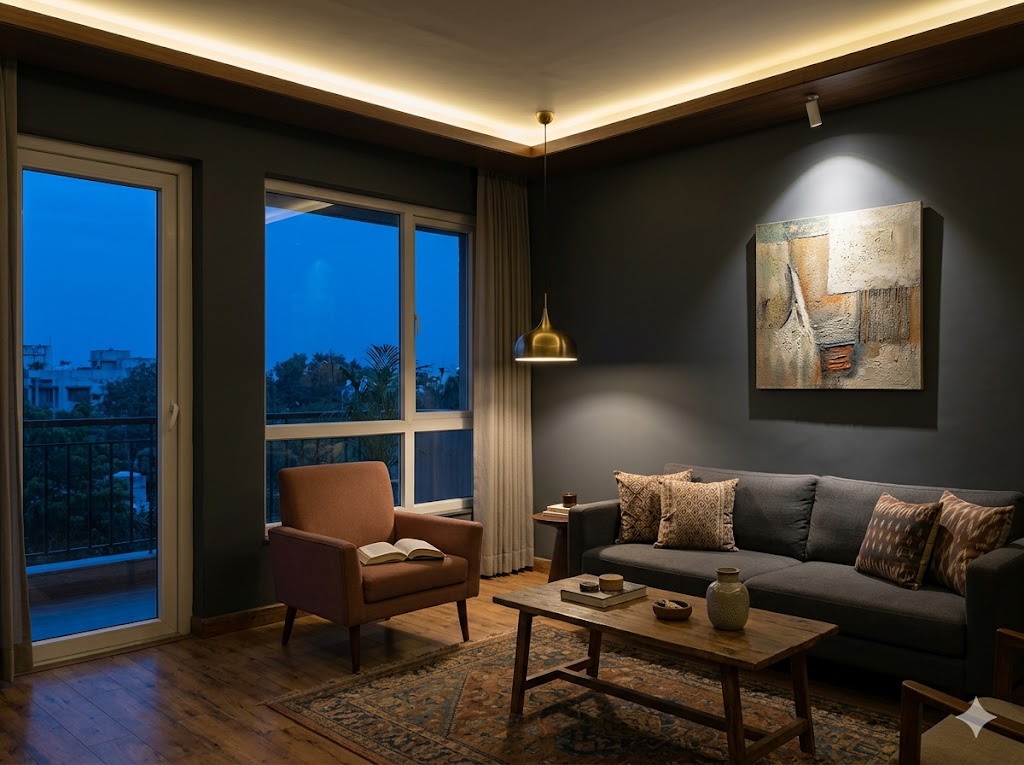
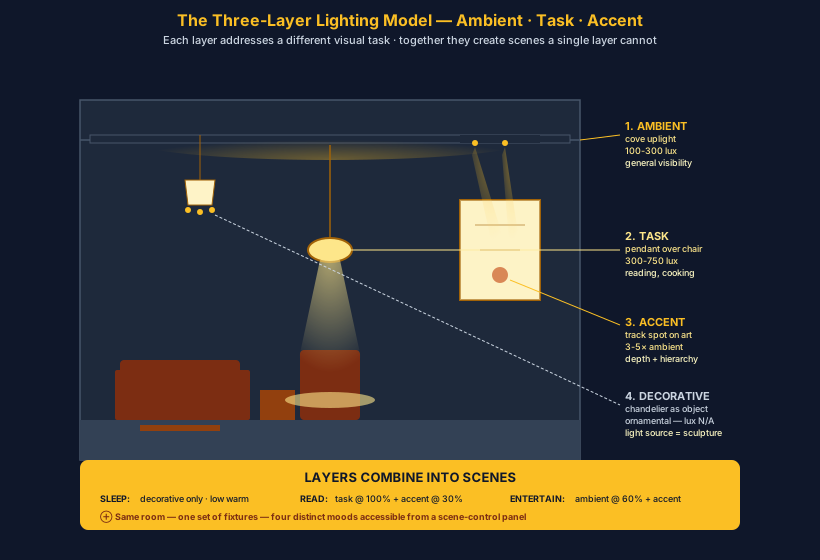
Every well-designed room contains three (sometimes four) layers of light, each addressing a different visual task. The layers add and modulate; together they create what designers call light scenes, which a single layer cannot.
| Layer | Purpose | Typical Fixtures | Indicative Lux at Surface |
|---|---|---|---|
| Ambient | General illumination — basic visibility, room-filling, "lights on" baseline | Recessed downlights, surface luminaires, cove lighting, indirect uplight from pelmets | 100–300 lux on horizontal surface |
| Task | Focused light for an activity — reading, cooking, grooming, working | Pendants over kitchen island, under-cabinet strip, study desk lamp, bathroom mirror lights | 300–750 lux on the task surface |
| Accent | Visual emphasis on objects, textures, art — creates depth and hierarchy | Track spotlights, picture lights, niche lights, wall-washers | 3–5× ambient (300–1500 lux) on the accent surface |
| Decorative | Light source itself as object — chandeliers, lanterns, sculptural pendants | Chandelier, sculptural pendant, vintage filament bulb, designer floor lamp | Ornamental — lux not the metric |
Source: IES (2021) Lighting Handbook, 11th edition; supplemented with Indian residential practice norms.
The single most consequential design decision an architect makes about a room's lighting is whether the room has all three layers (one switch group each) or only one. A bedroom with only ambient downlights is a room with one mood. The same bedroom with ambient + bedside task + accent on the artwork has at least four scenes (reading, sleeping, dressing, romantic) accessible from a single scene-control panel. The cost difference between the two designs is often less than ₹15,000 per room. The experiential difference is everything.
"To turn on a light is a small decision; to design how it turns on is an architecture." — Aphorism widely attributed to Richard Kelly (1910–1977), pioneer of modern lighting design
2. BIS Lux Targets per Room — IS 3646
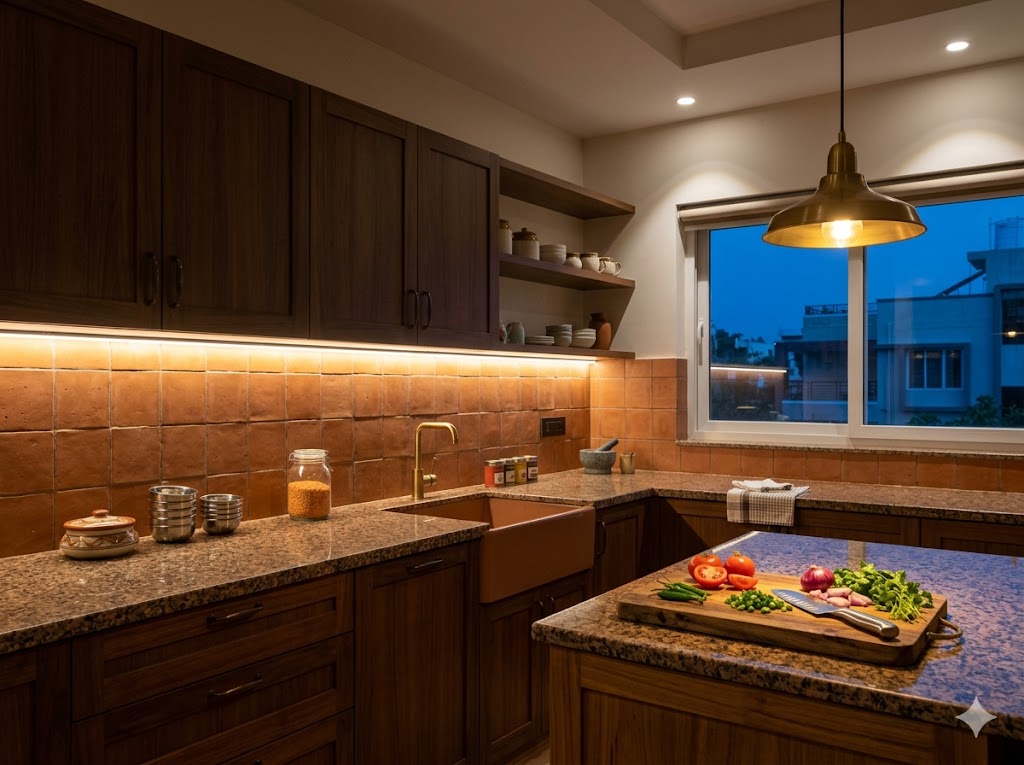
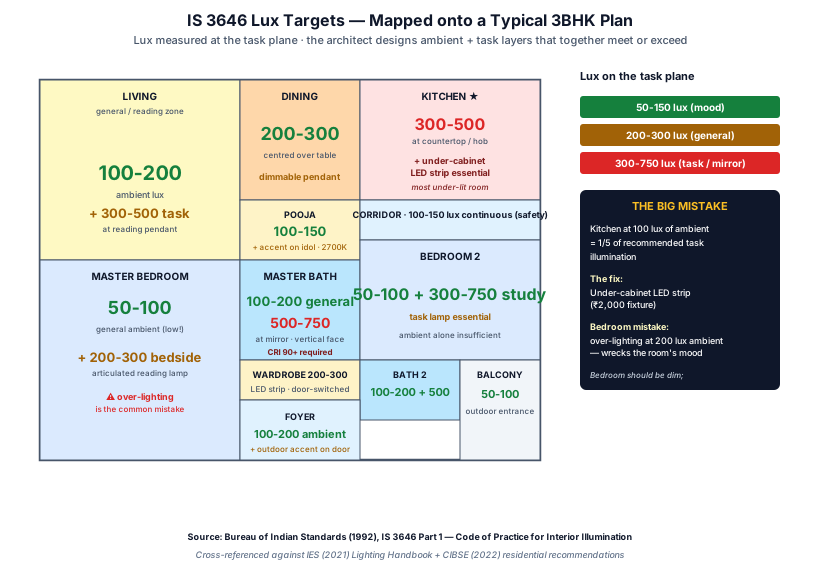
The Bureau of Indian Standards' IS 3646 (Code of Practice for Interior Illumination) prescribes lux levels for every room type and task. These are the minimum task-plane values — measured at the work surface, not at floor or ceiling. The architect's job is to design ambient + task layers that together meet or exceed these.
IS 3646 Lux Targets — Residential
| Room / Task | Recommended Lux (Task Plane) | Architect Notes |
|---|---|---|
| Kitchen — countertop / hob | 300–500 | Often the most under-lit room; under-cabinet task layer is essential |
| Kitchen — general | 200–300 | Ambient downlights at 1.5–2m centres |
| Living room — general | 100–200 | Layered design; rarely needs >150 lux ambient |
| Living room — reading task | 300–500 | Pendant or floor lamp at the seating zone |
| Bedroom — general ambient | 50–100 | Lower than typical practice; avoid over-lighting |
| Bedroom — bedside reading | 200–300 | Articulated bedside lamp or wall-mounted reading light |
| Study / home office — desk | 300–750 | Task lamp essential; ambient alone insufficient |
| Bathroom — general | 100–200 | Higher than typical living spaces |
| Bathroom — mirror / grooming | 500–750 | Vertical illumination on face; CRI 90+ required |
| Dining table | 200–300 | Pendant centred over table; dimmable strongly recommended |
| Pooja room | 100–150 + accent on idol | Reverence + visibility; warm CCT (2700K) |
| Corridors and stairs | 100–150 | Continuous, no dark patches; safety-critical |
| Wardrobe / closet | 200–300 | Often LED strip in shelf nose; switched on door |
| Outdoor — entrance | 50–100 | Plus accent on house number / address |
Source: Bureau of Indian Standards (1992), IS 3646 Part 1: Code of Practice for Interior Illumination — General Principles, with Indian residential practice adjustments. Cross-referenced against IES (2021) and CIBSE (2022) residential lighting recommendations.
The single most common Indian residential lighting failure is kitchen under-lighting. A homeowner cooking on a hob in 100 lux of ambient light is working at one-fifth of the task-recommended illumination, with predictable consequences for safety, food preparation accuracy, and visual fatigue. The under-cabinet LED strip — a ₹2,000 fixture — solves it; its absence in most Indian kitchens reflects an architectural oversight, not a budget constraint.
3. CCT and CRI — Colour Temperature and Render
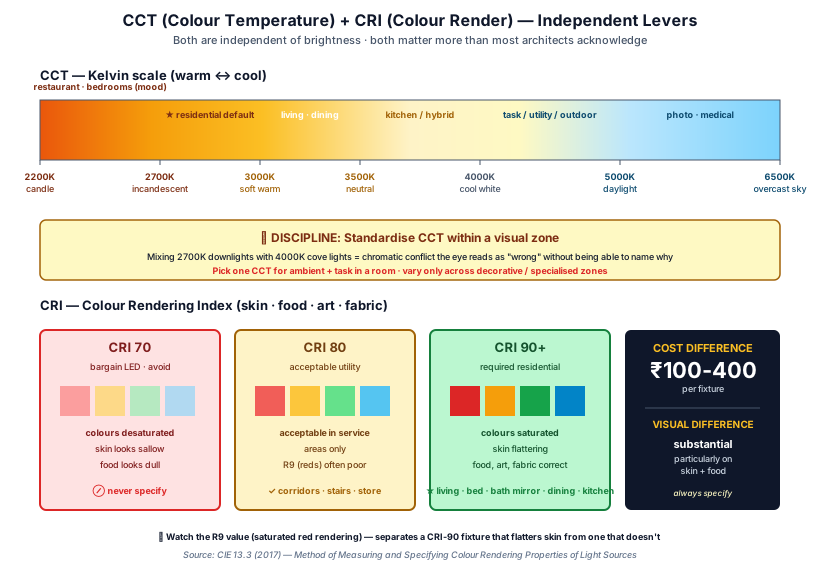
Two fixture properties determine what kind of light a luminaire produces. Both are independent of brightness and both matter more than most architects acknowledge.
CCT (Correlated Colour Temperature) is measured in Kelvin (K). Lower numbers (2200–3000K) are warm, amber, candle-like. Higher numbers (4000–6500K) are cool, blue, daylight-like. The ergonomic rule of thumb:
| CCT | Character | Best For |
|---|---|---|
| 2200–2400K | Very warm, candlelight | Decorative pendants, restaurant ambience, bedrooms (mood) |
| 2700K | Warm white (incandescent equivalent) | Living rooms, bedrooms, dining, hospitality |
| 3000K | Soft warm white | Versatile residential default; corridors, bathrooms |
| 3500K | Neutral warm | Kitchens (some prefer), studies, hybrid spaces |
| 4000K | Cool white | Task-heavy areas, garages, utility, outdoor |
| 5000–6500K | Daylight | Photography, medical, industrial — rarely residential |
The professional discipline is standardising CCT within a visual zone. A room mixing 2700K downlights with 4000K cove lights produces a chromatic conflict the eye reads as "wrong" without being able to name why. The rule: pick one CCT for ambient + task in any room, and only vary CCT across decorative or specialised zones.
CRI (Colour Rendering Index) measures how accurately a light source renders the colours of objects compared to natural daylight. CRI 100 is daylight; CRI 80 is acceptable utility; CRI 90+ is required wherever skin tones, food, art, or fabric colour matter. The often-overlooked R9 value — the rendering of saturated reds — separates a CRI-90 fixture that flatters skin from one that doesn't.
Where CRI 90+ matters in a home: living room, bedroom, bathroom mirror lighting, dining, kitchen. Where CRI 80 suffices: corridors, stairs, store-rooms, outdoor security. The cost difference is typically ₹100–₹400 per fixture; the visual difference, particularly on skin and food, is substantial.
"Colour is the keyboard, the eyes are the harmonies, the soul is the piano with many strings. The artist is the hand that plays, touching one key or another, to cause vibrations in the soul." — Wassily Kandinsky (1866–1944), in 'Concerning the Spiritual in Art' (1911)
4. Beam Angles and Fixture Spacing
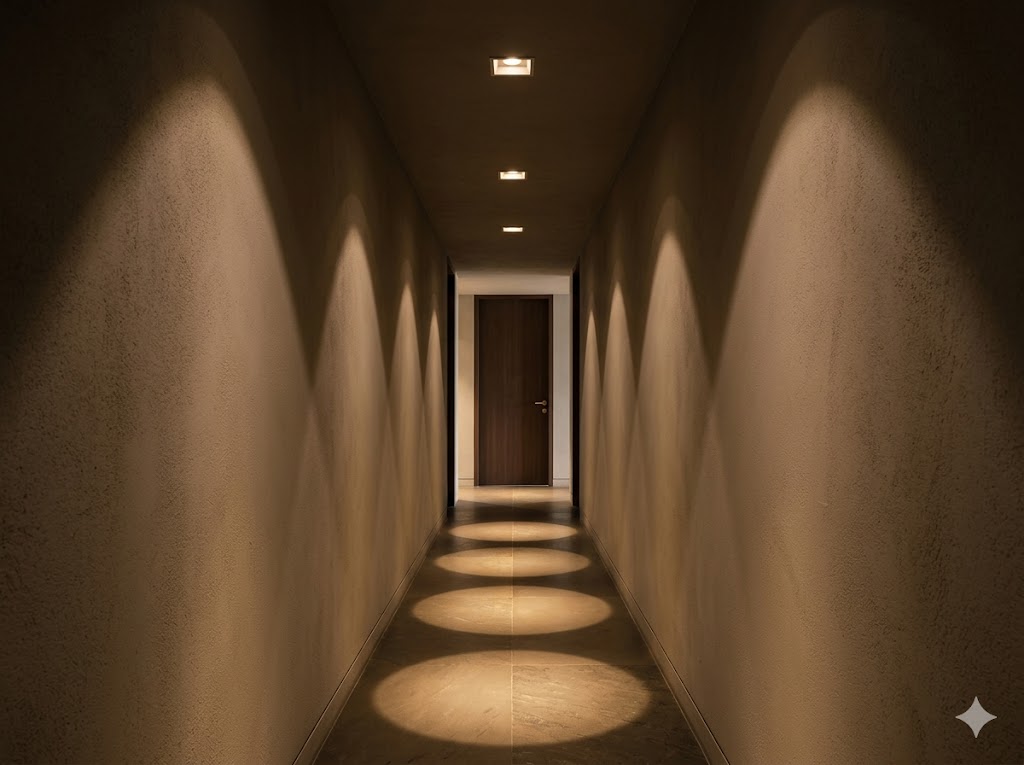
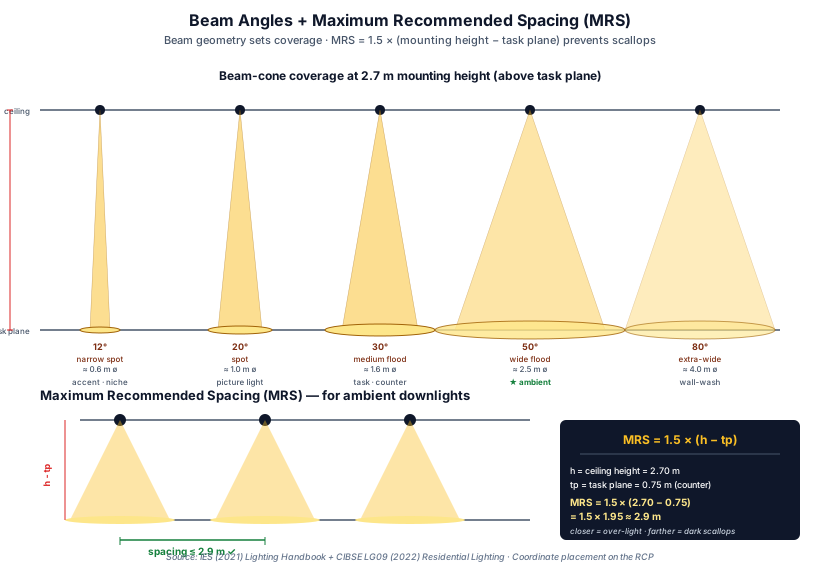
A downlight produces a cone of light. The cone's geometry — its beam angle — determines how much of the floor (or wall) is illuminated, and at what intensity.
| Beam Angle | Cone Width at 2.7m Mounting Height | Application |
|---|---|---|
| Narrow spot (10–15°) | ≈ 0.5–0.7m diameter | Accent on object, picture light, niche |
| Spot (15–25°) | ≈ 0.7–1.2m | Picture lighting, focused accent |
| Medium flood (25–40°) | ≈ 1.2–2.0m | Task lighting, kitchen counter, dining |
| Wide flood (40–60°) | ≈ 2.0–3.0m | Ambient downlight, general illumination |
| Extra-wide (60–90°) | ≈ 3.0–5.0m | Wall-wash, large area ambient |
The Maximum Recommended Spacing (MRS) rule of thumb for ambient downlights: spacing between fixtures should not exceed 1.5 × the mounting height above the task plane. For a 2.7m ceiling and a 0.75m task plane (kitchen counter), the calculation: (2.7 − 0.75) × 1.5 ≈ 2.9m maximum spacing. Closer than this is over-lighting; farther creates visible dark scallops between fixtures.
The architect's design move: place downlights on a regular grid that respects MRS for ambient illumination, and add task and accent layers as discrete fixtures (pendants, track, wall-wash) above the ambient grid. The grid should be coordinated with the RCP (reflected ceiling plan), not improvised on site.
5. Dimming Protocols
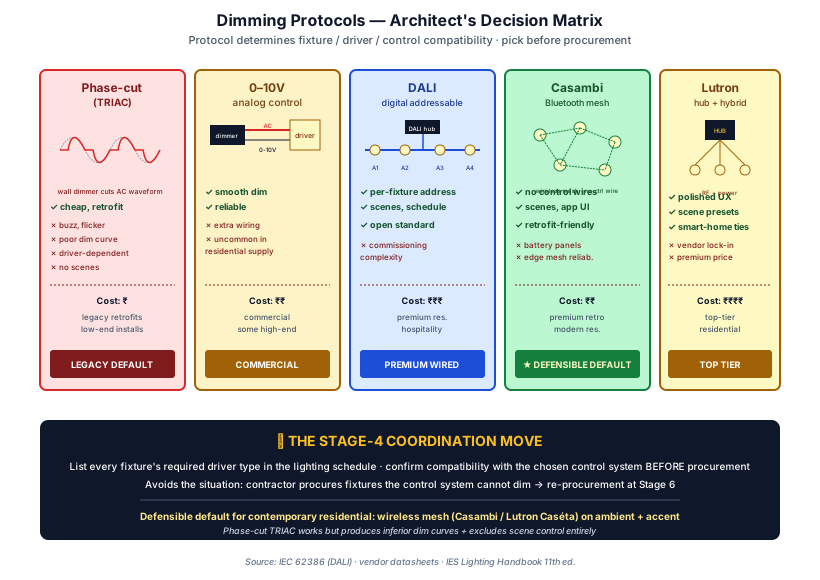
Indian residential lighting has historically been switched (on/off only). Contemporary practice expects dimming on at least the ambient and accent layers. The protocol matters because it determines compatibility between fixture, driver, and control.
| Protocol | How It Works | Pros | Cons | Where Used |
|---|---|---|---|---|
| Phase-cut (TRIAC) | Wall dimmer cuts part of the AC waveform | Cheap, retrofit-friendly | Buzz, flicker, limited to compatible drivers, worst dim curve | Legacy installations, low-end retrofits |
| 0–10V | Low-voltage control wire alongside power | Smooth dim, reliable | Extra wiring, less common in residential | Commercial, some high-end residential |
| DALI | Digital addressable bus protocol | Per-fixture addressability, scenes, scheduling | Higher cost, integration complexity | Premium residential, hospitality |
| Casambi / Bluetooth Mesh | Wireless mesh, app or panel control | No control wiring, scene-rich, easy retrofit | Battery panels, edge-of-network reliability | Premium retrofits, modern residential |
| Lutron / proprietary | Hub-based, often hybrid wireless+wired | Polished UX, scene presets, integration | Vendor lock-in, premium price | Top-tier residential |
For most contemporary Indian residential projects, the defensible default is wireless mesh (Casambi, Lutron Caséta, or equivalent) for ambient + accent, with the architect specifying compatible drivers from the fixture supplier at Stage 4. Phase-cut TRIAC is the legacy default; it works but produces inferior dim curves and excludes scene control.
The architect's coordination move: at Stage 4, list every fixture's required driver type and confirm compatibility with the chosen control system. This avoids the situation where the contractor procures fixtures that the control system cannot dim.
6. False-Ceiling Detailing for Lighting
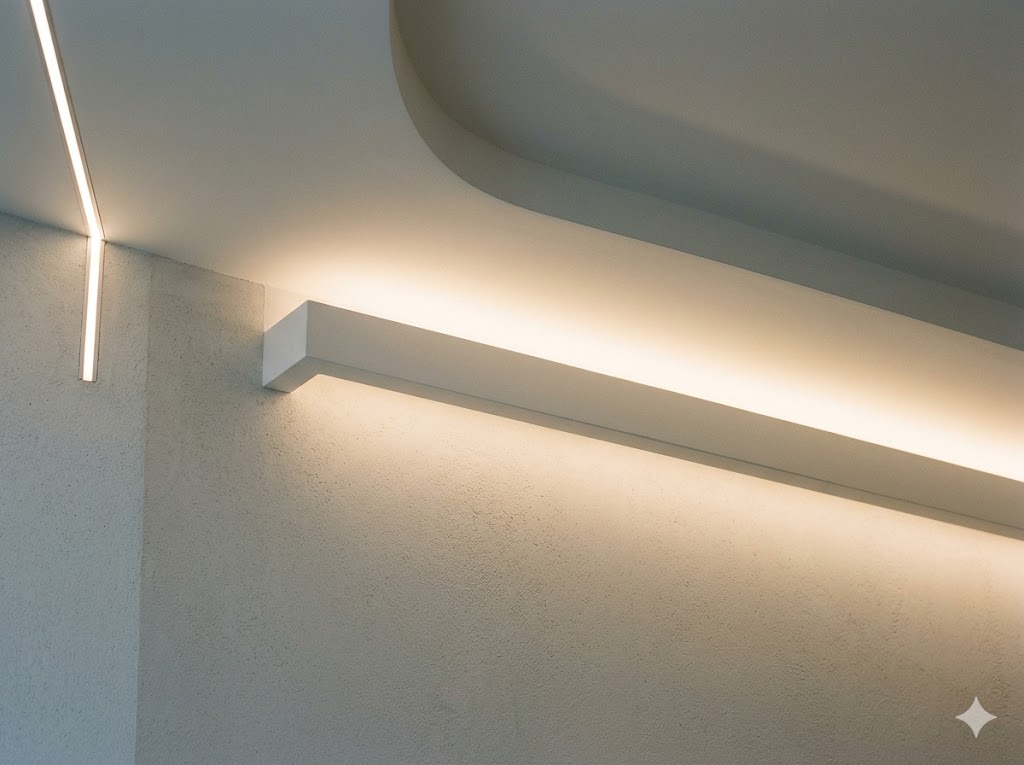
Indian residential lighting is overwhelmingly recessed into false ceilings. The architectural detail that determines whether the lighting looks clean is the false-ceiling cut-out, the trim, and the driver location.
The four critical details:
1. Cut-out diameter and trim — a 90mm fixture in a 95mm cut-out reads as a hole; in a 91mm cut-out it reads as a precise circle. The drawing must specify the cut-out exactly.
2. Driver location — the LED driver is usually larger than the fixture. It must sit in an accessible plenum, not above a sealed gypsum ceiling. Service hatches or removable panels are essential.
3. Heat dissipation — high-wattage fixtures (>15W) need 80–100mm of clearance above for thermal management. Insulation contact (IC) ratings matter.
4. Cove and pelmet detailing — the LED strip's mounting recess must shield the source from view; otherwise the eye sees bright spots, not a glow. Standard depth: 60–75mm; standard setback: 50–80mm.
The profile light has become the contemporary architect's preferred detail for cove and pelmet — a slim, pre-engineered aluminium channel with diffuser, available in straight and curved sections. It produces a clean, even line of light without the field assembly variance of strip-on-channel.
7. Coordination Drawings — RCP, Switching, Schedule
Lighting design is communicated to the contractor through three coordinated drawings, all part of the Stage 4 working-drawings package.
The Reflected Ceiling Plan (RCP) is a plan-view of the ceiling as if reflected in a mirror on the floor — showing every fixture, cove location, ceiling level change, and exhaust grille. The RCP must be coordinated with HVAC (no fixture under a duct), structural (no fixture in a beam zone), and architectural finish levels.
The Switching Diagram shows which fixtures are controlled by which switch, scene, or dimmer. Each fixture has a circuit symbol (A1, A2, T1, etc.); the switching diagram groups them. Without this drawing, the contractor wires by intuition and the result is "all kitchen lights on one switch."
The Lighting Schedule is a tabular drawing listing every fixture type by code, with quantity, manufacturer/model (or "equivalent"), wattage, lumen output, beam angle, CCT, CRI, dimming protocol, and procurement notes.
The discipline of producing all three at Stage 4 is what separates an architecturally-designed lighting scheme from a contractor-improvised one. Architects who skip this step deliver Stage 4 drawings that look complete but produce site-installed lighting that requires Stage 6 corrections — at the architect's reputational cost.
"The details are not the details. They make the design." — Charles Eames (1907–1978), in interview with Madame L'Express, 1966
8. Common Mistakes and the Fixes
A set of recurring lighting mistakes in Indian residential projects, with the design move that prevents each:
| Mistake | Why It Happens | The Fix |
|---|---|---|
| Single-switch rooms | Wiring shorthand, lack of scene thinking | Group fixtures into ambient/task/accent circuits; minimum 2–3 switches per primary room |
| Kitchen under-lit | Ambient-only design, no task layer | Under-cabinet LED strip + pendant over island as standard |
| Mixed CCT in same zone | Procurement from different vendors at different times | Specify CCT in the lighting schedule; demand vendor confirmation before purchase |
| CRI 80 in living/bedroom | Default specification, cost-driven | Specify CRI 90+ for all human-occupied rooms |
| No dimming on ambient | Phase-cut TRIAC default | Specify dimmable drivers + wireless mesh control |
| Bathroom mirror lit from above only | Standard practice but produces shadow on face | Vertical illumination on face — wall-mounted or backlit mirror |
| Cove visible source | Insufficient setback | 50–80mm setback minimum; profile light strongly recommended |
| Driver inaccessible | Driver placed above sealed gypsum | Service hatches in plenum; or surface-mount fixtures with integral driver |
| No outdoor accent on house number | Forgotten in Stage 4 | One small uplight or downlight at entrance — ₹3,000 fixture, large arrival impact |
9. Practitioner's Closing Note
Lighting design in Indian residential practice is one of the highest-leverage architectural moves available to a Stage 4 designer. The cost increment over default specifications is small; the experiential and resale-value increment is large; and the work itself requires only a few hours of additional drawing-board attention per project.
The discipline is to design lighting at Stage 4, not Stage 6. By Stage 6 the chases are cut, the ceilings are framed, the fixtures are procured. Adding scene control, changing CCT, or relocating a single downlight at that stage costs 5–10× what it would have cost at Stage 4, and the result is always a compromise.
Treat the RCP as a primary working drawing, not a footnote. List every fixture in the schedule. Specify CCT, CRI, beam angle, and dimming protocol explicitly. Group circuits into scenes. Ask the lighting supplier for a free site visit at Stage 4 — most will do it without charge — to validate the specification before issue.
Architectural lighting is not a separate consultant's discipline in residential practice. It is part of the architect's drawing set, and the buildings designed by architects who treat it that way are visibly different from those of architects who don't.
Cross-References Within Studio Matrx
- Natural Light Planning for Indian Homes — daylight as the first lighting layer
- Daylighting Indian Homes and Buildings — daylight-factor calculation reference
- Working Drawings & Documentation — RCP and schedule fundamentals
- The Architect's Scope of Services in India — Stage 4 deliverables that include the lighting set
- Use the Lighting Planner to model fixture spacing and lux targets for a specific room
- Use the Colour Palette Generator to select CCT-appropriate finishes
References
1. Bureau of Indian Standards (1992) IS 3646 Part 1: Code of Practice for Interior Illumination — General Principles. New Delhi: BIS.
2. Bureau of Indian Standards (2016) National Building Code of India 2016, Part 8 §2 (Electrical and Allied Installations — Lighting).
3. Illuminating Engineering Society (2021) The Lighting Handbook, 11th edition. New York: IES.
4. Chartered Institution of Building Services Engineers (2022) CIBSE Lighting Guide LG09 — Residential and Domestic Lighting. London: CIBSE.
5. Commission Internationale de l'Éclairage (2017) CIE 13.3 — Method of Measuring and Specifying Colour Rendering Properties of Light Sources. Vienna: CIE.
6. International Electrotechnical Commission (2018) IEC 62386 — DALI Digital Addressable Lighting Interface. Geneva: IEC.
7. Kelly, R. (1952) 'Lighting as an integral part of architecture', College Art Journal, 12(1), pp. 24–30.
8. Boyce, P.R. (2014) Human Factors in Lighting, 3rd edition. Boca Raton: CRC Press.
9. DiLaura, D., Houser, K., Mistrick, R. & Steffy, G. (2013) The Lighting Handbook: Reference and Application. New York: IES.
10. Indian Society of Lighting Engineers (ISLE) (2020) Practitioner's Guide to LED Lighting in India. Mumbai: ISLE.
Author's Note: Lighting is a craft that scales modestly with project size — the same principles apply to a 1500-sqft apartment and a 15,000-sqft villa. Architects who develop the habit of producing a coordinated RCP, switching diagram, and lighting schedule on every project, regardless of scale, find that the design quality of their lighting work compounds. This guide is a desk reference intended to support that habit.
Disclaimer: This article is for informational and educational purposes only. It does not constitute professional electrical-engineering advice. Lux targets, CCT/CRI conventions, and dimming protocols cited reflect current Indian and international practice but may differ in specific applications. Architects must verify against current IS, NBC, and IEC standards and consult qualified electrical consultants before final specification. Studio Matrx, its authors, and contributors accept no liability for decisions based on this guide.
Interactive · Layered lighting builder
2 layers on · ~650 lx · target 300-750 lx at book
Scene preset
Individual layers
Ambient fills the room; task pendant lights the page directly.
Active layers
- Ambient· Cove uplight · 100-300 lx
- Task· Pendant / reading · 300-750 lx
Common mistakes
- • One ceiling light only — flat, shadow-less, no mood
- • Mixed CCTs in the same scene (warm + cool clashes)
- • No dimming on at least one layer (locks you to “full bright”)
- • Accent < 3× ambient — sculptures and art read as flat
Export this guide
Related Guides — Deep-dive reading
Lighting Controls & Dimming Design: Zones, Scenes & Switches (2026)
How to plan lighting control so an Indian home's light is flexible — split each room's layers onto separate switches, choose dimmers that actually work with LEDs, add two-way switching where you need it, and layer scenes on top. The design decisions you must settle before the electrician wires.
LightingBathroom Mirror Lighting India: Shadow-Free Vanity Light, Colour Temp, CRI & Cost (2026)
Why a single ceiling downlight throws ugly shadows on your face, how vertical sconces either side of the mirror beat a light bar above, when a backlit mirror is glow not task light, plus the colour temperature, CRI, mounting height, IP rating and 2026 rupee costs that actually get make-up and shaving right.
BathroomsCove & Indirect Lighting: The Soft Glow Done Right (2026)
The design guide to cove and indirect lighting for Indian false ceilings — what it really is, why it is so loved and so often botched, and the depth, lip, setback, strip density and colour rules that separate a smooth ceiling wash from a strip of visible dots.
LightingRelated Tools — Try Free
Circadian Light Meter
Patient-centric circadian lighting visualizer for Indian healthcare design — time-of-day × intensity → CCT, melanopic lux (EML / mEDI), melatonin suppression, and an alertness curve. Calibrated against WELL v2 L03 Circadian Lighting Design, CIE S 026:2018, Brainard 2001, and Lucas et al. 2014.
Circadian ToolFalse Ceiling Cost Estimator
Live ₹/sqft across 8 ceiling types — POP, gypsum, designer, metal, PVC, wooden — with cove and spot lighting for 20 Indian cities.
Cost CalculatorApartment Video Door System Planner
Enter flats, entrances, floors and guard desk for a first-pass building intercom plan — door stations, indoor monitors, guard station, the right architecture and an indicative cost band.
Building Planner