
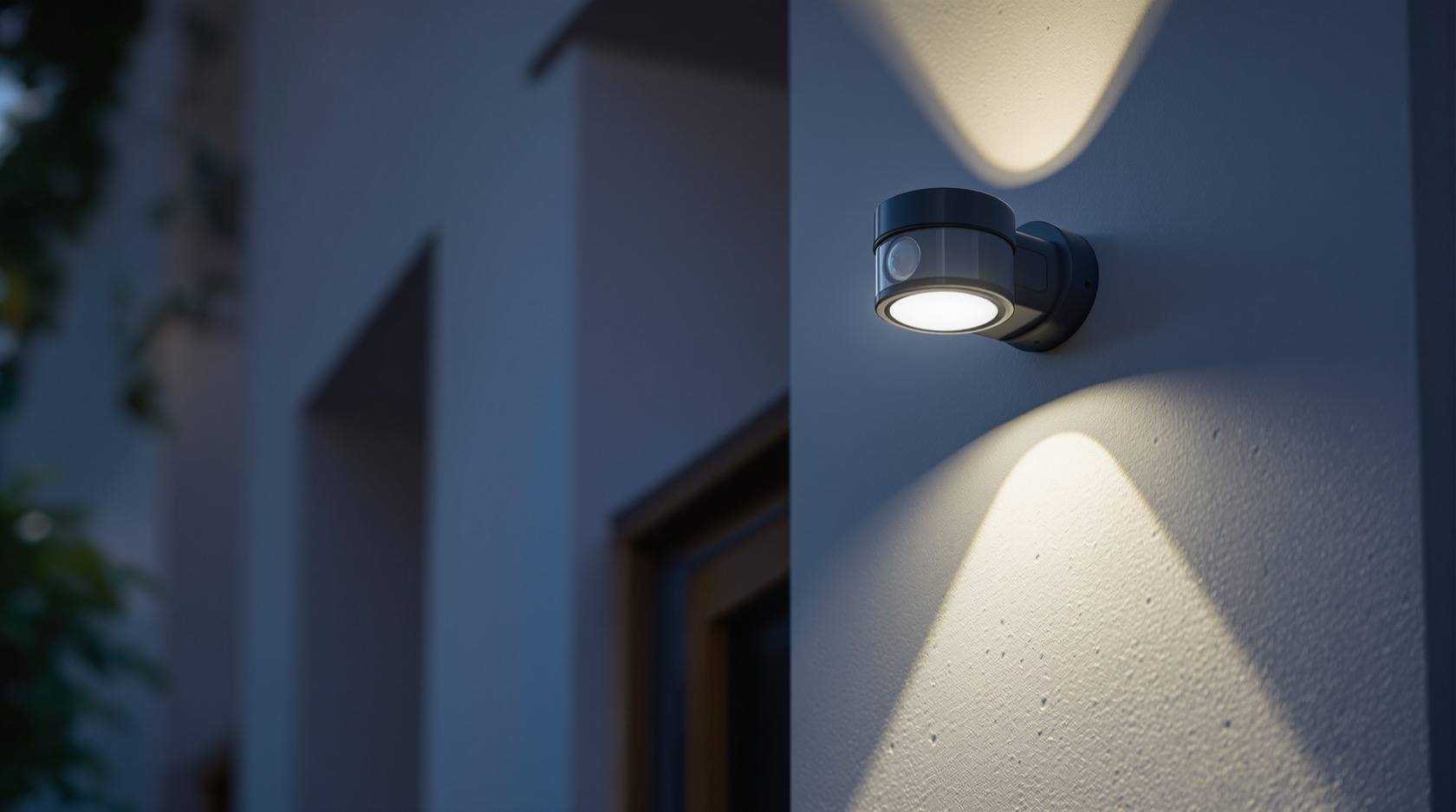
Motion-Activated Security Lighting in India (2026): Sensor Types, the False-Trigger Problem, and Pairing Motion With a Base Light So Your Camera Never Goes Blind
How PIR, microwave and dual-tech sensors really behave in Indian conditions, how to stop the stray-dog-and-passing-auto false triggers that make owners disable the light, and why a motion-only light leaves a camera dark until it is too late.
There is a specific, satisfying moment a motion-activated security light is designed to create. Someone steps off the road onto your side passage in the dark, expecting to stay unseen, and the light snaps on over their head. In that half-second the message is unmistakable: you are seen. A person with bad intent, who counted on darkness, now has to decide whether to keep going under a light or leave. Most leave. That startle-and-expose reflex, plus the plain fact that a light burning only when something moves costs a fraction of a floodlight left on all night, is why motion-activated security lighting is one of the most popular security buys in Indian homes.
It is also one of the most commonly disabled ones. Walk any residential lane and you will find motion lights taped over, unscrewed, or switched permanently off at the board — because a stray dog, a passing auto, a branch in the monsoon wind, or the neighbour's cat set them flashing on-and-off all night until the household gave up. A motion light that cries wolf protects nobody. And there is a deeper design trap that even a well-behaved motion light falls into: it leaves the scene dark until the moment it triggers, which is exactly wrong if a camera is supposed to be watching that spot continuously. This guide is about getting both right — choosing the sensor honestly, taming the false triggers, and pairing motion with a base light so the camera never goes blind.
This guide is part of the Studio Matrx security lighting library and sits under the security lighting design guide pillar; the security lighting spoke covers the boundary as a whole. It is written to be qualitative — no fabricated lux figures, no promised detection range in metres, just the decisions you actually make.
Scope, honesty & safety. This guide helps you plan, choose and coordinate motion-activated lighting, strictly as a defensive layer that deters and lets people and cameras see. You do the deciding; any mains wiring, and any fixture or sensor mounted at height, is licensed-professional work — route it to a licensed electrician (see the electrical hub), and set actual illuminance levels with a lighting designer to the applicable code. Never let a motion light on an escape route switch you into darkness, and never let a fixture or its wiring block an egress path. Detection range and coverage vary hugely with the exact product, mounting and site — treat every number as something to test on your own wall, not a guarantee. Verify any standard's current status and your local bye-laws before relying on them. This is educational guidance, not legal advice.
What a motion light is actually for
Before choosing a sensor, be clear about the two jobs a motion light does well and the one job it does badly.
It deters by surprise. A sudden light is a psychological event. An intruder who has scouted a dark approach and committed to it is jolted when it lights up — they are now visible to any camera, any neighbour, any passer-by, and to the household. That surprise is worth more than raw brightness. A steady floodlight that has burned all evening is part of the scenery; a light that changes when someone arrives draws the eye and breaks the intruder's plan.
It saves energy and reduces light nuisance. A light that runs only on demand uses a fraction of the power of an all-night floodlight, and it does not spill into a neighbour's bedroom for eight hours a night — a real and common source of RWA disputes. This is the energy-honest heart of good security lighting: do not flood everything all night when motion, dusk-to-dawn zones and sensible switching do the job for less (see security lighting energy use).
What it does badly: continuous watching. A motion-only light leaves the scene dark until it triggers. For deterrence that is fine — the darkness is broken the instant someone arrives. But for a camera that must always see, darkness-until-triggered is a failure, and it is the single most important design point in this whole guide. We come back to it in detail below.
The three sensor types, honestly
Almost every consumer motion light in India uses one of three detection technologies. They are not interchangeable, and the marketing rarely tells you the trade-offs. Here is what each actually does.
PIR — passive infrared. By far the most common and the cheapest. A PIR sensor watches for a moving source of heat — it sees the warm body of a person or animal crossing its field of view against a cooler background. It is passive (it emits nothing), sips power, and is reliable for the classic job of catching a warm body walking across a zone. Its honest weaknesses: it needs the target to move across its view (someone walking straight at it, or approaching very slowly, is detected less well), it is defeated by anything blocking line of sight (glass, a wall, dense foliage), and it is fooled by heat that is not a person — a hot exhaust, a sun-baked wall releasing heat at dusk, a warm gust in summer. In an Indian summer, a PIR aimed at a west wall that has cooked all day can trip on the heat coming off the masonry after sunset.
Microwave / radar. An active sensor that emits a low-power microwave (or radar) signal and watches for the Doppler shift when something moves. It is more sensitive, reaches further, and — crucially — can detect movement through thin non-metal materials like glass, plastic housings and light foliage. That reach is a double-edged sword: it will happily detect an auto passing on the road behind your wall, a person on the neighbour's side, or a branch moving beyond the fence, because it does not respect the barriers a PIR is blocked by. Microwave sensors are the classic cause of the "why does it keep turning on when nothing is there" complaint. They also cost more.
Dual-technology (PIR + microwave). A sensor that contains both a PIR and a microwave element and only triggers when both agree that something is moving. This "AND" logic is the honest fix for false triggers: a hot gust fools the PIR but not the microwave; a passing vehicle beyond the wall fools the microwave but not the PIR; because neither alone can fire the light, most single-technology false triggers are rejected. The trade-off is cost, and a slightly higher chance of a missed real event if one element is poorly sited (both must see it). For a spot plagued by false triggers — near a road, near a tree, on a hot wall — dual-tech is usually the sensor worth paying for.
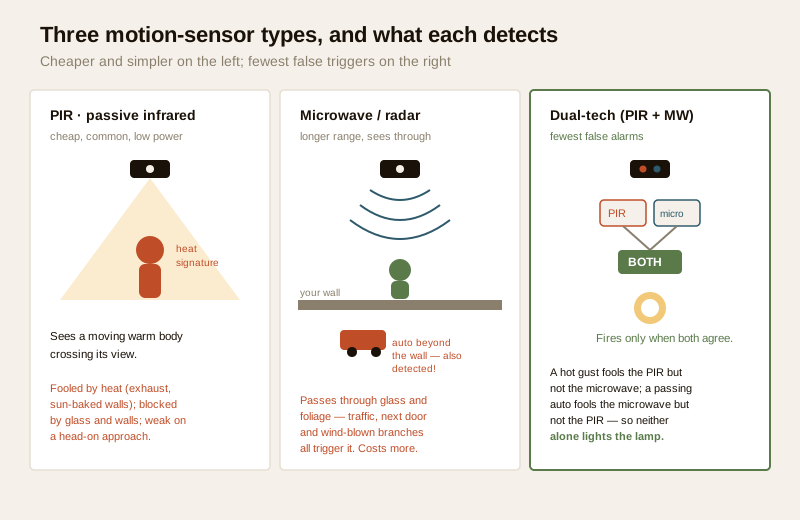
| Sensor type | How it detects | Strengths | Honest weaknesses | Best for |
|---|---|---|---|---|
| PIR (passive infrared) | Moving heat crossing its view | Cheap, common, low power, no emission | Fooled by heat (exhaust, hot walls), blocked by glass/walls, weak on head-on approach | The default choice for a clear, contained zone |
| Microwave / radar | Doppler shift of movement | Longer range, more sensitive, sees through glass/foliage | Detects through walls/fences — road traffic, next door, wind-blown branches all trigger it | Large open areas away from roads and trees |
| Dual-tech (PIR + microwave) | Both must agree before firing | Rejects most single-tech false triggers | Costs more; a missed event if one element is poorly sited | Trouble spots near roads, trees, hot walls |
The false-trigger problem — and how to tame it
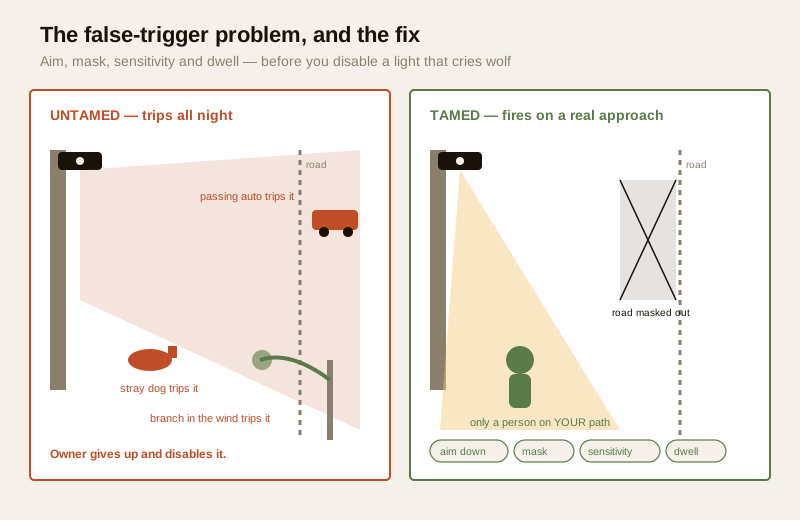
The reason so many Indian motion lights end up disabled is not that the technology is bad — it is that the sensor was aimed and set carelessly, and the environment did the rest. The usual culprits are utterly ordinary:
- Stray dogs and cats crossing the compound at night — warm, moving, exactly what a PIR is built to catch.
- Passing autos, bikes and traffic on the road beyond the wall — especially a problem for microwave sensors that see through the boundary.
- Foliage moving in the wind — a branch, a creeper, a potted plant swaying in the monsoon breeze, waving in and out of the sensor's view all night.
- Hot exhaust and heat sources — a parked car's warm bonnet, a compressor unit, or a west wall radiating the day's heat after dark, fooling a PIR.
- Monsoon rain and blowing debris — heavy rain and wind-driven leaves can trip an over-sensitive sensor repeatedly.
The good news is that almost every false trigger is fixable without buying a new light, by controlling four things: aim, masking, sensitivity, and dwell time.
Aim the sensor at your ground, not the road or the tree. This is the single biggest fix. Point the detection field along the path a real intruder walks — across your own approach or side return — and away from the road, the neighbour's side, and any tree or shrub. A sensor pointed down at your own paving sees the person who steps onto it and ignores the traffic beyond the wall.
Mask off the parts of the view you do not want. Most sensor heads can be physically hooded, angled down, or partly taped/masked so a specific troublesome sector — the gate to the road, the corner with the tree — is blanked out of the detection field. If the light keeps tripping on one direction, blind the sensor to that direction rather than turning the whole thing down.
Set sensitivity to the site, don't just max it. A sensor cranked to maximum sensitivity reaches into the road and the neighbour's plot and trips constantly. Turn it down until it reliably catches a person on your approach and stops catching the world beyond it. Sensitivity is a dial to tune, not a number to maximise.
Set a sensible dwell (hold) time. Dwell time is how long the light stays on after the last movement. Too short and it flickers off while a visitor is still there (annoying, and useless for a camera); too long and every brief false trigger lights the whole area for minutes. A moderate hold — long enough to walk the approach, short enough not to burn for ages on a false trip — is the balance. On a busy road-side wall, a shorter dwell also means a stray false trigger is over quickly.
Height and coverage matter too: mounted too low, a sensor is triggered by every dog and misses a person's torso; mounted at a sensible height and angled down, it covers the approach and looks over the small animals. Set the actual mounting height and coverage geometry with the installer and the product's own guidance — and then test it by walking the site at night, watching what trips it and adjusting, rather than trusting the box.
| False trigger (India reality) | Why it happens | The fix |
|---|---|---|
| Passing autos / traffic on the road | Sensitivity too high, or microwave seeing through the wall | Aim away from the road, mask the road sector, lower sensitivity, or use PIR/dual-tech here |
| Stray dogs and cats | Sensor mounted too low, aimed across their path | Raise and angle the sensor to look over small animals at torso height |
| Foliage moving in the wind | A branch or creeper waving in the detection field | Aim/mask away from the plant, or trim it back from the sensor's view |
| Hot exhaust or a sun-baked wall | PIR reading residual heat as movement | Keep PIR off hot surfaces; use dual-tech where heat is unavoidable |
| Flashing on-off all monsoon night | Over-sensitive setting + rain/wind | Lower sensitivity, shorten dwell, mask the worst sector |
The key design point: motion-only leaves a camera blind
This is the part most homeowners miss, and it is the reason a motion light and a CCTV camera must be designed together, not bought separately.
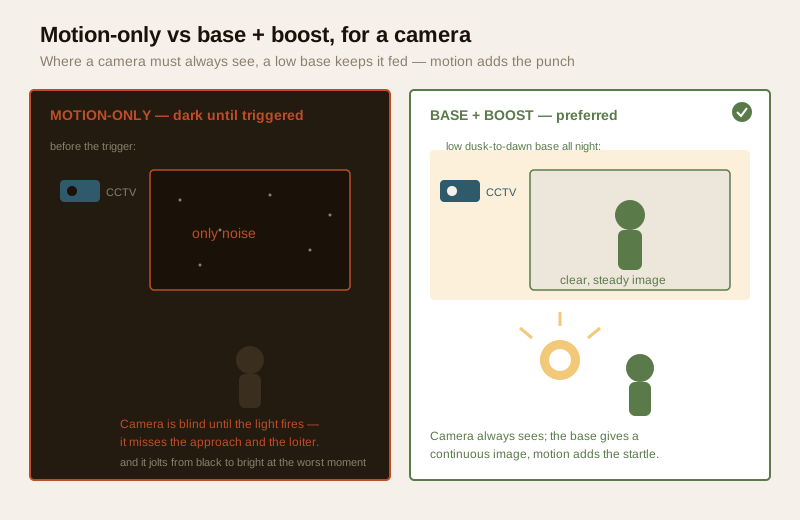
A motion-only light does exactly what it says: the scene is dark until movement triggers it. For pure deterrence that is fine. But if a CCTV camera is supposed to be watching that zone continuously, darkness-until-triggered is a serious flaw:
- In the dark before the trigger, the camera sees only noise — it cannot record an approach, a loiter, or someone studying the house, because there is nothing to see until the light fires.
- At the instant the light snaps on, the camera is hit with a sudden jump from black to bright and needs a moment to re-expose — often the exact moment you most wanted a clean frame of the face.
- If the intruder never crosses the sensor's narrow trigger zone — approaching from an angle the sensor misses — the light never fires and the camera records nothing at all.
The fix is not to abandon motion lighting; it is to stop using motion-only where a camera must always see. Instead, pair a low dusk-to-dawn base — a modest, steady light that keeps the scene and the camera's view lit all night — with a motion boost that punches up bright when someone arrives. The base gives the camera a continuous, evenly exposed image to record; the motion boost adds the deterrent surprise and the extra light for a clear face at the critical moment. Base-plus-boost gets you both: continuous camera vision and the startle effect, without the black-to-bright exposure jolt.
Motion-only still has a proper place — on a back gate, a rarely used side return, or a boundary stretch with no camera, where deterrence and energy-saving are the whole point and there is no camera to keep fed. But anywhere a camera's job is to watch continuously, base-plus-boost is the honest design. This is the same coupling described in CCTV-compatible lighting and set out in full in the dusk-to-dawn security lighting guide.
Linking the motion light to the camera and alarm
A motion light is more than a lamp — its trigger is a signal that something moved, and that signal is worth using. Where the system supports it, tie the motion event to the rest of your security so a trigger does more than switch a bulb:
- Trigger a recording. A motion event can prompt the camera to mark or start an event-based clip, so the moment of arrival is flagged in the footage instead of buried in hours of empty night.
- Send a notification. In an app-linked system, a motion trigger at an odd hour can push an alert to your phone — turning a passive light into an active warning.
- Cue the alarm zone. In a monitored setup, an outdoor motion trigger can arm or annunciate a perimeter zone, so a light coming on and an alert arriving are the same event.
Keep this proportionate and lawful: outdoor cameras and sensors that capture callers, staff or a neighbouring approach record personal data under the Digital Personal Data Protection Act, 2023 — set storage, access and privacy handling sensibly, and do not point detection or recording into a neighbour's private space.
Placement zones and power-cut backup
Where motion lighting earns its keep. The best spots for a motion light are the places an intruder would prefer to use because they are dark and unwatched — precisely where a sudden light does the most good:
- The approach — the driveway or path a visitor walks, where a light that comes up as they arrive both welcomes a guest and exposes an intruder.
- Side returns and blind corners — the narrow passages down the sides of the house, out of the neighbours' sight, that are an intruder's favourite route. A motion light here is often more valuable than one on the bright front.
- The back gate and rear boundary — the quiet, unobserved rear, where deterrence-by-surprise matters most and a motion-only light (no camera) is often the right, energy-saving choice.
Do not black out an escape route. One firm rule: a motion light must never be the only light on a path people use to leave in an emergency — a staircase, a corridor, the route to the gate. If the sensor fails to trip, or someone is standing still, a motion-only fixture drops that path into darkness at the worst possible moment. Escape routes need a steady baseline (and proper emergency lighting), with motion only ever added on top — see staircase and corridor security lighting and the dedicated emergency lighting guide.
Power-cut backup. A motion light on the mains alone is dark exactly when it may matter most — during load-shedding, or when someone deliberately trips the supply before approaching. In a country of routine power cuts, plan the backup honestly:
- Put the security-critical motion lights (and any camera they feed) on an inverter or UPS line so they survive a cut.
- Solar-powered motion lights suit a far gate or a long rear boundary that is hard to reach with backed-up mains — but chosen honestly: a cheap solar unit that goes flat by 10 p.m. in winter, or stays dead through a monsoon week, is worse than useless because you believe you are covered. Size the panel and battery for the worst season, and check it still fires late on a short winter night.
- Confirm the backup covers the whole chain — the light and the camera it lights and any alarm link — not just the bulb.
To map where your own plot is dark, unwatched, or over-relying on a single motion light, the home security risk scorecard is a useful starting point.
Key takeaways
- A motion light deters by surprise and saves power — a sudden light says "you are seen" — but it does its job only if it does not cry wolf, and only where continuous camera vision is not required.
- Choose the sensor honestly. PIR is cheap, common and fooled by heat; microwave reaches further and sees through walls (and so trips on traffic and branches); dual-tech fires only when both agree and is the fix for a false-trigger-prone spot.
- Tame false triggers by aim, mask, sensitivity and dwell — point the sensor down your own approach and away from the road and the tree, mask troublesome sectors, tune sensitivity down from maximum, set a sensible hold time, and test by walking the site at night.
- Never use motion-only where a camera must always see. Motion-only leaves the scene dark until it triggers; pair a low dusk-to-dawn base with a motion boost so the camera has a continuous image and the arrival gets a bright, startling punch.
- Place it on the approach, side returns, blind corners and back gate; link the trigger to recording and alerts; back it up for power cuts; and never let a motion light black out an escape route.
Where to go next
- Security lighting design guide — the pillar that frames light as a security system across the whole plot.
- Security lighting — the boundary and perimeter spoke this motion guide sits beside.
- Dusk-to-dawn security lighting — the steady base you pair with a motion boost so a camera never goes blind.
- CCTV-compatible lighting — matching light to what cameras want, and why base-plus-boost beats motion-only for a camera.
- Solar security lighting — off-grid motion and base light for far corners, chosen honestly for the worst season.
- Staircase and corridor security lighting — why a motion light must never be the only light on an escape route.
- Perimeter CCTV — the cameras your base-plus-boost lighting is designed to keep fed.
- Home security risk scorecard — map where your plot is dark, unwatched, or over-relying on a single motion light.
References
- SP 72 : 2025 — National Lighting Code of India (Bureau of Indian Standards) — the primary reference for illuminance, uniformity and glare in security lighting; treat specific levels and any detection geometry as figures a lighting designer sets to the current edition, not guarantees from a product box. Verify status via the BIS catalogue: https://www.services.bis.gov.in/
- IS 3646 (Part 1) : 2025 — Code of Practice for Interior Illumination (Bureau of Indian Standards) — for any covered porch, lobby or passage lit by a motion fixture that reads as a working interior; verify the current edition via the BIS catalogue: https://www.services.bis.gov.in/
- National Building Code of India, SP 7 : 2026, Part 8 Section 1 (Lighting and Ventilation) together with local municipal bye-laws and any light-nuisance / light-pollution provisions — for the amenity and neighbour aspects of an outdoor motion install; verify the current edition via the BIS catalogue: https://www.services.bis.gov.in/
- Digital Personal Data Protection Act, 2023 — where a motion trigger records footage or notifies, or where a sensor's field reaches a neighbouring approach, the resulting data is personal data; agree storage, access and privacy handling, and keep credentials private.
This is an educational overview, not legal advice. It is strictly about lighting a plot defensively so people and cameras can see, never about defeating any security measure. Mains wiring, work at height, and setting illuminance levels are qualified professional tasks — engage a licensed electrician and a lighting designer, never let a motion light black out an escape route, and verify any standard's current status via the BIS catalogue before relying on it.
Export this guide
Related Guides — Deep-dive reading
Security Lighting Integration for Smart Homes in India (2026): Making Light an Active Part of the Response, Not Just a Fixture
How to wire smart lighting into the security system so a sensor or camera can light an intruder for the camera to see, the alarm can throw every light full-on, and away-mode can fake occupancy — all built on a reliable base that keeps working when the hub, the network or the power drops.
SecurityPIR vs Microwave Sensor (2026): Which Motion Sensor for Indian Homes?
A neutral head-to-head between passive-infrared (PIR) and microwave (radar) motion sensors for intruder detection in an Indian home — how each detects, where each false-triggers, how they cover a room, and why their opposite weaknesses make dual-technology the honest best-of-both.
SecuritySecurity Fire Alarm Integration in India (2026): Smart Alerts, Certified Systems, Fail-Safe Egress
The most important sentence a smart-home designer can say about fire is also the least profitable: a smart-home smoke sensor or fire notification is a helpful add-on, not a substitute for a certified fire-alarm system. This guide draws the line hard — life-safety detection and alarm belongs to the NBC-governed certified system — and then covers the genuinely useful, correctly-scoped automations the smart layer can add on a verified fire signal: unlock for egress, open the gate for the fire tender, light the escape path, stop the away-scene, and notify everyone loudly. All of it fail-safe. None of it in the way of the system that actually saves lives.
SecurityRelated Tools — Try Free
CCTV Camera Coverage & Count Calculator
Estimate how many CCTV cameras you need, the NVR channels, storage in TB for your retention period, and an indicative all-in cost with GST.
CCTV CalculatorSecurity Backup Power Calculator
Size a UPS/inverter and battery to keep CCTV, NVR, router and alarm running through a power cut — load, Ah, VA and cost.
Backup PowerAccess-Control Battery-Backup Calculator
Size the standby battery so an access system keeps running through a power cut, with an egress life-safety note.
Battery Backup