
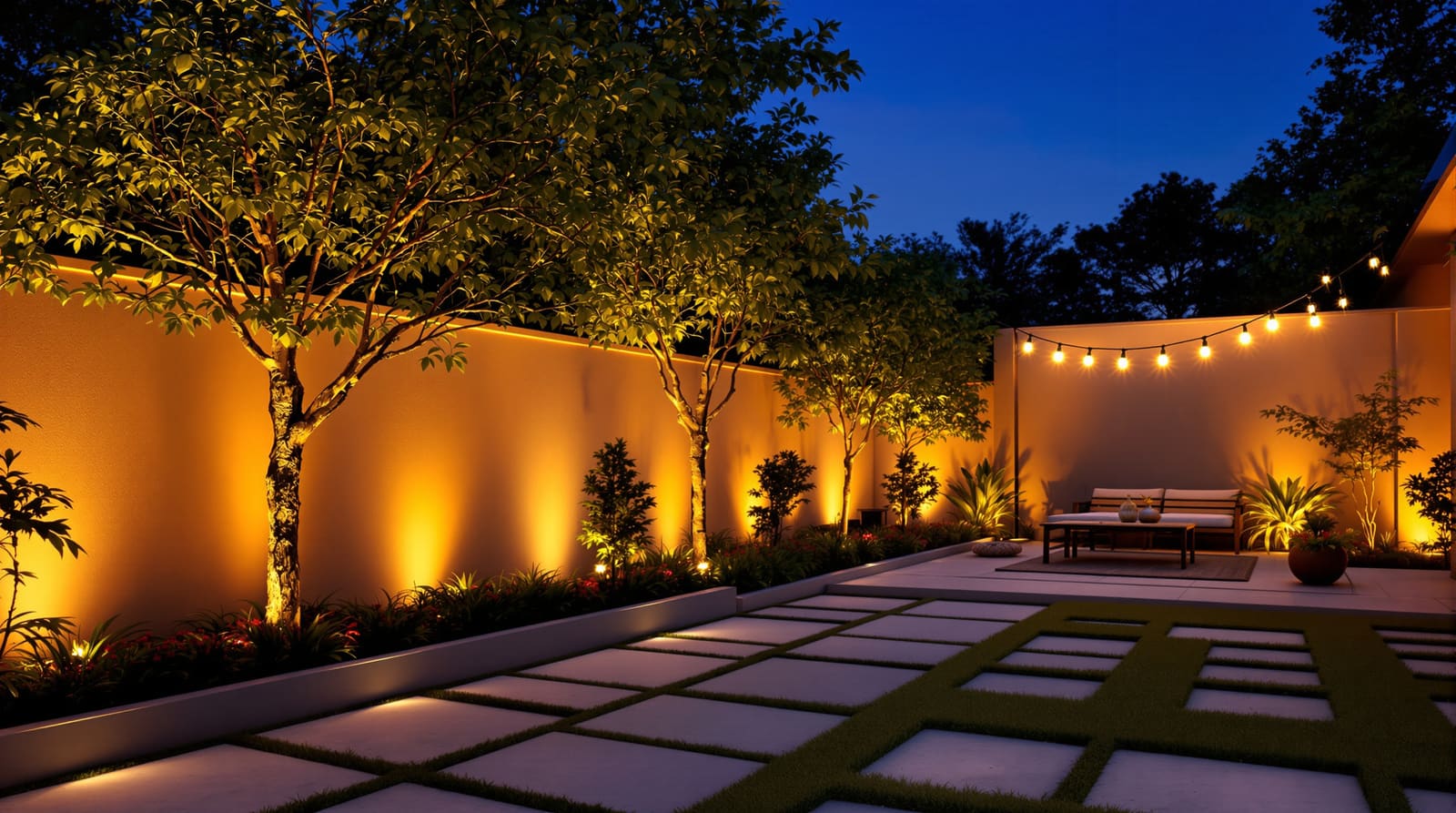
Landscape Lighting Guide
Lighting the garden — the layers, fixture types, warm light and glare control, 12V vs mains, IP-rated weatherproofing for the monsoon, zones and cost
Good landscape lighting is not about how much light you add to a garden — it is about how little, placed exactly where it earns its keep, so that the garden at night becomes a quieter, more theatrical version of itself rather than a floodlit car park. The single most common mistake in Indian homes is the 50-watt halogen "security" floodlight bolted to a wall, blasting white glare across the lawn and into the neighbour's bedroom. Done well, garden lighting is layered, warm, low and largely hidden — you see the lit tree, the glowing path and the soft wall, but never the bulb.
This guide is specifically about lighting the garden and outdoor spaces — lawns, planting, trees, paths, water features and seating. It is the outdoor counterpart to indoor and façade lighting, not a repeat of it: if you want to light the building elevation itself or the interiors, treat that as a separate exercise and link the two with a common control system. Here we stay in the soil and the open air.
Why bother — and the golden rule
A garden you cannot use after 7 pm is a garden you use for roughly half the year, because for most of India the usable outdoor hours are precisely the cooler evening ones. Lighting extends the day. It also delivers safety on steps and paths, a measure of security, and — most underrated — sheer pleasure. A frangipani uplit against a dark sky, or a string of warm lights over a charpai, does more for an evening than any amount of furniture.
The golden rule has four parts, and every decision flows from them:
- Light for effect, not coverage. Pick the few things worth seeing — a specimen tree, a textured wall, a water bowl, the path — and light those. Leave the rest in shadow. Contrast is what makes a garden look beautiful at night; flatten everything with even light and it looks like nothing.
- Less is more. Five well-placed 3-watt fixtures beat one 50-watt flood every time. Restraint reads as expensive; over-lighting reads as a godown.
- Warm, not white. Use 2700–3000K (warm white). Foliage, brick, stone and skin all look right in warm light; the bluish 6500K "cool daylight" that dominates Indian electrical shops makes a garden look clinical and cold, and attracts far more insects.
- No glare, no trespass. You should never see the bare lamp from normal viewing positions, and your light should not spill into a neighbour's window or up into the sky. This "dark-sky courtesy" is both good manners in a dense Indian colony and the difference between a refined scheme and an eyesore. Aim, shield and dim.
For how the lit garden connects to the spaces it serves, see Outdoor Wellness Spaces and Backyard Design Ideas; for the routes the path lighting follows, The Architecture of Pathways is the companion piece.
The lighting layers
Like a room, a garden is lit in layers, each doing a different job. The art is combining three or four of them — never all at once, never just one.
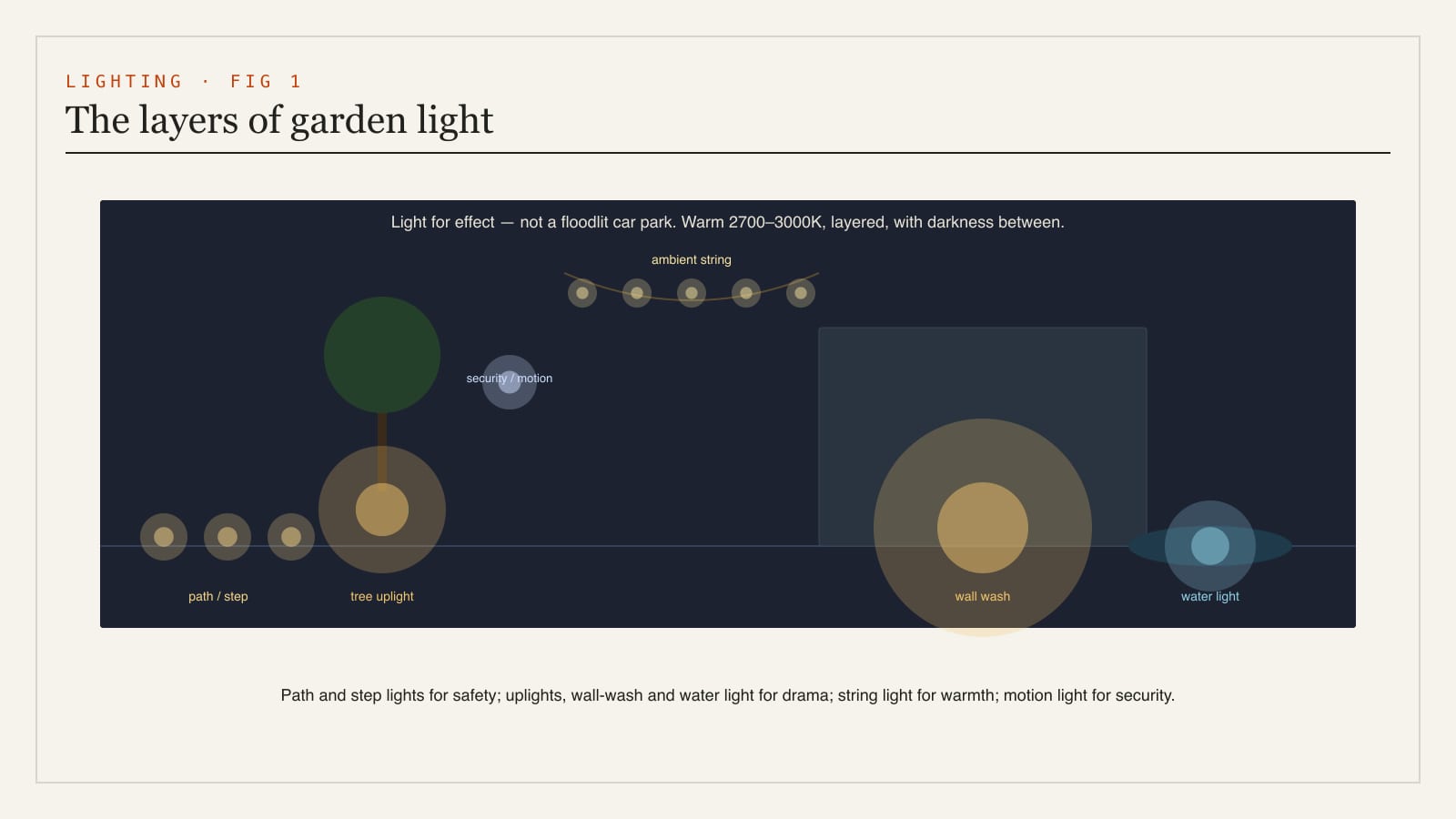
Path and step lighting (the safety layer). Low fixtures that put light down onto the walking surface so feet can see where they land. The job is to light the ground, not to be a row of glowing lollipops — keep them dim, spaced 1.5–3 m apart, and never line them up like a runway. Steps are non-negotiable: a recessed light in the riser or under the nosing of every change in level prevents the most common garden fall.
Accent uplighting (the drama layer). A spike spotlight at the base of a tree, aimed up through the canopy, is the highest-impact move in any garden. Uplight specimen trees (gulmohar, frangipani, a mature mango, a multi-stem tree with good bark), large pots, sculptures and architectural plants. One or two per tree; more for a big canopy.
Wall-wash and grazing (the texture layer). Wash a boundary wall with even, soft light to push the garden's "walls" back and add depth; graze a textured surface (exposed brick, stone cladding, a rough plaster wall) by placing the light close and skimming it along the surface so every bump throws a shadow. Grazing is what makes a textured wall look spectacular at night.
Water-feature lighting. Submersible or edge-mounted fixtures bring a pond, bowl or wall-spout alive. Light water from within or graze the falling sheet; never point a light at still water from across the garden, as it just becomes a mirror of glare. This pairs directly with Water Features in Landscape Design — plan the lighting and the plumbing together.
Ambient / string / festoon (the atmosphere layer). Warm string lights, festoon bulbs or lanterns over a seating area, pergola or courtyard. This is the layer that says "sit down and stay." It does the social work; the accent layers do the visual work.
Task lighting (the working layer). Genuinely functional light where you cook and eat outdoors — over the outdoor kitchen counter, the barbecue, the dining table. This is the one place brighter, slightly cooler light (3000K, never daylight-blue) and higher output is justified, because someone is handling knives and hot pans.
Security / motion lighting. A motion-triggered light at the gate, the side return and the service area. Keep it off until triggered — a flood that burns all night is both wasteful and useless (the eye stops noticing constant light). A warm, well-aimed motion fixture that snaps on at movement is far more effective as a deterrent and far kinder to the neighbours.
How to combine them: for most home gardens, start with the safety layer (paths and steps), add two or three accent moves (a couple of uplit trees, one washed or grazed wall), add the atmosphere layer over the main sitting spot, and add motion security at the edges. That is a complete, sophisticated scheme. You almost never need general "flood the lawn" lighting at all.
Fixture types — what each one does and where it goes
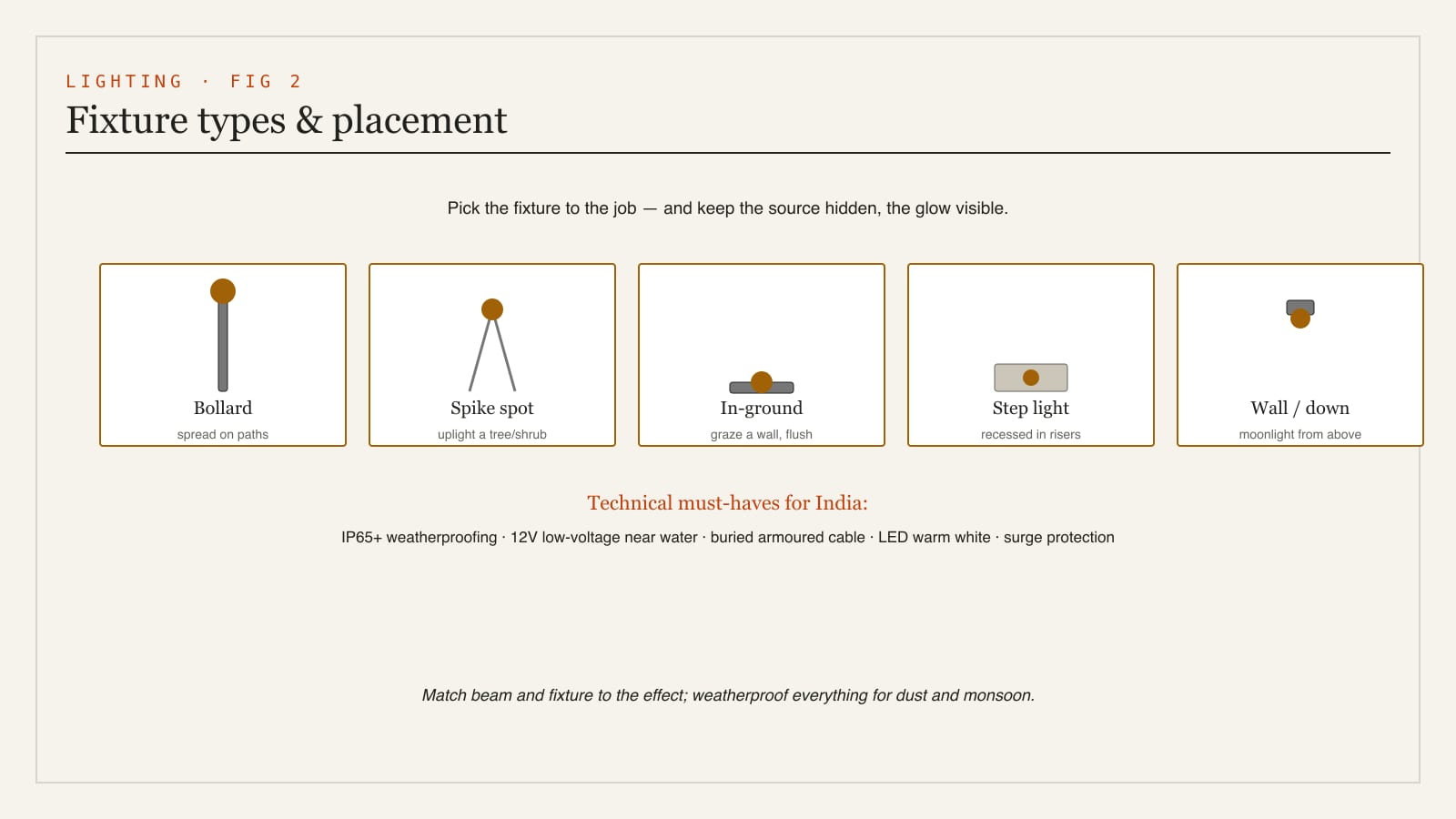
| Fixture | What it does | Where it goes | Watch out for |
|---|---|---|---|
| Bollard | Pool of light onto path/bed from waist height | Path edges, driveways, large beds | Glare if too tall/bright; keep 0.5–1 m, dim |
| Spike / spotlight | Adjustable accent beam | At tree bases, in beds for uplighting | Re-aim after a year as plants grow |
| In-ground / recessed uplight | Hidden flush light shining up | Up a wall or tree trunk, in paving | Drainage — must not sit in monsoon water |
| Step light | Low light onto a tread | Riser/wall of every step run | Skipping intermediate steps |
| Wall light | Down/up wash from a vertical surface | Gate, porch, boundary wall, outdoor kitchen | Bare-lamp glare; choose shielded/downward |
| String / festoon | Soft ambient sparkle | Over pergola, seating, courtyard tree | Cheap non-IP sets fail in first monsoon |
| Downlight from a tree ("moonlighting") | Dappled light falling through leaves, mimicking moonlight | Fixed high in a mature tree, aimed down | Cable management; mounting that won't girdle the tree |
Moonlighting deserves a special mention: a shielded downlight fixed high in a large tree, aimed down through the branches, throws beautiful dappled shadow-patterns across the ground and lights a wide area gently without a single visible glaring source. It is one of the most magical and least-used techniques in Indian gardens.
The technical basics — getting it to survive India
This is where most DIY garden lighting dies in the first monsoon. Get the engineering right and a scheme lasts a decade.
12V low-voltage vs 230V mains. Two valid systems:
- 12V low-voltage runs off a transformer that steps mains down to a safe 12 volts. It is the right choice for most planted areas — it is safe to handle near water and soil, the thin cable is easy to bury and reroute as the garden changes, and fixtures are compact. The trade-off is voltage drop over long cable runs, so the transformer must be sized and positioned sensibly.
- 230V mains suits high-output, long-run and permanent installations — driveway bollards, distant boundary floods, the outdoor kitchen. It must be installed by a licensed electrician, in proper conduit, with an RCD/ELCB on the circuit. Non-negotiable near a pool or water feature.
A common, sensible hybrid: 230V to a weatherproof junction and transformer near the action, then 12V out to the planting beds and trees.
Weatherproofing — read the IP rating. The IP (Ingress Protection) number is the single most important spec for Indian outdoor lighting, where the monsoon, dust and humidity are brutal. As a working rule:
| Location | Minimum rating |
|---|---|
| Sheltered wall under a deep eave | IP44 |
| Open garden, exposed to rain | IP65 |
| In-ground, paving, splash zone | IP67 |
| Submerged in water feature/pond | IP68 |
Do not buy a "garden light" without a printed IP rating — IP65 should be your floor for anything in the open, IP67 for anything that sits where monsoon water pools. Cheap unrated strings and spikes from the local market are a false economy; they corrode and short within one season.
Cable burial. Bury 12V cable 150–300 mm deep, ideally in a conduit so it can be pulled and replaced; route it along bed edges and label runs. Keep 230V in rigid conduit at proper depth per your electrician and the wiring code. Always leave a service loop of slack at each fixture so you can re-aim or replace without re-digging.
LED, lumens not watts, beam angles. Buy LED only — it is cheap to run, cool to touch, and lasts. Stop thinking in watts: a 3W LED can do what a 35W halogen did. Think in lumens (brightness) and beam angle: a narrow 15–24° spot for uplighting a single tree trunk; a wider 36–60° flood for washing a wall or lighting a bed. Insist on a stated colour temperature (2700–3000K) and a decent colour rendering (CRI 80+) so foliage and stone look natural.
Solar, honestly. Solar path and spike lights are genuinely useful for low-stakes, no-wiring spots — a far corner, a temporary layout, a rental. But be realistic: the cheap ones are dim, the battery fades in a couple of years, and in the monsoon and short winter days they barely charge. Use solar as a convenience accent, not as the backbone of a real scheme. For anything you actually care about, wire it.
Control and zones
A garden lit on a single switch is a garden you will under-use. Break it into zones — for example: paths and steps; accent/feature; ambient seating; security — each on its own switch or smart channel. Then layer the controls:
- Dusk-to-dawn / photocell sensors turn the safety and low-level lighting on automatically at dark.
- Timers shut the decorative layers off at, say, 11 pm — you rarely want the uplighting burning at 3 am, and it saves energy and goodwill with neighbours.
- Motion sensors drive the security layer only, snapping on at the gate and service zones.
- Smart control (app or voice, via a weatherproof outdoor-rated hub or smart relays) lets you set scenes — "dinner" lights the seating and kitchen, "ambience" lights only the trees and water. Dimming is the secret weapon: being able to pull every layer down to 30% transforms the mood and the running cost.
For Indian conditions, also fit the supply with surge protection and an RCD/ELCB; voltage spikes and fluctuation kill cheap drivers, and a stabiliser or surge device on the lighting circuit pays for itself.
Placement do's and don'ts
Do
- Hide the source; reveal only the lit object. Tuck spikes into planting, recess uplights, shield wall lights.
- Light both sides of steps and every level change.
- Vary intensity — bright accents against dark gaps create the depth that makes a garden glamorous.
- Mock it up first with a torch at night before you bury a single cable.
- Leave room for plants to grow and re-aim fixtures annually.
Don't
- Don't floodlight the whole lawn — it kills all drama and annoys everyone.
- Don't line path lights up like an airport runway.
- Don't point lights at windows, into the street, or up at the sky.
- Don't mix colour temperatures across the garden — keep it all warm.
- Don't buy unrated fixtures; the monsoon will find them.
What it costs
Rupee ranges for hardware (good-quality LED, properly IP-rated; supply only — add labour, cable and transformer):
| Item | Typical ₹ range |
|---|---|
| Spike/spot uplight (LED, IP65) | ₹800–3,500 each |
| In-ground recessed uplight (IP67) | ₹1,500–6,000 each |
| Bollard light | ₹2,000–8,000 each |
| Step light (recessed) | ₹600–2,500 each |
| Outdoor wall light (shielded) | ₹1,200–6,000 each |
| String / festoon (IP-rated, per ~10 m set) | ₹1,500–5,000 |
| 12V transformer/driver (60–300W) | ₹2,500–9,000 |
| Submersible water-feature light | ₹1,500–5,000 each |
As a rough whole-garden guide, a restrained, well-engineered 12V scheme for a typical urban home garden — a dozen-odd fixtures across paths, two or three uplit trees, a washed wall, seating string lights and motion security — lands around ₹40,000–1,20,000 supplied and installed, with premium fixtures, smart control and water-feature lighting pushing higher. The biggest savings come not from cheaper fixtures (false economy) but from lighting fewer things well. For how lighting sits within the overall garden budget, see the Landscape Cost Guide; for larger plots, Villa Landscape Design shows how lighting scales up.
A final word: spend on the things you cannot easily change — the buried cable, the transformer, the IP rating, the licensed wiring — and be willing to start small on fixtures and add over time. A garden lit gradually, layer by layer, almost always ends up better than one blasted with a single big order. As with planting (see Best Trees for Indian Homes) and the broader Outdoor Flooring Guide, the night garden rewards patience and restraint.
References & further reading
- National Building Code of India 2016, Part 8 (Building Services), Section 1 — Lighting and Ventilation, Bureau of Indian Standards — principles of artificial lighting and illuminance.
- IS/IEC 60529: Degrees of Protection Provided by Enclosures (IP Code), Bureau of Indian Standards — the definitive reference for IP44/IP65/IP67/IP68 ratings.
- IS 732: Code of Practice for Electrical Wiring Installations, Bureau of Indian Standards — earthing, RCD/ELCB and safe wiring for outdoor and wet locations.
- IES Lighting Handbook, Illuminating Engineering Society — authoritative reference on beam angles, layering and exterior lighting design.
- International Dark-Sky Association (DarkSky International) — Outdoor Lighting Principles — manufacturer-neutral guidance on shielding, warm colour temperature and avoiding light trespass and glare.
- Energy Conservation Building Code (ECBC), Bureau of Energy Efficiency (BEE) — efficiency benchmarks and controls (timers, sensors, zoning) for lighting.
Export this guide
Related Guides — Deep-dive reading
Compound Wall Lighting in India: Wall Lights, Bollards and Solar (2026)
A plain, India-grounded planning guide to lighting your compound wall and gate — entrance and pillar-top lights so guests find the door, wall-wash and grazing to show off texture, path and bollard lights, step lighting, and no-wiring solar fixtures — with warm-vs-cool colour, glare courtesy to neighbours, IP ratings for rain, and honest hand-offs to a licensed electrician and the Security hub.
Compound WallsLighting Safety & IP Ratings: Choose the Right Fixture for the Spot (2026)
The homeowner's safety-literacy guide to lighting — how to read the two-digit IP rating, pick the correctly-rated fixture for bathrooms, gardens and wet zones, and know exactly where selecting a light ends and a licensed electrician's wiring begins.
LightingHow to Choose Security Lighting in India (2026): The Right Light, Not More Light
A homeowner's guide to selecting outdoor security lighting that actually deters and lets cameras work — picking the right fixture type, the right brightness and colour, the right control (motion, dusk-to-dawn or timer) and the right placement, without over-lighting, glaring your camera or annoying your neighbours.
SecurityRelated Tools — Try Free
Cross-Ventilation Analyzer
Estimate airflow and air changes per hour (ACH) from room size, window areas, layout, and local wind — with NBC 2016 Part 8 compliance check.
Ventilation CalculatorCircadian Light Meter
Patient-centric circadian lighting visualizer for Indian healthcare design — time-of-day × intensity → CCT, melanopic lux (EML / mEDI), melatonin suppression, and an alertness curve. Calibrated against WELL v2 L03 Circadian Lighting Design, CIE S 026:2018, Brainard 2001, and Lucas et al. 2014.
Circadian ToolBrise-Soleil Visualizer
Interactive horizontal-louvre cut-off angle calculator — sun altitude, louvre depth, and spacing inputs with a live shadow preview. Computes θ = arctan(spacing/depth) for façade shading, ECBC envelope compliance, hospital daylight design, and tropical sun-control detailing.
Sun Shading Tool