
Security Lighting Maintenance in India (2026): Keeping the Whole Scheme Alive, Because a Dark Patch Is a Security Hole
The best-designed security lighting is worthless the day the lamp fuses, the sensor clogs with cobwebs, the solar panel dusts over or the fitting fills with monsoon water. This guide gives a homeowner and a society the simple maintenance routine that keeps every part of the scheme working, so no dark patch quietly opens up on a wall nobody looks at after dark.
Here is the truth this whole library has been building towards, and it is worth saying before anything else, because everything you have read about designing a security lighting scheme rests on it. The best-designed lighting in the world is worthless the day the lamp fuses. It is worthless the day the sensor clouds over, the day the solar panel greys under a film of dust, the day the outdoor fitting fills with monsoon water and the LED dies inside it. A lighting scheme is not a thing you install once and forget. It is a living system on the outside walls of your home, exposed to the worst that heat, rain, insects and rodents can do to it, and the day one part of it fails, a dark patch opens up. And a dark patch is not a cosmetic problem. It is a security hole. It hands an intruder exactly the pocket of cover the whole scheme was designed to remove.
The cruelty of it is that nobody notices. The failed light is on a wall no one looks at after dark. You do not walk your own boundary at night. You see the front of the house lit as you drive in, you assume the rest is fine, and the dead lamp at the back corner stays dead for weeks, for months, until the night someone uses that exact patch of darkness to get over the wall. Then you find out. This guide is the capstone of the Studio Matrx security lighting library under the security lighting design pillar, and it is about the least glamorous, most valuable habit in home security: keeping the scheme you paid for actually working, so the dark patch never gets its chance.
Scope and safety. You plan and decide the maintenance routine here, and you can safely do the visual part, the after-dark walk, the cleaning of lenses and panels, and swapping a failed lamp on a fitting you can reach and switch off. But anything behind live mains, the driver, the wiring, the circuit, the sealed housing of a mains fitting, is a licensed electrician's work to the wiring rules (see the electrical hub). Never open a live outdoor fitting yourself. Setting light levels is a lighting designer's job to the current National Lighting Code. Emergency and escape-route lighting is a separate, code-mandated system with its own testing regime, covered in the emergency lighting guide, not here, and its maintenance is not optional. Verify every standard's current edition and your local bye-laws before relying on it. Educational guidance, not legal or engineering advice.
The one habit worth more than all the rest: the after-dark walk-round
If you do nothing else in this guide, do this. Once a month, after dark, walk the whole perimeter of your property and look at it. Not from the gate, not from the balcony, but all the way round, every wall, every corner, the side return you never use, the back boundary behind the water tank. You are looking for one thing: a patch that is darker than it should be. A lamp that is out. A fitting glowing dim and orange when it used to be bright and white. A motion light that no longer comes on when you walk under it. A corner the scheme was meant to cover that is now in shadow.
This single habit is worth more than any checklist, because it is the only test that finds a failure the way an intruder finds it, with your own eyes, in the dark, from the ground. A daytime inspection tells you nothing; every light looks fine switched off in daylight. A remote app tells you a fitting is drawing power, not that it is actually lighting the spot. Only the walk finds the dark patch. And it finds it in minutes, before it becomes the night's opportunity.
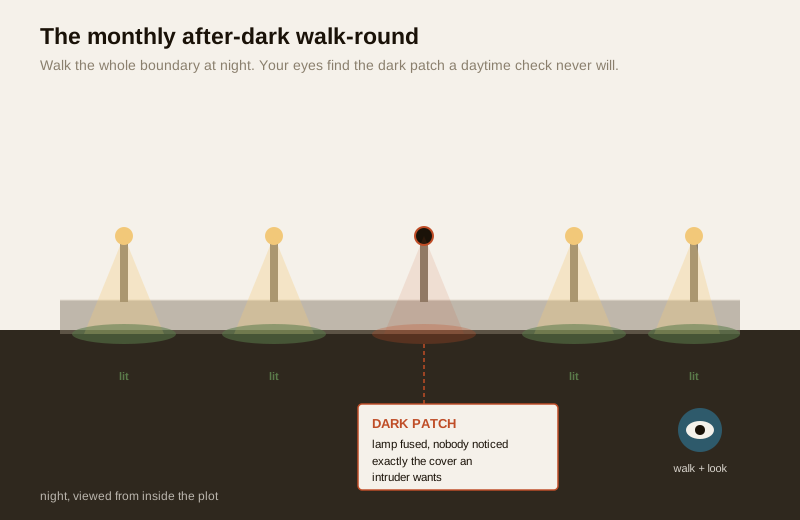
When you find a dark patch, the rule is simple: fix it now, not later. A failed lamp is not a job for the weekend after next. Every night it stays dark is a night the hole is open. If it is a lamp you can reach and the fitting switches off at a point you control, swap it. If it is anything more, a fitting that will not light with a fresh lamp, a flickering unit, a sensor that has stopped triggering, book the electrician and, in the meantime, treat that corner as unlit: park a car across it, move a temporary light there, but do not assume it is fine.
What actually fails, and why India is hard on lights
Outdoor lighting in India lives a hard life. The sun bakes it, the monsoon drowns it, the dust coats it, and a whole ecosystem of insects, spiders and rodents moves into it. Knowing what fails, and why, is what turns a vague worry into a specific thing you can look for. Here is the honest list.
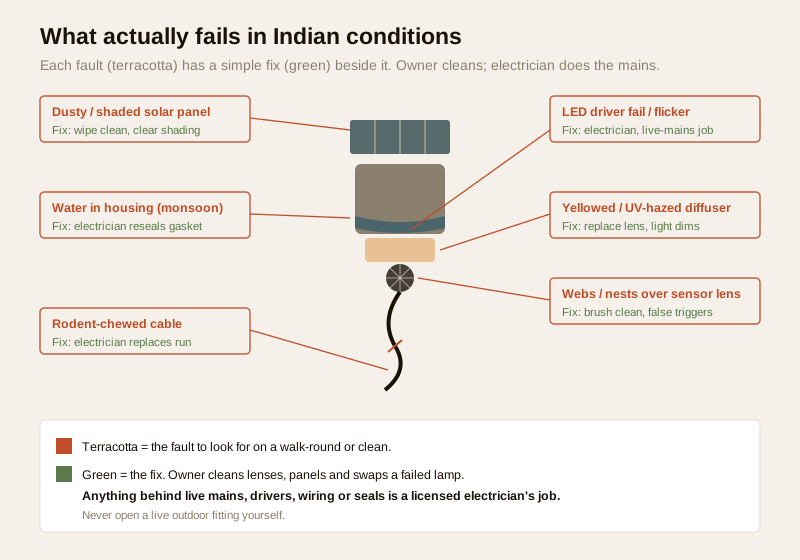
- LED driver failure and flicker. The LED chip itself lasts a very long time, but the driver, the small power supply that feeds it, is the part that dies, especially cheap ones cooking on a hot wall or sitting in a damp housing. A driver on its way out shows as flicker, as a light that will not come on cold, or as one that has quietly dimmed. This is a mains-electronics fault, and its repair or replacement is a licensed electrician's job, never a homeowner one.
- PIR sensor drift and lens clouding. The passive-infrared eye on a motion-activated light can drift out of adjustment after heat and time, and its little lens clouds with dust, haze and UV. A drifted or clouded sensor either stops triggering, so the light never comes on when it should, or triggers at everything, so the light is on all night until someone disables it. Cleaning the lens is a homeowner job; readjusting or replacing the sensor may not be.
- Photocell failure, stuck on or stuck off. The dusk-to-dawn photocell on an automatic light wears out, and it fails in one of two annoying ways: stuck on, so the light burns all day wasting power, or stuck off, so it never comes on at night and you have a dark patch you may not notice for weeks. The dusk-to-dawn guide covers the switching; here the point is simply to catch a photocell that has failed.
- Solar battery ageing and panel dust or shading. A solar security light fades as its battery ages and dies quietly when its panel greys over with dust or falls into the shade of a tree that has grown since you installed it. This is the commonest slow death in the whole scheme, because the far solar light is the one you never look at. Wiping the panel is the easiest maintenance win there is.
- Corroded and water-ingressed fittings. The monsoon is the great enemy. A fitting whose gasket has perished, whose seal has failed, whose gland was never tightened, fills with water, corrodes inside, and shorts or dies. You see it as a fitting with condensation on the inside of the lens, rust streaks, or one that has simply gone dark after the first heavy rain. Reopening and resealing a mains fitting is an electrician's job.
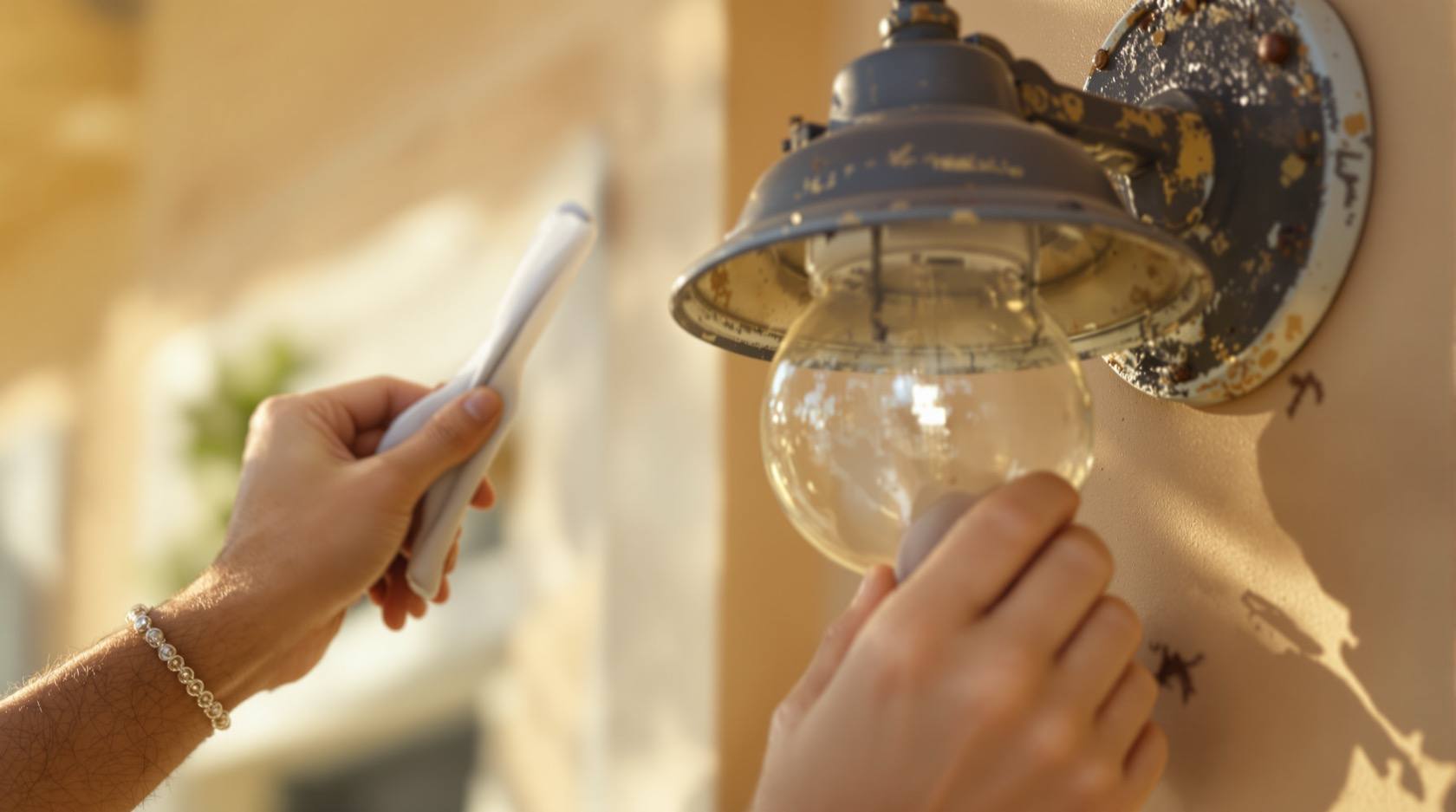
- Spider webs and insect nests over sensors and lenses. This is not a small thing, it is a huge, real cause of both failures and false triggers. Spiders love the warm glow of a light and spin webs right across the sensor and the lens; insects nest in the housing. A web across a PIR moves in the wind and triggers the light all night; a nest over the lens dims it to nothing. Brushing them off is simple, and it is astonishing how often it is the entire fix.
- Rodent-chewed cable. Rats and squirrels chew through the insulation on outdoor and garden cable, which is both a light failure and a genuine shock and fire hazard. A light that has died with no obvious cause, especially a garden or bollard run, can be a chewed cable. This is an electrician's job, and an urgent one.
- Loosened aim after wind, handling or a knock. A floodlight or a sensor that was carefully aimed can be knocked out of position by wind, by someone leaning a ladder on it, by a monkey, and now it lights the wrong place or blinds your own camera. Re-aiming a fitting you can safely reach and switch off is often a homeowner job; on a live or high fitting it is not.
- Yellowed and UV-degraded diffusers. The plastic diffuser or lens yellows and hazes under years of sun, and as it does it swallows the light, so a fitting drawing full power throws half the light it used to. Replacing the diffuser restores it.
The maintenance routine as a calendar
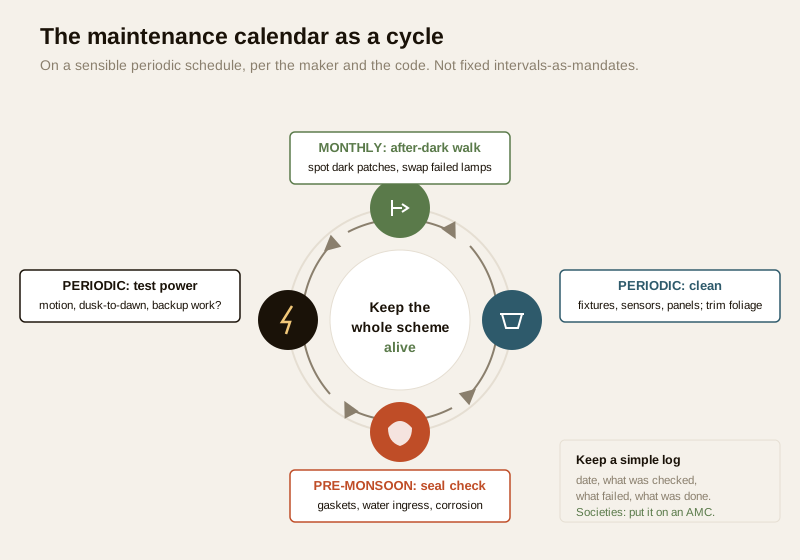
Maintenance is not a heroic annual overhaul; it is a set of small, regular habits, each on a sensible periodic schedule set by the maker's instructions and the code, not by a number I invent here. Think of it as a cycle rather than a to-do list, because it comes round again and again, and the point is that nothing is ever left long enough to quietly rot.
| When | What you do | Who |
|---|---|---|
| Every month, after dark | Walk the whole perimeter; look for any dark patch, dim or dead lamp, or light that should have triggered and did not | Owner |
| Straight away, on any failure | Replace a reachable failed lamp; treat any deeper fault as a dark corner until the electrician comes | Owner reaches; electrician for anything mains |
| On a sensible periodic schedule | Clean fixtures, sensor lenses and solar panels; brush off webs and nests; check aim is still true | Owner |
| Before the monsoon, and again after the first heavy rain | Check seals, gaskets and glands; look for water ingress, condensation and corrosion; reseal what has failed | Owner spots; electrician reseals mains |
| On a sensible periodic schedule | Test that motion, dusk-to-dawn and backup power actually work, do not assume, trigger them and watch | Owner tests; electrician for wiring faults |
| As foliage grows | Trim branches and shrubs that have grown to block a light or to reach and mask a sensor | Owner or gardener |
A few of these deserve a word. Cleaning is the most neglected and the highest-value after the walk: dust on a panel, haze on a diffuser and webs on a sensor between them account for a huge share of "the light stopped working" that is really "the light was never cleaned." The pre-monsoon seal check is the one seasonal job that saves the most fittings, because a fitting that goes into the rains with a perished gasket does not survive them; look at every outdoor fitting before the first rain and again after it. Testing that things actually work matters because the failures that hurt most, the photocell stuck off, the backup that does not cut in during a power cut, are silent, so you have to provoke them: cover a photocell to prove it switches, walk under a motion light to prove it triggers, and if a light is meant to stay lit through a power cut, kill the mains and check it does. A security light wired with no power-cut backup is dark exactly when it matters most, and only a deliberate test finds that out before an intruder does.
Who does what: the line between you and the electrician
The single most important safety rule in this whole guide is the line between what you may do and what a qualified person must do, so let me draw it plainly.
You, the owner, can safely do the visual and the surface work: the after-dark walk, cleaning lenses, panels and housings, brushing off webs and nests, swapping a failed lamp on a fitting you can reach and switch off at a point you control, spotting water ingress and corrosion, checking that motion and dusk-to-dawn actually trigger, and trimming foliage. None of that involves opening a live circuit.
A licensed electrician must do everything behind the mains: the driver, the wiring, the circuit, the connections, resealing or replacing a mains fitting, repairing a chewed cable, and any work on a fitting you cannot safely reach and isolate. Never DIY live mains. Outdoor electrical work is wet, earthed and unforgiving; the fitting that killed the light can kill you. If in any doubt about whether a job is yours or the electrician's, it is the electrician's. Book the visit, and treat the dark corner as unlit until it is done.
Societies, common areas and the AMC
For a gated community, an apartment block or any gated community, the maths of maintenance changes, because there is no single owner walking the boundary and the lights are on common walls, in stairwells, over parking, along the perimeter, that everyone assumes is somebody else's job. The result, over and over, is a perimeter with a dozen dead lamps that nobody has reported, because nobody owns the looking.
The fix is structural, not heroic. Put the outdoor and common-area lighting on an annual maintenance contract with a competent electrical contractor, so that cleaning, seal checks, lamp replacement and testing happen on a schedule regardless of who is on the committee this year. Fold the security lighting into the wider building security systems plan so it is maintained alongside the cameras and access control, not forgotten beside them. And, crucially, keep a log: a simple register of when each round was done, what was found, what was replaced and what is still outstanding. A log turns "I think the back lights are fine" into a record, and it is the difference between a scheme that stays alive and one that decays a lamp at a time until an incident exposes it.
Keep a simple log or register
Whether you are a homeowner or a society, keep a maintenance log, and keep it simple enough that you will actually use it. A line per round is enough: the date, what you checked, what had failed, and what you did about it. Note the date you last replaced a solar battery, so you can budget the next; note which fitting keeps letting in water, so you can decide to replace rather than reseal it again; note the corner that keeps going dark, because a recurring failure is telling you something the scheme needs fixed properly. The log is not bureaucracy. It is the memory the scheme does not have, and it is what makes maintenance a system rather than a series of forgotten good intentions.
Emergency lighting is a separate, mandated regime
One clear boundary before we close. Everything above is about security lighting, the light that deters and lets your cameras see. Emergency and escape-route lighting, the light that keeps a marked exit visible in a power failure or a fire, is a different system entirely, and it has its own mandated testing regime written into the codes: it is not maintained on a "sensible periodic schedule" of your choosing but on the specific tests the standard requires. Do not treat the two as one, and do not fold emergency lighting into your monthly walk and call it done. Its full requirements are covered in the emergency lighting guide; defer to that, and never let a security fitting or its maintenance block or mask an escape route.
Tying it back to the whole scheme
Maintenance is the thread that keeps the entire library's work standing. A failed light does not just leave a dark patch for an intruder; it blinds the camera that was relying on it, because a CCTV-compatible light that has gone dark turns a clear night-time image into a useless black frame, and you discover it only when you go to the footage after an incident and find nothing. It undoes the energy work too, a photocell stuck on burns power all day, and the false-triggering webbed sensor runs a floodlight all night. Every part of the scheme depends on every part working. To find where your own scheme is thin before a failure exposes it, the home security risk scorecard and the site perimeter security assessment walk you through your plot systematically, and the security lighting spoke covers the boundary scheme this guide keeps alive.
Key takeaways
- A dark patch is a security hole. The best-designed lighting is worthless the day the lamp fuses, the sensor clogs, the panel dusts over or the fitting floods, and a single dark corner hands an intruder the exact cover the scheme was meant to remove, unnoticed on a wall no one looks at after dark.
- The monthly after-dark walk is the single most valuable habit. It is the only test that finds a failure the way an intruder finds it, with your own eyes, from the ground, in the dark. When you find a dark patch, fix it now, not later.
- Know what fails in India: LED driver failure and flicker, PIR drift and lens clouding, photocells stuck on or off, ageing solar batteries and dusty or shaded panels, water-ingressed and corroded monsoon fittings, spider webs and insect nests over sensors (a huge real cause of false triggers and dead lights), rodent-chewed cable, knocked-out aim and yellowed diffusers.
- Run maintenance as a calendar, not a one-off: a monthly walk, prompt lamp replacement, periodic cleaning of fixtures, sensors and solar panels, a pre-monsoon seal and water check, a periodic test that motion, dusk-to-dawn and backup power actually work, and foliage trimming, all on a sensible periodic schedule per the maker and the code, no fabricated intervals.
- Draw the line between you and the electrician. You do the walk, the cleaning and a reachable lamp swap; a licensed electrician does all mains, drivers, wiring, chewed cable and sealed fittings. Never DIY live mains. Societies should put common-area lighting on an AMC and keep a log; emergency lighting has its own mandated regime, defer to that guide.
Where to go next
- Security lighting design guide the pillar for the whole discipline, and security lighting for the boundary and perimeter scheme this maintenance keeps alive.
- Motion-activated security lighting and dusk-to-dawn security lighting for the switching whose sensors and photocells you are testing, and solar security lighting for the far light that fades silently and needs the walk most.
- CCTV-compatible lighting because a failed light blinds the camera relying on it, and security lighting energy use for the running cost a stuck photocell quietly wastes.
- Gated community security and building security systems for the AMC and log approach a society needs, and emergency lighting for the separate, code-mandated testing regime you must not fold into this one.
- Home security risk scorecard and site perimeter security assessment to find where your scheme is thin before a failure exposes it.
References
- SP 72 : 2025, National Lighting Code of India, Bureau of Indian Standards, the primary reference for the illuminance, uniformity and glare goals a maintained scheme must continue to meet; treat all specific light-level figures as design values a qualified lighting designer sets to the current edition, and treat maintenance intervals as a sensible periodic schedule per the maker's instructions and the code, not as fixed mandates stated here. Verify status via the BIS catalogue: https://www.services.bis.gov.in/
- IS 3646 (Part 1) : 2025, Code of Practice for Interior Illumination, Bureau of Indian Standards, for the interior-illumination principles a maintained stairwell, corridor or covered-area light must keep meeting; verify status via the BIS catalogue: https://www.services.bis.gov.in/
- National Building Code of India, SP 7 : 2026, Part 8 Section 1 (Lighting and Ventilation), Bureau of Indian Standards, together with your local municipal bye-laws, for the lighting aspects of a fixed install; verify the current edition via the BIS catalogue: https://www.services.bis.gov.in/
- Emergency and escape-route lighting has its own mandated inspection and testing regime under the applicable codes and is covered in the Studio Matrx emergency lighting guide, not restated here; do not maintain it on an informal schedule.
- Maintenance intervals, lamp and driver lifetimes, solar battery life and seal-replacement periods are entirely product- and site-specific; this guide gives qualitative routine guidance only and states no fabricated interval as a mandate. Follow the maker's instructions, the code and a competent electrician's advice for your specific fittings and conditions.
This is an educational overview, not legal or engineering advice. It is strictly about keeping defensive lighting working so a home is safer and cameras can see, never about defeating any security measure. You may do the after-dark walk, the cleaning and a reachable lamp swap; all mains, driver, wiring, chewed-cable and sealed-fitting work is a licensed electrician's task; setting light levels is a lighting designer's task; emergency lighting has its own mandated testing regime; never let a fitting or its maintenance block an escape route; and verify every standard's current status via the BIS catalogue before relying on it.
Export this guide
Related Guides — Deep-dive reading
CCTV Maintenance and AMC in India (2026): Keeping the System Alive
How to keep a CCTV system actually working after install: clean lenses and housings, check every camera still records, watch drive health and retention, update firmware, and decide whether an Annual Maintenance Contract (AMC) is worth it.
SecurityParking Security Lighting in India (2026): Lighting Basement, Stilt and Open Parking So Nothing Hides in the Dark
How to light apartment and commercial parking so vehicles, people and number plates are clearly seen, cameras can actually read the scene, and the space stops being a soft spot for theft and lurking, without ever compromising the emergency lighting on the escape route.
SecurityBurglar Alarm Maintenance in India: Testing, Batteries & AMC (2026)
How to keep a burglar alarm actually working: weekly walk-tests, backup and sensor battery cycles, clean sensors, a live SIM, and an end-to-end alert check, plus what a good AMC covers.
SecurityRelated Tools — Try Free
Brise-Soleil Visualizer
Interactive horizontal-louvre cut-off angle calculator — sun altitude, louvre depth, and spacing inputs with a live shadow preview. Computes θ = arctan(spacing/depth) for façade shading, ECBC envelope compliance, hospital daylight design, and tropical sun-control detailing.
Sun Shading ToolCross-Ventilation Analyzer
Estimate airflow and air changes per hour (ACH) from room size, window areas, layout, and local wind — with NBC 2016 Part 8 compliance check.
Ventilation CalculatorHome Security Risk Scorecard
Score your home across six security layers — perimeter, entry points, lighting, detection, alarm and habits — and get a prioritised action plan.
Security Scorecard