
Security Lighting Energy Use in India (2026): Keeping Your Home Lit and Safe Without Running Up the Bill
The honest answer to "won't security lighting cost a fortune to run?" It does not have to. Done well, with efficient LEDs and smart switching, a home stays well protected on a fraction of the energy a blazing all-night floodlight burns, and it is safer for it.
Almost every homeowner who thinks about security lighting arrives at the same worry: won't it run up my electricity bill? It is a fair question, and the honest answer has two halves. Done badly, as a couple of blazing floodlights left on full all night, security lighting genuinely is wasteful, and here is the twist, it is also worse at keeping you safe. Done well, with efficient fittings and sensible switching, a home stays properly protected on a small fraction of that energy. The cheap way and the safe way are, happily, the same way.
This guide is about security lighting energy use: why the old blazing-flood approach costs so much and protects so little, and the handful of levers, better lamps, smarter switching, zoning, right-sizing and sometimes solar, that cut the running cost right down while making the light better for security, not worse. It is written for the homeowner who wants the light and does not want the shock on the bill. It sits in the Studio Matrx security lighting library under the security lighting design pillar, and it is about planning and deciding, never about wiring.
Scope and safety. You plan and decide the lighting here, strictly as a defensive measure so people and cameras can see. Mains wiring, circuits and any fixture at height are for a licensed electrician to the wiring rules (see the electrical hub). Actual illuminance, watts and colour numbers are for a qualified lighting designer to the current National Lighting Code, treat nothing here as a target figure. Never let a security fitting block an escape route or a marked exit. Verify every standard's current edition and your local bye-laws before relying on it. Educational guidance, not legal or engineering advice.
The two false economies, and the honest middle
Two beliefs pull homeowners in opposite wrong directions, and both cost money.
The first is that security means brightness, so more light equals more safety. This leads to a pair of harsh floodlights aimed outward and left on all night. It burns energy from dusk to dawn, every night, all year. And it does not even work: a single glaring source makes the eye and the camera shut down to everything beyond it, so the bright fitting throws deep black shadows an intruder simply stands in. You pay the most for a result that is less secure. This is the classic Indian gate flood that dazzles the very CCTV camera it was bought to help.
The second false economy is the opposite: skip the light to save the bill, leave the boundary dark, and hope. A dark home is the one a prowler picks. Saving a few units of electricity by going dark trades a small saving for a large risk.
The honest middle is that good security lighting is cheap to run because it is efficient and because it is not blazing all night. It uses modern, low-wattage lamps; it keeps only a gentle base level on through the quiet hours and lets movement bring up the bright light when something actually moves; it lights only what needs watching; and it is sized to do the job and no more. That combination is both the safest and the least expensive. The rest of this guide is those levers, one at a time.
Lever one: the lamp, LED versus the old halogen flood
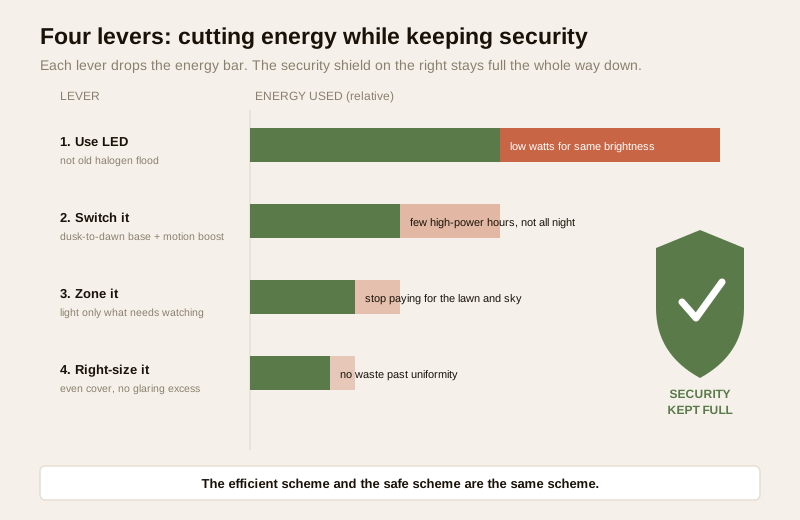
The single biggest saving is the oldest and simplest: use LED, not the old halogen or discharge floodlight. For years the standard security light was a hot halogen flood, a small heater that happened to give off light. It drew a lot of power, ran scorching hot, and burned out fairly quickly. A modern LED fitting of the same visible brightness draws a fraction of the power, because it turns far more of the electricity into light and far less into heat.
The energy story is only half of it. For security specifically, LED wins on things a halogen never could:
- Instant on, full bright. An LED reaches full output the instant it is switched, which is exactly what a motion-triggered security light needs, light now, when something moves, not a slow warm-up while the moment passes. Some older discharge lamps took minutes to restrike after a flicker, useless for security.
- Dimmable and controllable. LED sits happily at a low base level and steps up on demand, which is what makes the switching lever below possible. A halogen flood is really an on-or-off device.
- Long life, less waste. A good LED lasts far longer than a halogen, so you replace it less often, less money on lamps, and, importantly for security, fewer dark patches from a lamp that quietly died. A fused lamp is a security hole, and a lamp that rarely fails means fewer holes.
- Runs cool. Less heat means less fire risk near a fitting and less strain on the fixture itself.
So the first and largest move to cut energy use is simply to specify LED fittings throughout. There is no security case left for a halogen flood.
| Old halogen / discharge flood | Modern LED security fitting | |
|---|---|---|
| Energy for the same visible brightness | High, most of it lost as heat | Low, far more of the power becomes light |
| Response when switched | Slow warm-up / restrike delay | Instant full brightness |
| Suits motion + base-level switching | Poorly, really an on/off device | Well, dims to a base and steps up |
| Lamp life and replacement | Shorter, more frequent changes | Long, fewer dark-patch failures |
| Heat and running temperature | Runs hot | Runs cool |
Lever two: switching, you rarely need everything on full all night
If the lamp is how efficiently you make each hour of light, switching is how many hours you actually run. This is the lever most homeowners miss, and for an all-night application it is enormous, because the wasteful default is everything, on full, from dusk to dawn.
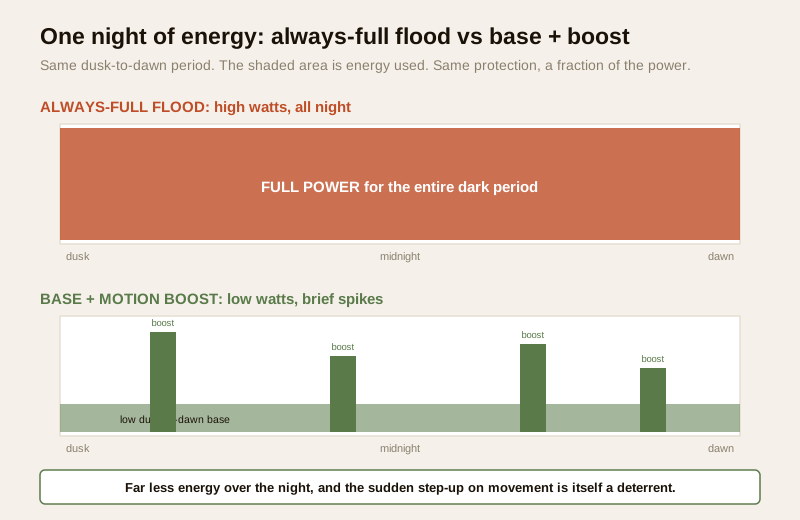
You almost never need that. A far better pattern for most homes is a low base level plus a motion boost:
- A gentle dusk-to-dawn base keeps the boundary and approaches softly lit all night, enough to remove the pitch-black that a prowler wants, enough for a camera to keep recording, and it does this at low wattage because it is a low level, not full flood. A photocell turns it on at dark and off at daylight so it is never burning in the day. The dusk-to-dawn security lighting guide covers this base layer.
- A motion boost on top brings the light up to full brightness only when something actually moves into a watched zone, then drops back after a while. The bright, attention-grabbing, energy-hungry light therefore runs for minutes across a night, not hours. The motion-activated security lighting guide covers sensor choice and, crucially, aiming the detection zone so a passing cat, an auto reversing in the lane or a swaying banner does not trip it all night, the classic Indian motion-light failure that ends with the owner disabling it in frustration.
The energy difference between the two patterns is the heart of this guide. An always-full flood runs at high wattage for the whole dark period. A base-plus-boost setup runs at low wattage for the whole period and only briefly spikes to high. Over a full night, the second draws a fraction of the first, and it is more secure, because the sudden step-up to bright light on movement is itself a deterrent (something noticed you), while a flood that is always on is just wallpaper an intruder has long stopped fearing.
Lever three: zoning, light only what needs watching
The third lever is deciding where the light goes. Much wasted energy is spent lighting places that do not need watching, the middle of a lawn, a decorative wall, the sky, while the places that matter, the gate, the boundary line, the dark side return, the doors and windows, are the ones a security design should spend its light on.
Zoning means grouping the lighting so each area is controlled to suit its own need rather than everything being wired to one switch that is either all-on or all-off. Then:
- The vulnerable approaches (gate, boundary, the blind side of the house, ground-floor openings) get the base-plus-boost treatment.
- Low-value open areas that no one needs to watch get little or nothing, or motion-only so they are dark until something enters.
- Decorative or garden lighting is kept separate from security lighting entirely, so you are not burning security-grade light for looks, or relying on a garden light for protection. Aesthetic schemes belong under general landscape and architectural lighting, controlled on their own.
Zoning saves energy twice over: you stop paying to light what does not matter, and you can run each zone on the switching that suits it. It also makes the light better, because effort is concentrated where security actually needs it.
Lever four: right-sizing, over-lighting wastes energy and hurts security
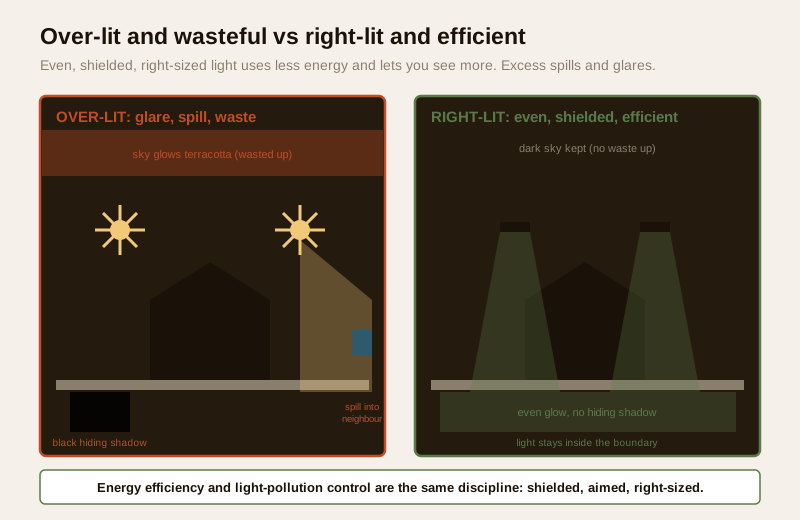
There is a stubborn myth that if some light is good, more must be better. For security it is simply false, and it is expensive. Past the point where a space is evenly and adequately lit, extra brightness does not add security, it subtracts.
Over-lighting fails on three fronts at once:
- It wastes energy. Every extra watt over what the space needs is money burned for no security gain.
- It creates glare. A source brighter than the scene dazzles the eye and the camera, which then cannot see into the darker areas around it, exactly the failure covered in the glare-free security lighting guide. The over-lit home is often less watchable than the evenly-lit one.
- It spills as light trespass. Excess light thrown past the boundary lands in a neighbour's bedroom window and washes the night sky orange (the terracotta glow over Indian cities). Light trespass is a real cause of RWA disputes, and it is pure waste, energy paid for, thrown where it does harm.
What security actually wants is even, uniform coverage with no dark hiding pockets, at a modest level, from shielded fittings aimed down at the ground they light. That is the opposite of a few blazing over-bright floods, and it uses less energy to achieve. Energy efficiency and light-pollution control turn out to be the same discipline: shielded, aimed, right-sized. A lighting designer sets the actual level to the National Lighting Code; your job as the homeowner is to insist the brief says even coverage, no hotspots, no spill, and to resist the instinct that says buy the brightest flood on the shelf.
Working out the running cost without inventing numbers
Homeowners often want a rupee figure, and it is right to want one, but the useful thing is not a made-up number, it is knowing what drives the cost so you can estimate and compare honestly for your own fittings and your own tariff.
The running energy of any light comes down to one simple idea:
energy used = the fitting's power (its watts) multiplied by the hours it runs.
That is the whole model, and both of the first two levers act directly on it:
- The lamp lever (LED) cuts the watts. For the same visible brightness, the LED's rated power is much lower than the halogen's, so every hour costs less.
- The switching lever (base plus motion) cuts the hours at high power. Instead of high watts for the whole dark period, you run low watts for the period and high watts only briefly.
To estimate your own cost, read two real numbers you already have access to, and do not let anyone hand you invented ones:
1. The fitting's rated watts, printed on the fixture, its box or its datasheet. Add up the watts of the fittings that will actually be running, and note which run all night at a low base versus which only spike briefly on motion.
2. Your local electricity tariff, the rate per unit (kilowatt-hour) on your own electricity bill, which varies by state, provider and slab.
Multiply the running watts by the hours they run to get the energy, then apply your tariff to get the rupees. That is an estimate you can trust because every number in it is real and yours. Comparing an always-full flood against a base-plus-motion LED scheme this way makes the saving obvious without anyone fabricating a figure. Studio Matrx will not quote you exact watts, units or rupees, those depend entirely on your fittings and your tariff, and a confident-sounding invented number is worse than none.
When you shop, look also for the Bureau of Energy Efficiency (BEE) star label that appears on many lighting and appliance products, more stars means more light per watt. Treat it as a guide to relative efficiency, and read the actual rated watts and output on the specific fitting rather than trusting a headline claim.
The false economies that cost more in the end
Two spending decisions look like savings and quietly cost more, in money and in security.
Buying the cheapest fitting. The rock-bottom flood is a false economy on several counts. It often dies fast, so you buy it again and again. Its optics are usually poor, so the light sprays everywhere except where you need it, meaning you buy more fittings to cover the gaps, and each one wastes energy spilling light past its target. And a cheap lamp that fails leaves a dark patch, a security hole, until someone notices and replaces it. A well-made, well-shielded LED fitting costs more at the till and less over its life, in energy, in replacements and in reliability.
Leaving fused lamps unreplaced. This is the most Indian of failures and the one that undoes everything above. A security scheme is only as good as its darkest gap. A single dead lamp at the gate or on the blind side turns a protected home into one with an obvious hole, and it happens constantly because no one is watching the lights themselves. Replacing a fused lamp promptly is both a security act and, oddly, an energy one, because a scheme that works as designed lets you run the efficient low-base-plus-boost pattern with confidence instead of over-lighting elsewhere to compensate for the dark patch you never fixed. This is why energy and upkeep sit together, and why the security lighting maintenance guide is the companion to this one.
Where solar can take load off the meter
Solar-powered security lighting can move part of the load off your electricity meter entirely, and where it fits, that is a genuine saving. A standalone solar fitting charges its own battery by day and runs at night on stored sun, drawing nothing from the grid.
It is not a universal answer, and honesty matters here. Solar security lights depend on getting enough daytime sun to fully charge, and in India that runs into two real limits: the monsoon, when overcast days leave the battery half-charged and the light fades before dawn exactly when you may want it, and short winter days in the north. A solar light with a tired battery that dies at two in the morning is a security failure dressed as a saving. Solar suits far bays, a boundary run, a gate or a garden edge where running a mains cable is costly and a mains-backed fitting is not essential, and it works best where the panel gets clean, unshaded sun and where the fitting is not the only thing protecting a critical approach. The trade-offs, battery sizing, monsoon derating and where mains backup is worth keeping, are covered in the solar security lighting guide. Used with eyes open, solar is a good lever; used as a blanket promise, it disappoints in the rains.
Bringing it together, and the professionals
Cutting security lighting energy use is not one clever trick, it is these levers together: LED lamps (low watts), base-plus-motion switching (few high-power hours), zoning (light only what needs watching), right-sizing (even coverage, no glare or spill), promptly replaced lamps, and solar where it genuinely fits. Every one of them cuts energy and improves the security result, which is why the efficient scheme and the safe scheme are the same scheme.
Two people turn the plan into a working install. A licensed electrician does all mains wiring, circuits, photocell and sensor connection and any fixture mounted at height, to the wiring rules. A lighting designer sets the actual levels, uniformity and glare control to the current National Lighting Code so the scheme is right-sized rather than over-lit. To map where your own home is dark, over-lit or wastefully spilling before you brief anyone, the home security risk scorecard is a useful starting point.
Key takeaways
- Good security lighting is cheap to run, and the cheap way is the safe way. A blazing all-night flood is both wasteful and worse for security (glare and shadows); an efficient, well-switched scheme protects more for a fraction of the energy.
- LED is the biggest single saving. It uses a fraction of a halogen flood's power for the same brightness, comes on instantly at full output, dims to a base level, lasts far longer and runs cool. There is no security case left for a halogen flood.
- Switching is the sleeper lever. You rarely need everything on full all night, a low dusk-to-dawn base plus a brief motion boost uses far fewer high-power hours than an always-full flood, and the step-up itself deters. Aim motion sensors so a cat or an auto does not trip them all night.
- Zone it and right-size it. Light only what needs watching, keep decorative light separate, and stop at even coverage, over-lighting wastes energy, causes glare and spills into the neighbour's window without adding any security past uniformity.
- Estimate honestly and avoid false economies. Energy equals watts times hours, read the fitting's rated watts and your own tariff rather than trusting invented numbers, watch the BEE star label, do not buy the cheapest fitting (it dies fast and spills light), and never leave a fused lamp, a dark patch is a security hole.
Where to go next
- Security lighting design guide, the pillar for the whole discipline, including glare control and even coverage.
- Dusk-to-dawn security lighting and motion-activated security lighting, the two switching layers that cut running hours.
- Glare-free security lighting for why over-lighting hurts security, and solar security lighting for taking load off the meter where it fits.
- Security lighting maintenance, the companion on replacing fused lamps, and CCTV-compatible lighting for lighting the camera without glare.
- Security lighting for the boundary and the home security risk scorecard to map where your home is dark or wasteful.
References
- SP 72 : 2025, National Lighting Code of India, Bureau of Indian Standards, the primary reference for illuminance, uniformity, energy-efficient lighting practice and glare control; treat all specific lux and wattage figures as design values a qualified lighting designer sets to the current edition. Verify status via the BIS catalogue: https://www.services.bis.gov.in/
- National Building Code of India, SP 7 : 2026, Part 8 Section 1 (Lighting and Ventilation), Bureau of Indian Standards, together with your local municipal bye-laws, for the lighting and energy aspects of an installation; verify the current edition via the BIS catalogue: https://www.services.bis.gov.in/
- IS 3646 (Part 1) : 2025, Code of Practice for Interior Illumination, Bureau of Indian Standards, for interior-illumination principles that inform right-sizing; verify status via the BIS catalogue: https://www.services.bis.gov.in/
- Bureau of Energy Efficiency (BEE) standards and labelling programme, for the star-rating labels that indicate relative efficiency of lighting and appliances; read the rated watts and output on the specific product and confirm the current scheme before relying on any claim: https://www.beeindia.gov.in/
This is an educational overview, not legal or engineering advice. It is strictly about using light defensively and efficiently so a home is safer and cheaper to protect, never about defeating any security measure. Mains wiring, circuit and sensor work, work at height, and setting illuminance and wattage levels are qualified professional tasks, engage a licensed electrician and a lighting designer, read your own fittings' rated watts and your own electricity tariff rather than any invented figure, and verify every standard's current status via the BIS catalogue before relying on it.
Export this guide
Related Guides — Deep-dive reading
Motion-Activated Security Lighting in India (2026): Sensor Types, the False-Trigger Problem, and Pairing Motion With a Base Light So Your Camera Never Goes Blind
How PIR, microwave and dual-tech sensors really behave in Indian conditions, how to stop the stray-dog-and-passing-auto false triggers that make owners disable the light, and why a motion-only light leaves a camera dark until it is too late.
SecuritySolar Security Lighting in India (2026): Where It Genuinely Works, and the Honest Reasons It Fades in the Monsoon
An all-in-one solar security light needs no cabling to a far gate and no running cost, which is exactly why it is oversold. This guide shows a homeowner where solar lighting is genuinely the right answer, where wired dusk-to-dawn is safer, and how to buy one that does not die at 2am in July.
SecuritySecurity Lighting in India (2026): Lighting the Boundary Without Dazzling the Camera or the Neighbour
How to use light as a security layer that deters intruders and lets your cameras see, done well with uniform shielded downlight, no glare, no neighbour trespass and a power-cut backup.
SecurityRelated Tools — Try Free
Cross-Ventilation Analyzer
Estimate airflow and air changes per hour (ACH) from room size, window areas, layout, and local wind — with NBC 2016 Part 8 compliance check.
Ventilation CalculatorSolar CCTV Sizing Calculator
Enter cameras, sun-hours and backup days to get the solar panel wattage, battery Ah and an indicative kit cost for an off-grid camera.
Solar SizingCCTV Camera Coverage & Count Calculator
Estimate how many CCTV cameras you need, the NVR channels, storage in TB for your retention period, and an indicative all-in cost with GST.
CCTV Calculator