
Low-Light Camera Illumination in India (2026): The IR and White-Light Illuminators That Let a Camera See in the Dark
The emitter side of night vision — how an infrared illuminator gives a camera an invisible monochrome image, how a white-light illuminator gives a usable colour one, and how to match the light to the scene without dazzling your own lens.
A camera cannot see what is not lit. This is the single fact behind every disappointing night clip in India: the owner bought a "night-vision" camera, trusted the box, and woke to a black rectangle where the gate should be, or a grey smear where a face should be. Night vision is not a property of the sensor alone — it is a partnership between a sensor that is good in the dark and a light source that gives it something to see. This guide is about that second half: the illuminator, the extra light you add so a night camera can actually record the scene. It is the emitter side of the story, deliberately kept separate from the camera side.
Two families of illuminator do this job, and they behave very differently. Infrared (IR) floods the scene with light your eye cannot see and hands the camera a black-and-white picture. White-light (visible) floods it with ordinary light you can see and hands the camera a colour picture — and doubles as a deterrent. Choosing between them, and aiming whichever you pick so it helps the camera instead of blinding it, is the whole craft. This page sits inside the Studio Matrx security lighting design guide; read that for the whole-property plan and this for the illuminator that lets the camera see after dark.
Scope & safety. You plan, choose and coordinate here — whether a scene needs IR or white light, what range and spread the illuminator must cover, where it mounts relative to the lens. A licensed electrician installs any mains wiring, fixtures and circuits, to the wiring rules; illuminators mounted at height are a qualified job. This guidance is strictly defensive: how to light your own scene so your own camera can see, never how to defeat anyone else's system. Never let an illuminator, its bracket or its wiring block an escape route, an exit door or a stair egress. Treat any range, lux or wattage as figures a lighting designer or the security lighting design guide sets to the applicable code — verify every standard's current edition and your local municipal bye-laws before relying on it. Educational guidance, not legal or engineering advice.
First, the boundary: this is the light, not the camera
It is easy to confuse the illuminator with the camera because in most home cameras they are built into the same box. But they are two different things doing two different jobs, and treating them as one is why people buy the wrong fix.
- The camera / sensor side — how well the chip and lens gather what light there is — is covered in the low-light CCTV camera guide and worked through in detail in CCTV low-light performance. That is where sensor size, aperture and the "starlight" claims belong.
- The illuminator side — this guide — is the extra light you add so the sensor has enough to work with. A world-class sensor still sees nothing in genuine pitch black; an ordinary sensor with the right illuminator sees plenty.
- General lighting-for-cameras — matching your everyday security lighting to what cameras need — is the job of the CCTV-compatible lighting guide. This page is the narrower question of a dedicated illuminator when ambient light is not enough.
Keep the three separate and the decision gets simple: fix the sensor problem with a better camera, fix the light problem with the right illuminator, and do not buy one hoping it cures the other.
The two ways to give a night camera light
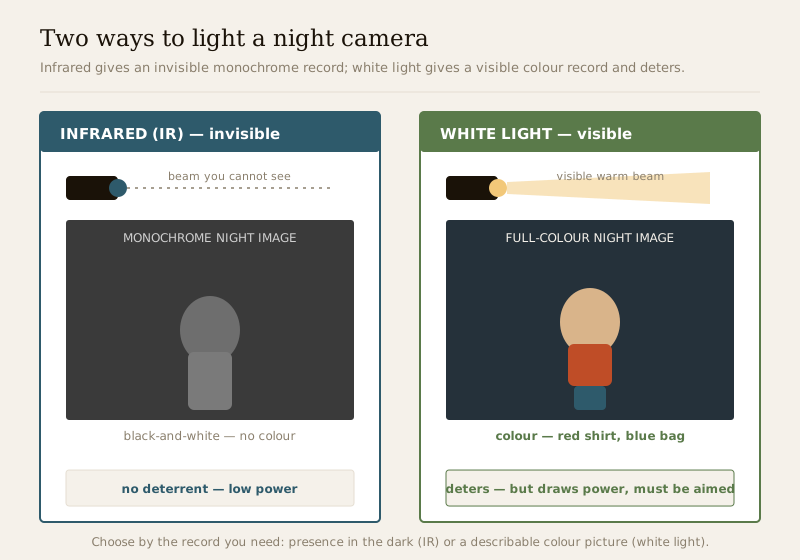
Everything downstream follows from this one choice, so it is worth laying out plainly.
| Infrared (IR) illuminator | White-light (visible) illuminator | |
|---|---|---|
| Can people see the light? | No — invisible (940nm) or a faint red glow (850nm) | Yes — ordinary visible light |
| Night image the camera gives | Monochrome / black-and-white | Full colour |
| Value for identification | You see that a person was there | You can describe the person — clothing colour, detail |
| Deterrent effect | None — it does not announce itself | Real — a lit scene deters, and can startle on motion |
| Power draw | Low | Higher — it is a real light |
| Neighbour / trespass issue | Almost none (invisible) | Same as any light — glare and spill must be controlled |
| Typical use | Discreet monitoring, dark rear yards | Where a describable colour record matters — gate, entrance |
Neither is simply "better." IR is the discreet, low-power, always-available option that gives a monochrome record; white light is the deterrent, colour-capable option that costs power and behaves like any light you must aim and shield. Most well-designed Indian homes end up with a mix: IR on the quiet flanks, white light where identification matters.
Infrared illuminators, honestly
Infrared light sits just beyond the red end of what the eye can see. The camera's sensor can see it (with its night filter swung out of the way), so an IR-lit scene looks bright to the camera and black to you. That invisibility is IR's great strength — a watcher cannot tell the scene is lit, and there is no light to trespass into a neighbour's window — and its great limitation: the image comes back monochrome, so you lose colour, the single most useful identifying detail.
Built-in versus add-on. Most bullet and dome cameras carry a ring of IR LEDs around the lens that switches on at dusk — that is the illuminator, built in. It is convenient and, for a modest scene, enough. But a ring at the lens has two weaknesses: its reach is limited, and being at the lens it is the worst possible place for bounce (more below). For a longer driveway or a deep yard, a separate IR lamp mounted away from the camera gives more reach and a cleaner image than the on-board ring straining to light a distant fence.
850nm versus 940nm — the one honest wavelength note. IR illuminators come in two common flavours. 850nm is slightly more efficient and reaches a little further, but its LEDs emit a faint visible red glow — look at the camera at night and you see a dim red constellation. 940nm is fully invisible — no glow at all — at the cost of slightly shorter reach for the same power. That is the whole trade, stated qualitatively: 850nm for a touch more range with a faint red tell; 940nm for true invisibility with a little less reach. Do not trust any box that promises a specific metre range as a guarantee — real reach depends on the lamp, the scene's reflectivity and the camera, and the honest way to size it is to test on your actual site.
The IR pitfalls — and how to fix them
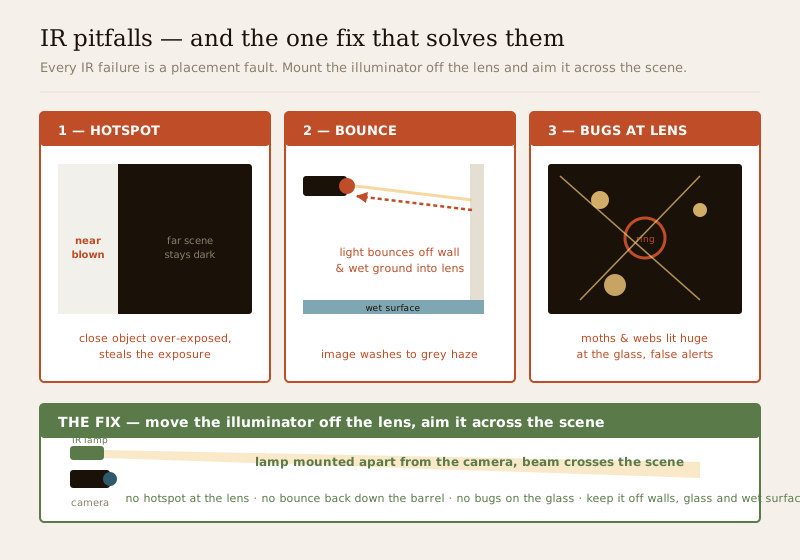
IR is cheap and invisible, but it fails in specific, recognisable ways — and every one of them is a placement or aiming problem, not a component fault.
- The hotspot / over-exposed near object. IR falls off fast with distance, so anything close to the illuminator — a wall corner, a pillar, a gate leaf right in front of the ring — gets blasted bright white while the scene you actually care about, further out, stays dark. The camera exposes for the bright near object and loses the far one. Fix: keep near clutter out of the beam, and prefer a separate IR lamp aimed across the scene rather than an on-lens ring lighting whatever is nearest.
- IR bounce washing the image. IR reflects off a pale wall, a glossy gate, a parapet, or a wet surface after rain and floods straight back into the lens, flattening the whole picture into a milky grey haze. This is the most common "my night image is foggy" complaint in India, and it peaks in monsoon when every surface is wet and reflective. Fix: aim the illuminator away from nearby walls and reflective surfaces, and mount it off the camera so the bounce does not return along the lens axis.
- Insects and spiderwebs at the lens. An IR ring at the lens lights up every moth, mosquito and spiderweb strung across the housing — they appear as huge glowing blobs and streaks, and the web becomes a permanent bright veil that also triggers false motion alerts all night. Fix: a separate illuminator mounted away from the lens means the bugs it attracts are not sitting in front of the camera; keep the housing and the lens clean, and site the lamp where its glow is not right at the glass.
- Reflection shooting through glass. Point an IR camera through a window and the ring's own light reflects straight back off the glass into the lens — you get a bright ghost and little else. Fix: do not shoot through glass with an IR camera; put the camera (and its light) on the same side as the scene, or use a camera designed for through-glass viewing with its IR off.
The thread through all four fixes is the same, and it is the single most useful sentence about IR: mount the illuminator away from the lens and aim it across the scene, not from beside the lens into it.
White-light illuminators: colour, and a real deterrent
A white-light illuminator is just that — a visible light, aimed to fill the scene the camera watches. Its advantages are exactly the things IR cannot give:
- Colour. The camera records in full colour, so you can describe a person — the colour of a shirt, a bag, a vehicle — not merely register that someone was there. For identification and for a usable statement to the police, this is decisive. The trade-off is worked through below and in the facial identification lighting guide.
- Deterrence. Unlike invisible IR, a white light announces that the scene is lit and watched. A lit approach is a deterrent in itself, and a white light that lifts on motion can startle an intruder in the moment.
But a white-light illuminator is a light, and it carries every burden a light carries. It draws real power (far more than IR), and it can glare and trespass exactly like a badly aimed floodlight — dazzling your own camera, throwing hiding-shadows, and spilling into a neighbour's bedroom until it becomes an RWA dispute. The discipline that keeps a white illuminator useful rather than harmful — shielding, aiming, even coverage, no hotspots, neutral colour rather than a harsh blue-heavy light the camera renders badly — is the whole subject of the glare-free security lighting guide. Treat a white-light illuminator as security lighting that happens to be pointed at the camera's scene, and design it to the same standard: warm-to-neutral white, even coverage, no glare back into the lens.
The modern "full-colour night" camera
There is now a popular middle path: cameras marketed as full-colour night vision (sometimes "warm-spotlight" or "colour night" cameras) that keep a low white LED on all night — or snap a brighter warm spotlight on when motion is detected — so the scene stays in colour after dark instead of dropping to monochrome IR. Done well, this is a genuinely good pattern for a home: a modest, steady white base gives the camera a colour image and a quiet deterrent, and the motion spotlight adds the startle. It is essentially a white-light illuminator built into the camera, and it obeys the same rules — keep the base low and even (not a glare), mind the neighbour spill, and give the scene enough reflective surface for the modest light to work. Many homes run these on the gate and entrance (colour where it matters) and leave IR-only cameras on the quiet flanks.
Matching the illuminator to the scene
The commonest mistake is buying an illuminator by its headline number rather than by the scene it must light. Match it instead to four things:
| Scene factor | What to match | Why |
|---|---|---|
| Range (how far) | Illuminator reach vs. the distance to the subject | A short-range ring cannot light a long driveway; a far-throw lamp over-exposes a close porch |
| Spread (how wide) | Beam angle vs. the camera's field of view | A narrow beam leaves the edges of a wide view black; match the cone to the lens |
| Near clutter | Keep walls, pillars, gate leaves out of the beam | Close objects hotspot and steal the exposure from the scene |
| Mounting position | Illuminator off the lens, aimed across the scene | Kills bounce, insect glow and hotspot in one move |
The two rules that matter most are match the beam spread to the camera's field of view (an illuminator that lights a narrow cone while the camera watches a wide one leaves you dark corners where someone hides), and mount the illuminator away from the lens so the light crosses the scene rather than bouncing back down the barrel. A separate illuminator, even a cheap one, sited a little away from the camera and aimed across the approach almost always beats a powerful on-lens ring fighting its own bounce.
When you need no separate illuminator at all
Here is the honest money-saver: if your ambient security lighting already lights the scene well, you may not need a dedicated illuminator at all. A camera watching a gate that is already covered by a well-designed, even, camera-friendly security light sees in colour, all night, with nothing added. The illuminator earns its place only where the scene would otherwise be dark or unevenly lit for the camera.
So before buying an IR lamp or a white illuminator, check whether the ambient scheme already does the job:
- A low dusk-to-dawn base on the approaches gives the camera a steady lit scene all night — often enough on its own. See the dusk-to-dawn security lighting guide.
- A properly designed security lighting scheme — even coverage, no glare, colour-temperature right for cameras — means the camera records colour with no illuminator at all. That whole-property design is the security lighting design guide and its boundary spoke, perimeter / security lighting.
Add a dedicated illuminator only for the gaps the ambient scheme leaves — the deep rear yard no amenity light reaches, the discreet flank where you want IR and no visible light, the long driveway the porch light cannot throw down. The best-lit homes reach for an illuminator last, not first.
The identification trade-off you are actually making
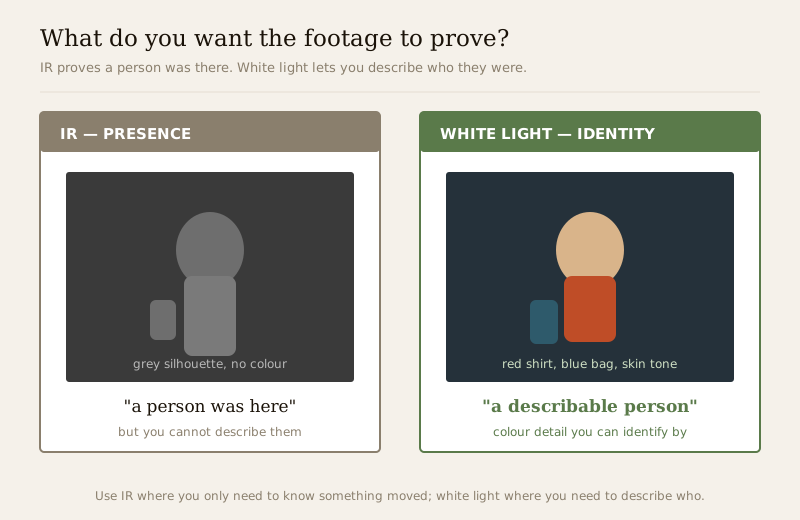
Strip away the technology and the choice comes down to one question: when something happens at night, what do you want the footage to prove?
- IR gives you presence. A monochrome frame tells you that a person was there, roughly their build and movement, the fact of the event. It does not give you colour, and colour is what a witness statement and a police description hang on. IR footage is real evidence of an event; it is weak evidence of who.
- White light gives you identity. A colour frame lets you say the shirt was red, the bag was blue, the auto was green — the describable detail that turns "someone" into "that someone." Where identifying a face and a person actually matters — the gate, the front door, the cash counter — that colour record is worth the power and the aiming discipline it demands.
This is why the standard advice is not "IR or white" but IR where you only need to know something moved, white light where you need to describe who — and the facial identification lighting guide goes deeper on getting a face, not just a silhouette, at the points that matter.
Power and backup
An illuminator is only as reliable as its supply, and this is where India tests every plan. Two honest points:
- White light costs power; IR is cheap. A white-light illuminator is a real light with a real load; an IR lamp draws little. If the scene runs all night, the running cost difference is not trivial — another reason to reserve white light for where colour identification actually matters and let IR carry the discreet, low-power flanks. The wider running-cost arithmetic is in the security lighting energy-use guide.
- The illuminator must survive the power cut. A camera on inverter backup staring at a scene whose illuminator died with the grid records nothing usable — and a deliberate power cut is a classic prelude to trouble. Put the illuminator on the same backed-up circuit as the camera and recorder so the light, the sensor and the recording all ride through an outage together. A lit scene with a dead recorder catches nothing; a live recorder in the dark records nothing; the two must be backed up as one.
The egress side of a power failure — keeping an escape route visible during an outage — is a separate life-safety subject that belongs to the emergency lighting guide and must never be conflated with, or obstructed by, a camera illuminator.
Bringing in the professionals
Own the design decisions on this page — whether a scene needs IR or white light, the range and spread the illuminator must cover, that it mounts off the lens and is backed up. Hand over the qualified craft:
- A licensed electrician for all mains wiring, the illuminator's connection into the circuit, load, earthing, weatherproofing, the inverter tie-in and any fixture at height — route it through the electrical hub. Outdoor illuminator wiring is not a DIY job.
- A lighting designer to set the actual levels, spread and colour so a white illuminator is even and glare-free rather than a hotspot, and specify optics that match the camera's field of view.
- A security integrator to marry the illuminator to the perimeter CCTV and outdoor CCTV plan, so the light the camera needs and the camera itself are designed on one drawing.
To find where your own plot goes dark for the camera and where an illuminator would matter most, run the lighting and visibility security assessment and the home security risk scorecard tool.
Key takeaways
- An illuminator is the light, not the camera. Night vision is the sensor plus a light source; this guide is the light. Fix a dark scene with the right illuminator, fix a weak sensor with a better low-light camera — do not buy one hoping it cures the other.
- IR is invisible and monochrome; white light is visible and colour. IR tells you a person was there with no glare and almost no trespass; white light lets you describe them and deters, at the cost of power and the same aiming discipline any light needs.
- 850nm shows a faint red glow with a little more reach; 940nm is fully invisible with slightly less — a qualitative trade, not a guaranteed metre figure. Test reach on your own site.
- Mount the illuminator off the lens and aim it across the scene. That one move defeats the IR hotspot, the bounce off walls and wet surfaces, the insects lit up at the lens, and the reflection off glass all at once.
- Often you need no separate illuminator — a well-designed dusk-to-dawn base or security lighting scheme already gives the camera a colour scene. Reach for a dedicated illuminator last, for the gaps the ambient light leaves, and back it up on the same circuit as the camera.
Where to go next
- The camera side — the low-light CCTV camera and CCTV low-light performance guides, the sensor half of night vision.
- Lighting for cameras — CCTV-compatible lighting, and glare-free security lighting for keeping a white illuminator from dazzling your own lens.
- Getting a face, not a silhouette — the lighting for facial identification guide.
- When ambient light is enough — dusk-to-dawn security lighting and the security lighting design guide.
- The wider picture — the lighting sub-hub, the security hub, the boundary spoke security lighting, perimeter CCTV, outdoor CCTV, and the home security risk scorecard tool.
References
- SP 72 : 2025 — National Lighting Code of India (Bureau of Indian Standards) — the primary reference for illuminance, uniformity, glare and colour of lighting, including the exterior lighting a camera relies on; treat any illuminator level or spread as figures a qualified lighting designer sets to this code. Verify the current edition via the BIS catalogue: https://www.services.bis.gov.in/
- National Building Code of India, SP 7 : 2026, Part 8 Section 1 (Lighting & Ventilation) — for the lighting and electrical provisions of the building and its services, read with local municipal bye-laws and any light-nuisance provisions where a white illuminator could spill onto a neighbour. Verify the current edition via the BIS catalogue: https://www.services.bis.gov.in/
- IS 3646 (Part 1) : 2025 — Code of Practice for Interior Illumination (Bureau of Indian Standards) — for lobbies, corridors and covered approaches where amenity and camera lighting overlap. Verify current status; do not rely on the withdrawn Parts 2 and 3.
- Digital Personal Data Protection Act, 2023 — footage of an identifiable person, whether monochrome IR or colour, is personal data; where an illuminator supports a camera overlooking a neighbouring property or a public road, agree access, storage and privacy handling, and keep credentials private.
This is an educational overview, not legal or engineering advice. It is strictly about lighting your own scene defensively so your own cameras can see, never about defeating any security measure. Mains wiring, connecting an illuminator into a circuit, inverter tie-ins and any fixture mounted at height are qualified professional tasks — engage a licensed electrician and a lighting designer, never block an egress route, and verify any standard's current edition via the BIS catalogue before relying on it.
Export this guide
Related Guides — Deep-dive reading
CCTV-Compatible Lighting for Indian Homes (2026): How to Light a Scene So the Camera Actually Sees It
The bridge between your lighting and your cameras — why a scene that looks fine to your eye can still be useless footage, and how uniformity, no light in the lens, the right white and flicker-free drivers make the difference.
SecuritySecurity Lighting Design for the Whole Property (India 2026): The Principles, the Zones and the Library Map
How to light an entire property as a security layer that deters and lets cameras see — the four design principles, the zones to cover, and where every deeper guide fits, done without dazzling your own CCTV or the neighbour.
SecuritySecurity Lighting in India (2026): Lighting the Boundary Without Dazzling the Camera or the Neighbour
How to use light as a security layer that deters intruders and lets your cameras see, done well with uniform shielded downlight, no glare, no neighbour trespass and a power-cut backup.
SecurityRelated Tools — Try Free
CCTV Camera Coverage & Count Calculator
Estimate how many CCTV cameras you need, the NVR channels, storage in TB for your retention period, and an indicative all-in cost with GST.
CCTV CalculatorCCTV Camera Overlap Calculator
The overlap or blind gap between two adjacent cameras, from coverage width and spacing, plus the spacing for a target overlap.
OverlapCCTV Night-Vision Selector
Answer five questions and get the right night technology — infrared, low-light, colour night vision or thermal — with reasons.
Night-Vision