
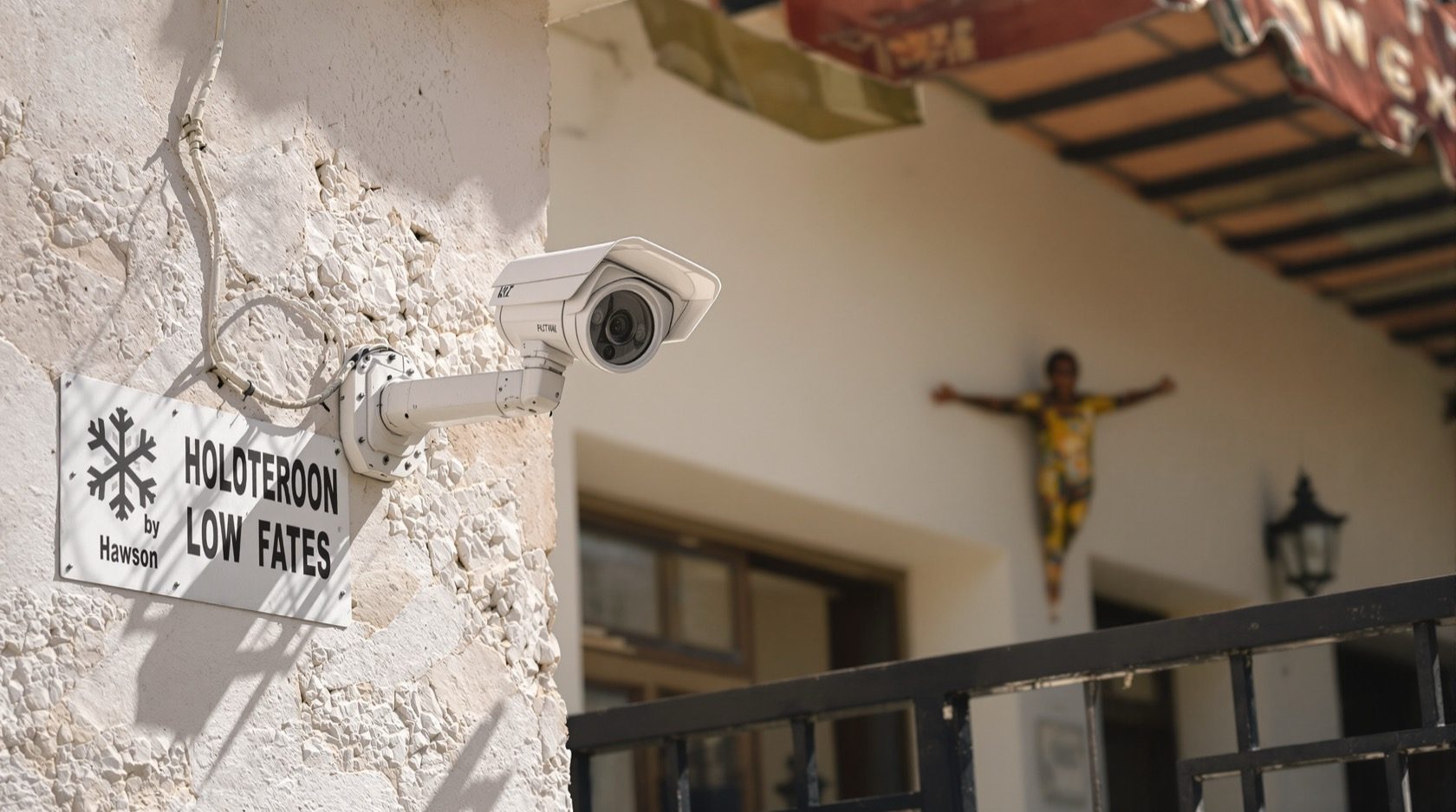
Outdoor CCTV in India: Cameras Built for Rain, Heat and the Night
How to choose and place weatherproof outdoor cameras for the gate, boundary, driveway and terrace — IP66/IP67 sealing, IK vandal resistance, night vision and WDR, all planned for the Indian climate.
The camera that matters most is almost always outside. It watches the gate, the boundary wall, the driveway and the front door — the line an intruder has to cross before anything valuable is in reach. But being outdoors is a hard posting in India: lashing monsoon rain, months of 45°C sun on the housing, dust that coats every lens, the occasional cricket ball or deliberate tamper, and — because most incidents happen after dark — long hours of shooting in near-black conditions.
This is the focused guide to outdoor CCTV in Studio Matrx's CCTV hub. It is the outdoor companion to the indoor CCTV guide — read that for cameras inside the home, and this for everything past the front door. Get the outdoor ring right and the inside becomes a second line, not the front line.
Scope & safety. This guide helps you understand, choose and coordinate. Mounting cameras high on walls, on the terrace parapet or under the eaves is work at height; the wiring and any mains power belong to a licensed electrician and a qualified installer. Plan the layout here, then have it fixed and certified by professionals. A camera must never be positioned so its bracket or cable creates a foot-hold that helps someone climb in.
How outdoor is different from indoor
Indoors, a camera lives an easy life: stable temperature, no rain, even light, and it is rarely within reach of anyone who wants it gone. Outdoors, every one of those comforts disappears. Before you match anything to a spec, hold the difference in mind:
- Weather. Rain, dust, humidity and salt-laden coastal air all attack an unsealed camera. Indoors this is a non-issue; outdoors it is the first filter.
- Heat. A dark housing in direct Indian summer sun can run far hotter than the air. Electronics and the lens both suffer — a sun-shield and a decent operating-temperature rating matter.
- Tampering. An outdoor camera at head height is a target: a hood, a can of spray paint, a stick. Height and a vandal-resistant body answer that.
- Darkness. Indoors there is usually some light. Outdoors, the useful footage is often at 2am in a compound with one dim bulb — night performance is not optional.
- Glare and back-light. A camera facing a gate at sunrise, or a bright street lamp, gets blinded unless it handles high contrast.
Everything below is really a response to those five pressures.
Weatherproofing: reading the IP and IK ratings
Two short codes tell you whether a camera can survive outside. Learn to read them and you can sanity-check any product page in seconds.
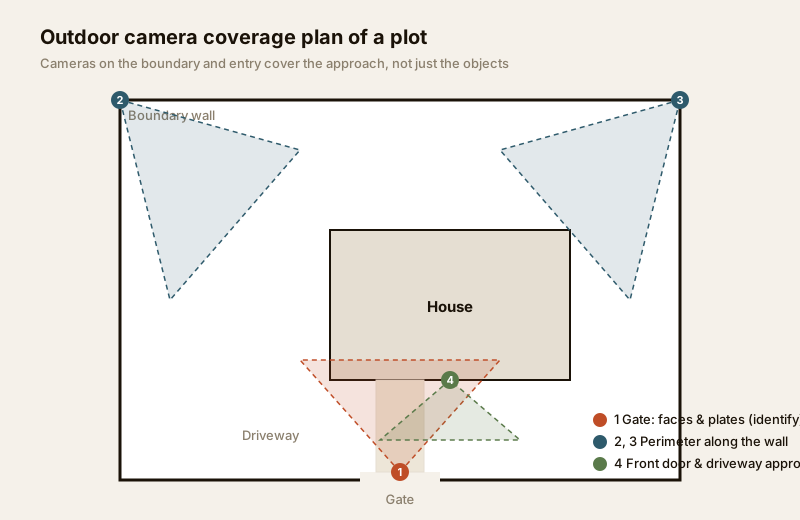
IP (Ingress Protection) is written as IP followed by two digits. The first digit (0–6) rates protection against solids/dust; the second (0–9) against water. For Indian outdoors you want the dust digit at its maximum, 6 (fully dust-tight), and a water digit that survives the monsoon.
- IP66 — dust-tight, and protected against powerful jets of water from any direction. This is the sensible minimum for an exposed outdoor camera in India.
- IP67 — dust-tight, and survives temporary immersion in water. Worth it for cameras low on a wall, near a downpipe, or anywhere that can flood or pond in heavy rain.
IK (impact resistance) rates how hard a knock the housing takes, from IK00 to IK10 (the toughest common rating, a hefty strike). For any camera within reach — near the gate, at head height, in a shared driveway — look for IK08 to IK10 and a metal body rather than thin plastic.
Sealing is only as good as the cable entry. The single most common way an outdoor camera dies in India is water tracking down the cable into the connector. Insist that the installer uses a weatherproof junction box or a proper gland/heat-shrink seal at every joint, and that the pigtail connector is not left dangling in the open. This is exactly the kind of detail a professional gets right and a rushed job gets wrong.
The outdoor requirements table
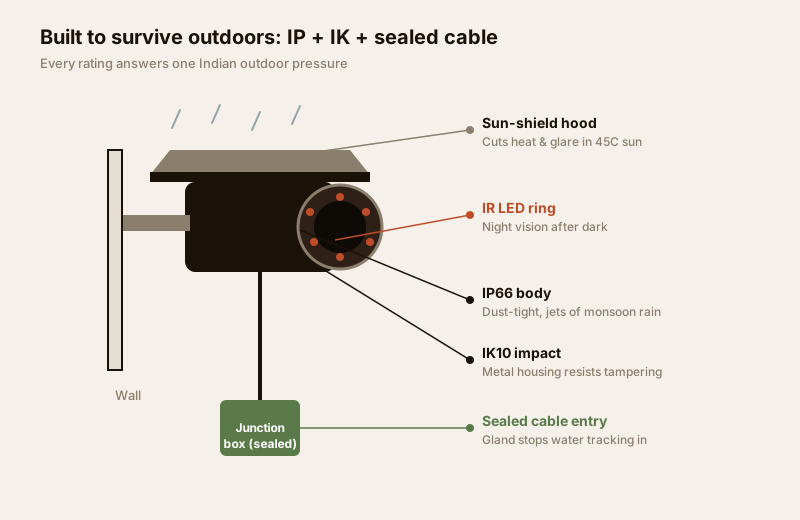
Match each outdoor demand to the spec that answers it. Use this as a checklist against any quote.
| Outdoor demand | What it means in India | Spec to look for |
|---|---|---|
| Rain & dust | Monsoon jets, dusty pre-monsoon winds | IP66 minimum; IP67 if low or flood-prone |
| Impact / tampering | Camera within reach, shared driveway | IK08–IK10, metal body, mount out of reach |
| Summer heat | Dark housing baking in 45°C sun | Operating range to ~ -10 to 60°C, sun-shield fitted |
| Darkness | Most incidents after dark | IR (with range to suit) or colour night vision |
| Glare / back-light | Gate facing sunrise, street lamp in frame | WDR (wide dynamic range), ideally true/120dB |
| Wet cable joints | Water tracking into connectors | Weatherproof junction box / gland seal |
| Wind & sag | Loose brackets drift off-target | Rigid metal bracket, wall-fixed, re-aim check |
Night performance: where outdoor footage is won or lost
If a camera only does one job well, make it night. The footage you will actually hand to the police or your society is far more likely to be from 1am than 1pm. Outdoor cameras handle darkness in two broad ways:
- Infrared (IR) night vision. Invisible IR LEDs light the scene; the camera shows crisp black-and-white footage. Cheap, reliable, and standard on outdoor cameras. Watch the IR range (the distance it usefully lights — a 30m gate needs more than a 10m camera) and beware IR bounce off a near wall or a sun-shield, which washes the image out.
- Colour night vision. A very sensitive sensor plus a small warm white LED (or ambient light) keeps the image in colour at night — and colour ("red scooter", "blue shirt") is far more useful for identifying someone than grey IR. It needs a little ambient light or the built-in light to work well, and the light can be a nuisance to neighbours, so aim it carefully.
Whichever you choose, night footage improves dramatically with good site lighting. A camera and a well-placed light work as a pair; a dark corner defeats even a good sensor. Plan the two together — see the lighting and visibility assessment, and check for the dark corners a camera cannot cover in the blind-spot identification guide.
WDR (Wide Dynamic Range) is the daytime twin of night vision. It lets the camera hold detail when part of the frame is very bright and part very dark — a gate with the morning sun behind it, or a porch light against a black driveway. Without WDR the bright area blows out to white and a face in the shadow is lost. For any camera facing a likely light source, treat true WDR as essential.
Placement by zone
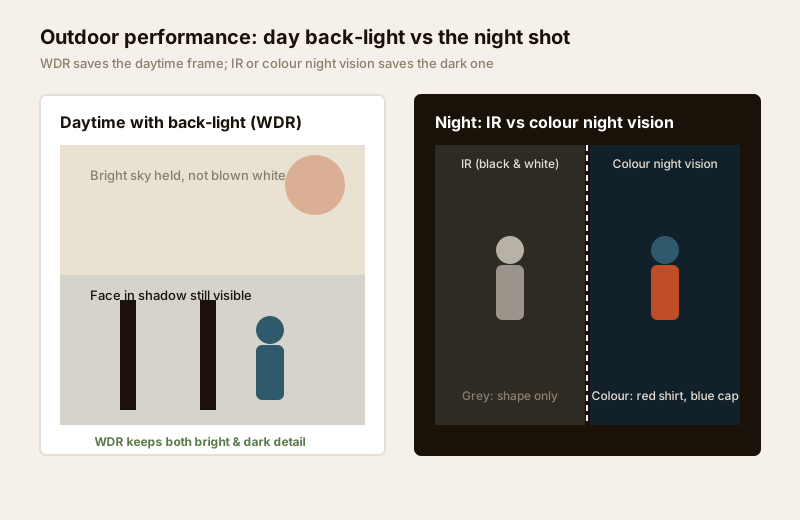
Outdoor cameras earn their keep only if each one has a clear job. Decide, per position, whether you need to detect (something is there), recognise (who/what, roughly) or identify (read a face or number plate) — the closer and narrower the shot, the more detail you get. This table maps the common zones of an Indian plot.
| Zone | What it must catch | Placement notes |
|---|---|---|
| Gate / entry | Faces, number plates, everyone in/out | Camera across the gate, not straight down; identify-level detail; angle to avoid headlight glare |
| Boundary / perimeter | Anyone approaching or climbing the wall | Corner cameras looking along the wall; wide view; pair with a good light |
| Driveway | Vehicles, deliveries, movement to the door | Cover the length; watch for back-light from the street |
| Front door / entrance | Callers, deliveries, forced entry | Close, identify-level; a video door phone complements this |
| Garden / side setback | Blind sides, the route to a window | Often the real weak point; a camera down each side |
| Terrace / roof access | Anyone reaching the roof or the tank | High vantage covering the parapet and the access ladder/stair |
Two placement rules run through all of them. Mount out of easy reach — roughly 3m or higher — so the camera cannot be hooded or knocked; this also widens the view and reduces tampering. And cover the approach, not just the object: a camera on the door alone catches an intruder who is already there; a camera watching the path to the door gives you warning and a better face.
Lawful framing: your property, not your neighbour's
An outdoor camera looks outward, so it is easy to sweep up things that are not yours to record. Keep it lawful and neighbourly from day one:
- Cover your own property and shared areas — your gate, your compound, your driveway. That is your legitimate purpose.
- Do not point cameras into a neighbour's windows, courtyard or private space. If a camera must face that way, use privacy masking to black out the parts that are not yours.
- Be careful with the public road. A little pavement in frame to catch someone at your gate is usually reasonable; a camera trained down the whole street is not. Keep it proportionate to protecting your own entrance.
- Tell people — a small "CCTV in operation" sign at the gate is both a deterrent and good practice, and in a society or RWA the installation should be agreed and minuted.
- Handle the footage responsibly under the Digital Personal Data Protection Act, 2023: record only what you need, keep it secure, and do not share it casually.
The privacy assessment guide walks through masking, signage and retention in detail — do it before, not after, the install.
When to bring in a professional. Decide the zones, camera count and detail level yourself using this guide — then hand over the mounting at height, brackets into masonry, weatherproof cable runs and connections, and the mains/PoE power to a qualified installer and, for anything at the electrical board, a licensed electrician (see the electrical hub). A professional seals every joint, mounts rigidly out of reach, and re-aims each camera on a full monitor — the difference between footage that holds up and a smear of glare and rain streaks.
India price bands (indicative)
Outdoor-rated cameras cost a little more than bare indoor units for the sealed housing and IR. Treat these as ballparks to check a quote, not fixed rates.
| Item | Typical range (₹) | Notes |
|---|---|---|
| 2MP outdoor bullet, IP66, IR | ₹1,500 – ₹3,500 | Entry-level perimeter / driveway |
| 4MP outdoor IP66/IK08 camera | ₹3,000 – ₹6,500 | The home workhorse for gate and boundary |
| 4MP colour night vision camera | ₹4,500 – ₹8,500 | Colour after dark; needs some ambient light |
| 8MP (4K) outdoor camera | ₹6,000 – ₹13,000 | Range and plate/face detail at the gate |
| Sun-shield / weather hood | ₹300 – ₹900 | Often included; fit it regardless |
| Weatherproof junction box + glands | ₹250 – ₹800 per point | Non-negotiable for cable-entry sealing |
A gate-plus-boundary outdoor set of three or four IP66 cameras with sun-shields, weatherproof joints and professional mounting commonly lands around ₹18,000 – ₹45,000 installed, depending on resolution and cable runs. Size your own coverage with the camera coverage calculator, and remember an outdoor system draws more power at night (IR LEDs), so plan a UPS on the recorder as covered in the IP CCTV guide.
Key takeaways
- Outdoor cameras face five pressures indoors never do: weather, heat, tampering, darkness and glare — every spec is an answer to one of them.
- Weatherproofing: insist on IP66 minimum (IP67 low or flood-prone), IK08–IK10 for anything within reach, and a sealed cable entry — the joint, not the camera, is what usually fails.
- Night is where outdoor footage is won: choose sufficient IR range or colour night vision, and pair every camera with good site lighting; add WDR for any camera facing the sun or a lamp.
- Place by zone — gate, boundary, driveway, door, sides, terrace — decide detect/recognise/identify per view, mount out of reach (~3m+), and cover the approach, not just the object.
- Keep it lawful: your property and shared areas only, mask neighbours' private space, be proportionate about the public road, sign the gate, and follow the DPDP Act.
- Route mounting, cabling, weatherproof joints and mains power to professionals — plan here, install certified.
References
- Ingress Protection ratings (IP code) and impact ratings (IK code) — verify a product's stated IP/IK figure against the manufacturer's datasheet and the relevant international standard before relying on it.
- Digital Personal Data Protection Act, 2023 — position cameras to cover only your own property and shared areas with a legitimate purpose; mask neighbours' private spaces and handle footage responsibly.
- National Building Code of India (SP 7), Bureau of Indian Standards, and local municipal bye-laws for any structural, electrical, working-at-height or life-safety aspect of an install; verify the current edition via the BIS catalogue: https://www.services.bis.gov.in/
This is an educational overview. Mounting at height, structured cabling, weatherproof connections and any electrical work are qualified professional tasks — engage licensed installers and verify any standard's current status via the BIS catalogue before relying on it.
Export this guide
Related Guides — Deep-dive reading
How to Choose a CCTV Camera (2026): The Homeowner's Decision Guide for India
Cut through the spec-sheet noise and choose the right CCTV camera for each spot around an Indian home. What actually matters — sensor and low-light performance, lens and field of view, form factor, IP and IK ratings, honest smart features — and the marketing claims to ignore.
SecurityCCTV Placement Perimeter and Compound Wall in India (2026): Watch the Line
How to position cameras ALONG your boundary wall at a grazing angle so you catch anyone approaching or climbing it, pair the view with line-crossing detection, light the line, cover corners and gates, and keep every camera on your own side.
SecurityHome Lighting and Visibility Security Assessment for Indian Homes
How to assess your home's security lighting after dark — checking every entry, path and boundary for coverage, uniformity and glare, testing what each camera can actually see at night, and turning the findings into a simple lighting plan.
SecurityRelated Tools — Try Free
CCTV Identification-Distance Calculator
How far a camera can still identify a face or number plate (DORI 250 px/m), from resolution, lens and sensor.
Identify DistanceCCTV Placement Compliance Checker
A quick DPDP-grounded privacy and safety self-check for where a camera is pointed — flags the items to fix.
ComplianceCCTV Camera Coverage & Count Calculator
Estimate how many CCTV cameras you need, the NVR channels, storage in TB for your retention period, and an indicative all-in cost with GST.
CCTV Calculator