
CCTV Low Light Performance in India (2026): Reading the Lux Rating Honestly
What a camera's minimum illumination (0.01 lux, 0.001 lux, 0 lux with IR) really means, which specs actually drive it, how vendors game the number, and how to compare two cameras' low-light claims like-for-like.
Every CCTV spec sheet carries a minimum illumination figure — 0.01 lux, 0.001 lux, sometimes a bold "0 lux with IR." It is meant to answer one question: how dark can the scene get before this camera stops seeing? Get it right and your gate reads faces at 2 a.m.; trust it blindly and you buy a headline number that dissolves into grain the moment someone actually walks past.
This guide is the honest explainer on cctv low light performance as a spec metric in Studio Matrx's CCTV hub. It is about reading and comparing the number — the lux rating, what drives it, and how it gets gamed. It is deliberately not a "which camera should I buy" guide. When you have decided how to read the metric here and want the actual camera-type recommendation — starlight sensors, colour-at-night models, IR-only workhorses — go to the companion low-light CCTV cameras guide. The two are designed to sit side by side without overlapping: this one is the ruler, that one is the shopping list.
Scope & safety. This guide helps you read specs and brief an installer. Mounting at height, cabling and any mains-electrical work belong to licensed professionals. A camera must never block a window, door or fire-escape route, and cameras belong only on your own property and shared areas — never bathrooms, bedrooms or changing areas, and always positioned to respect neighbours and the spirit of the Digital Personal Data Protection Act, 2023.
What "lux" and "minimum illumination" actually mean
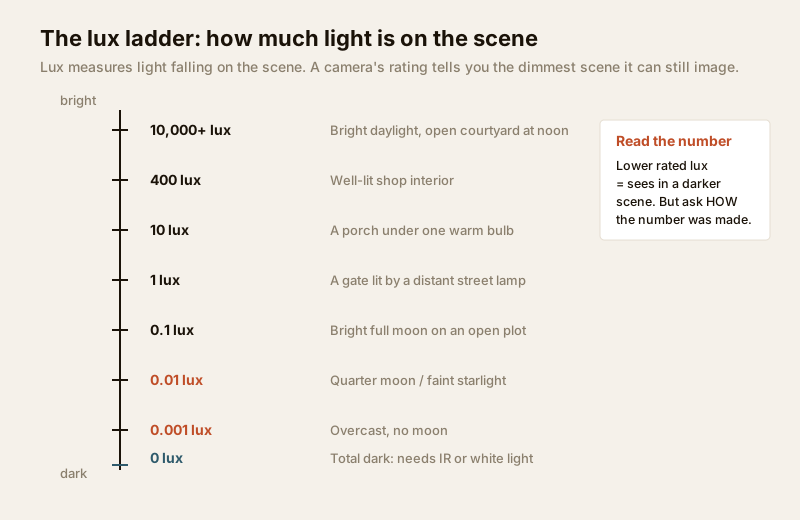
Lux is the unit for how much light is falling on a scene. Bright noon in an open courtyard is well over 10,000 lux; a porch under one warm bulb is around 10 lux; a gate lit only by a distant street lamp might be 1 lux; a moonless, overcast night can drop below 0.001 lux.
A camera's minimum illumination (or "min. illumination", "sensitivity") is the lowest scene lux at which it still produces a usable image. So a lower number is, in principle, better: a 0.001 lux camera claims to see in a darker scene than a 0.01 lux one. That is the whole promise of the metric.
Two cautions before you trust any single figure:
- "0 lux" is not a sensitivity claim — it is a lamp. A camera cannot make an image from no light. "0 lux" always means the camera switches on its own infrared (IR) or white-light LEDs and lights the scene itself. That is a real capability, but it is a different thing from how sensitive the sensor is to ambient light. For how that active illumination works, see the night vision CCTV guide.
- Colour lux and IR lux are different numbers. The lux at which a camera holds colour is much higher than the lux at which it will switch to black-and-white IR. A sheet quoting "0.001 lux" often means the mono/IR figure, while the colour figure — the one that matters for recognising a shirt or a car — is far higher.
The four specs that actually drive low-light performance
The rated lux is a summary. What produces it is hardware. Four factors do the real work, and reading them tells you far more than the headline number.
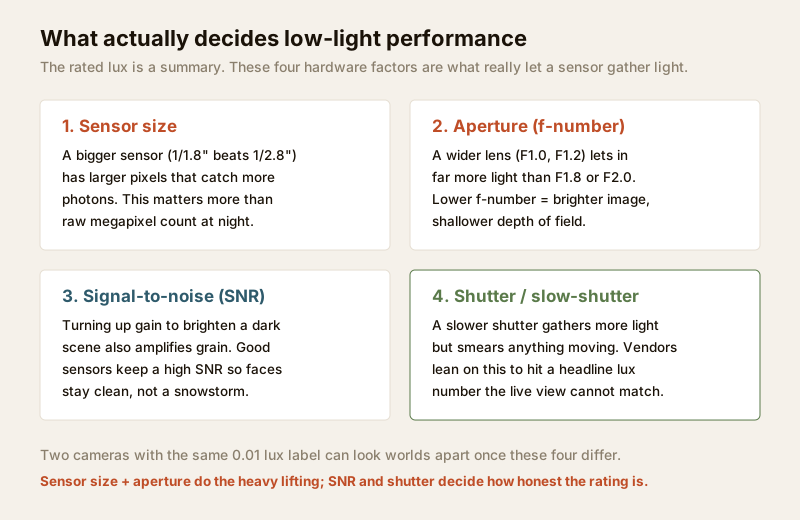
1. Sensor size. A physically larger sensor (1/1.8" beats 1/2.8" beats 1/3") has bigger pixels that catch more photons per pixel. At night this matters more than raw megapixel count — cramming 8MP onto a tiny sensor gives smaller, noisier pixels than 4MP on a larger one. This is exactly why chasing megapixels backfires in the dark; the CCTV image quality guide unpacks the megapixel myth in full.
2. Aperture (f-number). The lens opening. A lower f-number (F1.0, F1.2) lets in dramatically more light than F1.8 or F2.0 — every step roughly doubles the light. A wide aperture is one of the cheapest honest routes to a genuinely brighter night image. The trade-off is a shallower depth of field, so very close and very far objects can soften.
3. Signal-to-noise ratio (SNR). In a dark scene the camera turns up gain to brighten the picture — but gain amplifies grain along with the image. A good sensor and processor keep a high SNR so faces stay clean instead of dissolving into a snowstorm. A camera can hit a low lux number and still be useless if it does so by drowning the frame in noise.
4. Shutter speed. A slower shutter holds each frame open longer and gathers more light — but anything moving in that longer exposure smears. A parked car looks fine; a person walking becomes a blur. This is the single most abused lever in low-light marketing, which brings us to the honest-reading part.
How vendors game the lux number
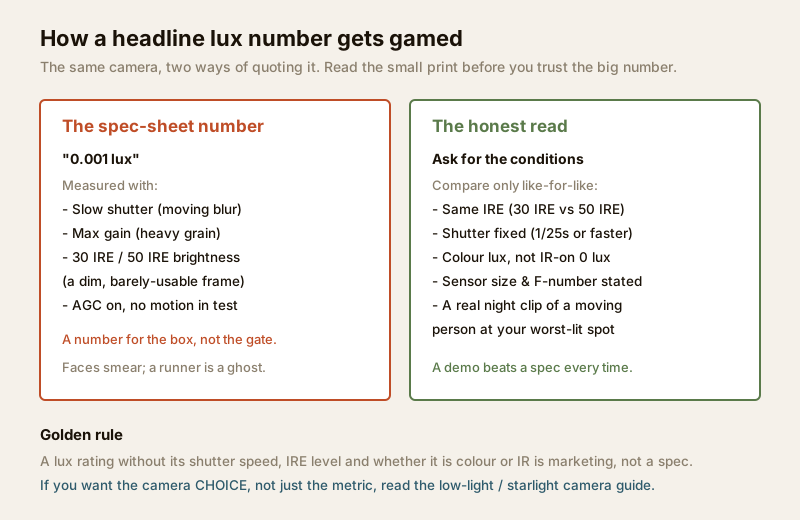
Here is the uncomfortable truth: the same camera can be quoted at wildly different lux figures depending on the test conditions the vendor chooses — and those conditions are usually buried or omitted.
The common tricks:
- Slow shutter to hit the number. Drop the shutter to a long exposure and the rated lux plummets — on paper. In real life a moving intruder is a ghost. Always ask at what shutter speed the figure was measured; 1/25s (or faster) is a fair floor for a camera meant to catch people.
- Maximum gain, maximum noise. Crank the gain and the sensor "sees" in darker scenes, but the image is grain. The lux figure says nothing about whether the result is recognisable.
- A dim IRE brightness threshold. Manufacturers pick how bright the test frame has to be to "count" — expressed as an IRE level (say 30 IRE vs 50 IRE). A 30 IRE frame is a dim, barely-usable picture. A low lux number quoted at 30 IRE is not comparable to a rival's number quoted at 50 IRE.
- Quoting the IR/mono figure as if it were colour. As above — the impressive tiny number is usually the black-and-white figure, not the colour one.
None of this means the metric is worthless. It means a lux rating without its conditions attached — shutter speed, IRE level, colour-or-IR, gain — is marketing copy, not a spec. A camera that states F1.0, a 1/1.8" sensor and its colour lux at 1/25s and 50 IRE is being far more honest than one that just shouts "0.001 lux."
Reading a spec sheet: what to demand
| Line on the sheet | What to look for | Why it matters |
|---|---|---|
| Sensor size | 1/1.8" or larger for serious night use | Bigger pixels = more light gathered, less noise |
| Aperture (F) | F1.6 or lower; F1.0–F1.2 is excellent | Each step roughly doubles the light reaching the sensor |
| Min. illumination (colour) | The colour figure, with shutter and IRE stated | The number that matters for recognising people and vehicles |
| Min. illumination (IR/mono) | Separate, lower figure; often with "0 lux IR" | Confirms night fallback, but it is black-and-white |
| Shutter used for the lux figure | 1/25s or faster is a fair basis | Slow-shutter figures smear anything that moves |
| SNR | Higher dB is better | Predicts whether the dark image is clean or grainy |
| WDR | True/native, not "digital" | Bright lamp beside dark shadow needs WDR |
If a sheet omits the shutter speed and IRE behind its lux number, treat the number as optimistic and ask the vendor for them in writing — or better, ask for a night demo (below).
Comparing two cameras honestly
The metric is only useful when you compare like for like. To put two cameras side by side:
- Match the light figure type. Colour-vs-colour, or IR-vs-IR — never one camera's colour lux against another's IR lux.
- Match the conditions. Same shutter, same IRE, same gain assumptions. If one vendor will not state them, you cannot fairly compare — weight the one that discloses.
- Weight sensor size and aperture over the lux label. A camera with a 1/1.8" sensor at F1.2 will almost always out-perform a 1/2.8" sensor at F1.8 in real dark, even if their printed lux numbers look similar.
- Then ignore the sheet and watch a clip. The single most reliable test is a real night video of a moving person at your actual worst-lit spot — the gate under the failing street lamp, not a studio. A demo beats a spec every time.
| Scenario at your plot | What to prioritise in the spec | Note |
|---|---|---|
| Gate with a street lamp nearby (~1–10 lux) | Colour lux + aperture; WDR for the lamp's glare | Most homes; colour identification is realistic |
| Unlit boundary wall (<0.1 lux) | Large sensor + low F; accept mono/IR fallback | Recognition, not colour, is the honest goal |
| Coastal / dusty open plot | Low-light spec plus weatherproofing | Pair with an IP rating suited to salt and dust |
| Shopfront with mixed neon + shadow | High SNR + true WDR | Noise and glare, not just darkness, are the enemy |
For the whole picture of a night scene — not just the lux metric but how backlight, glare and IR bloom interact — read the image quality guide alongside this one. And when you are ready to translate all of this into an actual purchase, the low-light camera guide is the companion that names the camera classes (starlight, colour-night, IR-only) and where each fits.
India-specific realities
- Power cuts kill the number. A camera rated for starlight is useless if the street lamp and the camera both die in an evening cut. Plan a UPS for the recorder and network as part of the wider resilience picture in the building security systems guide.
- Add a little honest light. The cheapest low-light upgrade is often not a better camera but one warm bulb over the gate. Lifting a scene from 0.1 lux to 10 lux does more for identification than a spec-sheet decimal place. See the lighting and visibility security assessment.
- Monsoon and dust degrade the glass, not just the sensor. A smeared or web-covered lens ruins a night image regardless of lux rating. Low-light performance assumes clean optics — an outdoor camera needs an occasional wipe.
- Price bands (indicative). A basic IR-only outdoor camera runs ₹1,500–₹3,500; a genuine large-sensor, low-F "starlight-class" camera that holds colour at low lux is typically ₹4,500–₹12,000. Treat the jump as buying sensor size and aperture, which is what the night image actually rides on.
When to bring in a professional. Read and compare the specs yourself — that is what this guide is for. Then hand the mounting at height, cabling, weatherproof terminations and recorder commissioning to a licensed installer, and any work at the mains board to a licensed electrician (see the electrical hub). Ask your installer for a live night demo of a moving person at your worst-lit position before you sign off; the specification is a shortlist tool, the demo is the decision.
Key takeaways
- Cctv low light performance is quoted as a lux rating / minimum illumination — the dimmest scene the camera can still image; a lower number is better only if the conditions are honest.
- "0 lux" means the camera lights the scene itself with IR or white light — a capability, not a sensitivity figure; and colour lux is a much higher number than IR/mono lux.
- The real drivers are sensor size, aperture (f-number), signal-to-noise ratio and shutter speed — sensor size and a low F do the heavy lifting.
- Vendors game the number with slow shutter, max gain and a dim IRE threshold — demand the shutter speed, IRE level and whether the figure is colour or IR before trusting it.
- Compare like-for-like, weight sensor and aperture over the printed lux, and always insist on a real night clip of a moving person; then pick the actual camera with the low-light cameras companion guide.
References
- Digital Personal Data Protection Act, 2023 — position cameras to cover only your own property and shared areas with a legitimate purpose; avoid capturing neighbours' private spaces.
- Illumination (lux) and camera minimum-illumination figures — verify the sensor size, aperture (f-number), shutter speed and IRE/AGC conditions behind any low-light rating on the manufacturer's specification sheet before comparing two cameras.
- National Building Code of India (SP 7), Bureau of Indian Standards, and local municipal bye-laws for any structural, electrical or life-safety aspect of an install; verify the current edition via the BIS catalogue: https://www.services.bis.gov.in/
This is an educational overview, not legal advice. Mounting at height, cabling and any electrical work are qualified professional tasks — engage licensed installers and verify any standard's current status via the BIS catalogue before relying on it.
Export this guide
Related Guides — Deep-dive reading
How to Choose a CCTV Camera (2026): The Homeowner's Decision Guide for India
Cut through the spec-sheet noise and choose the right CCTV camera for each spot around an Indian home. What actually matters — sensor and low-light performance, lens and field of view, form factor, IP and IK ratings, honest smart features — and the marketing claims to ignore.
SecurityCCTV-Compatible Lighting for Indian Homes (2026): How to Light a Scene So the Camera Actually Sees It
The bridge between your lighting and your cameras — why a scene that looks fine to your eye can still be useless footage, and how uniformity, no light in the lens, the right white and flicker-free drivers make the difference.
SecurityInfrared vs Colour Night Vision CCTV in India (2026): Which Sees Better in the Dark?
A homeowner's head-to-head between traditional infrared (IR) night vision, which lights the scene invisibly and shows a black-and-white image, and colour night vision, which keeps the picture in colour at night using a very sensitive sensor and a little white light — with an honest verdict on when each wins and why a hybrid camera is usually the smartest buy.
SecurityRelated Tools — Try Free
CCTV Night-Vision Range Planner
A realistic infrared night range versus the datasheet claim, and whether it covers your target for identification.
IR RangeCCTV Night-Vision Selector
Answer five questions and get the right night technology — infrared, low-light, colour night vision or thermal — with reasons.
Night-VisionSecurity Backup Power Calculator
Size a UPS/inverter and battery to keep CCTV, NVR, router and alarm running through a power cut — load, Ah, VA and cost.
Backup Power