

Visitor Data Protection in India (2026): The Gate Register Problem
Every day your gate collects the name, phone, photo and often an ID card of people who are just visiting. Most gates gather far more than they need. Here is how a home, an RWA or a small office can protect visitors' data, minimise what is kept, and use a gate-management app responsibly.
Walk up to almost any gated home, apartment society or small office in India and something quietly happens to you: your name goes into a book, a guard asks for your phone number, a tablet photographs your face, and — far too often — someone points a camera at your Aadhaar or driving licence. You came to deliver a parcel or visit a friend on the third floor. You left behind a small trail of personal data, and you have no idea where it now lives.
That trail is the subject of this guide. Visitor data protection is the unglamorous, everyday side of privacy that most gates get wrong — not out of malice, but out of habit and a vague belief that collecting more must mean more security. It does not. Every extra field in the register, every stored ID photo, every visitor database sitting on a vendor's cloud is a liability that can leak, be misused, or embarrass the very residents it was meant to protect. This guide sits inside the Studio Matrx privacy and data protection hub, and it takes a firmly minimisation-first line: the safest visitor data is the data you never collected.
Scope & how to read this. This is practical guidance grounded in the Digital Personal Data Protection Act, 2023 (DPDP Act), not legal advice. It is written for homeowners, RWA committees and small employers who run a gate, a register or a visitor-management app. For anything with legal weight — a vendor contract, a data breach, a resident complaint — take professional advice from a lawyer or your Data Protection Officer. Throughout, prefer the least intrusive option that still lets you run a safe gate.
What actually gets collected at the gate
Start by being honest about the pile. A typical Indian gate, on paper or in an app, captures some or all of this for every single visitor:
- Name of the visitor
- Phone number
- A face photograph
- Vehicle number
- Purpose of visit
- Who they are visiting (the flat or the person)
- Time in and time out
- And, disturbingly often, a photograph of an ID card — Aadhaar, driving licence, voter ID — or its number written into the book
Each field feels harmless on its own. Together they are a rich profile of a stranger who simply wanted to come in and leave. And the register is worse than a single record: it is a running log of who visits whom, when, and how often — a map of residents' private lives that no one asked to have drawn.
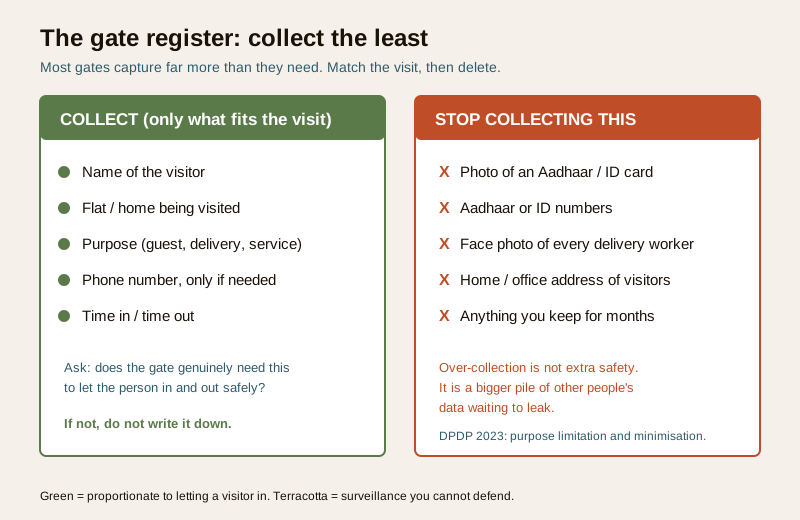
The DPDP Act frames this cleanly. Personal data should be collected for a clear, lawful purpose, with notice, and limited to what is genuinely needed for that purpose — the principle of data minimisation — then not kept longer than necessary. The test at the gate is simple and worth repeating every time a new field is proposed: does the gate actually need this to let the person in and out safely? If the answer is no, it should not be collected.
Minimisation: the one idea that fixes most of it
If you take a single thing from this guide, take this: collect the least, and delete it soon. For the overwhelming majority of visits, a gate needs remarkably little.
- Name and the flat being visited is usually enough to route a visitor and to let the resident confirm the guest.
- A phone number is defensible where the resident needs to be called for approval — but it is not always needed, and it should not be demanded reflexively.
- Time in and out helps with genuine accountability and is low-intrusion.
That is close to the whole legitimate list. Now the harder part — the stop collecting this list, which for most gates is where the real over-reach lives:
- Do not photograph or store ID cards. There is rarely a lawful, proportionate reason for a residential gate to hold an image of a visitor's Aadhaar or licence. It is a high-value target for fraud and identity theft, and the gate almost never needs it. If someone insists on ID, visually checking it and handing it back is very different from capturing and keeping it.
- Do not record Aadhaar numbers. Aadhaar is sensitive, tightly governed, and completely unnecessary for letting a plumber into the compound.
- Do not photograph every delivery worker and domestic helper by default. A rider dropping a parcel is not a security event that justifies a permanent face record.
- Do not keep visitor addresses, or hold any of it for months.
The heuristic to hand your guards and your committee is the proportionality test that runs through this whole hub: the least intrusive means that still does the job. If a gate can operate on a name and a flat number, it should not be capturing biometrics-grade data on strangers. This is the same discipline covered, from the systems side, in privacy by design for security systems — build the restraint in, do not bolt it on later.
The gate-management app question
More and more societies have replaced the paper book with an app: a guard's tablet that photographs visitors, scans IDs, pings residents for approval, and logs every movement. These apps are genuinely convenient. They also change the privacy picture completely, and most committees adopt them without asking the questions that matter.
Under the DPDP Act, when a society uses a third-party app to handle visitors' personal data, the app vendor is acting as a data processor on the society's behalf — and the society, as the body deciding why and how the data is collected, carries real accountability for what happens to it. That is not a detail to wave through in a committee meeting.
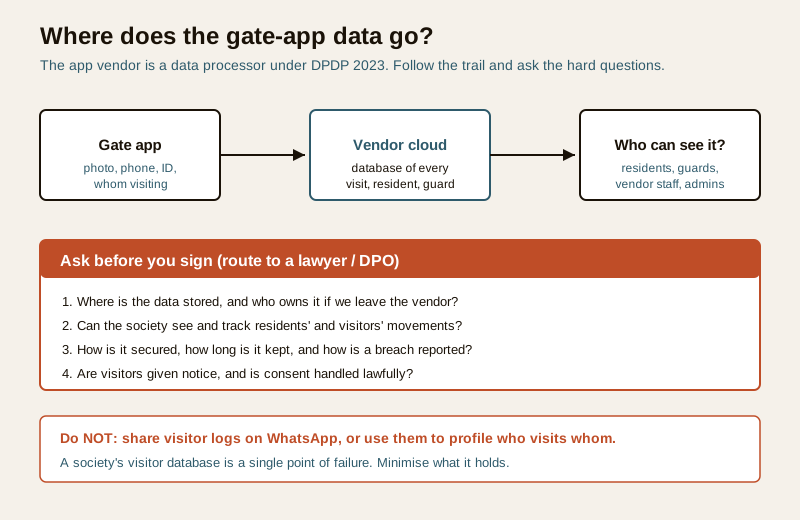
Before a society signs, someone competent should get honest answers to questions like these — and the contract, not a sales deck, is where they must be nailed down:
| Question to the vendor | Why it matters |
|---|---|
| Where is the data stored, and who owns it? | If the society leaves the vendor, can it export and delete everything, or is residents' data held hostage? |
| Who can see residents' and visitors' movements? | An app that lets any resident, or vendor staff, browse who visited whom is a surveillance tool, not a gate log. |
| How is the database secured? | A society's visitor database is a single, concentrated target. Weak security means one breach exposes everyone. |
| How long is data retained, and can we set it? | Storage limitation is a DPDP principle. The society should control retention, not accept an indefinite default. |
| How is a breach handled and reported? | You need to know the vendor will tell you promptly, so the society can meet its own obligations. |
| Is visitor consent and notice handled lawfully? | Visitors are data principals too. They deserve to know what is captured and why. |
None of this replaces legal review. The society's app contract, its data-sharing terms and its breach obligations are exactly the kind of thing to route to a lawyer or a Data Protection Officer rather than settle on WhatsApp. The point here is to know which questions to insist on before committing residents' and visitors' data to someone else's cloud. The access-control side of this — logs, approvals, who holds the keys to the data — is covered in depth in access control and data privacy and in the practical visitor access management guide.
Dignity: a visitor is not a suspect
There is a human layer under the legal one, and it is easy to lose. The people passing through your gate all day are delivery riders, domestic workers, electricians, nurses, tuition teachers, the friend visiting for chai. They are not threats to be processed. How a society treats their data says a great deal about how it treats them.
Dignity and rights callout. Do not build a gate that treats every visitor as a suspect. Photographing and databasing every delivery worker and house-help, while waving through well-dressed guests, is both undignified and discriminatory. Visitors are data principals under the DPDP Act with the same interests in notice, minimisation and security as anyone else. Collect less from everyone, apply the same light touch to all, and never let a worker's data be the price of doing their job.
Two practices deserve to be named and stopped:
- Do not share visitor logs on WhatsApp. The moment a screenshot of who-visited-whom lands in a residents' group, it is out of anyone's control — copied, forwarded, and impossible to delete. It exposes visitors and residents alike, and it is exactly the kind of casual leak the DPDP Act's security and accountability principles exist to prevent.
- Do not use the gate log to police residents' private lives. Who visits a home, how often, and until when, is that household's business. A visitor system is for safe entry and exit, not for a committee to monitor its neighbours.
The related question of where you may screen and observe visitors — and where you may not — is handled in visitor screening areas, and the boundary on cameras in shared spaces in CCTV in common areas.
Retention and access: keep it short, lock it down
Two DPDP principles do most of the protective work once data is collected: storage limitation (do not keep it longer than needed) and security safeguards (restrict who can touch it). A gate that collects little but keeps it forever, visible to everyone, has still failed.
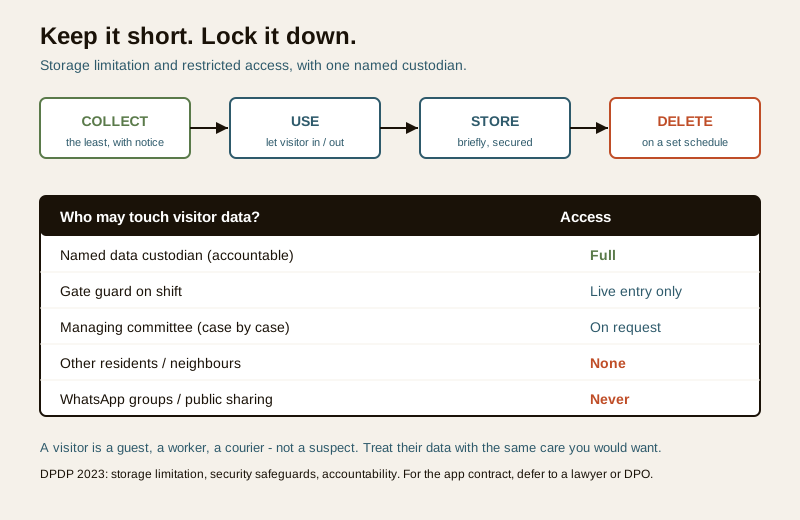
- Retention: decide, in advance, how briefly a routine visitor record is kept, and delete on that schedule — do not let logs pile up indefinitely. Set a short, deliberate retention for ordinary visits and take advice on any record you may genuinely need to keep longer for a specific reason.
- Access: the fewer eyes, the safer. A named custodian — a specific committee member accountable for visitor data — should be the point of responsibility. Guards see only what a live shift needs. Ordinary residents and neighbours get no browsing access to the log at all.
- Security of the book itself: a paper register left open on a desk is a privacy leak too. Keep it out of casual view, and shred old volumes rather than dumping them.
| Who | Access to visitor data | Basis |
|---|---|---|
| Named data custodian | Full, accountable | Responsible for the data on the society's behalf |
| Gate guard on shift | Live entry / exit only | Needs it to do the immediate job, nothing more |
| Managing committee | Case by case, on request | Only for a specific, defensible reason |
| Other residents / neighbours | None | No legitimate purpose to browse who visits whom |
| WhatsApp groups / public | Never | Uncontrolled disclosure; a breach waiting to happen |
An RWA visitor-data minimisation checklist
A short, practical list a committee can adopt at its next meeting:
- Cut the fields to the minimum: name, flat visited, purpose, time in and out — and phone only where a resident approval genuinely needs it.
- Stop capturing ID-card photos and Aadhaar numbers. Visual check and return, never capture and keep.
- Post a plain notice at the gate telling visitors what is collected and why — visitors deserve notice as much as residents do.
- Set a short retention and actually delete on schedule, on paper and in any app.
- Name a custodian who is accountable for visitor data, and restrict access to them and the guard on shift.
- Ban visitor logs on WhatsApp and any casual sharing, as a written society rule.
- Vet the app vendor on storage, ownership, access, security, retention and breach handling — in the contract, reviewed by a lawyer or DPO.
- Apply the same light touch to everyone — workers, couriers and guests alike — never a heavier hand on those with less power to object.
The "stop collecting this" list
Put this where the guards can see it:
- ID-card and Aadhaar photographs
- Aadhaar or other ID numbers
- Default face photos of delivery workers and domestic help
- Visitors' home or office addresses
- Anything kept for months with no reason
When to get legal or professional advice
Most of this you can act on today, at the gate, with no lawyer in the room — cutting fields, posting notice, deleting sooner, naming a custodian. But some decisions carry real legal weight and deserve a professional:
- The gate-app contract and data-sharing terms — get a lawyer or Data Protection Officer to review where residents' and visitors' data goes, who owns it, and how a breach is handled.
- A suspected data breach or leak of the visitor database — this can trigger obligations you should meet under advice, not improvise.
- A resident or visitor complaint about how their data was handled, or a request to access or erase it — DPDP gives data principals rights, and how you respond matters.
- Any workplace or tenancy angle if you are a small employer or landlord — worker and tenant data rights sit under broader law; take advice.
Legal and ethics caution (not legal advice). This guide is an educational overview grounded in the DPDP Act 2023, not a legal ruling. It does not state exact retention periods, penalties or clause numbers, because those are fact-specific and evolving. For a society's app contract, a breach, or a rights request, consult a qualified lawyer or your Data Protection Officer, and act on the least-intrusive, most respectful option available.
Key takeaways
- Most gates over-collect. The safest visitor data is the data you never gathered — cut the register down to name, flat, purpose and time.
- Never photograph or store ID cards or Aadhaar numbers. Check and return; do not capture and keep.
- A gate app is a data processor. Vet the vendor on storage, ownership, access, security, retention and breach — in the contract, under legal review.
- A visitor is a guest, a worker, a courier — not a suspect. Treat everyone's data with equal, light-touch care, and never post visitor logs on WhatsApp.
- Keep it short and locked down. Short retention, a named custodian, restricted access — the DPDP principles of storage limitation and security in plain practice.
- This is guidance, not law. For contracts, breaches or complaints, take advice from a lawyer or DPO.
References
- Digital Personal Data Protection Act, 2023 — collect personal data for a clear, lawful purpose, with notice, limited to what is needed, kept no longer than necessary, and secured; verify the current text and rules before relying on it.
- Data minimisation and storage limitation — collect the least visitor data that lets a gate function, and delete on a short schedule; seek professional advice for records you believe you must keep longer.
- Data processor arrangements — where a society uses a visitor-management app, the vendor processes personal data on its behalf; review the contract, data ownership, security and breach terms with a lawyer or Data Protection Officer.
- Rights of the data principal — visitors and residents have interests in notice, access, correction and erasure; handle requests carefully and take legal advice where a decision has weight.
This is an educational overview, not legal advice. How a home, RWA or office may lawfully collect and hold visitor data depends on the exact facts — consult a qualified lawyer or your Data Protection Officer, and default to collecting the least and keeping it the shortest time.
Export this guide
Related Guides — Deep-dive reading
Security Privacy Assessment for Indian Homes
Getting the privacy side of home security right: camera placement ethics and limits, notice and consent, the extra caution audio demands, and treating footage as personal data you store, retain and delete responsibly under India's DPDP Act 2023 direction.
SecurityVisitor Vehicle Management in India: A Professional Guide
The everyday weak point of every society and office gate is not the resident's car — it is the visitor, the cab, the delivery rider and the contractor who must be let in without opening the whole park to anyone. This is the process, not just the hardware: verify at the gate before the boom lifts, park visitors away from resident bays, and never jam the gate a fire tender needs.
SecurityDomestic Worker Privacy in India (2026): Security With Dignity
Maids, cooks, drivers, nannies and live-in help are people with rights, not permanent suspects to be watched. Use home cameras for real security, and never as a tool to monitor, control, shame or pressure the person who works in your home.
SecurityRelated Tools — Try Free
Interior Contract Clause Checklist
16 sections and 98 checkboxes covering scope, BOQ, milestones, penalties, warranty, and disputes.
Contract ChecklistCCTV Camera Coverage & Count Calculator
Estimate how many CCTV cameras you need, the NVR channels, storage in TB for your retention period, and an indicative all-in cost with GST.
CCTV CalculatorCCTV Placement Compliance Checker
A quick DPDP-grounded privacy and safety self-check for where a camera is pointed — flags the items to fix.
Compliance