
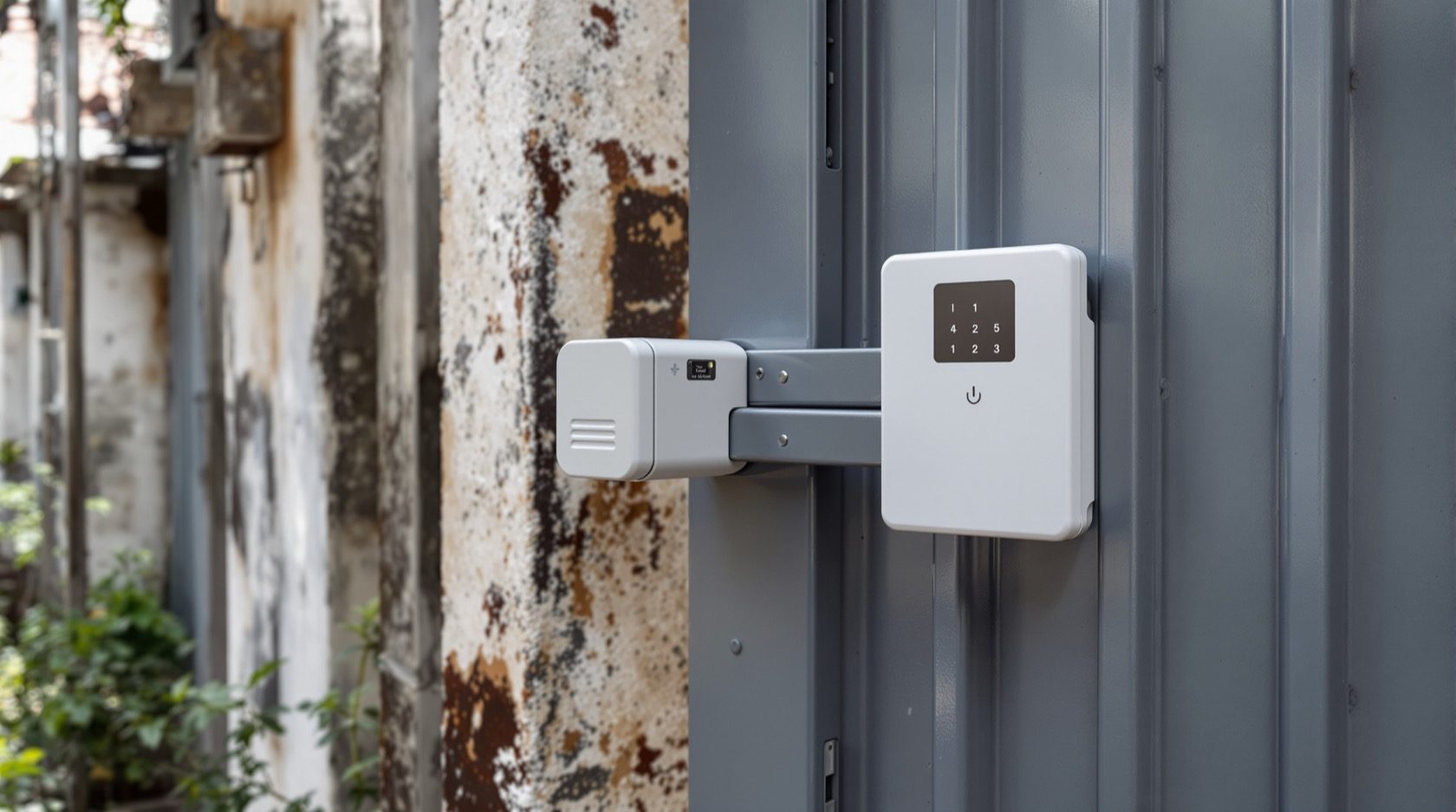
Smart Gate Locks in India (2026): Locking the Compound Gate the Right Way
How to choose, mount and power a smart lock on a metal compound or property gate in India, weatherproofed for monsoon and heat, tied into gate automation and a video door phone, and planned so no one is ever trapped inside.
The main door of a house has it easy. It sits under a porch, in the shade, on a solid timber frame, with a person on the other side who can always reach for a key. A compound gate has none of that comfort. It stands in the open through a Chennai summer and a Mumbai monsoon, it is welded from steel that rusts, it might be a sliding leaf running on a track, and when a visitor arrives you often want to let them in from indoors without walking to the gate at all.
So a lock made for a bedroom door is the wrong tool for a gate. Smart gate locks are the family of electronic locks built for that harsher, more exposed job: locking swing gates, sliding gates and small pedestrian "wicket" gates, surviving the weather, mounting on metal, running on their own power, and talking to your gate automation and video door phone so you can buzz a courier in from the sofa.
This guide is part of Studio Matrx's complete guide to smart locks in India and its smart locks and access control hub. Our job here is the lock form for a gate — not the credentials themselves. For how a fingerprint, PIN or app actually unlocks a lock, follow the credential guides linked below; here we stay on the gate.
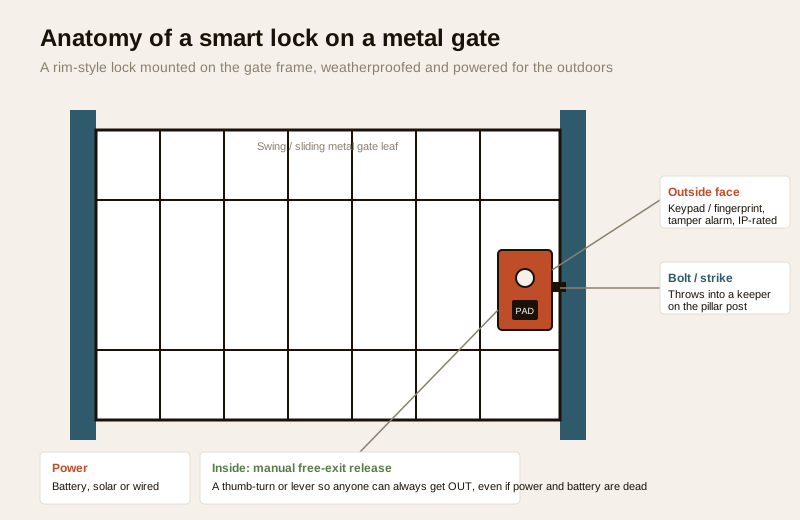
Scope & safety. This guide helps you plan, decide and coordinate. A compound gate is usually NOT a fire-escape door — but people, and in an emergency a vehicle, must always be able to get OUT. Every gate lock in this guide must have a manual free-exit release on the inside (a thumb-turn or lever) plus a mechanical key override, both working with zero power. Fitting the lock to a metal gate, any mains wiring, and interlocking a lock with gate automation are licensed jobs — hand them to a qualified installer and electrician. Access logs are personal data under the Digital Personal Data Protection Act, 2023. This is educational guidance, not legal or safety-code advice.
Why a gate is a different problem from a door
Four things change the moment you move a lock from the front door to the gate.
- Full outdoor exposure. The lock takes direct sun, driving rain, dust storms, and — if you are near the coast — salt-laden air. A lock rated for indoor use will corrode, its keypad will fog, and its electronics will die. You need a high IP weatherproofing rating and a genuinely rust-proof build.
- It mounts on metal, not timber. A gate is a steel frame and a grille, not a 40 mm door leaf. A mortise lock designed to sink into a wooden door will not fit. Gate locks are surface-mounted (rim or "on-frame" style), and the gate frame has to be strong and flat enough to carry the lock and take the strain when someone pushes.
- There is no mains socket at the gate. Powering an outdoor lock means a battery that must survive the heat, a solar panel, or a wired low-voltage supply run out from the house — each with its own trade-off.
- It is part of a bigger system. A gate lock rarely works alone. It pairs with a video door phone (to let a visitor in remotely), with gate automation (the motor that slides or swings the leaf), and with the property's access control for a gated community.
The five form factors for a gate
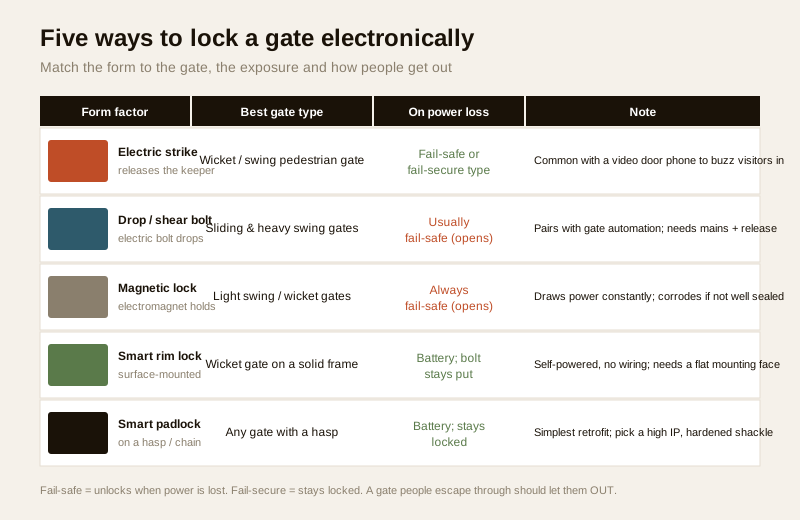
There is no single "gate smart lock." There are several mechanisms, and the right one depends on your gate type, how exposed it is, and — most importantly — how people get out. Here is the honest comparison.
| Form factor | How it holds the gate | Best for | On power loss | Watch-out |
|---|---|---|---|---|
| Electric strike | Releases the keeper the existing latch sits in | Wicket / pedestrian swing gates | Fail-safe or fail-secure versions exist — choose deliberately | Needs a matching mechanical latch; usually mains-wired |
| Electric drop / shear bolt | A motorised bolt drops into the gate or ground | Sliding gates and heavy swing gates | Usually fail-safe (releases) | Pairs with automation; needs power + a manual release |
| Magnetic lock (maglock) | An electromagnet clamps the gate shut | Light swing / wicket gates | Always fail-safe — no power, no hold | Draws power continuously; corrodes fast if not well sealed |
| Smart rim lock | A self-contained surface lock throws a bolt | Wicket gate on a solid, flat frame | Battery-run; bolt holds its state | Needs a flat mounting face and a strong frame |
| Smart padlock | Locks a hasp, chain or sliding-bolt | Any gate with a hasp — the simplest retrofit | Battery-run; stays locked | Choose a high IP and a hardened shackle — see the caution below |
For a lot of Indian homes the pragmatic answer is the humblest one: a heavy smart padlock on the existing gate hasp. It needs no wiring, no metalwork and no electrician, and you can move it to another gate later. If you go this route, weatherproofing and shackle strength are everything — spend on a well-rated one rather than the cheapest.
A smart rim lock is the next step up where you have a solid pedestrian gate and want keypad or fingerprint entry without a padlock hanging off the frame. The strike, drop-bolt and maglock options are electrically operated and belong with gate automation — they are an installer's coordinated job, not a DIY fit.
A note on fail-safe versus fail-secure
You will see these two words on every electric gate lock, and they matter for safety:
- Fail-safe — the lock unlocks when it loses power. A maglock is always fail-safe. This is what you want on anything people escape through.
- Fail-secure — the lock stays locked when power is lost, so a power cut does not leave the gate open.
A compound gate is usually not a legally defined fire-escape door, so a fail-secure gate lock is not automatically wrong. But the guiding principle is unbending: no lock may ever trap a person inside. That is why every setup in this guide keeps a mechanical inside release that works whether the lock is fail-safe, fail-secure, or flat out of battery. If the gate is the only way out of a property, treat it like an egress door, make it fail-safe, and get the interlock designed by a professional against the National Building Code fire rules.
Weatherproofing: the number that decides the lock
For a gate lock, the single most important spec is the IP rating — the two-digit code that says how well the body keeps out dust and water. Get this wrong and nothing else matters, because the lock will be dead within a monsoon or two.
| IP rating | Roughly means | Suitable for a gate? |
|---|---|---|
| IP54 | Dust-protected; splashing water | Borderline — only under a good hood/canopy |
| IP65 | Dust-tight; low-pressure water jets | Yes — the sensible minimum for an exposed gate |
| IP66 | Dust-tight; strong water jets | Yes — better for fully open, driven-rain sites |
| IP67 | Dust-tight; short immersion | Best for coastal, flood-prone or ground-level bolts |
Alongside the IP number, look at the build: stainless steel or a marine-grade, powder-coated body rather than plain steel or zinc that will streak rust down your gate. Near the coast, salt is the real enemy — favour stainless, rinse the lock occasionally, and expect to service it more often. Heat matters too: a keypad or fingerprint reader in direct afternoon sun runs hot, which shortens battery life and can make touchscreens sluggish, so a small hood or an east-facing mounting helps.
Mounting on a metal gate
A gate lock is only as strong as what it is bolted to. Before you choose a lock, look hard at the gate itself:
- Is the closing stile flat and solid? Surface locks need a flat face wide enough to take the body and a matching keeper on the pillar. A thin, flexing grille is not enough.
- Does the gate sag or rack? An old swing gate that has dropped on its hinges will not align its bolt with the keeper. Fix the hinges first; a lock cannot compensate for a gate that no longer closes squarely.
- Sliding gate? A sliding leaf usually wants a drop bolt into the ground or a hook-bolt into the receiving post, not a swing-gate rim lock. This is automation territory.
- Wicket gate in a larger gate? The small pedestrian gate set into a big driveway gate is often the best place for a smart rim lock — it is the door people actually walk through daily.
Drilling and tapping a steel gate, adding a reinforcing plate, and aligning the keeper are metalwork tasks. A neat, weather-sealed install by someone who does this for a living is worth far more than a lock that is a millimetre out and jams every time the gate warms up in the sun.
Powering an outdoor lock
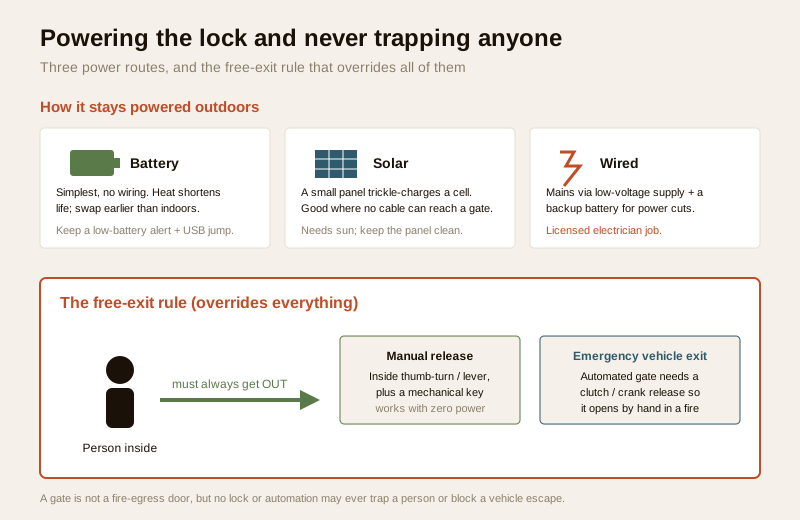
With no socket at the gate, you have three routes, and the choice cascades into everything else.
| Power route | Pros | Cons | Best when |
|---|---|---|---|
| Battery | No wiring; simplest retrofit | Heat shortens life; you must never be caught by a dead cell | A self-contained rim lock or padlock on a gate you can reach |
| Solar | No cable run; self-charging | Needs sun; panel must stay clean; more parts to fail | A far gate with no way to run a cable and decent daylight |
| Wired (low-voltage) | Constant power; suits maglocks and automation | Needs a licensed electrician and a weatherproof cable run | Electric strikes, drop bolts, maglocks, automated gates |
Two rules save you every time. First, whatever the power source, insist on a low-battery warning in the app well before the cell dies, and know the emergency route in — many locks take a 9V or USB "jump" on the outside, and all of them should still take a mechanical key. This is the same "how do I get in when the battery dies" question the pillar guide stresses for door locks, and it is even more acute on a gate baking in the heat. Second, any mains-connected work belongs to a licensed electrician — see the electrical hub. Running a live cable out to a metal gate in the rain is precisely the kind of job you do not improvise.
Letting a visitor in without walking to the gate
The whole appeal of a smart gate lock is answering the gate from wherever you are. That means integration, and there are two common ways to do it.
- With a video door phone. A courier presses the bell, you see and speak to them on the video door phone or your phone, and you release the gate strike from the handset — no walk to the gate, and it works when you are out of the house. This pairing is covered in depth in video door phones and smart locks and video door phones and access control.
- With gate automation. For a driveway gate, the smart lock is one part of a motorised system that slides or swings the leaf, often with a remote, a keypad and app control. This is a bigger, coordinated install — the lock, the motor, the safety sensors and the power all have to work together, and it is designed and fitted by an automation specialist.
For a villa or independent house, a rim lock or padlock on the pedestrian gate plus a video door phone is often all you need — see the villas and independent houses security guide. For a gated community or RWA, the gate is part of a much larger access-control and visitor-management system, with logs, resident credentials and guard workflows — that is its own discipline, covered in the gated communities security guide. Whichever you are, remember the access logs and any resident data are sensitive personal data under the DPDP Act, 2023: collect only what you need, secure it, and remove a departed resident's or guard's credentials promptly.
Choosing: a quick decision path
1. What gate is it? Sliding leaf, heavy swing gate, or a small pedestrian/wicket gate? Sliding and heavy swing gates point to drop bolts and automation; a wicket gate suits a rim lock or padlock.
2. How exposed is it? Fully open to sun and rain, or under a canopy? Coastal? This sets your minimum IP rating (IP65 as a floor, IP67 for coastal or ground bolts) and whether you want stainless.
3. Can a cable reach it? If yes and you want a maglock, strike or automation, plan a wired supply with an electrician. If no, choose battery or solar and a self-contained lock.
4. Do you want to buzz visitors in? If yes, pair it with a video door phone from the start.
5. How does everyone get OUT? Confirm the inside manual release and the mechanical key override before you buy. If the gate is the only exit, treat it as an egress route and involve a professional.
The Studio Matrx smart lock selector walks you through these questions, and the smart lock cost calculator helps you sanity-check a quote.
When to bring in a professional. You can happily choose the lock, read the IP spec, and fit a smart padlock to an existing gate hasp yourself. Hand over to a qualified installer or electrician the moment the job involves drilling and reinforcing the gate, running mains or low-voltage cable, fitting an electric strike, drop bolt or maglock, or interlocking the lock with gate automation — and especially if the gate is the only way out of the property, where fire-egress rules apply and the setup must fail-safe. Never let a lock or an automated motor leave anyone unable to get out.
Key takeaways
- A gate is not a door. It lives fully outdoors on metal, so a gate lock needs a high IP rating (IP65 as a floor, IP67 near the coast or at ground level) and a rust-proof, ideally stainless build — the front-door lock is the wrong tool.
- Match the form to the gate. Sliding and heavy swing gates want drop bolts and automation; a pedestrian wicket gate suits a smart rim lock; the simplest retrofit of all is a weatherproof smart padlock on the existing hasp.
- Plan the power before you buy. Battery is simplest but the heat shortens its life; solar suits a far gate with sun; wired suits maglocks and automation — and any mains work is a licensed electrician's job.
- No one gets trapped. A gate is usually not a fire-escape door, but every setup must let people OUT with an inside manual release and a mechanical key that work with zero power, and an automated gate needs a hand-crank release so a vehicle can leave in an emergency.
- Integrate for convenience, respect the data. Pair the lock with a video door phone to buzz visitors in remotely; for an RWA it is part of a larger access-control system whose logs are sensitive personal data under the DPDP Act, 2023.
References
- Digital Personal Data Protection Act, 2023 — gate access logs, visitor records and any resident or guard credentials are personal (and biometrics are sensitive) data; collect the minimum, secure it, and delete a departed user's access promptly.
- Manufacturer specifications — verify the IP rating, operating-temperature range, body material and battery life on the maker's own datasheet before ordering an outdoor gate lock, and confirm fail-safe versus fail-secure behaviour for any electric lock.
- National Building Code of India (SP 7), Bureau of Indian Standards, and local fire and municipal bye-laws for any gate that serves as an escape route and for the electrical side of an automated or mains-wired install; verify the current edition via the BIS catalogue: https://www.services.bis.gov.in/
This is an educational overview, not legal or safety-code advice. Fitting a lock to a metal gate, any mains wiring, gate automation and any fire-egress interlock are qualified professional tasks — engage licensed installers and electricians, and verify any standard's current status via the BIS catalogue before relying on it.
Export this guide
Related Guides — Deep-dive reading
Smart Locks in India (2026): The Complete Guide to How They Work, How to Choose and How to Fit One Safely
The umbrella guide to smart locks for Indian homes: what a smart lock actually is, the credential that opens it, the lock body it lives in, and the safety, power and privacy calls every buyer must make.
SecurityAccess Control Maintenance in India (2026): Readers, Locks and Fail-Safe Egress
How to keep a card, keypad, fingerprint or face access-control system reading reliably and locking securely — and, above everything, how to test that its doors still release on a fire alarm and on power loss, so an access-controlled door never becomes a life-safety trap.
SecuritySmart-Lock Power Battery Planning in India (2026): How the Lock Is Fed and What Happens When Power Runs Out
The install-side power decision for a smart lock: battery versus wired mains, sizing a UPS so a power cut cannot lock people out, and always planning the dead-battery get-in-anyway path with a mechanical key.
SecurityRelated Tools — Try Free
Door Lock Selector
Answer a few questions and get the right lock type — mortise, multipoint, deadbolt, privacy or smart — for any door.
Door ToolWindow Grill Design Selector
Pick a window grille style and material by priority — security, looks, budget, view — and estimate cost.
Window ToolDoor Security Rating Calculator
Score your main door out of 100 across leaf, frame, lock and hardware — and see the top upgrades.
Security Tool