
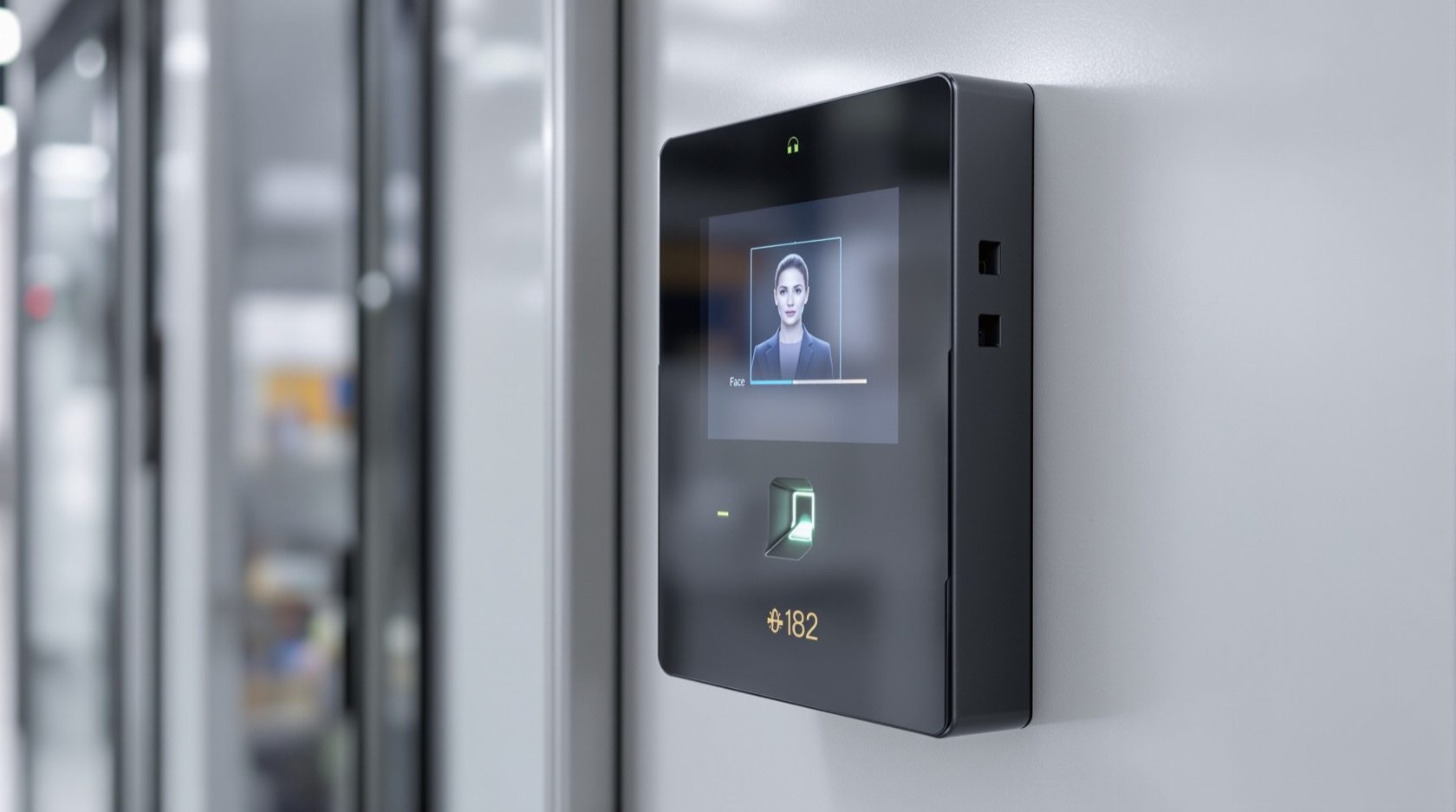
Biometric Access Control in India (2026): Fingerprint, Face and Palm Systems Done Right
A professional's guide to networked biometric access control for buildings: fingerprint, face and palm readers on many doors, tied to attendance, planned around the DPDP Act, fire-egress fail-safe and honest field limits.
Walk into most Indian offices, factories or newer apartment towers and the first thing that greets you is a reader on the wall: press a finger, show your face, or hover a palm, and the door releases and your arrival is logged. That is biometric access control — and it is a very different animal from the biometric lock on a single flat door. This is a system: readers at many doors, wired back to controllers, run from central software, with one enrolment record per person and a full audit trail. Because the credential is a part of someone's body and the logs usually double as attendance, it is also the most privacy-loaded access method you can deploy in India, and the one the Digital Personal Data Protection Act, 2023 watches most closely.
This guide is written for the people who specify, approve and administer these systems — architects, builders, facility managers, HR and IT leads, and Resident Welfare Association (RWA) committees. It sits inside Studio Matrx's access-control pillar and the Smart Locks & Access Control sub-hub. For the single-door cousin — a battery lock with a fingerprint or face reader built in — see biometric locks; for how the sensors themselves actually work, fingerprint locks and face-recognition locks cover the basics we will not repeat here.
Scope & safety. This guide helps you plan, decide and coordinate a biometric access system — it is not a fitting manual. The reader/controller wiring, the maglock or strike, the mains and network, and above all the fire-alarm interlock are a coordinated licensed job for a security-systems integrator, an electrician and a fire-safety consultant. Any biometric-controlled door on an escape route MUST fail-safe: release on power loss and on a fire-alarm signal, and carry a manual emergency release (break-glass / request-to-exit) — governed by the National Building Code and local fire rules. Never trap anyone. And because you are collecting sensitive personal data, treat the DPDP obligations below as a design input, not an afterthought. This is educational guidance, not legal advice.
What "biometric access control" actually means
The word "biometric" gets used loosely. In access control it means the reader identifies a person by a physical trait rather than something they carry or know. Three modalities dominate in India:
- Fingerprint — the cheapest and most common, from ₹3,000 desktop attendance units to ruggedised outdoor readers. Fast, familiar, but the most affected by wet, worn, cut or dirty fingers.
- Face recognition — now very common at office and society entrances; hands-free, quick at a turnstile, but sensitive to lighting, masks, caps and camera angle, and the most privacy-sensitive because a face is captured passively.
- Palm vein / palm print — the premium, hygienic, contactless option (the reader reads the vein pattern under the skin). Harder to fool, unaffected by surface cuts or grime, but costs more per reader.
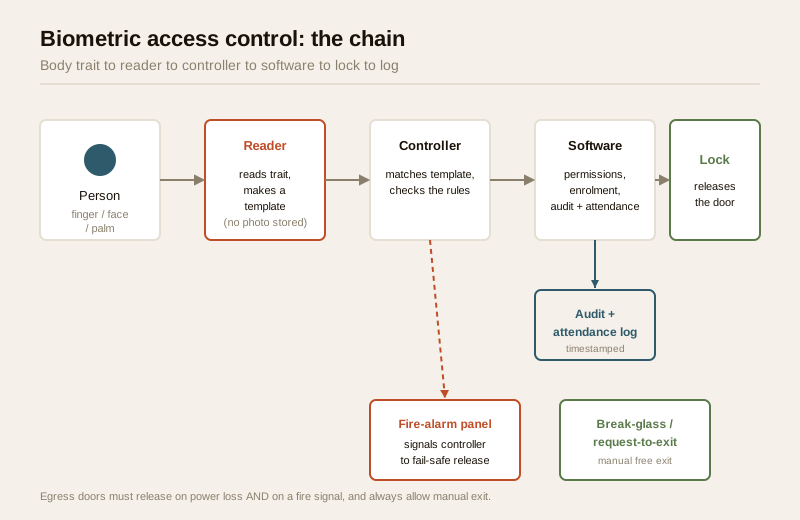
Whichever the modality, the system does not store a photo of your finger or face. At enrolment it converts the trait into a mathematical template — a one-way numeric summary from which the original cannot be reconstructed — and matches future presentations against that template. Understanding that the asset is a template, not an image, is the foundation of every privacy decision that follows.
System, not a lock: why the distinction matters
A biometric lock is a self-contained device: the sensor, the decision and the bolt all live in one unit on one door, and enrolment happens by walking up to that door. Beautiful for a home. It does not scale, it has no central record, and it cannot tie into attendance or a fire panel across a building.
Biometric access control separates the parts so it can scale to hundreds of doors and thousands of people:
| Aspect | Single biometric lock | Biometric access control system |
|---|---|---|
| Doors / users | One door, a handful of users | Many doors, hundreds to thousands of users |
| Where the decision is made | Inside the lock | At a networked controller (with the reader) |
| Enrolment | At the door, per device | Once, centrally, then pushed to every relevant door |
| Audit trail | Little or none | Full timestamped log, exportable |
| Attendance | No | Yes — this is the common reason it is bought |
| Fire-alarm interlock | Rarely | Expected, and mandatory on escape routes |
| Power | Battery | Mains + UPS; maglock/strike needs backup power |
| Privacy exposure | One person's own data | A whole workforce's or society's sensitive data |
That last row is the crux. The moment a system holds the biometric templates of other people — employees, tenants, visitors, domestic staff — you are a Data Fiduciary under the DPDP Act, and their body-data is your legal responsibility. The rest of this guide treats that as the headline design constraint, because in India it is.
The DPDP Act, 2023: biometrics are sensitive, plan for it first
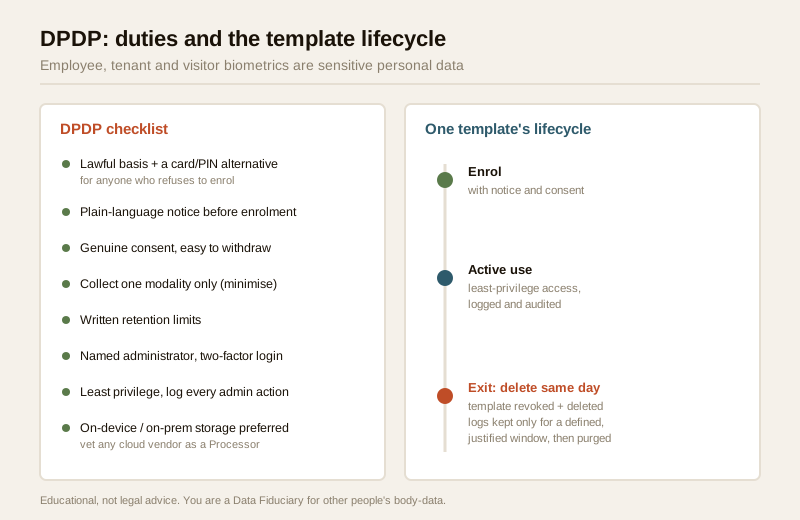
The Digital Personal Data Protection Act, 2023 governs the personal data of people in India. Biometric templates and the access/attendance logs built from them are among the most sensitive data you can hold. The Act does not ban biometric access control — but it demands you can answer, in writing, why you collect it, on what basis, who sees it, and when it is destroyed. Build these seven duties into the specification, not into a scramble after an audit.
1. A clear, lawful basis — and a real alternative
You must have a lawful basis to process each person's biometric. For employees, consent is legally fragile because the power imbalance means it is rarely "free" — an employee who fears for their job cannot truly refuse. The safer posture is to rely on a legitimate, narrowly-defined purpose (attendance, secured-area access) and to offer a genuine, non-punitive alternative credential — a card or PIN — to anyone who declines to enrol their biometric. A system that forces every employee onto a fingerprint reader with no alternative is the classic DPDP failure. Design the fallback in from day one; the same door should accept a card or PIN for those who opt out.
2. Notice, in plain language
Before enrolment, every person gets a clear notice: what is collected (fingerprint / face / palm template), why, how long it is kept, who it may be shared with, and how to withdraw or complain. Post it at the enrolment point and in the employee/tenant handbook, in a language people actually read.
3. Genuine consent, and the right to withdraw
Where consent is the basis (visitors, some tenants), it must be specific, informed and freely given — a pre-ticked box or a "sign here or you don't get in" is not consent. People can withdraw it later, and withdrawal must be as easy as giving it, after which their template is deleted and they move to the alternative credential.
4. Data minimisation
Collect the least that does the job. You do not need a face and both thumbs and a palm. One modality plus a fallback card is usually enough. Do not quietly repurpose an attendance system into behavioural surveillance — logging entry/exit for payroll is one purpose; tracking who lingered where is another, and needs its own basis.
5. Retention limits and same-day deletion of leavers
Keep templates only while the person's relationship with the building lasts. The single most-breached rule in Indian installations is leaving an ex-employee's or former-tenant's template — and their access — live for months. When someone leaves, their template and credential must be revoked and deleted the same day, as a documented step in the exit/off-boarding checklist. Access logs may be kept longer for a defined, justified period (a payroll dispute window, a security-incident window), but not forever, and the retention period must be written down.
6. Template storage: on-device / on-prem vs cloud
Where the templates live is a core decision with privacy, resilience and cost trade-offs:
| Storage model | Where templates sit | Privacy / control | Resilience (India realities) | Best for |
|---|---|---|---|---|
| On-device | In each reader/controller | Highest local control; data never leaves the premises | Works through internet outages; keep readers physically secure | Small offices, single-building sites |
| On-premises server | A local server/NVR in the building | Full control; you own the box and its backups | Needs UPS + backups; survives internet cuts | Multi-door campuses, factories |
| Cloud | Vendor's servers | Convenient multi-site, but you must vet the processor, data-residency and their DPDP compliance | Depends on internet; patchy links stall enrolment/sync | Multi-site chains with reliable links |
For most Indian single-site deployments, on-device or on-prem template storage keeps the sensitive data on your own premises, which is easier to defend and less exposed. If you choose cloud, the vendor is a Data Processor acting for you — put data-residency, breach-notification and deletion duties in the contract, and confirm where in the world the templates physically rest.
7. Who administers it — and least privilege
Name the accountable owner (usually HR or facilities), keep the admin console behind strong unique credentials and two-factor login, log every admin action, and give each administrator only the access their role needs. The person who can enrol and delete templates holds the workforce's most sensitive data — treat that seat accordingly. For a society, this is an RWA governance question as much as a technical one; the apartments security guide and gated-community guide cover who should hold the keys.
Life-safety: the fire-egress fail-safe is non-negotiable
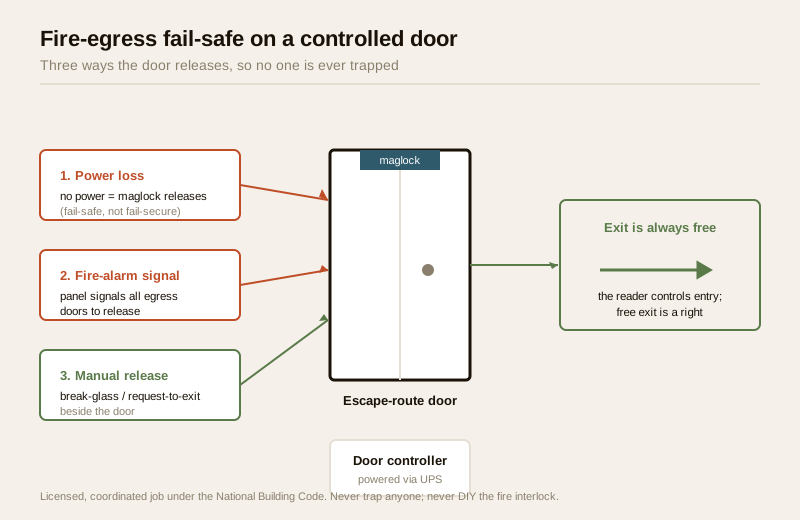
Because these systems control building doors, the fire code sits above every other consideration. An access-controlled door on an escape route must never trap a person during a fire or a power cut. In practice, coordinated with your fire-safety consultant and integrator:
- Fail-safe, not fail-secure, on egress. Doors on escape routes use fail-safe locking (typically a maglock) that releases when power is lost, so a power cut or load-shedding never locks people in. (Non-egress doors — a store-room, a server room — may be fail-secure; that is a per-door decision the fire consultant signs off.)
- Fire-alarm interlock. The controller must be hard-wired to the fire-alarm panel so that on a fire signal, all egress-route doors release automatically. This is a mandatory, licensed integration under the National Building Code and local fire rules — never a DIY jumper.
- Manual emergency release. Every controlled egress door carries a break-glass unit and/or a request-to-exit device so anyone can leave without a credential. The reader controls entry; free exit is a life-safety right, not a permission.
- UPS on the whole chain. Readers, controllers, the maglock and the network need backup power sized for realistic Indian outages — but the UPS keeps the system running, it never overrides the fail-safe release on a fire signal.
Get this wrong and you have not built security, you have built a hazard. Coordinate the fire interlock and egress hardware through the electrical hub and a licensed fire-safety consultant, and verify the current code edition before design.
Honest limits: what biometric access control does badly
No responsible specification hides the failure modes. Biometrics are convenient, not magic, and in Indian conditions they misbehave in predictable ways. Plan around these rather than discover them at go-live.
| Limitation | Why it happens | Mitigation (defensive) |
|---|---|---|
| Wet, worn or cut fingers | Factory, kitchen, monsoon and manual-labour hands read poorly; worn ridges on older workers | Choose face or palm for such sites; always keep a card/PIN fallback |
| Shared-sensor hygiene | Hundreds of fingers on one contact plate | Prefer contactless face or palm at high-traffic doors; clean plates on a schedule |
| Shift-change throughput | A factory gate with 300 people at 8:00 am jams if matching is slow | Face at a distance or multiple readers/lanes; do not funnel everyone through one plate |
| False reject (genuine person denied) | Poor read, lighting, angle, ageing template | The fallback credential must be quick, not a walk to security; re-enrol drifted templates |
| False accept (wrong person allowed) | Set thresholds too loose to cut rejects | Tune the security threshold for the door's risk; add a second factor on high-risk doors |
| Outdoor exposure | Heat, dust and monsoon degrade unsheltered readers | Specify the right IP rating and a shade/canopy; keep the controller indoors |
| Power and internet | Cuts stall cloud sync and unpowered readers | On-prem storage + UPS; local decision-making so doors work offline |
Two design responses fall out of this table. First, there is always a backup credential — a card or PIN — so a false reject or a wet finger never leaves a legitimate person locked out; that is both a usability and a DPDP-alternative requirement. Second, on genuinely high-risk doors, do not rely on biometrics alone: pair the reader with a card or PIN as multi-factor access control. The false-accept/false-reject trade-off is a dial, and the right setting depends on the door — read card-based access control for the common card-plus-biometric combination.
Attendance: the reason it usually gets bought — and the extra duty it creates
Most Indian biometric access systems are sold as attendance systems that happen to open doors. That dual role is convenient but doubles the privacy load: an entry log is now also a record of someone's working hours, tied to payroll and possibly to disciplinary action. Treat the attendance data with the same DPDP discipline as the templates — a defined purpose (payroll), a defined retention (the dispute window, then deletion), least-privilege access for HR only, and no silent repurposing into productivity surveillance. If attendance is the only goal, a desktop fingerprint punch that never controls a fire-egress door is a lighter-touch choice than wiring biometrics into the building's doors.
Specifying and coordinating the job
Because the fire interlock, mains and network wiring are licensed work, your role is to plan, decide and coordinate — then hold the integrator to the spec. A sound sequence:
1. Map the doors and risk. Which doors are on escape routes (fail-safe, fire-interlocked), which are internal high-risk (multi-factor), which are convenience. Use the access-control system designer to lay this out.
2. Choose modality per door. Face or palm for high-throughput or dirty-hand environments; fingerprint where cost rules and hands are clean; a fallback card/PIN everywhere.
3. Decide template storage (on-device / on-prem / cloud) against the privacy and resilience trade-off above.
4. Write the DPDP pack before enrolment: notice, consent form, opt-out alternative, retention schedule, off-boarding deletion step, named administrator.
5. Coordinate the licensed trades. Integrator + electrician + fire-safety consultant, with the fire interlock and egress hardware signed off against the current code.
6. Budget realistically. Size it with the access-control cost estimator; for larger buildings the commercial-buildings security guide frames the wider system.
When to bring in a professional. You can decide the policy, the modality per door and the DPDP framework yourself. Hand the reader/controller wiring, the maglock or strike, the mains and UPS, and the fire-alarm interlock to a licensed security-systems integrator working with an electrician and a fire-safety consultant — the egress fail-safe is a coordinated life-safety job under the National Building Code, never a DIY task. Have the DPDP notices, consent forms and deletion process reviewed by someone competent before you enrol a single person, and never give a departing administrator or contractor lingering access to the enrolment console or the template store.
Key takeaways
- Biometric access control is a networked system, not a lock — readers to controllers to central software across many doors and users, usually tied to attendance; the single-door biometric lock is its home-scale cousin, so cross-link, don't duplicate.
- DPDP is the headline design input. Employee, tenant and visitor biometrics are sensitive personal data: you need a clear lawful basis, plain-language notice, genuine consent with a real card/PIN alternative for those who refuse, data minimisation, written retention limits, and same-day deletion of a leaver's template.
- Fire-egress fail-safe is non-negotiable — egress-route doors release on power loss and on the fire-alarm signal, carry a manual break-glass release, and are a licensed, coordinated integration; never trap anyone.
- Be honest about the limits — wet or worn fingers, shared-sensor hygiene, shift-change throughput and false accept/reject are real; always keep a backup credential and add a second factor on high-risk doors.
- Keep the sensitive data close and governed — prefer on-device or on-prem template storage for single sites, name an accountable administrator with two-factor login and least privilege, and vet any cloud vendor as a Data Processor under contract.
References
- Digital Personal Data Protection Act, 2023 — the governing law for biometric templates and access/attendance data of people in India: lawful basis, notice, consent, minimisation, retention, and the Data Fiduciary's duties; treat this as a design input and have your notices and consent process reviewed by a competent person.
- Manufacturer specifications — verify sensor modality, false accept/reject rates, template-storage location (on-device vs cloud), IP rating and fire-interlock inputs on the maker's own datasheet before specifying a reader or controller.
- National Building Code of India (SP 7), Bureau of Indian Standards, and the local fire authority's rules for egress door hardware, fail-safe locking and the fire-alarm interlock; verify the current edition via the BIS catalogue: https://www.services.bis.gov.in/
This is an educational overview, not legal advice. Reader/controller wiring, electrical work, maglock/strike fitting and the fire-alarm interlock are licensed professional tasks — engage a security-systems integrator, electrician and fire-safety consultant, confirm your DPDP obligations with a competent adviser, and verify any standard's current status via the BIS catalogue before relying on it.
Export this guide
Related Guides — Deep-dive reading
Access Control Maintenance in India (2026): Readers, Locks and Fail-Safe Egress
How to keep a card, keypad, fingerprint or face access-control system reading reliably and locking securely — and, above everything, how to test that its doors still release on a fire alarm and on power loss, so an access-controlled door never becomes a life-safety trap.
SecurityFail-Safe vs Fail-Secure Locks: The Guide (India 2026)
Why fail-safe vs fail-secure is the single most important access-control decision, and how to get it right for every door.
Home Doors & EntrancesOffline Access Control in India (2026): Standalone Locks That Work Without a Network
How standalone, non-networked access control works when the permission lives on the door or on the card, where offline is the right choice, how you manage it, and the honest trade-offs versus a live cloud system.
SecurityRelated Tools — Try Free
Access-Control Battery-Backup Calculator
Size the standby battery so an access system keeps running through a power cut, with an egress life-safety note.
Battery BackupSecurity Backup Power Calculator
Size a UPS/inverter and battery to keep CCTV, NVR, router and alarm running through a power cut — load, Ah, VA and cost.
Backup PowerSecurity System Cost Estimator
Estimate the all-in capex with GST, annual running cost and 5-year total cost of ownership of a home or building security system.
Cost Estimator