
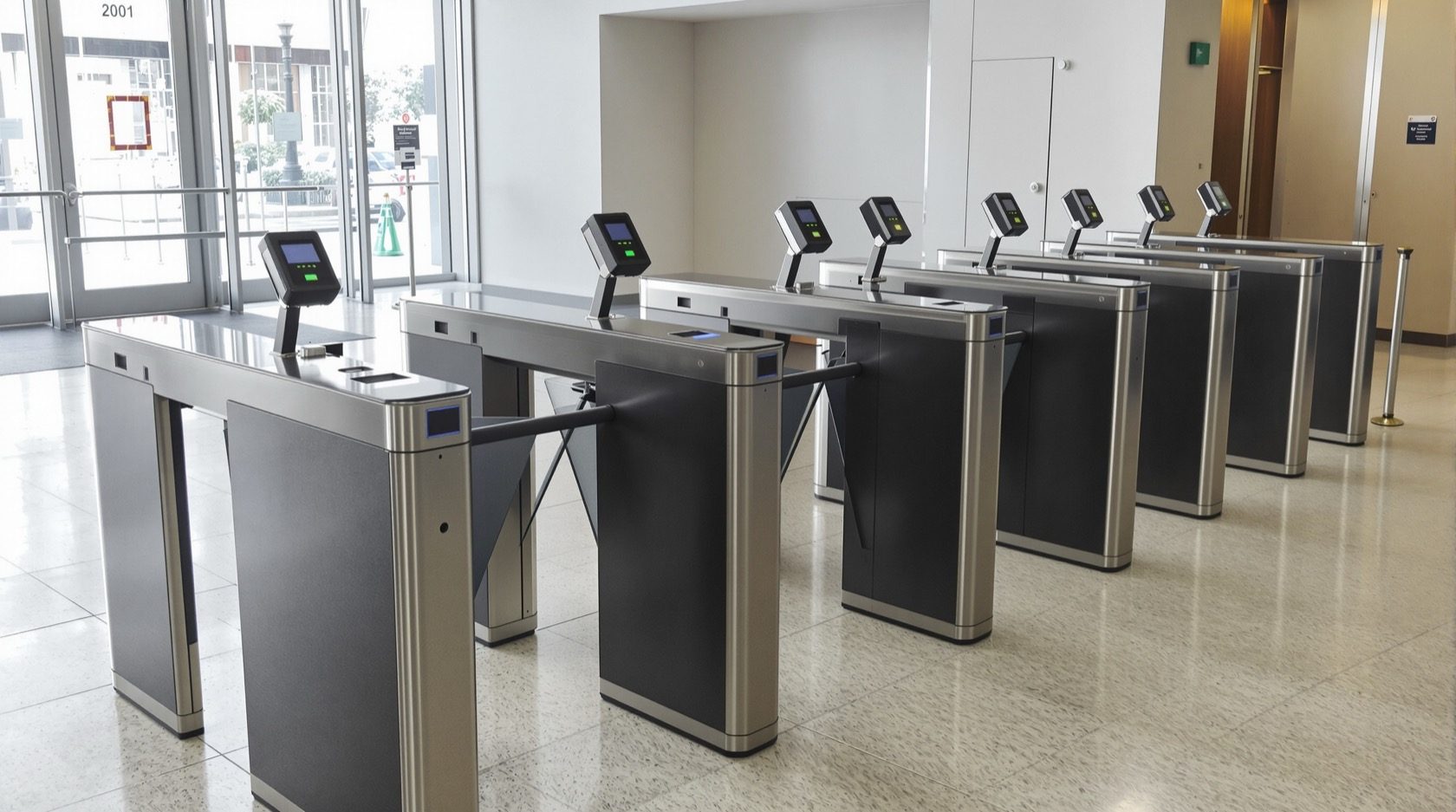
Turnstile Systems in India (2026): Types, Throughput and Safe Egress
How turnstile systems control pedestrian flow at offices, metros, stadiums and factories in India, how each type pairs with a reader, and why every lane must fail-safe and free-wheel in an emergency.
A turnstile is the point where a policy about who may enter meets a moving crowd. Get it right and thousands of people flow through an office lobby, a metro concourse or a stadium gate in an orderly single file, each tap logged. Get it wrong and you have either a bottleneck at shift change or, far worse, a barrier that will not open when a fire alarm sounds and a crowd is trying to leave. This guide treats both problems as one design job.
Turnstile systems are pedestrian barriers that permit one authorised person to pass per valid credential, at controlled entry and exit points: office and IT-park lobbies, metro and transport gates, stadium and event entries, and factory shift gates. They are the pedestrian sibling of the vehicle boom barrier at the gate and part of the broader access-control system. This guide covers the four families of turnstile, how each pairs with a reader, throughput and directional logic, the defensive anti-tailgate and anti-passback features, Indian pricing, DPDP duties for the entry log, and above all the life-safety rule that makes every one of them legal to install.
Scope & safety. This guide helps you plan, specify and coordinate a turnstile installation and hold your integrator to account; it is not a fitting manual. A turnstile sits on an escape route, so it MUST fail-safe: on a fire-alarm signal and on power loss the arm drops or free-wheels, the flap or speed-gate wing opens, and the full-height rotor unlocks, with a manual emergency release and an adjacent, always-passable free-exit route. The actual barrier fitting, mains and network wiring, and the fire-alarm interlock are a coordinated LICENSED job for an integrator, an electrician and a fire-safety consultant together. Never specify a lane that can trap a crowd. Entry logs are personal data under the Digital Personal Data Protection Act, 2023. This is educational guidance, not legal advice.
The four families of turnstile
Turnstiles trade openness and speed against physical security. A waist-high tripod is fast and welcoming but is only a deterrent; a full-height rotor is a genuine physical barrier but slower and, crucially, needs the most careful egress design. Choosing well starts with matching the family to the setting and the crowd.
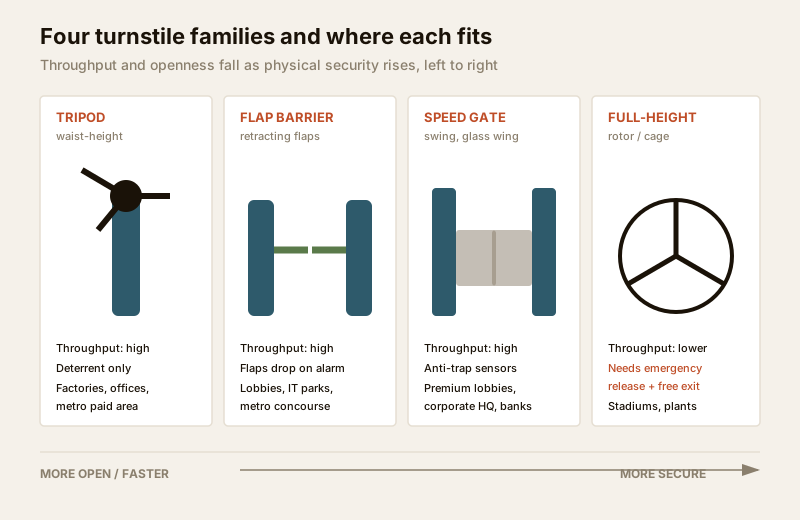
Tripod (waist-height)
Three rotating arms at waist height. The workhorse of Indian access control: cheap, robust, tolerant of dust and heat, and easy to service. A tripod is a deterrent barrier, not a wall; it enforces one-person-per-tap and creates an orderly queue, but it does not physically stop a determined intruder from stepping over. That is fine for a factory shift gate, an office where a guard is present, or a metro paid-area boundary where the real deterrent is the fine and the CCTV. On a fire signal the arm must drop or free-wheel so people can simply walk through.
Flap barrier
Two low pedestals with retracting acrylic or polycarbonate flaps that slide back to let an authorised person through, then close. Faster and more elegant than a tripod, common in IT parks, corporate lobbies and metro concourses. The flaps are motorised, so a proper flap barrier has anti-trap sensors that stop the flaps closing on a person, and it opens the flaps on alarm or power loss. Throughput is high, roughly a person every one to two seconds per lane.
Swing gate and speed gate
A swing gate uses a hinged panel; a speed gate is the premium version with tall glass wings, optical sensors and a wide, accessible lane. These are the lobbies of corporate headquarters, banks and premium offices, where the turnstile is also a piece of interior design. Speed gates carry the most sensors and therefore need the most careful commissioning: the same optical array that detects tailgating must also guarantee the wings never close on a person and open fully in an emergency.
Full-height rotor (cage)
A floor-to-head rotating cage, the only turnstile that is a real physical barrier one cannot step over. Used at stadium perimeters, unmanned factory gates and high-security plant boundaries. Because it fully encloses a person, the full-height turnstile carries the heaviest life-safety burden: it MUST have an emergency release that unlocks the rotor completely, and the design MUST provide an adjacent free-exit gate so a crowd is never funnelled through a slow cage in a panic. Never place a bank of full-height turnstiles across an escape route without a separate, wide, always-open exit beside them.
| Family | Physical security | Throughput per lane | Typical Indian setting | Indicative price per lane |
|---|---|---|---|---|
| Tripod (waist-height) | Deterrent | High (about 30-45 per min) | Factory, office, metro paid area | ₹40,000 - ₹1,20,000 |
| Flap barrier | Medium | High (about 30-40 per min) | IT park, lobby, metro concourse | ₹1,20,000 - ₹3,50,000 |
| Speed gate (glass wing) | Medium-high | High, accessible | Corporate HQ, banks, premium | ₹3,00,000 - ₹8,00,000 |
| Full-height rotor | High (true barrier) | Lower (about 15-20 per min) | Stadium, plant, unmanned gate | ₹1,50,000 - ₹4,50,000 |
Prices are indicative 2026 supply-and-fit bands per lane and swing widely with brand, sensor count, finish and integration; treat them as planning figures and confirm with quotes. Use the access-control cost estimator to build a project figure across multiple lanes and readers.
Pairing the turnstile with a reader
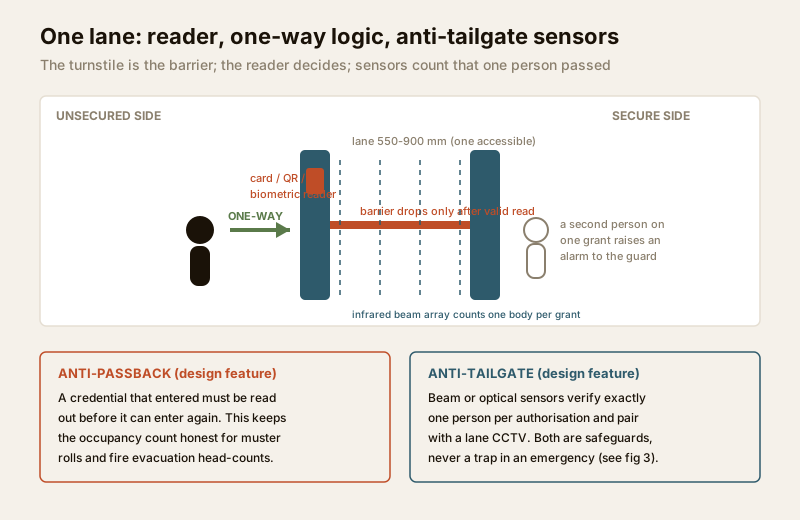
A turnstile is only the barrier. It decides nothing on its own: a reader mounted on the pedestal captures the credential, the controller checks the rule and schedule and logs the event, and only then does the turnstile release for one pass. Choosing the credential is a separate decision from choosing the barrel, and the two must be specified together.
| Credential | How it pairs | Best for | Guide |
|---|---|---|---|
| Card / fob | Fast tap, low cost, easy reissue | Factories, large offices, shift gates | Card-based access control |
| Biometric (face / palm) | No card to share or lose | Attendance-linked, higher assurance | Biometric access control |
| Mobile credential | Phone as the pass, remote issue | Corporate, hybrid workforces | Mobile credential access |
| QR / dynamic code | Time-boxed, printable, visitor-friendly | Stadiums, events, visitor gates | QR-code access control |
| Multi-factor | Two proofs at high-security lanes | Data centres, cash rooms | Multi-factor access control |
For an office, cards or mobile credentials keep throughput high while the rule set lives in a role-based model so a contractor badge and an employee badge open different lanes and floors. Stadiums and events lean on QR because a ticket can be a time-boxed code issued to a phone. Factories often combine a card tap with a face read so the same turnstile pass feeds time and attendance. Whatever the credential, the controller writes the audit trail that later answers who passed and when.
One-way, two-way and directional logic
Every lane is configured for direction. A one-way lane admits only in the permitted direction and holds against the other; a two-way lane reads and releases for both entry and exit, keeping an accurate occupancy count. Bidirectional counting is what makes an evacuation head-count trustworthy, so on any site that must muster people, at least the boundary turnstiles should read on exit too. Direction is a configuration choice, not a physical feature, and it is set during commissioning against the site's flow plan.
Anti-tailgate and anti-passback, as design features
Two features come up in every turnstile specification, and both are safeguards, never a trap. Anti-tailgate uses an infrared beam array or optical sensors to verify that exactly one person passed per authorisation; a second body following through raises an alarm to the guard rather than being physically crushed. Anti-passback requires a credential that entered to be read out again before it can re-enter, which keeps the occupancy count honest for muster rolls and prevents one pass being handed back. These are stated here as design intentions and their value to safety and audit; the method of defeating them is deliberately out of scope. The one device you never design a way around is the emergency release.
Pair every lane with a CCTV view. An ANPR or lane camera turns an anti-tailgate alarm into reviewable evidence and gives the guard context before they respond. The turnstile enforces; the camera explains.
The non-negotiable: fail-safe egress
This is the part of a turnstile project that is not optional and not a place to save money. A turnstile stands on an escape route. If it can hold a person in when a building is on fire, it is illegal and it is deadly. Every turnstile system in India must be designed so that a fire-alarm signal and a loss of power both drive the lane to a safe, open state, with a manual override that anyone can operate without a tool.
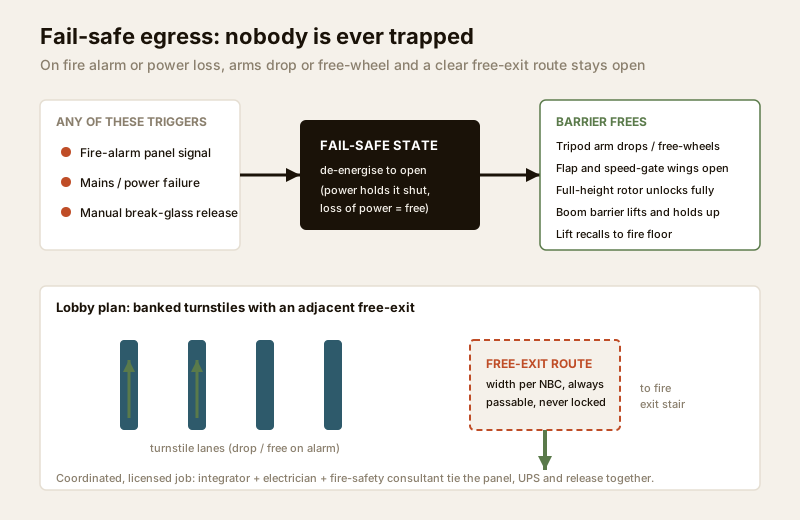
- Fail-safe by design. Specify de-energise-to-open behaviour: power holds the barrier in its controlled state, and loss of power frees it. The tripod arm drops or free-wheels, the flap and speed-gate wings open, and the full-height rotor unlocks fully.
- Fire-alarm interlock. The turnstile controller takes a signal from the fire-alarm panel and releases every lane the instant the alarm sounds, before anyone reaches it. This tie-in is a coordinated, licensed job with the fire-safety consultant, mirroring the emergency door release.
- Manual emergency release. A break-glass or clearly marked release frees the lanes by hand. On full-height rotors this is mandatory and must unlock the cage completely.
- Adjacent free-exit. Never rely on the turnstile lanes alone for evacuation. Provide a separate, always-passable exit gate of the width the National Building Code requires beside the bank, so the crowd has a route that is never metered.
- UPS, not just mains. Readers and controllers ride through India's power cuts on a UPS, but the fail-safe logic must still open the barrier on total power loss; the UPS keeps the log and reader alive, it does not keep people locked in.
The interplay of these is what a fire-safety consultant signs off. It is why a turnstile is not a DIY fit and why the barrier, the wiring and the alarm interlock are commissioned together, not bought separately.
Setting by setting
The same barrel behaves differently by setting, and the difference is mostly egress load and environment.
| Setting | Typical family | Egress priority | Notes |
|---|---|---|---|
| Office / IT-park lobby | Flap or speed gate | High (dense at shift change) | Tie into office access control; wide accessible lane mandatory |
| Metro / transport | Flap or tripod | Very high (crowd surge) | Two-way counting; heavy-duty; frequent AMC |
| Stadium / event | Tripod or full-height | Very high (panic risk) | QR tickets; free-exit gates dominate the design |
| Factory shift gate | Tripod | Medium-high (surge at bell) | Attendance-linked; dust and heat rated |
| Apartment / gated community | Tripod or flap | Medium | Coordinate with apartment access control and gate access control |
For a corporate campus the turnstile is one layer inside a wider scheme that also covers lift access and parking; plan them as one system so a single credential and one audit trail run the whole journey from the boom barrier to the desk floor. The access-control system designer helps lay out the points before you quote.
DPDP and the entry log
Every tap a turnstile logs is personal data. A record of who entered where and when, and any linked face template, card ID, employee number or visitor detail, is personal data under the Digital Personal Data Protection Act, 2023, and biometric and location-linked entry data should be treated as sensitive. That brings duties: a lawful basis and clear notice at the point of enrolment, minimisation so you keep only the fields the security purpose needs, a stated retention period after which logs are purged, and a named administrator who controls access to the log. Visitor QR passes should expire and their data should not outlive the visit. Handle enrolment and retention the way the visitor access management and audit-trail guides set out, and document who can pull a report.
When to bring in a professional
Bring in the team early. A turnstile is a licensed, coordinated installation, not a product you bolt down. Engage a security integrator, a licensed electrician and a fire-safety consultant together the moment the lane count and locations are fixed. The integrator sizes throughput and specifies readers and sensors; the electrician runs mains and network on a UPS; the fire-safety consultant designs and signs off the fail-safe interlock, the manual release and the adjacent free-exit against the National Building Code. On a full-height rotor or any lane on an escape route, this coordination is not optional. Model the site first with the access-control system designer and the smart-lock selector, then take a clear scope to quote.
Key takeaways
- Turnstile systems meter pedestrian flow one authorised person at a time; the four families are tripod, flap barrier, speed gate and full-height rotor, trading openness for physical security.
- The turnstile is only the barrier: pair it deliberately with a card, biometric, mobile or QR reader, and set one-way or two-way direction to keep an accurate occupancy count.
- Anti-tailgate and anti-passback are safeguards for accurate counting and audit, framed as design features; the emergency release is the one device never to design around.
- Fail-safe egress is non-negotiable: on fire alarm and power loss the barrier must free-wheel or open, a manual release must exist, and a wide always-passable free-exit must sit beside the bank; full-height rotors carry the heaviest duty.
- It is a licensed, coordinated job of integrator, electrician and fire-safety consultant; entry logs are personal data under the DPDP Act, 2023, so enforce lawful basis, notice, minimisation and retention.
References
- Digital Personal Data Protection Act, 2023 (India) — lawful basis, notice, minimisation, retention and rights governing access logs, ANPR and biometric enrolment data.
- National Building Code of India and fire-safety provisions on means of egress and exit widths — verify current status via the Bureau of Indian Standards, https://www.services.bis.gov.in/.
- Turnstile and barrier manufacturer datasheets — confirm fail-safe (de-energise-to-open) behaviour, fire-alarm interlock inputs, anti-trap sensors, throughput ratings and IP/environmental ratings for outdoor Indian conditions.
- Studio Matrx access-control pillar and emergency-door-release guides for the coordinated egress interlock and free-exit requirements.
This guide is educational and does not constitute legal, fire-safety or engineering advice; retain licensed professionals and verify all statutory requirements for your site.
Export this guide
Related Guides — Deep-dive reading
Visitor Vehicle Management in India: A Professional Guide
The everyday weak point of every society and office gate is not the resident's car — it is the visitor, the cab, the delivery rider and the contractor who must be let in without opening the whole park to anyone. This is the process, not just the hardware: verify at the gate before the boom lifts, park visitors away from resident bays, and never jam the gate a fire tender needs.
SecurityStaircase Access Control in India (2026): Securing the Stair Without Locking In Escape
How to control who can enter a stair from a floor while guaranteeing that anyone inside can always walk out - free-exit egress hardware, fail-safe locks that release on fire and power loss, monitored doors, and coordinating the whole thing with your fire officer and the NBC.
SecurityAccess Control Maintenance in India (2026): Readers, Locks and Fail-Safe Egress
How to keep a card, keypad, fingerprint or face access-control system reading reliably and locking securely — and, above everything, how to test that its doors still release on a fire alarm and on power loss, so an access-controlled door never becomes a life-safety trap.
SecurityRelated Tools — Try Free
Gate Access Planner
Size a vehicle gate or boom barrier — lanes needed at peak and the right credential speed (RFID, ANPR, manual).
Gate FlowVisitor Access Planner
Size visitor handling at a gate or reception — lanes needed at peak and the temporary-pass pool.
Visitor FlowSecurity System Cost Estimator
Estimate the all-in capex with GST, annual running cost and 5-year total cost of ownership of a home or building security system.
Cost Estimator