
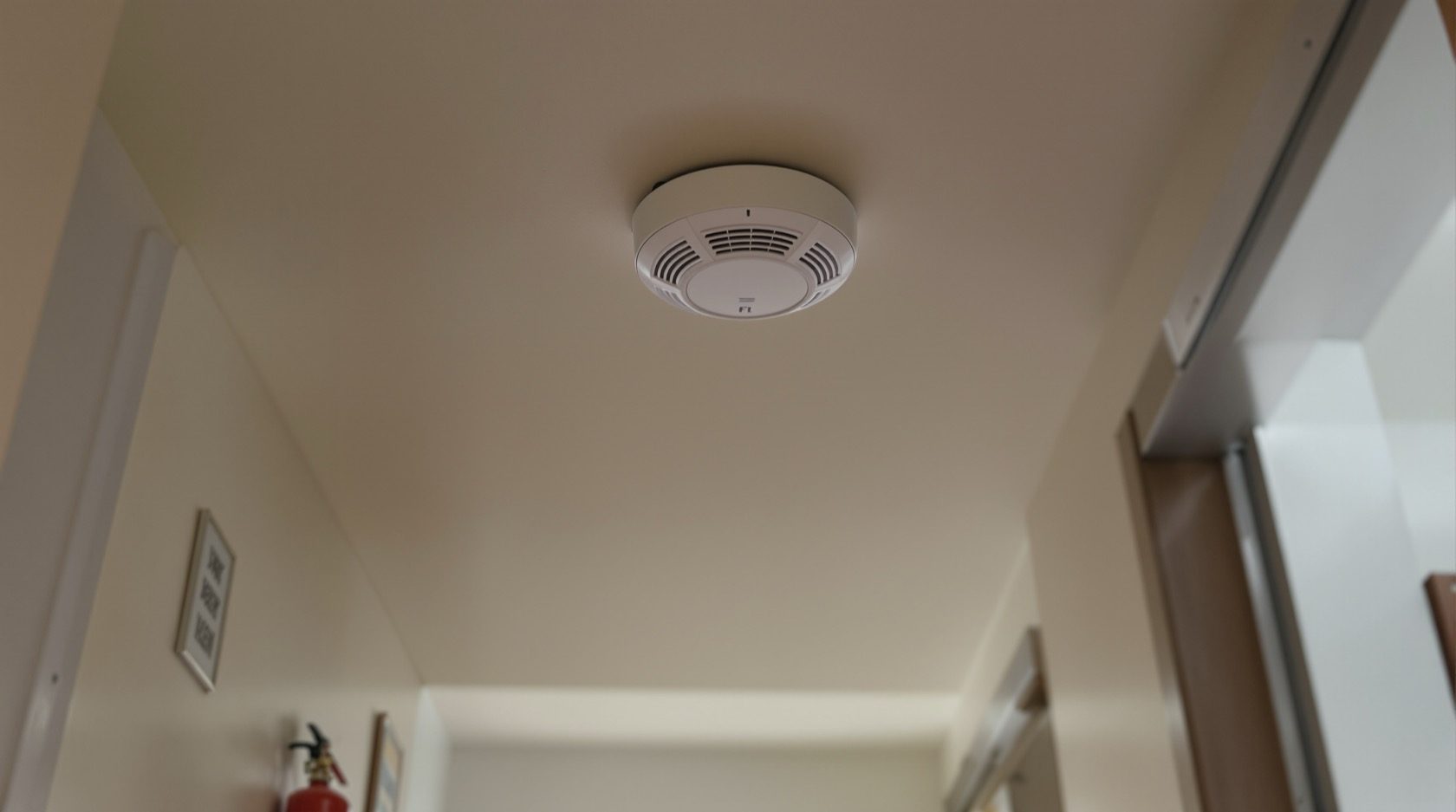
Home Fire Safety in India (2026): Alarms, Extinguishers and an Escape Plan
The realistic fire-safety baseline for an Indian house or flat: room-by-room prevention, smoke alarms placed right, one ABC extinguisher and a fire blanket, and a two-way escape plan you actually practise.
Most homes in India have no smoke alarm, no extinguisher, and no escape plan. Not because the family does not care, but because fire safety is quietly assumed to be a builder's problem, or a high-rise problem, or something you only think about after the news carries another tragedy. It is none of those things at home. Home fire safety is a short list of cheap, achievable habits and a few inexpensive devices that, together, turn a house fire from a fatal event into a scare you walk away from. This guide is that list — practical, India-grounded, and sized to a real flat or independent house, not a mall.
This is the home chapter of Studio Matrx's fire-safety library, and it sits under the complete guide to fire safety in India which sets out how requirements scale with building type and height. Here we stay firmly at the scale of your own front door: what starts fires in Indian homes, the small kit that actually helps, where to put a smoke alarm, and how to get everyone out. When you are done, the home fire-safety scorecard turns this into a quick self-check you can score in ten minutes.
Scope and safety — read this first. This guide helps you prevent, detect, plan and evacuate at home. It is empowering by design: you can and should do everything below yourself. But statutory fire systems — building-wide fire detection and alarm systems, sprinklers, hydrants, pumps, pressurised staircases and the Fire NOC / occupancy certificate your building may legally need — are the job of licensed fire-safety consultants, registered contractors and the State Fire Services, not a DIY project. This is educational guidance, not legal advice or a substitute for a licensed fire consultant. And one rule overrides everything that follows: if a fire is anything more than tiny and already-contained, do not fight it — get everyone out and call the fire brigade on 101 or 112.
Start with prevention: the fire never lit is the one you survive
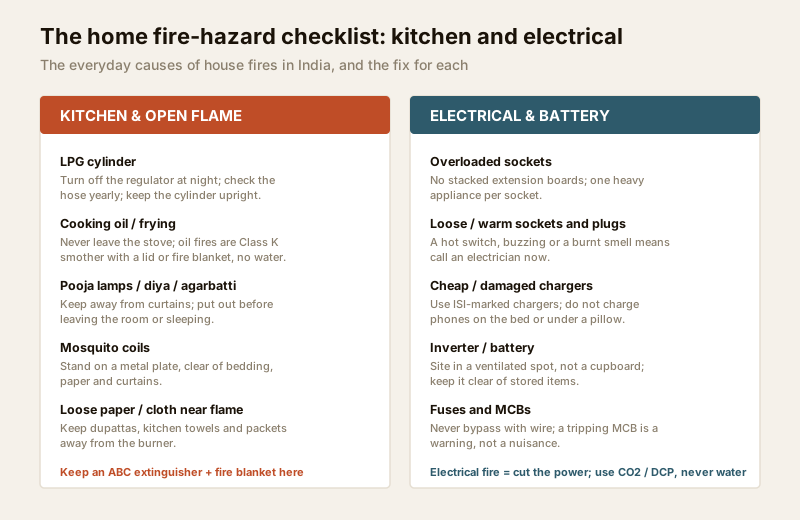
Almost every home fire in India starts in a handful of predictable places. Walk your home once with this list and you remove most of the risk before you buy a single device.
The kitchen — the number-one starting point
The kitchen is where open flame, hot oil and an LPG cylinder all live together, so it earns the most attention.
- LPG cylinder and regulator. Turn the regulator knob off at night and whenever you leave the house. Replace the rubber hose on or before its printed expiry (typically every couple of years), keep the cylinder upright and ventilated, and if you ever smell gas, do not touch any electrical switch — open the windows, shut the regulator, and leave.
- Cooking oil and frying. Never leave a pan of hot oil unattended, even for a minute. An oil fire is a Class K fire: you smother it with a lid or a fire blanket and cut the heat — you never throw water on it, because water flashes the oil into a fireball.
- Loose cloth near the flame. Dupattas, saree pallus, kitchen towels and plastic packets catch fire when they drift over a burner. Keep them back and tie loose clothing while cooking.
Electrical — the silent, year-round hazard
- Overloaded sockets and stacked extension boards are a classic cause. Run one heavy appliance (iron, heater, microwave) per socket, and never plug one extension board into another.
- Loose or warm sockets, buzzing switches, or a burnt smell are warnings, not quirks. Stop using that point and call an electrician. For the wiring side of the house, see the electrical hub.
- Cheap or damaged chargers. Use ISI-marked chargers, replace frayed cables, and never charge a phone on the bed or under a pillow where heat cannot escape.
- Inverter and battery. Site it in a ventilated spot, never a closed cupboard, and keep stored items clear of it.
- Fuses and MCBs. A repeatedly tripping MCB is telling you something is wrong — never bypass it with a wire. That "fix" removes the one thing standing between a fault and a fire.
The small Indian sources people forget
Pooja lamps, diyas and agarbatti near curtains; mosquito coils resting on bedding or paper; candles left burning during a power cut. Each is a tiny open flame left unattended near something that burns. Keep them on a metal plate, clear of fabric, and put them out before you leave the room or sleep.
Know the fire classes — because the wrong extinguisher makes it worse
You do not need to memorise the whole table, but knowing the classes tells you why one extinguisher is not right for everything, and why water on the wrong fire is dangerous.
| Class | Burning material | At home this is | Do NOT use |
|---|---|---|---|
| A | Ordinary solids | Wood, paper, cloth, furniture, plastics | Fine with water or ABC powder |
| B | Flammable liquids | Petrol, kerosene, paint, solvents | Never water (it spreads the liquid) |
| C | Flammable gases | LPG, piped gas | Shut the supply first; then extinguish |
| D | Combustible metals | Rare in homes | Special agents only |
| K | Cooking oils and fats | The frying pan, deep-fry oil | Never water; smother with a lid or blanket |
| Electrical | Live equipment | A shorting socket, TV, wiring | Never water while live; use CO2 or dry powder |
The takeaway for a home: a single ABC dry-powder extinguisher covers the everyday solids, liquids and gas fires you are likely to meet, and a fire blanket handles the kitchen oil fire and a burning garment. Between them they cover the realistic home. The one hard rule to burn into memory: never put water on an oil fire or a live electrical fire.
The realistic home fire-safety kit
You do not need a high-rise's systems. You need a smoke alarm or two, one extinguisher, a fire blanket, and — the free part — a plan. Here is the honest baseline for an Indian home.
| Item | What it does | The realistic home baseline |
|---|---|---|
| Smoke alarm | Wakes you to smoke, especially while asleep | One near the bedrooms and one on the escape path; more for a larger house |
| ABC dry-powder extinguisher | Knocks down a small, early solids/liquids/gas fire | One accessible unit, near (not inside) the kitchen, wall-mounted |
| Fire blanket | Smothers an oil-pan fire or burning clothing | One in the kitchen within arm's reach of the stove |
| Escape plan + meeting point | Gets everyone out and accounted for | Free; two routes from each bedroom, one meeting spot, practised |
| Torch by the bed | Sees through a power cut or smoke | One per bedroom, charged or with spare cells |
Buy the extinguisher and alarm to Indian standards where you can — portable extinguishers are made and rated to IS 15683 : 2018, selected and maintained per IS 2190 : 2024, and home smoke alarms and larger building detection systems follow IS 2189 : 2026. Whatever you buy, check the extinguisher's pressure gauge monthly and note its refill/expiry date; a discharged or expired extinguisher is decoration.
Where the smoke alarm goes — and where it must not
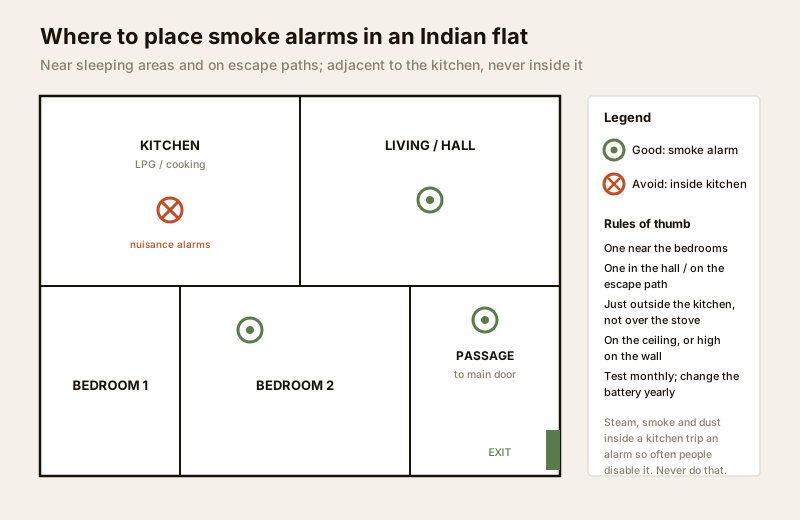
This is the part people get wrong, and getting it wrong is why so many disabled alarms sit dead on a shelf. Do not put a smoke alarm inside the kitchen. Steam, cooking smoke and dust set it off so often that families pull the battery — and a disabled alarm is worse than none, because it feels like protection while offering none. Instead:
- Put one just outside the kitchen, in the passage or hall, where it catches real smoke but not every fried onion.
- Put one near the bedrooms, because your best warning is the one that wakes you while you sleep.
- Mount alarms on the ceiling, or high on the wall — smoke rises, so a low alarm reacts late.
- Test every alarm monthly with its button, and change the battery once a year (a common trick: do it on a fixed date you will remember).
The escape plan — the free device that saves the most lives
Detection buys you seconds; the plan turns those seconds into everyone standing safely outside. It costs nothing and matters more than any gadget.
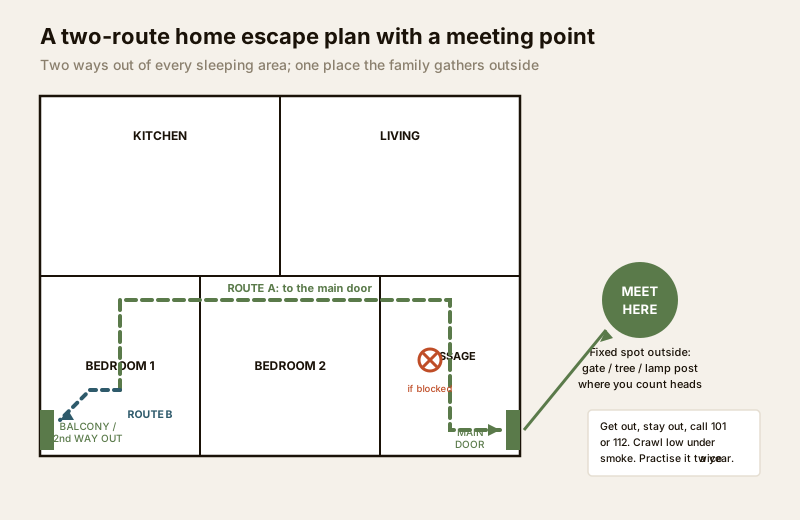
Two ways out of every sleeping area
Fires block routes. So every bedroom needs two ways out — the door, and a second option: another door, a window onto a balcony or a low roof, or a route through an adjoining room. Walk it now, at night, and check the second way actually opens. This is exactly why the deadly Indian habit of a locked collapsible gate on the only balcony or the main door kills people: it turns the second escape route into a trap. If you must have a security grille, fit a quick-release latch openable from inside without a key, and keep that key on the grille itself, not in a drawer.
One family meeting point
Pick a fixed spot outside — the gate, a particular tree, the lamp post across the lane — where everyone goes and where you count heads. It answers the most dangerous question in a fire: is everyone out? Without a meeting point, someone runs back in for a person who is already safe. With one, you know in seconds, and you can tell the fire brigade exactly who, if anyone, is still inside — you never go back in yourself.
Practise it
A plan read once and forgotten is not a plan. Walk the routes with the whole family, including children and older relatives, at least twice a year. Practise crawling low under imagined smoke (the breathable air is near the floor), practise the meeting point, and make sure a child knows the fire number is 101 (or 112). For the wider household emergency picture, the emergency-preparedness guide puts fire alongside the other events a family should rehearse.
If a fire starts: the thirty-second decision
When something catches, you have one quick judgement to make, and then you act.
1. Is it tiny and contained — a pan, a wastebasket, a single socket — with a clear path behind you to the door? Only then consider using the extinguisher or blanket, standing between the fire and your exit, never with the fire between you and the way out.
2. Otherwise, GET OUT. If it is spreading, if there is smoke you cannot see through, if you feel any doubt — leave. Shout to alert everyone, close doors behind you to slow the fire, do not stop for belongings, and crawl low if there is smoke.
3. Once out, stay out. Go to the meeting point, count heads, and call 101 or 112. Tell them the address and whether anyone is still inside. Never re-enter a burning building — that is the fire brigade's job, with equipment you do not have.
A closed door buys minutes. A burning home is not worth a life, a phone or a document. The single most important sentence in this guide is: when in doubt, get out and call.
The deadly Indian mistakes to design out
These recur in Indian home-fire tragedies. Fix them and you have addressed the failure modes that actually kill.
- A single exit. If your flat or floor has only one way out and it is the fire's path, you are trapped. Know your building's second staircase; if there genuinely is only one, that is a serious limitation worth raising with your society and, for apartments, reading the apartment fire-safety guide.
- A locked collapsible gate or grilled window on the escape route. Fit an inside quick-release; never fully padlock the only way out at night.
- Hoarding in the passage, lobby or stairwell. Cartons, old furniture, cycles and shoe-racks in the common corridor turn your escape route into a fuel-lined obstacle course, and block the fire brigade. Keep corridors and stairs clear — this is a shared, legal duty in apartments, not a preference.
- Blocked fire-tender access. Cars parked across the internal road or over a hydrant stop the fire engine reaching the building. Keep the fire-tender path open.
- A disabled or missing smoke alarm and an expired extinguisher. Both feel like protection while offering none.
For the building fabric that resists a fire's spread between homes — the doors that matter — see fire-rated doors and the fire-exit doors guide; these are the passive protections your building should have, and you should never wedge, prop or lock them.
When the law requires a professional or a Fire NOC. Everything in this guide is homeowner-doable. But whether your building legally needs a Fire NOC, building-wide detection and alarm, wet risers, hydrants, sprinklers or a pressurised staircase depends on its occupancy, height and floor area under the National Building Code (via SP 7 : 2026, Part 4 Fire and Life Safety), your State Fire Services Act and Rules, and the local Model Building Bye-Laws. Those systems must be designed, installed, certified and maintained by licensed fire-safety consultants and contractors and cleared by the State Fire Services — never DIY, never a substitute for the statutory system. If you live in an apartment or manage a building, confirm the Fire NOC exists and is current, and route all statutory work to qualified professionals.
Key takeaways
- Prevention comes first and it is free. Most Indian home fires start at the LPG cylinder, hot oil, overloaded or loose electrical points, cheap chargers, and unattended lamps, coils and candles — walk your home and fix these before buying anything.
- The realistic home kit is small: smoke alarms near the bedrooms and on the escape path (never inside the kitchen), one ABC dry-powder extinguisher, and a fire blanket in the kitchen. Test the alarms monthly and check the extinguisher's gauge.
- Know the fire classes enough to never put water on an oil fire (Class K) or a live electrical fire — smother oil with a lid or blanket, and cut the power before tackling electrical fires with CO2 or dry powder.
- The escape plan matters more than any gadget: two ways out of every bedroom, a fixed family meeting point outside, and practise twice a year — and never lock the only exit with a collapsible gate that has no inside quick-release.
- When a fire is more than tiny and contained, get out, stay out, and call 101 or 112 — close doors behind you, crawl low under smoke, count heads at the meeting point, and never re-enter.
References
- National Building Code of India, SP 7 : 2026 (the NBC), Part 4 "Fire and Life Safety" — the fire and life-safety framework for buildings; the older SP 7 : 2016 edition is withdrawn but still widely quoted. Verify the current edition via the BIS catalogue: https://www.services.bis.gov.in/
- IS 2189 : 2026 (automatic fire detection and alarm systems), IS 2190 : 2024 (selection, installation and maintenance of first-aid fire extinguishers) and IS 15683 : 2018 (portable fire extinguishers, performance and construction), Bureau of Indian Standards — the standards behind home smoke alarms and extinguishers. Verify current editions via the BIS catalogue: https://www.services.bis.gov.in/
- The relevant State Fire Services Act and Rules and the Model Building Bye-Laws (MoHUA), plus your local municipal/development-authority fire rules — these set when a Fire NOC, building-wide detection, hydrants or sprinklers are legally required for your building's occupancy and height.
This is an educational overview, not legal advice, and not a substitute for a licensed fire-safety consultant. Statutory fire detection, suppression, compartmentation and the Fire NOC are qualified professional tasks — engage licensed fire-safety consultants and contractors and the State Fire Services, and verify any standard's current status via the BIS catalogue before relying on it.
Export this guide
Related Guides — Deep-dive reading
Fire Safety Inspection in India (2026): The Routine Checks That Catch Failures Early
The cheap, frequent in-house walk-round - are exits clear, extinguishers charged, the alarm panel normal, fire doors closing - that catches the drift toward a neglected building before it can matter, and the log that proves you looked.
SecurityKitchen Fire Safety in India (2026): LPG, Oil Fires and the Right Extinguisher
The kitchen starts most Indian home fires. Here is how to prevent an LPG or PNG leak, kill an oil fire the right way, and keep the small kit that actually stops a flare-up spreading.
SecuritySecurity for People Living Alone in India (2026): Calm, Practical Habits When There Is No Second Person to Notice
Living alone is an ordinary and growing part of Indian life - the student in a new city, the working single, the elder whose children are abroad, the person after a separation. It does not call for fear. It calls for a few deliberate habits, because there is no second person in the home to notice trouble, raise the alarm, or catch an accident. This is calm self-reliance, layer by layer.
SecurityRelated Tools — Try Free
Cross-Ventilation Analyzer
Estimate airflow and air changes per hour (ACH) from room size, window areas, layout, and local wind — with NBC 2016 Part 8 compliance check.
Ventilation CalculatorWindow Grill Design Selector
Pick a window grille style and material by priority — security, looks, budget, view — and estimate cost.
Window ToolApartment Video Door System Planner
Enter flats, entrances, floors and guard desk for a first-pass building intercom plan — door stations, indoor monitors, guard station, the right architecture and an indicative cost band.
Building Planner