
Voice Evacuation Systems in India (2026): PAVA, Phased Messages & Intelligibility
Why malls, hotels, hospitals, airports and high-rises replace the bell with spoken instructions - how a voice-alarm (PAVA / EVAC) system tells people exactly what to do, floor by floor, and why intelligibility, zoning and standby power decide whether it works.
In a small shop or a two-storey office, a fire bell is enough: it is loud, everyone can see the exit, and the whole place empties in seconds. But put a few thousand people into a shopping mall, a hospital, a hotel, an airport terminal or a thirty-storey tower, and a bell stops being enough. A tone tells people that something is happening; it does not tell them what, where, or what to do - and in a crowded, echoing, unfamiliar building that gap becomes hesitation, milling, and lost minutes that people do not have. This is the problem that voice evacuation systems exist to solve: instead of a bell, loudspeakers deliver clear, pre-recorded spoken instructions, backed by a live microphone, telling each part of the building exactly what to do.
This guide is part of Studio Matrx's fire-safety library, under the complete guide to fire safety in India. It closes the detection-and-alarm chapter alongside the fire-alarm panel and fire-alarm zoning guides and the wider emergency-communication systems guide. It is written for the people who own, manage or specify large and public buildings - facility managers, builders, hotel and hospital owners, RWA committees of big towers - so you understand what a voice-alarm system is for, can specify one properly, and above all do not let it be quietly value-engineered out or left to rot.
Scope and safety - read this first. A voice evacuation system (also called a Public Address and Voice Alarm system, PAVA, or an EVAC / voice-alarm system) is a life-safety installation - designed, installed, commissioned and certified by a licensed fire contractor to IS 2189 : 2026 and the National Building Code (via SP 7 : 2026, Part 4 Fire and Life Safety), and tied to your Fire NOC under the State Fire Services Act and Rules. This guide helps you understand, specify, and maintain such a system; it is educational guidance, not legal advice, and never a manual for silencing, bypassing or reprogramming one. When a real alarm sounds, one rule overrides everything: follow the spoken instruction, get out, and call the fire brigade on 101 or 112.
What a voice evacuation system actually is
A voice evacuation system takes the place - or rather, takes the role - of the ordinary fire sounders. Where a conventional alarm drives bells or electronic sounders, a voice system drives loudspeakers distributed through the building, and instead of a tone it plays a spoken message: an attention-getting alert tone followed by clear words that tell people what has happened and what to do. It is not a music or paging system that happens to also do alarms; it is a supervised, fire-rated system whose everyday paging use (if any) is secondary to its one real job.
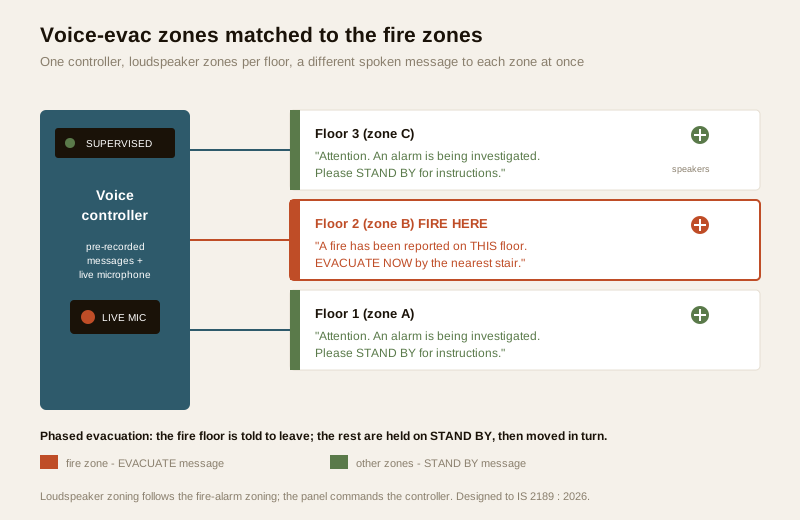
The core of the system is a voice-alarm controller that stores the pre-recorded messages, routes them to the correct loudspeaker zones, and is triggered and supervised by the building's fire-alarm panel. Around it sit the amplifiers that power the loudspeakers, the loudspeaker lines running to every occupied space, a live microphone (usually in the fire control room or at the security desk) so a trained person can make direct announcements, and a standby battery so the whole thing keeps working through a power cut. Every part of it is monitored: the controller watches its own amplifiers and each loudspeaker line, and reports a fault if any of them fails, exactly as the fire-alarm panel supervises its detection circuits.
Why a spoken message beats a tone
The case for voice is not about sophistication; it is about human behaviour under stress. Decades of evacuation research and hard experience from real fires point to the same finding: when people hear an alarm tone, most do not immediately leave. They stop, they look around, they ask each other what it means, they wait to see if anyone else moves, they assume it is a test or a false alarm - and all of that is time burning while smoke spreads. The technical name is pre-movement time, and it is the single biggest variable in whether a large building empties safely.
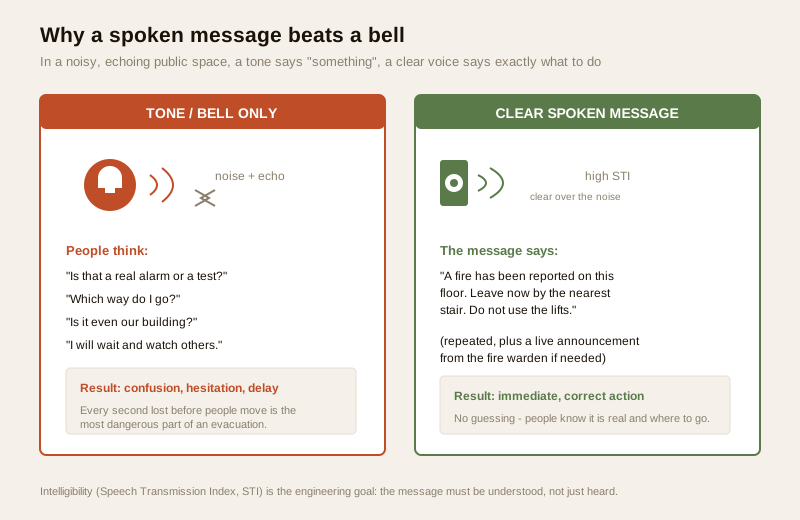
A clear voice cuts straight through that hesitation. A message that says "A fire has been reported on this floor. Please leave now by the nearest staircase. Do not use the lifts" removes every ambiguity that a tone leaves open. People know it is real, they know it applies to them, and they know which way to go. A live announcement from a warden - "This is building security, the fire is on level two, everyone on levels two and three please move down the west stairs now" - is more powerful still, because a calm human voice giving specific directions is what actually moves a crowd.
| A tone or bell alone | A clear spoken message |
|---|---|
| Signals only that "something" is wrong | States what has happened and what to do |
| Ambiguous - people assume test or false alarm | Unambiguous - people know it is real |
| Gives no direction - which exit, which way | Directs people to the correct escape route |
| Same signal everywhere - no phasing possible | Different message per zone - supports phasing |
| Long pre-movement time, milling, delay | Short pre-movement time, immediate action |
| No way to update people as the situation changes | Live microphone lets wardens direct and reassure |
Phased evacuation and defend-in-place
The second reason large buildings need voice is that in many of them you cannot, and should not, tell everyone to leave at once. Empty a forty-storey tower or a full hospital simultaneously and you get dangerously overloaded stairs, and in a hospital you get critically ill patients being moved who should not be. The strategy for such buildings is phased evacuation (move the floors nearest the fire first, hold the rest until it is their turn) or defend-in-place / progressive horizontal evacuation (move people sideways to a safe compartment on the same floor rather than out of the building). Both strategies are impossible with a single bell that says the same thing everywhere.
A voice system makes them work, because it can send a different message to each loudspeaker zone at the same instant. The fire floor and the floor above hear an EVACUATE message; the other floors hear a STAND BY message - "an alarm is being investigated, please stand by for instructions" - which keeps them calm and in place without leaving them ignorant. As the situation develops, the control room escalates zones from stand-by to evacuate in the correct order. This is why the loudspeaker zoning must match the fire-alarm zoning and the building's fire-compartment layout, and why the high-rise and hospital settings, where these strategies are load-bearing, almost always need a voice system rather than plain sounders.
| Building / setting | Why a bell is not enough | Typical voice strategy |
|---|---|---|
| Shopping mall, large retail | Huge open volumes, crowds, background noise, unfamiliar public | Zoned evacuate messages, live warden override, staged crowd control |
| Hotel | Sleeping, unfamiliar guests, many languages, tall floors | Phased floor-by-floor evacuation, clear multilingual messages |
| Hospital | Non-ambulant patients cannot simply run out | Defend-in-place, progressive horizontal evacuation by ward |
| Airport / transport terminal | Enormous reverberant spaces, dense crowds, many languages | High-intelligibility zoned messaging, live announcements |
| High-rise office / residential | Cannot empty all floors at once; long travel distances | Phased evacuation, fire-floor-first, stand-by for others |
| Large single-occupancy office | Big floor plates, background noise, staff spread out | Zoned voice with directed exit instructions |
Intelligibility - the message must be understood, not just heard
Here is the engineering catch that decides whether a voice system is worth anything: a spoken message only helps if people can actually make out the words. A loudspeaker that is plenty loud but produces a muddy, echoing blare in a hard, reverberant atrium is no better than a bell - arguably worse, because it wastes the seconds people spend trying to decode it. The property that matters is speech intelligibility, and it is measured on a scale called the Speech Transmission Index (STI): the higher the STI in a space, the more of the message a listener understands.
Intelligibility is fought for at design time, not fixed afterwards. It depends on the loudspeaker layout (enough speakers, correctly spaced and aimed so coverage is even and no listener is too far from one), on the acoustics of the space (hard, echoing halls scatter speech and must be tackled with more, closer, better-directed speakers), and on the system having enough clean output to sit clearly above the ambient noise without distorting. In a difficult space - a marble hotel lobby, an airport concourse, a mall atrium - achieving a good STI takes real acoustic design and, often, verification by measurement after installation. This is precisely the sort of engineering that gets quietly dropped when a project is value-engineered, and it is precisely the part you must not let go.
| What drives intelligibility | Get it right by |
|---|---|
| Loudspeaker coverage and spacing | Enough speakers, evenly placed and aimed so no listener is far from one |
| Room acoustics and reverberation | Design for the hard, echoing spaces; more, closer, directional speakers |
| Level above background noise | Clean output that sits clearly over ambient noise without distortion |
| System bandwidth and clarity | Fire-rated loudspeakers and amplifiers chosen for speech, not just volume |
| Verified performance | Intelligibility checked, ideally measured, in the difficult spaces after install |
Studio Matrx cites IS 2189 : 2026 for the selection and installation of the fire detection and alarm system that a voice system integrates with, and the National Building Code via SP 7 : 2026, Part 4 for where voice alarm is required by occupancy and size. For the detailed acoustic intelligibility criteria and the voice-alarm component specifications, the applicable BIS / IEC / EN voice-alarm and intelligibility standard governs - verify the current applicable standard and its acceptance criteria with your fire consultant rather than relying on a remembered number.
Integration, monitoring and standby power
A voice evacuation system is not a stand-alone gadget bolted on beside the fire alarm; it is an extension of the fire-alarm system, and it must be built to the same discipline. Three engineering requirements separate a real system from a decorative one, and all three are the first casualties of a cheap or neglected installation.
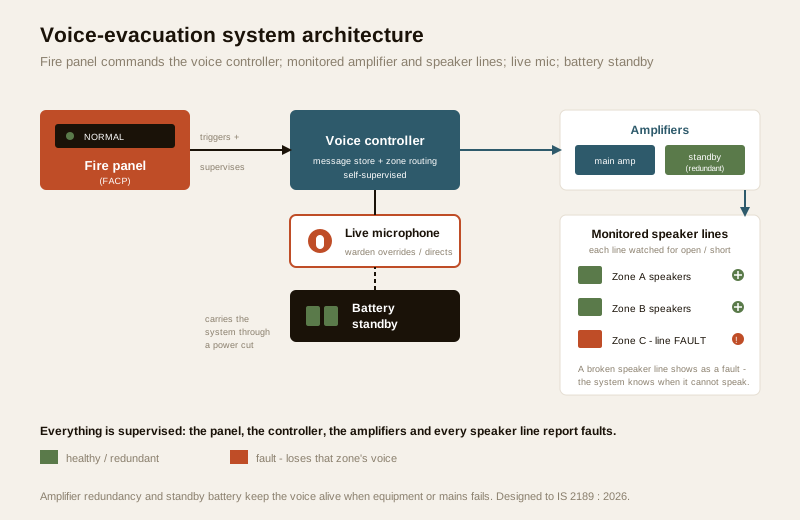
Integration with and supervision by the fire panel. The voice controller is triggered by the fire-alarm panel through the cause-and-effect programming: when the panel confirms fire in a zone, it commands the controller to play the correct messages to the correct loudspeaker zones. The two systems supervise each other, so a failure in one is seen by the other. A voice system that is not properly interfaced with the panel is not a fire system at all - it is a public-address system that happens to be in the building.
Amplifier and loudspeaker-line monitoring, with redundancy. Every loudspeaker line is electrically monitored so that a broken or short-circuited line shows up as a fault - because a system that has silently lost the speakers on the third floor, and does not know it, will fail exactly when that floor needs to hear the message. Amplifiers are commonly arranged with a standby amplifier that automatically takes over if a main amplifier fails, so a single amplifier fault does not silence a zone. This is the audio equivalent of the standby battery on the panel: the system is engineered to keep speaking even when a component dies.
Battery standby. Like the fire-alarm panel, the whole voice system must run through a mains failure on its own standby batteries - and in India, where power cuts and fires so often arrive together, this is not a nicety. A voice system that goes dark the moment the grid drops is useless in exactly the scenario an electrical fire creates. The batteries must carry the system in its monitored state and still have the reserve to drive a full voice evacuation, and they age and must be replaced on schedule under the maintenance contract, just as covered in the fire-alarm maintenance guide.
The honest India reality
Here is what too often happens in practice. A large building is designed with a proper voice evacuation system on the drawings, the Fire NOC assumes it, and then the budget tightens. The voice system is one of the most expensive line items in the fire package, and it is invisible when it is working, so it becomes a target: the loudspeaker count is thinned, the intelligibility design is skipped, the amplifier redundancy is dropped, or the whole thing is swapped for plain sounders with a note that voice will be "added later." It rarely is. In other buildings a real system is installed to get the NOC and then abandoned - dead standby batteries, amplifier faults nobody clears, loudspeaker lines cut during a renovation and never restored, messages never tested, staff who have never once heard it and would not know how to use the live microphone.
None of this shows until the day it matters, and on that day the building has a public-address system that cannot be heard, or cannot be understood, or cannot power itself through the power cut the fire caused. The discipline that prevents it is the same discipline the whole fire-safety library argues for: specify the system properly and refuse to value-engineer the intelligibility and redundancy out of it; keep it under an AMC with real periodic testing; train the staff who will use the microphone; and treat every amplifier, line or battery fault as the emergency it is. Use the fire-alarm system selector to think through the alarm architecture for your building, and tie the voice system into the building's evacuation plan through the emergency-preparedness guidance and the wider emergency-communication systems guide. Owners and managers of large premises will also find the compliance framing in the office, hotel, hospital and high-rise fire-safety guides and the commercial-building security guide.
When the law requires a professional - and why you never leave it disabled or unmaintained. A voice evacuation system is a statutory life-safety installation. Its design, the intelligibility engineering, the interface with the fire-alarm panel, the commissioning and the certification are all qualified professional tasks - carried out by a licensed fire contractor to IS 2189 : 2026 and the National Building Code (SP 7 : 2026, Part 4), tied to the Fire NOC under the State Fire Services Act and Rules. The owner's and manager's job is different and non-negotiable: specify a proper system and defend it against value-engineering, keep it under a genuine maintenance contract, test it (informing occupants and using test mode so you do not cry wolf), train staff on the live microphone, and never leave amplifiers, speaker lines or batteries in an unfixed fault. A voice system that has been silently disabled or left to rot is the most dangerous kind, because the building believes it is protected.
Key takeaways
- In large and public buildings a bell is not enough - a voice evacuation system (PAVA / EVAC) replaces the tone with clear spoken instructions plus a live microphone, telling people exactly what has happened and what to do, which is what actually moves a crowd and cuts the deadly pre-movement delay.
- Voice makes phased evacuation and defend-in-place possible - different loudspeaker zones can hear different messages at once (evacuate this floor, stand by on the others), which is essential in high-rises, hospitals, hotels, malls and airports where you cannot empty everyone at once.
- Intelligibility is the whole point - the message must be understood, not merely heard; that takes real loudspeaker coverage and acoustic design (Speech Transmission Index, STI), and it is the first thing lost when a system is value-engineered.
- It must be integrated, monitored and battery-backed - triggered and supervised by the fire panel, with monitored loudspeaker lines and amplifier redundancy, and standby batteries so it keeps speaking through the power cut a fire so often causes.
- In India these systems are too often value-engineered out or left unmaintained - specify properly, refuse to drop the intelligibility and redundancy, keep it under an AMC with real testing, train staff, and route all design, commissioning and maintenance to a licensed fire contractor to IS 2189 : 2026 and the Fire NOC.
References
- IS 2189 : 2026, Bureau of Indian Standards - Selection, Installation and Maintenance of Automatic Fire Detection and Alarm System, Code of Practice. The core code governing the fire detection and alarm system that a voice evacuation system integrates with and is triggered by, including zoning, supervision and battery standby. Verify the current edition via the BIS catalogue: https://www.services.bis.gov.in/
- National Building Code of India, SP 7 : 2026 (the NBC), Part 4 "Fire and Life Safety" - the framework requiring automatic fire detection and alarm, and public-address / voice-alarm evacuation provisions, in buildings by occupancy, size and height; the older SP 7 : 2016 edition is withdrawn but still widely quoted. Verify the current edition via the BIS catalogue: https://www.services.bis.gov.in/
- The applicable BIS / IEC / EN voice-alarm and speech-intelligibility standard for public-address and voice-alarm (PAVA / EVAC) system components and their intelligibility acceptance criteria - verify the current applicable standard and its criteria with your fire consultant; the relevant State Fire Services Act and Rules and the Model Building Bye-Laws (MoHUA) set when a certified voice-alarm system is legally required for a given premises.
- Manufacturer datasheets and installation manuals for the specific voice-alarm controller, amplifiers, loudspeakers and batteries installed - the authority for the system's ratings, monitoring behaviour, message programming and battery-standby autonomy; always follow the equipment's own documentation and the commissioning contractor's records.
This is an educational overview, not legal advice, and not a substitute for a licensed fire-safety consultant or fire-alarm contractor. A voice evacuation system, its intelligibility design, its interface with the fire-alarm panel, the Fire NOC and any statutory installation or maintenance are qualified professional tasks - engage licensed fire professionals and the State Fire Services, and verify any standard's current status via the BIS catalogue before relying on it.
Export this guide
Related Guides — Deep-dive reading
High-Rise Fire Safety Requirements in India (2026): Why Height Changes Everything
As a building gets tall, a whole layer of fire and life-safety systems stops being optional and becomes the reason the building is legal to occupy. A plain-language guide for professionals to what generally kicks in with height, why, and who to verify it with.
SecurityFire Alarm Zoning in India (2026): Detection Zones, Search Limits & Phased Evacuation
How dividing a building into detection zones lets responders find the fire fast, drives phased evacuation and cause-and-effect - the IS 2189:2026 principles every owner and committee should understand.
SecurityHow to Choose a Fire Alarm in India (2026): A Life-Safety, Code-Governed Buying Guide
A fire alarm is not shopped on price or looks. It is specified to the National Building Code and the local fire officer, built from listed and certified parts, and installed by a licensed contractor. This guide shows a homeowner, manager or architect how to choose and verify one correctly.
SecurityRelated Tools — Try Free
Acoustic Privacy (STC) Visualizer
Indian healthcare acoustic visualizer — compare wall assemblies and noise sources, see received SPL after STC attenuation, and check FGI 2018 / IS 1950 / NABH speech-privacy compliance with live dual-canvas waveform.
Acoustic ToolBefore vs After — Cost Reality Check
Compare what you expected to pay vs what you actually paid, category by category.
Reality CheckCircadian Light Meter
Patient-centric circadian lighting visualizer for Indian healthcare design — time-of-day × intensity → CCT, melanopic lux (EML / mEDI), melatonin suppression, and an alertness curve. Calibrated against WELL v2 L03 Circadian Lighting Design, CIE S 026:2018, Brainard 2001, and Lucas et al. 2014.
Circadian Tool