
 Lesson 0.1
Lesson 0.1 · Foundations: From Sustainable to Regenerative
What Regenerative Architecture Is
Sustainability asks a building to do less harm. Regenerative design asks it to do active good - to give back more than it takes
A sustainable building takes less from the world. A regenerative one leaves the world better than it found it.
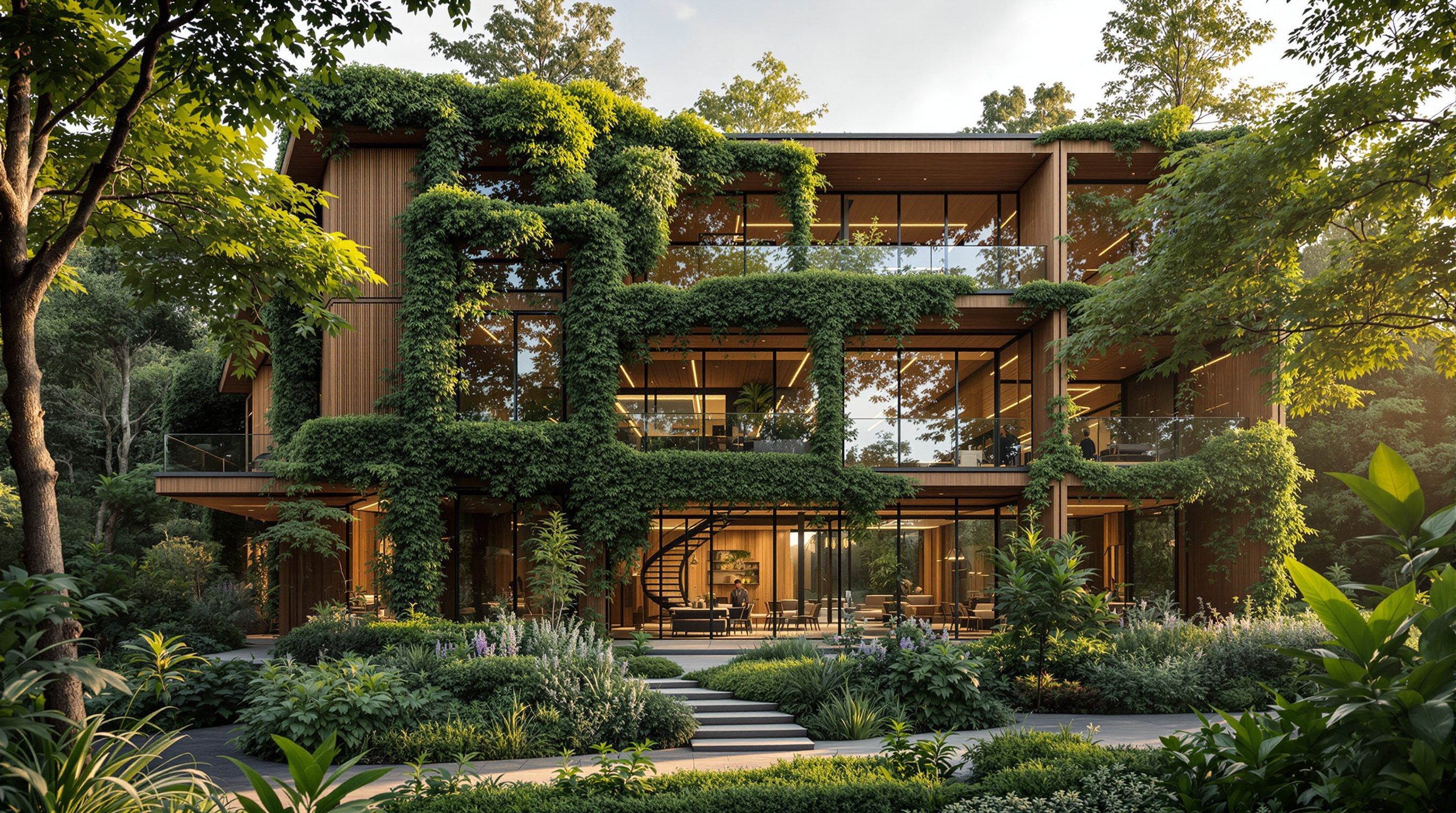
For thirty years, 'sustainable' has meant a building that does less damage - less energy, less water, less waste, a smaller footprint. That was a vital first step, and most of the world has not even taken it. But less-bad is still bad; a building that halves its harm is still, every year, a net drain on a planet already in overshoot. Regenerative architecture sets a different goal: not neutral, but net-positive - a building that gives back more than it takes.
That sounds utopian until you see it built. A regenerative building can generate more clean energy than it uses, harvest and clean more water than it consumes, sequester more carbon than its construction emitted, and turn a barren site into habitat that supports more life than was there before. It treats the building not as a machine that minimises damage, but as a living part of its place that actively heals it. This course is about that whole trajectory - from the efficiency basics every project needs, through net-zero, to genuinely regenerative design - and this first lesson sets the mindset it all rests on.
Sustainable = neutral (less harm). Regenerative = net-positive (give back). Whole system, not a checklist.
The spectrum: degenerative, sustainable, regenerative
It helps to see design as a spectrum of impact. At one end is the conventional building - what we mostly still build: it depletes. It burns fossil energy, embeds high-carbon materials, sends water to drains and waste to landfill, and replaces living ground with sealed surface. Call it degenerative: it leaves its place poorer. Move along and you reach the efficient building, which does the same things but less wastefully - the domain of most 'green' work today. Further still is the net-zero building, which balances its books: it produces as much energy (or sequesters as much carbon) as it uses over a year. That is genuine sustainability - a neutral footprint.
Regenerative design goes past neutral into net-positive: the building becomes a source, not just a non-drain. It exports clean energy to its neighbours, returns cleaner water than it drew, supports pollinators and birds, and improves the health of the people inside and the soil outside. The crucial shift is one of ambition: sustainability asks 'how do we stop making things worse?'; regenerative design asks 'how do we make things better?'. Most real projects live somewhere on this spectrum and move rightward over time - and knowing where a project sits, and what the next step right would cost, is a core skill this course builds.
Degenerative -> efficient -> net-zero (neutral) -> regenerative (net-positive). Aim right.
Why buildings, and why now
This is not a niche concern - it is one of the largest levers humanity has. The built environment is responsible for roughly 37-40% of global energy-related carbon emissions: about 27% from operating buildings (heating, cooling, lighting, plug loads) and another ~10% from the materials and construction themselves - the embodied carbon locked into concrete, steel and aluminium the moment a building goes up. Buildings consume a huge share of the world's raw materials and freshwater, and construction and demolition generate a third or more of all waste in many countries. When you design a building, you are making one of the most consequential environmental decisions in the economy.
And the timing is not optional. Climate targets require the sector to roughly halve emissions this decade and reach net-zero around mid-century, while a warming, resource-stressed, biodiversity-poor world raises the stakes every year. India makes the point vividly: most of the building stock that will exist in 2050 is yet to be built, so the choices made now lock in decades of emissions - or of regeneration. That combination - enormous impact plus a closing window - is why sustainability has moved from a specialism to a baseline expectation, and why regenerative thinking is the direction the whole field is heading.
What a regenerative building actually does
Concretely, regenerative design works across several linked flows, each of which this course takes a module or more to develop. Energy: slash demand through passive and bioclimatic design, then meet what remains with on-site renewables until the building is net-zero or net-positive (Modules 1-2). Carbon: count and cut both operational and embodied carbon across the whole life-cycle, and choose materials that store carbon rather than emit it (Modules 3-4). Materials: build with less, with bio-based and low-impact materials, in a circular way that designs out waste and lets components be reused (Module 4). Water and land: capture, clean and reuse water, and turn the site into living, biodiverse landscape (Module 5). People: make interiors healthy, comfortable and biophilic, because a building that harms its occupants is not sustainable in any real sense (Module 6).
What makes it regenerative rather than just efficient is that these flows are pushed past neutral and, crucially, treated as one connected system. A regenerative project does not optimise energy in isolation; it asks how the roof can both generate power and harvest water, how the landscape can cool the building and host wildlife, how a material can be low-carbon and healthy and reusable at once. That whole-systems, net-positive ambition - and the honest measurement (Modules 3 and 7) that keeps it from being wishful - is the thread running through every module.
Energy+, water+, carbon-, biodiversity+, health+ - and all ONE connected system.
What this course will teach you - and what it won't
This is a design-led, principle-first course. Over eleven modules you will build the strategy of sustainable and regenerative design: passive and bioclimatic design (Module 1); energy and net-zero (2); carbon and life-cycle (3); materials and circularity (4); water, land and biodiversity (5); health, comfort and wellbeing (6); green-building certifications - LEED, BREEAM, GRIHA, IGBC, WELL, Passivhaus (7); regenerative design in practice and the Living Building Challenge (8); retrofit, reuse and the existing stock (9); and sustainable practice, the business case, avoiding greenwashing and career (10).
A note on scope, so you take the right course: this one is about the strategy and design of sustainability - the principles, choices and frameworks. Two sibling courses go deeper on adjacent ground: Building Performance Simulation teaches the software that predicts energy, daylight and comfort in numbers, and Climate-Responsive Design dives into bioclimatic detail. This course tells you what to aim for and why; reach for those when you need the how of precise modelling. Like every course in this Academy, it rewards judgement over slogans - the ability to tell a genuinely regenerative move from a green-painted one is exactly what the field, and the planet, now need.
Regenerative design
Design that is net-positive - gives back more than it takes
The horizon of this course: buildings that heal their place, not just harm it less. Developed fully in Module 8.
Net-zero
A balanced footprint over a year (energy or carbon)
Genuine sustainability - neutral, not positive. The stepping stone to regenerative. Module 2 (energy), Module 3 (carbon).
Embodied vs operational carbon
Carbon in materials/construction vs in running the building
~10% vs ~27% of global energy emissions; embodied carbon is locked in on day one and increasingly dominant. Module 3.
Whole-systems / integrated design
Treating energy, water, carbon, materials and people as one system
What makes design regenerative rather than a checklist of features. Module 0.4 and throughout.
Workshop — place a building on the spectrum
You need no software - just a building you can observe and an honest eye. The first skill is diagnosing where a real building sits on the degenerative-to-regenerative spectrum, because you cannot push a project rightward until you can see where it stands.
None - just a building and a notebook. (Later modules touch real frameworks and tools - LCA, ECBC/Eco Niwas Samhita, GRIHA/LEED, the Living Building Challenge - but the systems eye comes first.)
Goal: build the diagnostic eye the whole course sharpens
Inputs: a building you know well (home, campus, office) + a notebook
Time: ~25 minutes
- 1Pick a building you use. For each flow, note honestly what it does today - Energy: fossil or renewable, wasteful or efficient? Carbon: high-carbon materials (lots of concrete/steel)? Water: harvested and reused, or straight to drain? Materials/waste: built to last and be reused, or to be demolished? Land/biodiversity: sealed surface or living landscape? People: healthy, daylit, comfortable?
- 2For each flow, place it on the spectrum: degenerative, efficient, net-zero, or regenerative. Most everyday buildings will be degenerative-to-efficient on most flows - that is the honest starting point.
- 3Find the single flow where this building is worst, and imagine one realistic move that would shift it one step rightward (e.g. rooftop solar, rainwater harvesting, a low-carbon material swap, native planting).
- 4Now imagine the regenerative version: what would this building do if it gave back on that flow - exported energy, returned clean water, hosted wildlife? Note what would have to change.
- 5Keep the notes. As each module adds depth - energy, carbon, materials, water, health, certification, regeneration - come back and sharpen your diagnosis and your proposed moves.
You’ll walk away with
A one-page diagnosis of one real building: each flow (energy, carbon, water, materials, land, people) placed on the spectrum, its worst flow identified with one realistic step-right move, and a sketch of what its regenerative version would give back.
Three altitudes on the same idea
Read the band that fits you — or all three.
For you, this is fast becoming the core of the job, not an add-on. Clients, planning regimes and financiers increasingly demand carbon and energy performance, and the architect who leads on it - setting the ambition early, running an integrated process, defending the low-carbon choice - is the one who stays relevant and wins the interesting work. The biggest sustainability decisions (form, orientation, structure, materials) are architectural decisions, made early, by you.
Interiors carry a large, often-ignored share of a building's impact - and its health. Fit-outs are replaced every few years, so their embodied carbon and waste add up fast, and the materials you specify are the ones occupants breathe and touch. Low-carbon, circular, healthy material selection, biophilic design, and daylight and comfort are squarely your territory, and increasingly what discerning clients ask for by name.
Sustainability fluency is now a baseline expectation of a design graduate, and deep regenerative skill is a genuine advantage. Practices are hiring for carbon literacy, certification know-how and low-impact design, and the students who can speak this language credibly stand out immediately. You are also the generation who will practise entirely inside the climate transition - learning this now is not a specialism, it is preparation for the whole of your career.
“Sustainable and regenerative design mean the same thing - just being 'green'.”
Do it yourself
No tools needed - reason it through.
- 1In one sentence, how does regenerative design differ from sustainability?
- 2Name the four points on the impact spectrum, from worst to best.
- 3Roughly what share of global energy-related carbon emissions comes from buildings, and how does it split between operational and embodied?
- 4Name three flows a regenerative building pushes past neutral into net-positive.
- 5Why does 'green' need to be treated with caution as a term?
The one line to carry out
Peer-reviewed journals & authoritative standards
- 01Sustainable architecture — Wikipedia, 2026.
- 02Regenerative design — Wikipedia, 2026.
- 03Zero-energy building — Wikipedia, 2026.
We have set the ambition. Next we look hard at the why - the climate and ecological imperative in numbers - so the urgency behind every strategy in this course is concrete, not abstract.
The author
Amogh N P
Architect, interior designer, and creative polymath. Studio Matrx began in his notebooks — his vision of design made honest, useful, and open to everyone. Its Academy is written and taught in his memory, and free, forever.
More about Amogh →