
 Lesson 2.2
Lesson 2.2 · Statics & Structural Behaviour
Tension, Compression, Shear & Bending
Four internal actions explain every structure ever built - learn to see them, and you can read the forces flowing through any building at a glance
Every force in every building you have ever seen is one of just four things - and once you can name them, structures stop being a mystery.
Structures look endlessly varied - a suspension bridge, a brick arch, a steel frame, a concrete slab - but the forces inside them are not. Cut into any loaded member and the internal effect resolves into some combination of just four internal actions: tension pulling it apart, compression pushing it together, shear sliding one part past another, and bending curving it. That is the entire alphabet. Master these four and you can read the mechanics of anything.
What makes this so useful to a designer is that different elements and different materials are good at different actions. A cable is brilliant in tension and useless in compression; a masonry arch is the reverse; concrete loves compression but cracks in tension, which is exactly why we thread steel through it. Once you can look at a structure and see which action is flowing where - this member pulling, that one squashing, this beam bending - you understand not just how it works but why it is shaped and made the way it is. This lesson teaches you to see the forces.
Cable pulls, column pushes, beam bends, bolt shears. Name the action, and the material chooses itself.
The four internal actions
When a load is applied to a member, the material inside responds with internal forces that hold it together, and those forces always sort themselves into four fundamental types. Tension is a pulling-apart action: the fibres of the material are stretched, and every part is trying to move away from its neighbour. A tow rope, a suspension cable and the lower fibres of a loaded beam are all in tension. Compression is the opposite - a pushing-together, squashing action: the fibres are crushed toward each other. A column under a roof, the stone in an arch, and the upper fibres of a loaded beam are all in compression.
Shear is a sliding action: two adjacent layers of material try to slide past one another, like the blades of a pair of scissors (the origin of the name). You feel shear wherever a load tries to cut a member across its length - at the supports of a beam, in a bolt holding two plates together, at the junction where a bracket meets a wall. Bending is the action that curves a member: it is not really a fifth independent thing but a clever combination - when you bend a beam, one face goes into tension and the opposite face into compression, with a neutral surface in between that does neither. A fifth action, torsion (twisting), appears when a load tries to spin a member about its own axis, but for reading most everyday structures the first four carry the story.
The reason this taxonomy is so powerful is that it is complete and it is universal. There is no secret sixth thing happening inside a mysterious high-tech structure; there is only tension, compression, shear, bending and torsion, mixed in different proportions. Learn to recognise them and every structure becomes legible.
Pull apart, push together, slide across, curve over. Four actions - that is the whole alphabet.
Axial actions: the pure, efficient forces
Tension and compression are together called axial actions because the force runs straight along the member's axis, and they are the most efficient way a structure can carry load. In a pure tension or compression member, every fibre of the cross-section is working equally hard - the stress is spread uniformly across the whole area, so no material is wasted. This is why the most efficient structures ever built - suspension bridges, cable nets, geodesic domes, trusses - are made almost entirely of members in pure tension or compression, and why they can span so far with so little material.
Tension is the simpler and, in one sense, the ideal action: a member in pure tension cannot buckle, so its strength is limited only by the material and the size of its cross-section. A thin steel cable a few centimetres across can hold up an entire bridge deck. Compression is trickier, because a compression member has a second enemy besides crushing: buckling. A long, slender element in compression can suddenly bow sideways and fail at a load far below its crushing strength - which is why a column, unlike a cable, needs bulk and stiffness, not just strength. A steel cable can be whisker-thin, but the steel column carrying the same force must be far chunkier to resist buckling. This asymmetry - tension is limited by strength, compression by buckling - explains an enormous amount about why structures look the way they do.
The truss is the beautiful expression of this principle. A truss carries load across a span using only triangulated members in pure tension and compression, avoiding bending almost entirely - which is exactly why a lightweight steel roof truss can span a stadium while a solid beam of the same weight could not. Reading a truss is a wonderful exercise: under a downward load the bottom chord is usually in tension, the top chord in compression, and the diagonals alternate - and you can often reason it out by eye before touching a calculation.
Bending and shear: the actions in every beam
The moment you lay a member horizontally and load it across its length - which describes nearly every beam, slab, lintel and floor in a building - you invoke bending and shear together, and these are the demanding, material-hungry actions. Bending is what happens to a beam under a load: it sags, and in sagging its top surface is squashed into compression while its bottom surface is stretched into tension, with a neutral axis in the middle where the fibres are neither. The further from the neutral axis, the harder the fibres work - which is the single most important fact about beams, and the reason for their entire shape, as the next lesson explores.
Bending is far less efficient than pure axial action because the material near the neutral axis is barely working - it is along for the ride. That inefficiency is precisely why beams must be deep and why clever beam cross-sections, like the steel I-beam, pull most of the material to the top and bottom (the flanges) where the bending stresses are largest, leaving only a thin web in the middle. It is also why, wherever an architect can convert bending into pure tension or compression - by using a cable, an arch or a truss instead of a beam - the structure gets dramatically lighter.
Shear accompanies bending and peaks where bending is smallest: near the supports. Think of a diving board - it is trying to snap off right at the fixed end, and that snapping is shear. In a concrete beam, shear failure is sudden and brittle and therefore feared; it is resisted by the vertical steel stirrups you see wrapped around a beam's reinforcement. So a loaded beam is simultaneously bending (worst at mid-span) and shearing (worst at the ends), and a competent beam must be designed for both. Recognising that a horizontal spanning member is always fighting this two-front battle is the heart of reading everyday structures.
Materials have preferences - match action to material
The deepest practical idea in this whole lesson is that different materials are good at different actions, and great structural design matches the material to the action it must carry. Get this pairing right and the structure is efficient, economical and honest; get it wrong and you are fighting the material.
Steel is the all-rounder: it is superb in tension and compression, roughly equally strong in both, which is why it makes such versatile beams, columns, cables and frames. Concrete is strong in compression but weak and unreliable in tension - it will happily carry a crushing load but cracks under a modest pull, at perhaps a tenth of its compressive strength. This single fact is the reason for reinforced concrete: we cast steel bars into the concrete precisely where the tension will occur - along the bottom of a beam, up the sides of a column facing bending - so the concrete takes the compression it loves and the steel takes the tension the concrete cannot. Codes such as IS 456 are built entirely around this division of labour. Masonry and stone are like concrete without the steel: strong in compression, feeble in tension - which is exactly why traditional masonry structures are arches, vaults and domes, forms that keep the material in pure compression and never ask it to bend or stretch. Timber is good in both tension and compression along the grain, but weak across it, and needs care in shear at connections.
Once you carry this table in your head, structures explain themselves. Why is a cable never a strut? Because it can only pull. Why is a Gothic cathedral all arches and flying buttresses? Because stone can only push, so every load must be steered into compression and down to the ground. Why does a concrete beam have steel along its bottom? Because that is where it would otherwise crack in tension. The four actions and the materials' preferences, read together, unlock the logic of built form across the whole history of architecture.
Reading a structure by its forces
Put it all together and you have a genuine superpower: the ability to look at a structure and read the forces flowing through it, member by member, before any analysis. This is what experienced designers and engineers do instinctively, and it is a learnable skill, not a gift.
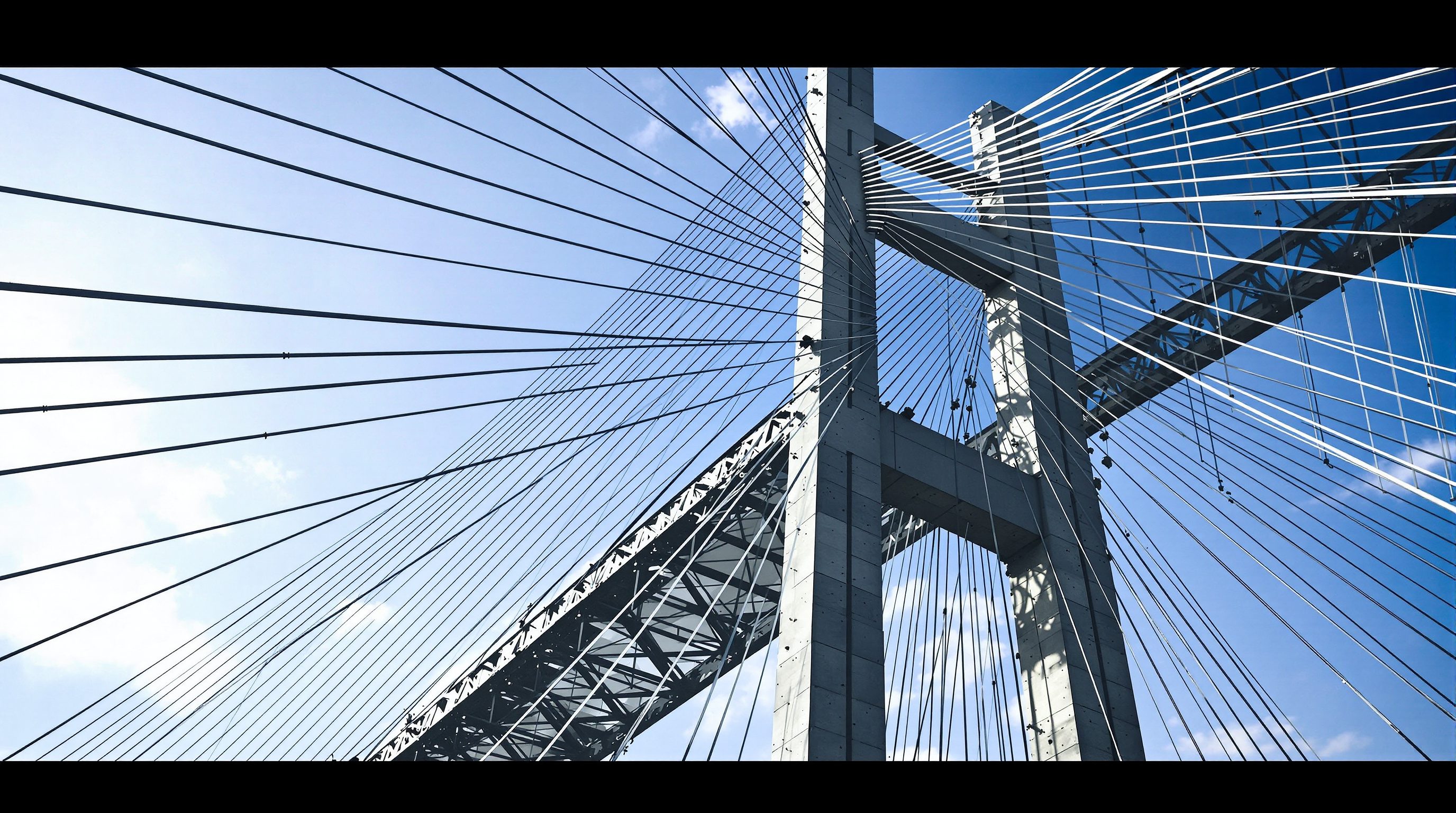
The method is simple. Start where the load enters - a floor, a roof, a person - and follow it. Ask of each element: is this being pulled, pushed, sheared or bent? A hanging tie rod: tension. A column or a wall pier: compression. A horizontal beam or slab spanning between supports: bending, with shear at its ends. An arch or a dome: compression, steered along its curve. A cable-stayed roof: tension in the cables, compression in the mast. A cantilever: bending, with the top surface in tension (the reverse of a simple beam - a crucial thing to get right). As you name each action, the reason for the member's material and shape becomes obvious, and any mismatch - a slender member asked to carry compression, a brittle material asked to take tension - jumps out as a warning.
This reading is also how you catch danger in an existing building. A crack that opens on the underside of a beam is a tension crack telling you where the beam is bending; a diagonal crack near a support is a shear crack; a vertical crack down a column may be a compression or buckling warning. The forces leave signatures, and a designer who can read the four actions can read those signatures too. That is the payoff of this lesson: not to calculate the forces - the next lessons and your engineer do that - but to see them, so that every structural decision you make is made with your eyes open.
Internal actions (axial, shear, bending, torsion)
The complete set of internal force effects in any member
Every loaded member carries some mix of these; naming them is the basis of all structural reading.
IS 456 : 2000
Plain and reinforced concrete - code of practice (India)
Built around concrete's strength in compression and weakness in tension; places steel in the tension zone.
IS 800 : 2007
General construction in steel (India)
Steel serves tension, compression and bending; the code treats buckling as the key limit for compression members.
IS 883 : 2016
Design of structural timber in buildings (India)
Timber is strong along the grain in tension and compression but weak across it and in shear at joints.
Workshop - map the four actions across a real structure
The skill here is reading forces by eye. This exercise trains it on a structure you can actually see, member by member, with nothing but observation and a sketch.
Paper, pencil, and a structure you can observe. A camera helps for capturing details to sketch later.
Goal: label every major element of a real structure with its internal action
Inputs: a visible structure (a footbridge, a shed frame, a canopy, a truss roof) + a sketch of it
Time: ~35 minutes
- 1Choose a structure whose members you can actually see - a steel footbridge, a market canopy, a warehouse truss, a balcony. Sketch it simply as a line diagram.
- 2Trace the load path from where load enters (deck, roof, people) down to the ground, following it element by element with your finger.
- 3Label each member with its dominant internal action: T for tension, C for compression, B for bending (with shear at its ends), A for arch/compression-steered. For a truss, work out the top chord, bottom chord and diagonals.
- 4For each member, name its material and check the match: is a tension member something that can pull (a cable, a steel rod), a compression member something stout enough not to buckle, a bending member deep enough? Flag any mismatch.
- 5Write one paragraph explaining why the structure is shaped and made the way it is, in terms of the actions - for example why the designer used an arch, a truss or a cable instead of a plain beam.
You’ll walk away with
A labelled line diagram of one real structure with every major member marked T, C, B or A, its material noted, and a short written explanation of the structure's logic in terms of the four actions.
Three altitudes on the same idea
Read the band that fits you — or all three.
Matching action to material is where structure becomes design. When you choose an arch, a cable, a truss or a beam, you are choosing which of the four actions will carry the load - and therefore the material, the slenderness and the whole visual character of the structure. The most memorable buildings are usually the ones that express this honestly: tension shown as tension, compression as compression. Learn to see the actions and you can shape structure as an architectural idea, not hide it behind cladding.
Reading the four actions tells you what a member is doing and therefore what you may do to it. A column is in compression carrying everything above - never notch or weaken it. A beam bends, so its bottom is in tension: drilling holes low down or cutting its depth is dangerous, while services can often pass near its mid-height neutral axis. A brick arch over an opening is in pure compression and must not be pierced at its crown. Knowing the action turns 'is this safe to touch?' into a question you can reason about.
This is the mental model that makes the rest of structures intuitive. Drill the four actions until naming them is automatic, then practise reading real structures on your commute: that is a tie, that is a strut, that beam is bending. Learn which material loves which action - steel both, concrete compression, masonry compression, timber along the grain - and you will understand why reinforced concrete has steel where it does and why old buildings are all arches. Reviewers can always tell who reads forces and who only draws shapes.
“Concrete is a strong material, so a plain concrete beam should be perfectly fine on its own.”
Do it yourself
Reason it through - no calculation needed.
- 1Name the four main internal actions and give one everyday example of each.
- 2Why can a cable carry huge tension but no compression at all?
- 3In a simply supported beam under load, which surface is in tension and which in compression?
- 4Why is concrete reinforced with steel, and where in a beam do the steel bars go?
- 5Explain why a masonry cathedral is built from arches and vaults rather than flat beams.
The one line to carry out
Peer-reviewed journals & authoritative standards
- 01Macdonald, A. - Structure and Architecture — Routledge, 2018.
- 02Schodek & Bechthold - Structures — Pearson, 2013.
- 03Building construction - structural systems — Encyclopaedia Britannica, 2024.
- 04Steel Construction Info — steelconstruction.info, 2024.
We now know that beams work by bending. Next we go deep into bending itself - the bending moment, why depth matters far more than you think, and how deflection and stiffness govern whether a floor merely stands or actually feels solid.
The author
Amogh N P
Architect, interior designer, and creative polymath. Studio Matrx began in his notebooks — his vision of design made honest, useful, and open to everyone. Its Academy is written and taught in his memory, and free, forever.
More about Amogh →