
 Lesson 9.4
Lesson 9.4 · Documenting & Coordinating Structure
Structural Health, Failure & Forensics
A structure talks to you through its cracks, its sags and its stains - and learning to read those signs is the difference between catching trouble early and reading about it in the news
Buildings almost never fail without warning - they fail after a long conversation nobody was listening to.
Structures rarely collapse out of a clear blue sky. In the aftermath of almost every failure, the investigation finds a trail of signs that were there for months or years - cracks that widened, floors that sagged, concrete that spalled and rusted, a lean that grew - all of them the structure telling anyone who could read them that something was wrong. Failure is usually the end of a long conversation, and the tragedy is how often nobody was listening, or nobody knew how.
This final lesson teaches you to listen. Not to become a forensic engineer - that is a deep specialism - but to acquire the literacy that every architect and interior designer should carry: the ability to look at a building and read its state of health, to know which cracks are cosmetic and which are a warning, to recognise the slow diseases of deflection and corrosion, to understand what a structural audit does and why buildings should have them, and to grasp how failures are investigated so that the lessons are learned. This is the payoff of the whole course: everything you have learned about load paths, materials and behaviour now becomes a diagnostic instrument, letting you tell, in a real building, whether the structure is quietly doing its job or quietly asking for help.
Failure is the end of a long conversation nobody was listening to. Learn to listen - the cracks, sags and stains are the structure talking.
Cracks: reading the structure's handwriting
Cracks are the most common and most misread of all structural signs. The first thing to understand is that not all cracks are dangerous - many are cosmetic, the result of shrinkage, thermal movement or plaster drying, and are stable and harmless. The skill is not to panic at every crack but to read each one, and the reading is done with four questions: where is it, which direction does it run, how wide is it, and is it moving? Those four answers between them usually name both the cause and the urgency.
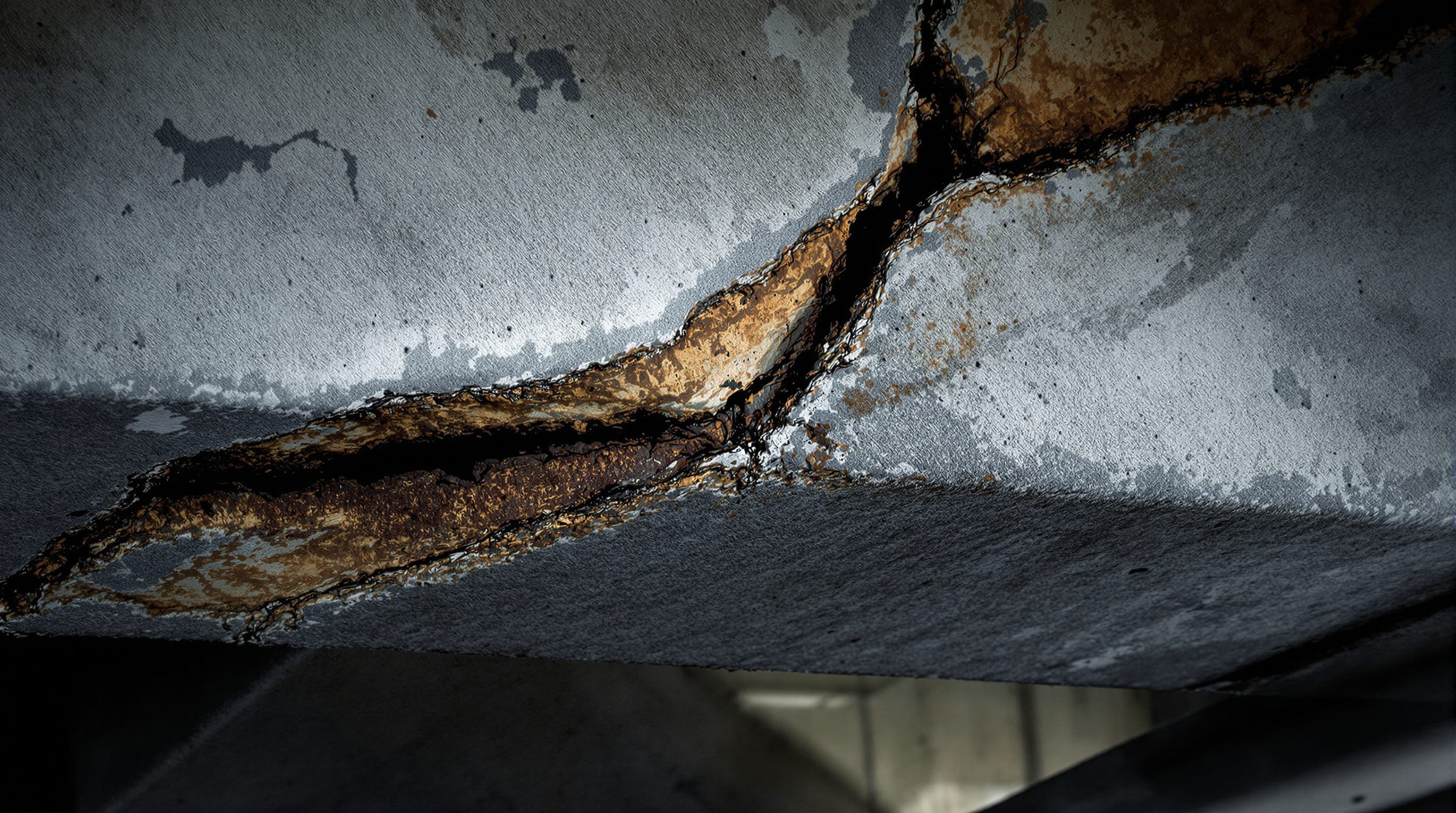
Direction and location name the mechanism. A diagonal crack that widens as it rises, especially near a corner or an opening, is the classic signature of differential settlement - one part of the foundation sinking relative to another, tearing the wall along the line of movement. Fine, regularly spaced vertical cracks are often thermal or shrinkage movement and are frequently benign. A wide crack running through a structural member - across the middle of a beam, at a beam-column junction, or through a slab - is structural distress and demands attention now. A horizontal crack tracking along the line of reinforcement, often with a rust stain, is the fingerprint of corrosion pushing the cover off from inside. Stepped cracks following the mortar joints in masonry usually mean movement rather than crushing.
Width and movement tell you how urgent it is. A hairline crack that has been stable for years is a very different thing from a crack you can fit a coin into, or one that is visibly widening. This is why monitoring matters: telltales (glass or plastic gauges bridging a crack), or simply marking and dating the crack ends and measuring over weeks, reveal whether a crack is dead or alive. A dead crack is a scar; a live, widening crack is an active process that has not finished. As a rule of thumb the alarming combination is wide, diagonal or across a structural element, and moving - that is when you stop interpreting and call an engineer. But even here your value is enormous: an architect who photographs, measures and dates a crack, and notes its pattern, hands the engineer a diagnosis half-made.
Ask any crack four things: where, which way, how wide, is it moving? Pattern names the cause; width and movement name the urgency.
Deflection and the slow diseases
Beyond cracks, structures suffer slower, quieter conditions that an educated eye can catch long before they become dangerous. The most fundamental is deflection - the amount a beam or slab sags under load. Some deflection is entirely normal and designed for; the concern is excessive or increasing deflection, a floor that visibly dips in the middle, a beam that has begun to sag, a roof that ponds water where it should drain. Because concrete creeps - deflecting more over years under sustained load - and because overloading, water damage or deterioration can all reduce stiffness, a floor that was flat can slowly become one that is not. A visibly deflecting structural member is always worth investigating: it may be benign long-term creep, or it may be a member that is being asked to carry more than it safely can.
The great slow disease of reinforced concrete is corrosion of the reinforcement, and it works through a cruel piece of chemistry. Fresh concrete is highly alkaline, and that alkalinity forms a protective film on the steel that stops it rusting. Over time two processes destroy that protection: carbonation, where carbon dioxide from the air slowly neutralises the concrete from the surface inward, and chloride attack, where salts (from sea air, de-icing or contaminated materials) reach the steel. Once the protection is gone the steel rusts - and rust occupies several times the volume of the steel it consumes. That expansion generates enormous internal pressure that cracks and then spalls off the concrete cover, exposing more steel to more moisture, so the decay accelerates in a vicious circle. The visible signs are a sequence: rust staining, then cracking along the bar lines, then spalling that reveals the corroding steel beneath. Adequate cover, good dense concrete and sealing cracks early are the front line of defence, because it is far cheaper to keep water out than to repair a spalled, corroded member.
Other slow diseases follow the same logic of a small breach becoming a large problem: damp and water ingress rotting timber and rusting steel, sulphate attack and other chemical degradation of concrete, fatigue in structures under repeated load, and foundation movement from changing ground conditions. In every case the pattern is the same - a defence is breached, moisture or load exploits it, and a slow process runs until someone intervenes. The educated eye catches these while they are cheap to fix.
Rust is bigger than the steel it eats. The expansion cracks the cover, more water gets in, and the decay feeds itself.
Warning signs and the structural audit
Beyond individual cracks and diseases, a building gives off a broader set of distress signals that together paint a picture of its health. Leaning or bulging walls, doors and windows that jam or fall out of square (a sign the frame around them has moved), floors that slope or bounce, visible sagging, water stains that track a hidden leak, exposed and rusting reinforcement, crushed or crumbling concrete at highly stressed points, and the sound of a structure - creaks, cracks - all belong in the vocabulary of distress. No single sign is proof of danger, but a cluster of them, or any one of them worsening, is the structure raising its voice. Learning to walk through a building and register these signals is a skill worth deliberately practising.
The formal, systematic version of this is the structural audit (or structural condition assessment) - a professional inspection of a building's structural health, increasingly required by law for older buildings in many Indian cities precisely because ageing, poorly maintained structures have failed with loss of life. An audit typically proceeds in stages: a visual survey recording all the distress signs; testing where needed, much of it non-destructive testing (NDT) that assesses the structure without damaging it - a rebound hammer for surface concrete strength, ultrasonic pulse velocity for internal soundness, a cover meter and half-cell potential survey for the reinforcement and its corrosion, carbonation testing, and core sampling where a real strength figure is needed; and finally an assessment and report grading the structure's condition and prescribing repairs, strengthening or, in the worst cases, evacuation.
For an architect, the audit is both a tool and a responsibility. It is the right response whenever you inherit an older building, take on a change of use, or see distress you cannot confidently dismiss - and commissioning one at the right moment is a mark of professional care. You are not the auditor, but you should understand what an audit examines and be able to read its report and design your intervention around its findings. A structural audit turns the scattered, ambiguous signs a building gives off into a clear, prioritised understanding of its health - and, often, into the difference between a managed repair and a preventable disaster.
Why structures fail - and forensic investigation
When a structure does fail, the causes almost always fall into a small, sobering set of recurring patterns, and knowing them is a powerful preventive lens. Failures come from design errors (a mistake in the calculations, a load underestimated, a load path not thought through), construction defects (poor workmanship, wrong or substandard materials, reinforcement misplaced or omitted, inadequate cover, unauthorised shortcuts), material deterioration over time (the slow diseases left unchecked), overloading or change of use (a building asked to carry far more than it was designed for), foundation and ground problems, extreme events (earthquake, flood, fire, impact, explosion), and unauthorised alterations - the wall removed without a beam, the opening cut through a slab, exactly the renovation sins of the previous lesson. A great many real failures involve several of these compounding, and the deadliest add one more ingredient: lack of redundancy, where the failure of a single element has no alternative load path to fall back on and triggers a disproportionate, progressive collapse in which one local failure cascades through the whole structure.
Forensic structural engineering is the discipline of investigating failures after they happen - the structural equivalent of an air-crash investigation. The forensic engineer gathers evidence from the wreckage and the surviving structure, examines the original design and construction records, tests materials, reconstructs the sequence of events, and forms a reasoned conclusion about why the structure failed and in what order. The purpose is partly to assign responsibility, but far more importantly to learn - many of the codes, rules and safety factors that protect buildings today were written in direct response to specific past failures, each disaster paid for once and turned into a lesson that protects everyone afterwards. Progressive-collapse provisions, ductile detailing requirements, and countless material and inspection rules all trace back to forensic investigations of buildings that fell.
You will almost certainly never conduct a forensic investigation, but its mindset is the most valuable thing this lesson can leave you with. Read every building as if you might one day have to explain how it behaves. Respect the load path as continuous and unbroken. Value redundancy, because the structure that has a second path when one element fails is the structure that gives warning instead of collapsing. And treat maintenance not as an afterthought but as the ongoing act of keeping a structure healthy - clearing drains and gutters, sealing cracks, protecting cover, repairing leaks, repainting steel, watching for the signs. A well-maintained structure that is read regularly by someone who knows what to look for is a structure that will tell you, in good time, what it needs - which is the entire promise of thinking structurally as an architect.
Structural audit / condition assessment
Systematic professional inspection of a building's structural health
Increasingly mandated for older buildings; proceeds from visual survey to testing to a graded report and repair plan.
Non-destructive testing (NDT)
Assessing a structure without damaging it
Rebound hammer, ultrasonic pulse velocity, cover meter, half-cell potential and carbonation tests read health from the surface.
IS 456 (durability & cover)
Concrete durability provisions - cover, grade, crack control
The code's cover and durability rules are precisely the front-line defence against carbonation, chloride attack and corrosion.
Forensic structural engineering
Investigating failures to establish cause and learn from them
Reconstructs why and in what order a structure failed; many codes and safety factors were written in response to past failures.
Workshop - a structural health walk-through
The skill this lesson builds is reading a real building for its structural health - the crack vocabulary, the slow diseases, the distress signals - and knowing what to escalate. You can practise it on any older building you can walk around, in about an hour, with a camera and a notebook.
A phone camera, a notebook, a ruler or coin for crack-width scale, and optionally a torch. No destructive testing and no special equipment required.
Goal: produce a structural health snapshot of one real building
Inputs: an older building you can inspect (a house, an apartment block, a public building) + a phone camera + a notebook
Time: ~60 minutes
- 1Walk the building and record every crack you find. For each, note the four readings - where it is, which direction it runs, roughly how wide, and any sign of whether it is old (painted over, dirt-filled) or fresh - and photograph it with something for scale.
- 2Classify each crack by likely cause using the pattern: diagonal widening upward (settlement), fine regular vertical (thermal/shrinkage), horizontal with rust stain (corrosion), or wide through a structural member (distress). Mark which ones you would monitor and which you would escalate.
- 3Look for the slow diseases and distress signals: sagging or bouncing floors, spalling concrete or exposed rusting steel, damp and water stains, leaning or bulging walls, doors and windows out of square. Record each.
- 4Assess maintenance: are drains and gutters clear, is water being kept off the structure, is exposed steel protected, have past cracks been sealed or just hidden? Note the maintenance failures feeding any decay you found.
- 5Write a one-paragraph verdict: the building's overall structural health, the single most concerning sign, whether you would recommend a formal structural audit, and what you would say to the owner.
You’ll walk away with
A structural health snapshot of one building: a photographed, classified crack log with monitor-or-escalate calls, a list of distress signals and slow diseases, a maintenance assessment, and a one-paragraph verdict recommending whether a formal structural audit is warranted.
Three altitudes on the same idea
Read the band that fits you — or all three.
Diagnostic literacy is the mature end of structural thinking: read every building for its health, not just its geometry. Learn the crack vocabulary well enough to tell a cosmetic scar from a live structural warning, recognise the slow diseases of deflection and corrosion, and know when to commission a structural audit - on any inherited or ageing building, change of use, or distress you cannot confidently dismiss. Value redundancy and continuous load paths in your own designs so a single failure gives warning rather than collapsing. And treat maintenance as design's long tail, not someone else's problem.
You are often the first professional to spend real time inside an ageing space, which makes you an early-warning system - if you know the signs. Learn to notice the cluster of distress signals: diagonal cracks widening upward, floors that slope or bounce, doors that jam out of square, rust stains and spalling concrete, damp that tracks a hidden leak. You are not diagnosing the cause, but you can photograph, measure and date what you see and raise it before you build over it. Never hide active distress behind a finish - a crack plastered over is a warning silenced, and it is exactly the kind of thing a later failure investigation finds.
This lesson turns everything you have learned into a diagnostic instrument: a load path you understand is a load path whose distress you can read. Learn the four questions for any crack - where, which direction, how wide, is it moving - and the corrosion sequence of rust, crack, spall. Understand why failures cluster into design errors, construction defects, deterioration, overloading, extreme events and unauthorised alterations, and why lack of redundancy turns a local failure into progressive collapse. Carry the forensic mindset: read every building as if you might have to explain how it behaves, and value the redundancy that lets a structure warn instead of fall.
“A crack in a building means the structure is failing and about to collapse - any crack is a serious danger sign.”
Do it yourself
Reason it through - no tools needed.
- 1State the four questions you ask of any crack, and what each one tells you.
- 2Explain the corrosion sequence in reinforced concrete from loss of protection to spalling - and why rust cracks the cover.
- 3Distinguish a cosmetic crack from one that warrants a structural engineer.
- 4What is a structural audit, and name three non-destructive tests it might use.
- 5Why does lack of redundancy turn a single element's failure into progressive collapse, and how does this lesson change how you would design?
The one line to carry out
Peer-reviewed journals & authoritative standards
- 01IS 456: Plain and Reinforced Concrete - Code of Practice — Bureau of Indian Standards, 2000.
- 02The Institution of Structural Engineers (IStructE) — IStructE, 2024.
- 03Earthquake & building performance guidance — FEMA, 2024.
- 04Civil engineering knowledge base — The Constructor, 2024.
You have now followed structure all the way from the load in your hand to the crack in an ageing wall - learning to feel it, shape it, choose its material, design its systems, draw it, coordinate it, alter it safely and read its health. That is the whole arc of thinking structurally as an architect: structure not as a constraint handed to you, but as a language you can now speak with the engineer as an equal.
The author
Amogh N P
Architect, interior designer, and creative polymath. Studio Matrx began in his notebooks — his vision of design made honest, useful, and open to everyone. Its Academy is written and taught in his memory, and free, forever.
More about Amogh →