
 Lesson 0.1
Lesson 0.1 · Foundations of Real-Time & VR
What Real-Time Architecture Is
The image responds to you now — a different medium from offline photoreal, not just a faster one
An offline render is a photograph you wait for. Real-time is a place you can walk into - and change while you stand in it.
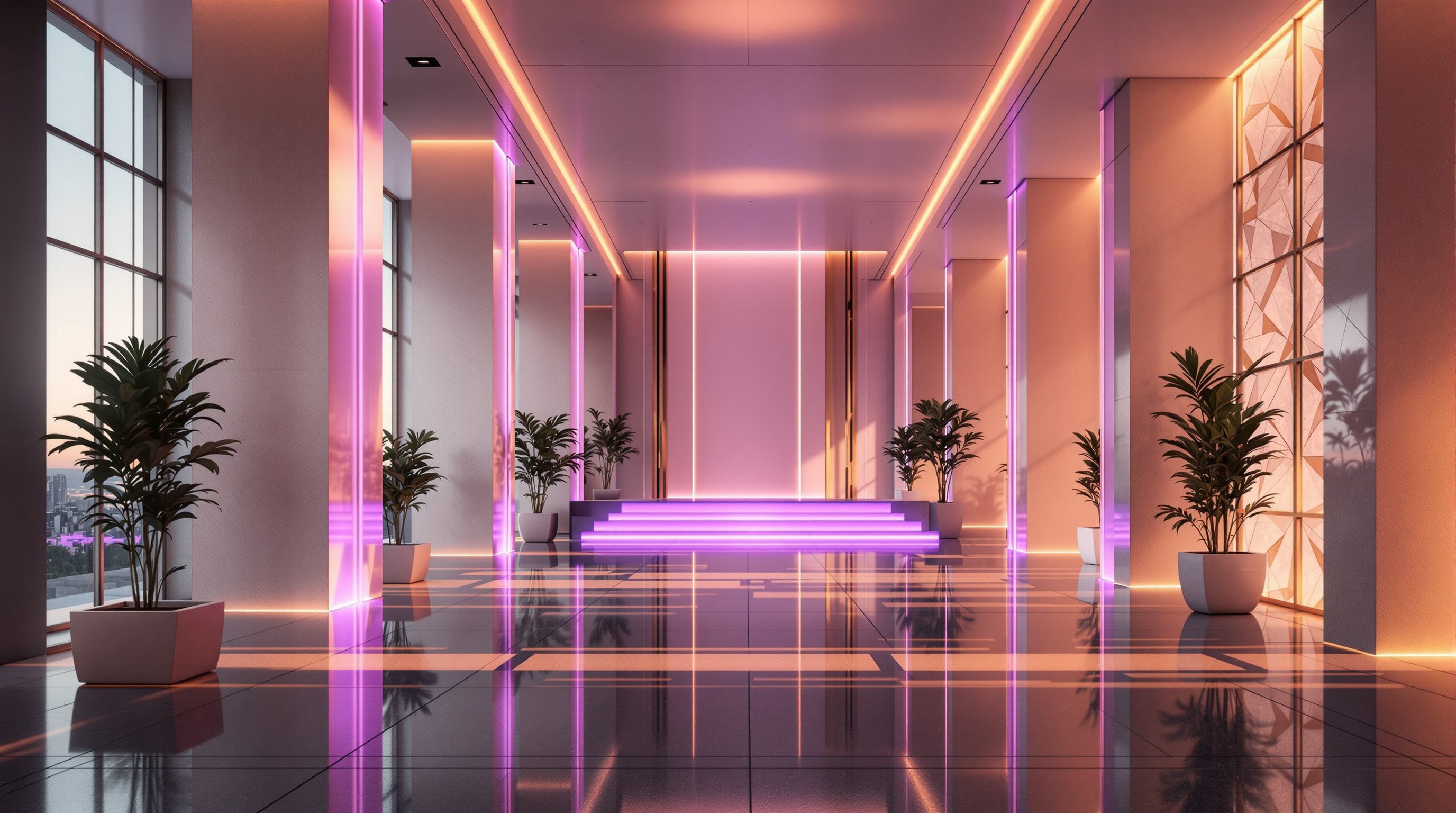
Most people meet architectural imagery as renders - beautiful still frames or pre-baked videos that took a farm of computers hours to produce. Real-time is a different thing entirely. The image is recomputed many times every second in response to what you do - so you move, and the view updates now; you change a material, and it is right; you put on a headset, and you are simply inside the building.
That live responsiveness is the whole premise of this course. When the picture is generated on the fly instead of baked in advance, a rendering stops being a deliverable and becomes a space you can inhabit and interrogate. You can explore any angle, test a change instantly, walk a client through the design at full scale, and let them flip options themselves. The tool that does this best for buildings is a game engine - Unreal Engine - and learning to think in real-time is the shift this course is really about.
Real-time = live, walkable, changeable image. Offline = one perfect still you wait for. Different media.
Real-time means the frame is redrawn in milliseconds, in response to you
The single idea the whole course rests on is what real-time actually means. A traditional offline renderer (V-Ray, Corona, Arnold) computes one frame at a time, tracing light with great accuracy - and taking anywhere from minutes to hours per frame. The camera is fixed before you press render; to see a different angle, you set it up and wait again. A real-time engine does the opposite: it draws the entire frame in a few milliseconds - fast enough to redraw it 30, 60 or 90 times a second - so the picture keeps up with you as you move, edit and interact.
That speed changes the whole relationship. Sixty frames a second means about 16 milliseconds per frame; cross roughly 90fps and the experience is smooth enough for VR without making people queasy. To hit that budget, real-time engines approximate light cleverly rather than simulating every ray - and for years that meant real-time looked obviously worse than offline. That gap has closed dramatically: with Unreal Engine 5's Lumen (real-time global illumination) and Nanite (virtualized geometry), real-time archviz now reaches a quality that was pure offline territory a few years ago. The trade is no longer 'fast but ugly' - it is 'interactive' versus 'a single perfect still'.
You move -> engine draws the frame in ~16ms -> you see it NOW -> you move again. The loop is the medium.
A different medium, not just a faster render
It is tempting to file real-time under 'quicker rendering', but that undersells it. Real-time gives you things offline simply cannot, because the image is live. You get free camera - explore any viewpoint the instant you think of it, no re-render. You get interactivity - open a door, switch a finish, toggle day to night, and the scene responds. You get presence - in VR you stand at true scale inside the space, judging ceiling height and sightlines with your body, not your eyes alone. And you get iteration speed - change something and the answer is immediate, so you test ten ideas in the time one offline frame would cost.
So the honest framing is that offline and real-time are different media with different strengths, not rivals where one wins. Offline still owns the single, uncompromising hero still - the print-quality cover image where you will happily wait an hour for perfect caustics. Real-time owns everything that benefits from being explored: design review, client immersion, walkthroughs, VR, interactive presentations, configurators. Mature studios use both, and increasingly reach for real-time first because it collapses the feedback loop that design actually runs on.
Why a game engine ended up rendering buildings
The engines that do this best were built to render games - worlds that must respond to a player 60 times a second - and that is exactly the problem architecture visualization has. Unreal Engine, made by Epic Games and free to learn and use for most archviz work, has become the deepest real-time tool for buildings: Datasmith imports your Revit, Rhino, SketchUp or 3ds Max model with materials and metadata largely intact; Lumen lights it convincingly; the Sequencer produces cinematic films; Blueprints add interactivity with no code; and native VR support puts you inside it. Twinmotion (also Epic, and built on Unreal) is the friendlier, faster sibling; Enscape and D5 Render plug straight into design tools for quick real-time views. Module 0 lesson 3 maps this whole toolscape.
Crucially, real-time skills are transferable and in demand. The same engine that walks a client through a house drives films, product configurators, virtual production stages, and the visual layer of digital twins (the sister course in this Academy). Learning Unreal is not learning one narrow archviz plug-in - it is learning a general-purpose real-time medium that happens to be extraordinary at architecture. That breadth is why real-time visualization has become a genuine career path, not just a rendering button.
Game engine solves the same problem as archviz: draw a responsive world 60x a second.
What this course will actually teach you
This is a hands-on, build-it course, not a gallery tour. Over eleven modules you will set up Unreal and learn to move around it like a native (Module 1); bring your own CAD and BIM models in cleanly with Datasmith (Module 2); build believable physically based materials (Module 3); light a scene convincingly with Lumen (Module 4); place it in a real landscape and context (Module 5); direct a cinematic walkthrough with the Sequencer (Module 6); add interactivity - doors, lights, options, configurators - with Blueprints (Module 7); take the design into VR for immersive review (Module 8); keep it all running smoothly with Nanite, LODs and profiling (Module 9); and package, deliver and build a career from it (Module 10).
Like every course in this Academy, it rewards judgement over button-pushing. The goal is not to memorise menus - those change with every release - but to understand the medium: what real-time is good for, how light and materials read, how to keep a heavy building interactive, and how to use immersion to make better design decisions and win a client's trust. Get that, and the specific tool becomes easy to swap. That real-time literacy - thinking in a live, walkable, changeable image - is what this course sets out to build.
Unreal Engine
A real-time game engine, the deepest real-time tool for architecture
Free to learn and for most archviz use; Datasmith import, Lumen, Sequencer, Blueprints and native VR. The spine of this course.
Real-time rendering
Drawing the frame in milliseconds, many times a second
Fast enough to respond to you as you move and edit; approximates light rather than simulating every ray. Contrast with offline.
Offline rendering (V-Ray, Corona, Arnold)
Computing one accurate frame at a time, minutes to hours each
Still owns the single print-quality hero still; the camera is fixed before you render. A different medium, not a rival.
Frame rate (fps)
How many frames the engine draws per second
~60fps (16ms/frame) for smooth desktop; ~90fps+ for comfortable VR. The budget everything else must fit inside.
Workshop — feel the difference between a render and a real-time space
You do not need Unreal installed yet. The first skill is seeing what real-time gives you that a still cannot - because that eye is what tells you when to reach for it. This is a looking-and-reasoning exercise.
None yet - just a browser and something to write with. (From Module 1 you install Unreal Engine; later modules add Datasmith, Lumen, the Sequencer, Blueprints and VR.)
Goal: build the instinct for when real-time earns its place
Inputs: any device with a browser; a design you know
Time: ~25 minutes
- 1Find a real-time architectural experience you can move around in - an Unreal or Twinmotion archviz walkthrough on YouTube, an interactive property tour, or a free Enscape/Twinmotion sample. Notice: the camera goes anywhere, instantly.
- 2Now find a traditional offline hero render of a similar space. Ask what each does better: where does the still win (a single perfect image), and where does the walkable version win (angles, scale, change)?
- 3List three questions about a design that you can only answer by moving through it or standing at true scale - a sightline, a ceiling height, how a corridor feels. These are the questions real-time exists to answer.
- 4Take one design you know (yours or a famous building) and decide, honestly, which deliverables want offline (a competition cover still?) and which want real-time (the client review? a VR walk?).
- 5Keep the notes. As each module adds a skill - import, materials, Lumen, Sequencer, Blueprints, VR - come back and mark which of your questions it lets you answer.
You’ll walk away with
A short written comparison of one real-time walkthrough versus one offline render of similar spaces: what each medium does better, plus three design questions that only real-time (movement or true-scale immersion) can answer.
Three altitudes on the same idea
Read the band that fits you — or all three.
For you, real-time is a design and persuasion instrument. Walking a scheme at true scale surfaces proportion, light and sightline problems that a plan hides, and doing it early - while the design is still soft - is where the value is. And nothing wins a client's confidence like letting them stand inside their building and change the stone themselves. Real-time shortens the loop between an idea and the judgement of it.
Interiors live or die on material, light and scale - exactly what real-time shows honestly. Swap a finish, dim the lights, move from morning to evening, and see the room respond instantly instead of waiting on a render. Clients who cannot read a moodboard understand a walkable room immediately, and a real-time configurator lets them explore palettes with you rather than being presented to.
Real-time is one of the most hireable skills in visualization right now. Unreal Engine, VR and interactive archviz are what studios, developers and visualization houses are actively recruiting for, and the people who can take a model all the way to a polished, interactive, immersive experience are still relatively rare. Learn the medium end to end and you build a portfolio that genuinely stands out.
“Real-time rendering is just a faster version of a normal render - same thing, less waiting.”
Do it yourself
No software needed - reason it through.
- 1In one sentence, what makes rendering 'real-time' rather than offline?
- 2Roughly how many milliseconds per frame is 60fps, and why does VR want ~90fps or more?
- 3Name two things real-time gives you that a fixed offline render cannot.
- 4Why did a game engine end up being the best tool for rendering buildings?
- 5Give one deliverable that still wants offline rendering, and one that wants real-time.
The one line to carry out
Peer-reviewed journals & authoritative standards
- 01Real-time computer graphics — Wikipedia, 2026.
- 02Unreal Engine — Wikipedia, 2026.
- 03Architectural rendering — Wikipedia, 2026.
We have separated real-time from offline as a medium. Next we go deeper into exactly how they differ - frame budgets, how each treats light, and when to use which - so you can choose the right tool for every deliverable.
The author
Amogh N P
Architect, interior designer, and creative polymath. Studio Matrx began in his notebooks — his vision of design made honest, useful, and open to everyone. Its Academy is written and taught in his memory, and free, forever.
More about Amogh →