
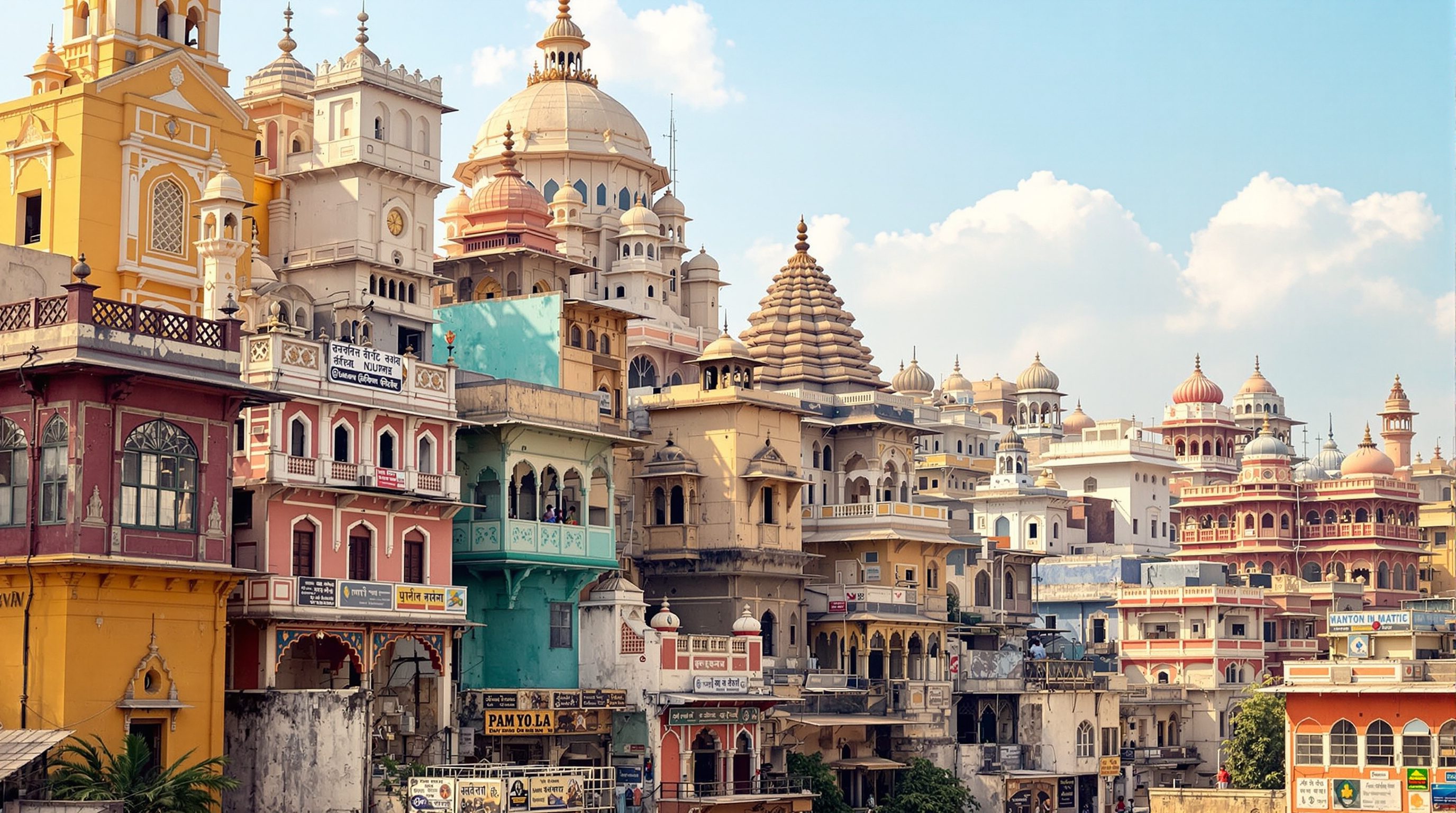
 Lesson 9.2
Lesson 9.2 · Ethics, IP, Bias & Limits
Bias & Western-Centric Datasets
Why models default to a Western look, what it costs non-Western design, and how specificity fights back
The model has a default, and the default is not neutral.
Type 'a house' and the model does not hand you the average of all houses on Earth - it hands you the average of the houses it saw most, and it saw far more suburban America and photogenic Europe than it saw Kumbakonam or Kigali. A model is a mirror of its data, and the mirror is tilted. This lesson is about the tilt: where it comes from, what it costs non-Western and Indian architecture, and the one reliable way a designer pushes back.
The model saw more villas than courtyards. Name the courtyard, part by part.
A model is a mirror of its data
There is no taste or intention inside an image model. It has no opinion that a Mediterranean villa is more beautiful than a Chettinad house. What it has is a distribution - a statistical record of what it saw, and how often. When you prompt it, it reaches for the densest, most confident region of that record. So its 'default' is simply its most-represented data, wearing the costume of a neutral choice.
This is the honest, mechanical root of bias, and it matters that we state it mechanically rather than morally. The model is not prejudiced; it is faithful - faithful to an unbalanced sample of the world. If the training set contains ten thousand captioned photographs of white-rendered modernist houses and two hundred of laterite courtyard homes, the model learns the first far more richly and reproduces it far more readily. Bias is not a bug bolted on; it is the training data's imbalance showing through.
Understanding this frees you from two dead ends. One is outrage at the tool, as if it were choosing to erase your context - it isn't choosing anything. The other is helplessness, as if the bias were an unfixable law of nature - it isn't, because you control the prompt, and the prompt can steer the model away from its lazy default toward the specifics it under-learned. The rest of this lesson is about doing exactly that. But it starts here: the skew is real, it lives in the data, and naming it plainly is the first professional move.
No taste inside. Just a tilted mirror of what it saw most.
Why the datasets skew Western
The tilt is not an accident of one company; it is baked into how the raw material was gathered. Three forces stack up.
First, the web itself is unbalanced. The large models learned largely from images scraped from the public internet, and that internet over-represents wealthy, English-speaking, highly photographed parts of the world. A much-photographed Californian house has thousands of captioned images; a village house in Odisha may have almost none. The camera, and the caption, were simply pointed elsewhere more often.
Second, the captions are mostly English, and written from a particular cultural vantage. The words that reliably steer a model are the words that appeared consistently in its captions - so Western architectural vocabulary ('mid-century modern', 'craftsman', 'brownstone') is densely learned, while equally precise non-Western terms are thin or mislabelled. The language layer inherits the same skew as the image layer.
Third, what little non-Western data exists is often stereotyped. The images that do get tagged 'Indian' or 'African' skew toward the exotic, the touristic, the temple-and-palace postcard - not the ordinary contemporary buildings people actually live and work in. So even where the model has data, that data can be a cliche to begin with, and the model faithfully reproduces the cliche.
The consequence follows directly. A broad prompt lands in the densest region, which is Western-default; and a broad non-Western prompt lands in a thin, stereotyped region, which is cliche. Neither is the model 'deciding' anything. Both are the data's shape, made visible. Fairness research on machine learning has documented this representation problem across domains for years - image generation is one more place the same imbalance surfaces.
What this costs non-Western and Indian architecture
For a designer working in India - or anywhere outside the data's centre of gravity - the tilt has real, daily costs, and it is worth naming them concretely rather than abstractly.
The first cost is collapse into cliche. 'Traditional Indian house' tends to return a mash-up of temple motifs, saturated colours and Rajasthani havelis regardless of the actual region you meant, because that is the thin, stereotyped cluster the term maps to. A Kerala courtyard home, a Goan-Portuguese townhouse, a Himachali cator-and-cribbage house and a Bengali aat-chala roof are wildly different traditions; the model flattens them into one exotic average.
The second cost is wrong defaults creeping in unasked. Prompt for a contemporary Indian living room and you may get Western proportions, Western furniture logic, a fireplace nobody needs, and climate responses tuned for a cold country. The model imports the assumptions of its dominant data even when you didn't ask for them, so an unwatched render can quietly design for the wrong climate and the wrong life.
The third cost is erasure of the ordinary. The buildings that make up most of a real Indian city - the everyday RCC-frame home, the shop-house, the middle-class apartment - are under-represented, so the model is least fluent in exactly the architecture most designers actually work on. It is confident about the palace and clueless about the plot next door.
The fourth cost is subtler and worth watching: because the seductive default is Western, it can nudge a designer's own eye, making the imported look feel more 'finished' or 'aspirational' than the local one. Bias in the tool becomes bias in the taste of the person using it, if they don't notice. Naming these four costs is not complaint for its own sake - it is what lets you catch each one in your own output before a client does.
Cliche, wrong defaults, erased ordinary, drifting eye. Catch all four.
Countering with specificity
Here is the good news, and it is the practical heart of this lesson: the same prompt control that fixes vague output fixes biased output, because bias is a form of vagueness. When you leave a slot blank, the model fills it with its default - and its default is the tilted one. So the antidote is to leave fewer slots blank, in exactly the places the model is weakest.
The core technique is decomposition. A broad regional label lands in a thin, stereotyped cluster; its named parts land in rich, well-attested ones. So instead of 'traditional Indian home', name the components the model learned reliably: the climate response (deep verandahs, cross-ventilation), the roof form (sloping Mangalore tile), the material (laterite, teak, lime plaster), the plan type (central courtyard), the light (monsoon overcast). Each of those terms is concrete and well-represented, so each one truly steers - and recombined, they reconstruct the faithful building the umbrella term could never summon.
Second, reach for control, not just words. When a tradition is genuinely thin in the data, prompting alone may not be enough, and that is where the earlier modules pay off: feed a real reference photo through img2img or an IP-adapter (Module 3), or condition on an actual plan or sketch, so the geometry and character come from your input rather than the model's biased memory. A small, well-chosen reference beats a thousand words when the words themselves are under-learned.
Third, verify against reality. You are the fluent one here; the model is not. Check that the render's climate logic, materials and proportions actually match the place - because the model will happily hand you a confident image that is subtly, culturally wrong. Specificity plus a critical eye is the whole method, and it scales: Module 6.4 applies exactly this to Indian-context interiors in depth.
Bias is vagueness. Name the parts; feed a real reference; check against place.
Bias you can't prompt away - and the honesty it demands
Specificity does a great deal, but honesty means admitting its ceiling. Some bias you can steer around; some is welded into the model, and pretending otherwise would be its own failure.
A few kinds resist prompting. Where a tradition is almost absent from the data, no wording conjures what the model never learned - you have to supply it yourself through references and control, or accept the model can't help. Where the stereotyped cluster is strong, it can reassert itself even against specific terms, dragging your careful prompt back toward the postcard. And beyond architecture, image models carry documented social biases about people - who appears as a 'professional', whose home looks 'poor' - which matters the moment your renders include figures or context, and which you should watch for deliberately rather than assume away.
So the professional stance has two halves. The first is effort: use decomposition, references and verification to get faithful, respectful output, because most of the time it genuinely works and 'the tool is biased' is not an excuse for a lazy, cliched render. The second is humility: know that the tool has a worldview you didn't choose, stay alert to it entering your work uninvited, and be honest with clients and collaborators about what the model does and doesn't represent well.
There is also a quiet responsibility here worth naming. Every designer who insists on specificity, who refuses the cliche and renders their own context faithfully, is pushing back - in a small way - against a genuine gap in how these tools see the world. You cannot retrain the model, but you decide what leaves your studio. Using these tools well from a non-Western practice is not only self-interest; it is part of making the built world these systems imagine a little less lopsided than the data they were fed.
Steer what you can; name what you can't. Refuse the cliche either way.
Representation bias (fairness in ML research)
The documented tendency of models to reflect imbalanced training data
Image generation is one more domain where an over-represented group becomes the 'default'; the mechanism is distributional, not intentional.
Decomposition into named parts
Replacing a broad regional label with well-attested components
Climate response + roof form + material + plan type each steer reliably where the umbrella term collapses to cliche - the core counter-technique.
Reference-driven control (img2img / IP-adapter)
Supplying character the model under-learned via your own images
When a tradition is genuinely thin in the data, condition on a real photo or plan rather than trusting the biased default (Module 3).
Human verification against place
Checking climate logic, materials and proportions against reality
The model can be confidently, culturally wrong; you are the fluent one - the final check is yours, not the tool's.
Workshop - a bias audit and correction
You'll make the tilt visible on one prompt, then correct it with decomposition, so the technique becomes something you've seen work rather than taken on faith. Use any text-to-image tool.
Any text-to-image tool (Midjourney, a Stable Diffusion space, Firefly, or Studio Matrx DesignAI); a reference photo helps for thin traditions.
Goal: see bias, then correct it with specificity
Inputs: one text-to-image tool + a regional building type you know well
Time: ~40 minutes
- 1Generate the broad umbrella term for a tradition you know - e.g. 'traditional Indian house'. Keep the result as your biased baseline.
- 2Write down honestly what's cliched, wrong or missing: wrong region mashed in, wrong climate response, stereotyped motifs, erased ordinary detail.
- 3Decompose the tradition into named, well-attested parts: climate response, roof form, material, plan type, light. Build a new prompt from those parts, front-loading the load-bearing one.
- 4Generate the decomposed prompt. If a part is still thin, feed a real reference photo through img2img or an IP-adapter and generate again.
- 5Verify against reality: does the climate logic, material and proportion match the actual place? Note anything still off - that's the ceiling you can't prompt away.
You’ll walk away with
A labelled before/after pair - umbrella-term baseline vs decomposed (and, if used, reference-driven) result - with a short written note listing what improved and what bias remained.
Three altitudes on the same idea
Read the band that fits you — or all three.
The bias bites hardest exactly where you practise - the ordinary contemporary building the model under-learned. For concept work in a specific region, stop prompting the umbrella term and decompose the brief into climate response, roof form, structural system, material and plan type, each of which the model steers on reliably. When a tradition is genuinely thin in the data, drive the image from your own reference photographs or massing through conditioning rather than trusting the model's memory - and always sense-check that the render's climate logic suits the actual site, not a colder, richer country.
Interiors is where the wrong defaults sneak in unasked - Western proportions, imported furniture logic, a fireplace nobody needs. Name the specifics that matter for the room and the region: the actual materials, the light, the way people use the space. Feed a real reference of the style you mean through a restyle rather than hoping 'Indian living room' lands faithfully, and watch that the seductive Western default doesn't quietly become your own taste. Faithful, specific interiors read as considered; cliched ones read as stock.
Learning to see and counter bias is a distinguishing skill, especially for a designer trained outside the data's centre of gravity. Practise the diagnostic move: generate a broad regional term, name what's cliched or wrong about the result, then decompose it into well-attested parts and show the improvement side by side. Being able to explain why the model skews and how you corrected it is exactly the kind of critical, portfolio-worthy thinking that separates a tool-user from a designer - and it makes your own cultural context an asset, not an afterthought.
“The model is prejudiced - it deliberately favours Western architecture over mine.”
Do it yourself
No tool needed - reason it through.
- 1Explain why 'a model is a mirror of its data' is a more accurate frame than 'the model is prejudiced'.
- 2Give two of the three forces that make image datasets skew Western.
- 3Name three of the four concrete costs the tilt imposes on Indian architecture.
- 4Rewrite 'traditional Indian house' as a decomposed, well-attested prompt for one specific tradition you know.
- 5Name one kind of bias you cannot prompt away, and what the honest response to it is.
The one line to carry out
Peer-reviewed journals & authoritative standards
- 01A survey on bias and fairness in machine learning (representation and dataset bias across domains) — arXiv preprint, 2022.
- 02Bommasani, R., et al. - Evaluating the Social Impact of Generative AI Systems in Systems and Society — arXiv preprint, 2023.
- 03Rombach, R., Blattmann, A., Lorenz, D., Esser, P., & Ommer, B. - High-Resolution Image Synthesis with Latent Diffusion Models — IEEE/CVF Conference on Computer Vision and Pattern Recognition (CVPR), 2022.
You can now make faithful, specific images - but the client doesn't see your process, only the polished result. That raises a different responsibility: telling them honestly what the image is and isn't. Next: labelling AI imagery, not overselling buildability, and being straight about authorship.
The author
Amogh N P
Architect, interior designer, and creative polymath. Studio Matrx began in his notebooks — his vision of design made honest, useful, and open to everyone. Its Academy is written and taught in his memory, and free, forever.
More about Amogh →