
 Lesson 0.2
Lesson 0.2 · Foundations of Architectural Visualization
Real-Time vs Offline Rendering
The great divide of the field - and how each side shapes your whole workflow
One choice shapes everything downstream: does the image appear in a second, or in an hour?
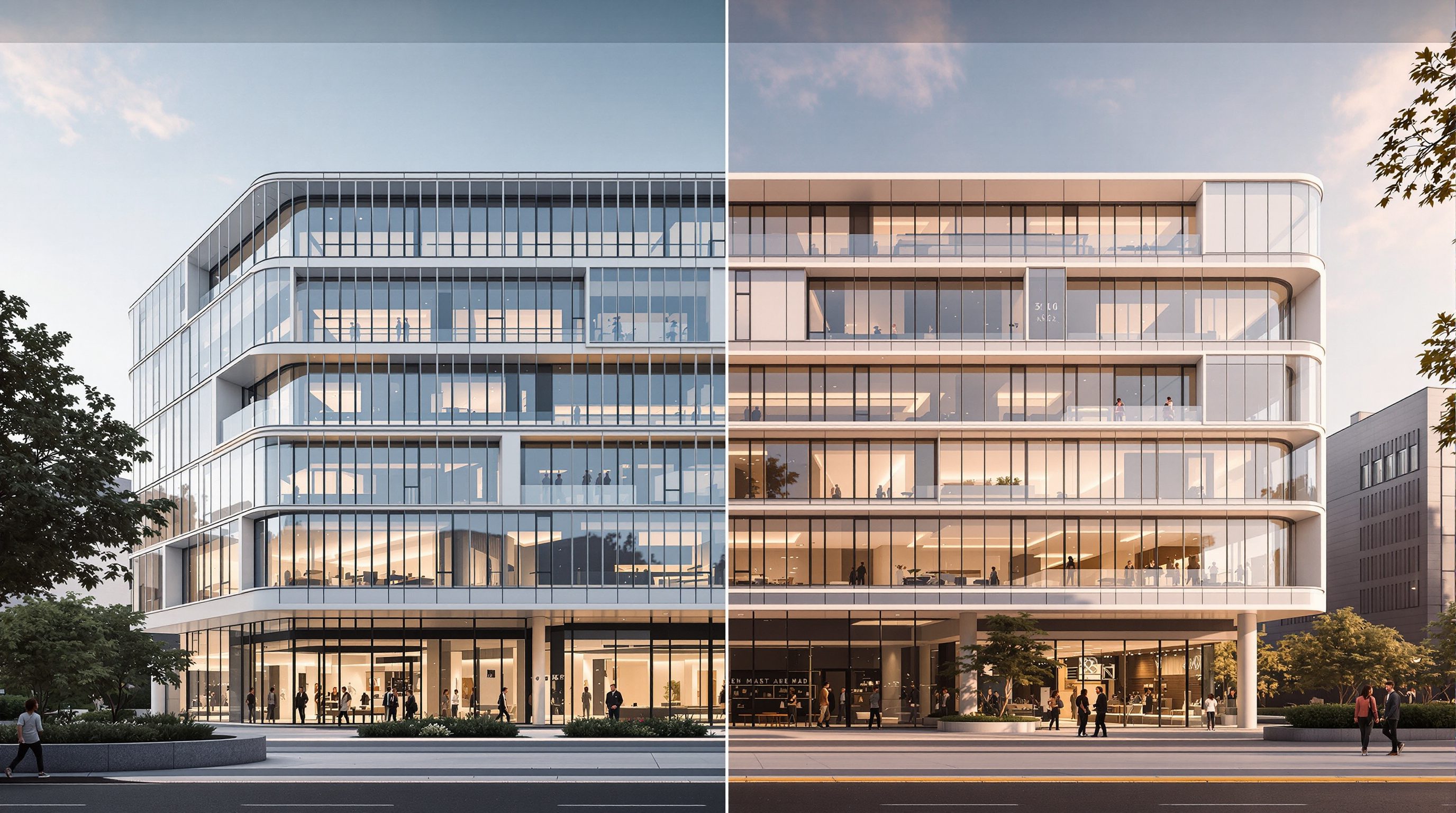
Every visualization pipeline splits at one fork. On one side, real-time engines paint the whole scene many times a second, so you move the sun and watch the shadows swing. On the other, offline engines compute a single frame slowly and precisely, chasing the last few percent of photorealism.
This is not a small technical footnote - it is the decision that shapes how you work, how you present, and what your images can look like. Get the distinction clear now and every tool in the rest of the course drops into one of these two buckets without confusion.
Two loops: tweak-and-see (real-time) vs set-up-and-wait (offline). Everything else follows from that.
What 'real-time' and 'offline' actually mean
The words describe how fast the engine produces a finished image, and that single difference cascades into two completely different ways of working.
A real-time renderer - Twinmotion, Enscape, Lumion, D5 - draws the entire scene dozens of times per second, the same way a video game does. Move the camera and the image updates instantly; drag the sun and the shadows sweep across the floor live. Because the result is interactive, you are not really rendering so much as exploring: you walk through the space, try a material, nudge a light, and see the consequence immediately. The image on screen essentially is the final image.
An offline renderer - V-Ray, Corona - works the opposite way. It takes your set-up and computes one frame carefully, tracing far more light paths than a real-time engine can afford, and it takes its time doing it: seconds for a draft, minutes to hours for a final. You do not interact with the result as it forms; you set everything up, press render, wait, and then judge the finished picture. In exchange for that patience you get physical accuracy and control that real-time engines only approximate.
The honest one-line version: real-time trades a little ultimate quality for enormous speed and interactivity; offline trades speed for the highest possible photoreal ceiling. Neither is 'better' - they are different tools for different moments, and most professionals use both.
Real-time = design WITH the render. Offline = set it up, wait, judge the result. Two different loops.
How the choice reshapes the whole way you work
The speed difference is only the surface. What really matters is how each loop changes your behaviour.
With a real-time engine the feedback loop is measured in seconds, so rendering stops being a separate final stage and becomes part of designing. You test three sofa fabrics in the time an offline engine would take to draw one. You catch a lighting problem while you can still fix the model, because you are seeing the lit result continuously. This tight loop is exactly why real-time has become the industry default for day-to-day architectural work: it is fast enough to think with, and it is fast enough to sit beside a client and change things live in the meeting.
With an offline engine the loop is long, so your behaviour flips. Because every test costs real minutes, you plan carefully, set things up deliberately, and batch your changes before committing to a render. You often render a small, fast, low-quality draft to check composition and light, then send the final at full quality - frequently overnight or to a render farm. The workflow rewards patience and precision rather than exploration. That is not a flaw; it is the natural shape of chasing maximum quality, and it is why offline still owns the top of the photoreal ceiling for hero marketing images.
A useful way to hold it: real-time changes how you _design_; offline changes how you _finish_. The same model can pass through both - explored in real-time, then finalised offline - and understanding which loop you are in tells you how to behave.
When to choose which - an honest guide
There is no universal winner, only a fit to the job. Reach for a real-time engine when speed and interactivity matter more than the absolute last percent of realism: iterating on a design, running quick option studies, presenting live to a client, walking a stakeholder through a space, producing a large volume of images on a deadline, or making walkthrough animations and VR - all of which are real-time's home turf. For the overwhelming majority of everyday architectural and interior work, real-time is now the right default, and you can build a whole career on it.
Reach for an offline engine when the image itself is the product and it must be as photoreal as physically possible: a hero shot for a competition board, a magazine cover, a developer's flagship marketing render, or a close-up interior where the exact behaviour of a glossy surface or a soft caustic has to be perfect. Offline is also the right call when you need very specific physical accuracy - complex reflections, refractions, and light interactions that real-time engines still fake rather than fully compute.
Many studios use a blended approach and so should you: design and iterate in real-time, then, if the shot truly demands it, finalise the two or three hero images offline. The mistake beginners make is reaching for the slow, complex offline pipeline for every image out of a belief that it is more professional. It is not - it is just slower. Choose the loop that fits the image's actual job.
Iterate + present -> real-time. Hero image that must be flawless -> offline. Most work is the first kind.
The gap is closing - fast
For years the trade-off was stark: real-time was noticeably less realistic, and if you wanted a truly photoreal image you had no choice but to go offline and wait. That is no longer true to anything like the same degree.
The turning point was real-time ray tracing - modern GPUs and engines like D5 now trace real light rays live, computing reflections, soft shadows and global illumination that used to be the exclusive territory of offline engines. Twinmotion, built on Unreal Engine's rendering technology, and Enscape have all climbed steeply in quality. The result is that a well-lit real-time render today can be indistinguishable from an offline one to most viewers - and it arrived in seconds instead of hours.
Offline still holds the very top of the ceiling: for the most demanding physical accuracy and the absolute final few percent, V-Ray and Corona remain unmatched. But the gap that once justified reaching for offline by default has narrowed to the point where, for most projects, the speed and interactivity of real-time simply win. The practical takeaway for you as a learner is reassuring: you can start on a free or low-cost real-time engine and produce genuinely professional work today, then add offline skills later for the specific images that need them. The divide still matters - but it is no longer a wall.
It is not either/or - the hybrid workflow most pros actually use
One last correction to a common beginner assumption: the divide is a choice per image, not a lifelong allegiance. You do not pick a team and stay on it. The single most productive way to work uses both sides of the divide on the same project, and understanding that hybrid rhythm now will save you a lot of wasted effort later.
The pattern looks like this. You do all of your designing and iterating in a real-time engine, because that is where the fast feedback lives - you try options, catch problems, and refine the model with the lit result constantly in front of you. You do all of your client conversations in real-time too, walking them through the space live and changing things in the meeting. Then, and only then, you look at your final deliverables and ask a blunt question: does any single image genuinely need the last few percent of photorealism that only offline can give? For a weekly review or a planning submission, the answer is almost always no - export the real-time frames and you are done. For the one competition hero or the developer's flagship marketing shot, the answer might be yes - and that image, and only that image, you set up and finalise offline.
The mistake is inverting this: treating offline as the default and real-time as a rough preview. That burns hours rendering images that never needed the quality, and it slows your design thinking to the speed of your slowest render. Flip it. Real-time is your default; offline is the specialist you call in for the handful of images that truly earn the wait. Keep that rhythm and you get the speed of one world and the ceiling of the other, applied exactly where each belongs.
Design and present in real-time. Finish only the hero shots offline. Not a team you join - a choice per image.
Real-time engines (Twinmotion, Enscape, Lumion, D5)
Interactive rendering, updated many times a second
Design and present with the lit result live; the industry default and the focus of Modules 4 and 5.
Offline engines (V-Ray, Corona)
Physically-accurate rendering computed frame by frame
The photoreal ceiling for hero images; slower but maximally controllable. Module 6.
Real-time ray tracing
Tracing real light rays live on the GPU
The technology (seen in D5 and Unreal) that closed most of the real-time-to-offline quality gap.
Path tracing
The accurate light-transport method behind offline engines
Simulates many bounces per pixel for physical accuracy; the reason offline still tops the ceiling.
Workshop - map the divide onto real images
You do not need to install anything to internalise this divide. Train your eye and your judgement on real examples first, so the software choices later feel obvious.
None - just a browser and the official tool galleries. No installs required; later modules use the engines themselves.
Goal: turn the real-time/offline distinction into working judgement
Inputs: a browser, and the marketing pages of Twinmotion, Enscape, D5, V-Ray and Corona
Time: ~30 minutes
- 1Open the official galleries of two real-time engines (say Twinmotion and D5) and two offline engines (V-Ray and Corona). Look at 4-5 hero images from each.
- 2For each image, guess before you check: does this look real-time or offline? Note what tipped you off - the softness of a reflection, the perfection of a caustic, the overall polish.
- 3Now list three project situations from your own studio or work life - for example 'weekly design review', 'competition board', 'live client meeting'. For each, decide which loop fits and write one sentence saying why.
- 4Find one image you assumed must be offline that a caption reveals was real-time (they exist, and increasingly). Note what that tells you about the closing gap.
- 5Write a two-line personal rule: 'I reach for real-time when _; I reach for offline when _.' Keep it - you will refine it all course.
You’ll walk away with
A short written decision rule - when you will choose real-time versus offline - grounded in real images you have judged, plus three project situations mapped to the right loop.
Three altitudes on the same idea
Read the band that fits you — or all three.
For you the real prize of real-time is designing with the lit result in front of you. When you can move the sun and watch a facade change, rendering stops being an afterthought and becomes a design instrument - you catch problems while they are still cheap to fix. Keep offline in your back pocket for the one or two competition images that must be flawless, but let real-time carry your daily thinking and your live client conversations.
Real-time lets you sit beside a client and swap a fabric, a floor or a wall colour live - a superpower in an interiors meeting. That interactivity often closes the sale faster than any static image. When a hero shot for a portfolio or a magazine needs the deepest material realism - a lacquer, a marble, a soft glow - that is your moment to finish it offline in Corona or V-Ray, which excel at exactly those interior surfaces.
Do not believe the myth that offline is 'more professional' and real-time is 'just for students'. The industry runs on real-time. Learn a real-time engine first - it is faster to learn, cheaper to access, and produces portfolio-grade work now - then add one offline engine so you understand the ceiling. Employers want to see that you know which loop fits which job, not that you always reach for the slow one.
“Offline rendering (V-Ray, Corona) is more professional; real-time is just a shortcut for people who can't do 'proper' rendering.”
Do it yourself
Reason it through before you touch a tool.
- 1In one sentence, what is the core difference between real-time and offline rendering?
- 2Name two real-time engines and two offline engines.
- 3How does a real-time loop change the way you actually design, compared with an offline loop?
- 4Give one project situation where offline is clearly the right choice, and one where real-time is.
- 5What technology is most responsible for closing the quality gap between the two?
The one line to carry out
Peer-reviewed journals & authoritative standards
- 01Akenine-Moller, T., et al. - Real-Time Rendering (resources) — realtimerendering.com, 2026.
- 02D5 Render - real-time ray tracing renderer — D5 Render, 2026.
- 03Chaos - V-Ray & Corona documentation hub — Chaos, 2026.
- 04Twinmotion - Official Documentation — Epic Games, 2026.
- 05Enscape - Documentation & Knowledge Base — Enscape (Chaos), 2026.
Now that you can place any engine on the real-time/offline divide, the next lesson lays out the whole landscape - a map of the actual tools, what each is good at, and where your modeller fits as the source of it all.
The author
Amogh N P
Architect, interior designer, and creative polymath. Studio Matrx began in his notebooks — his vision of design made honest, useful, and open to everyone. Its Academy is written and taught in his memory, and free, forever.
More about Amogh →