
 Lesson 0.1
Lesson 0.1 · Could You Be a Host?
Why Host a Homestay
A homestay turns a spare room and a welcome into income, company and purpose — but it is a real business and a real commitment. This lesson sets the honest picture the whole course rests on.
A homestay is the rare business you can start from a home you already own — but it is still a business, and this course treats it like one.
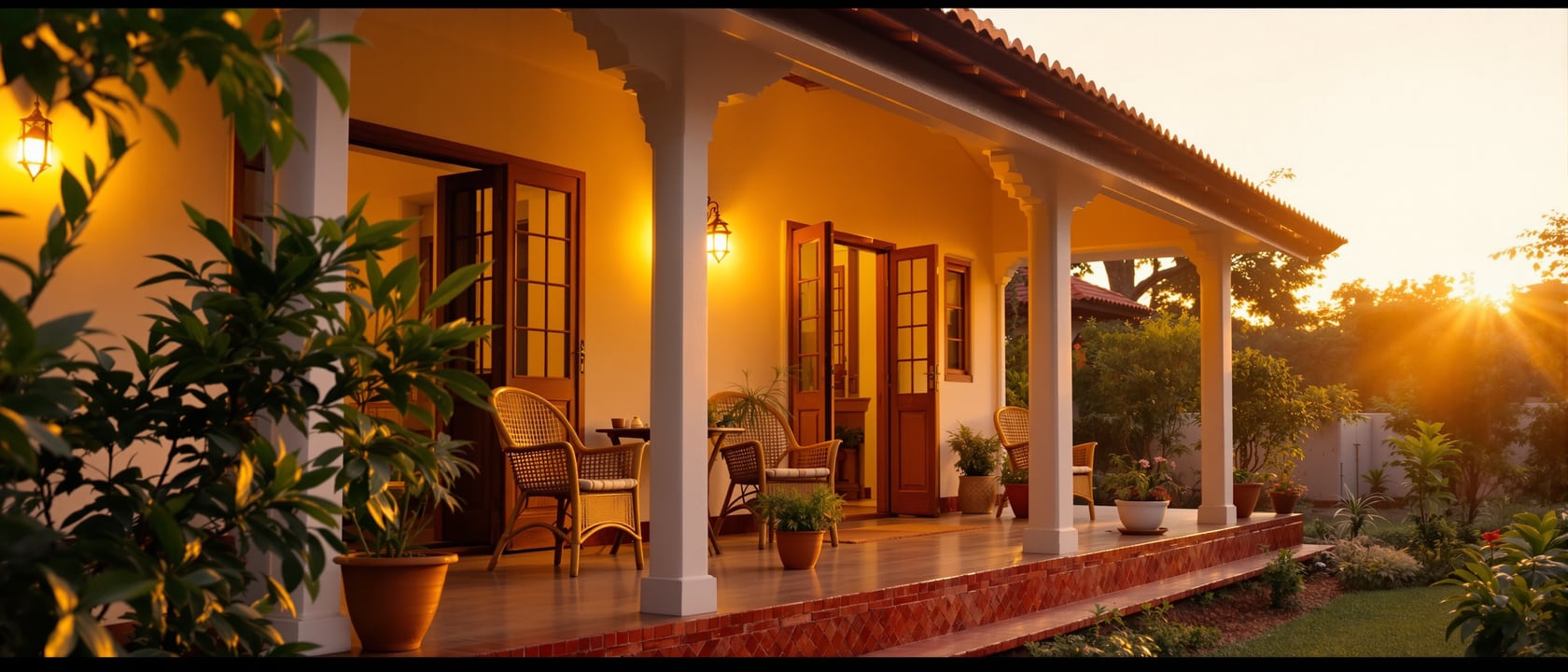
Somewhere in your house is an asset doing nothing: a spare room, a separate floor, a cottage in the garden, a family home that stands half-empty now the children have gone. A homestay turns that into three things at once — income, company, and a reason to keep a loved place alive and full. That is the pull, and it is real: across India, ordinary homeowners are earning a meaningful second income by letting a room or two to travellers who want a home, a host and a story rather than a hotel.
This course exists because the gap between wanting to host and hosting well is wide, and crossing it badly is expensive. A homestay is not passive income and it is not free money — it is a small hospitality business with legal duties, real costs, a demanding season and guests who will review you honestly in public. Done right, it is one of the most rewarding things a homeowner can do. Done casually, it drains money and goodwill. Over the next eleven modules we will take you from this honest why, through the law, the numbers, the design, the setup and the hosting, to a launch plan you can actually act on — so you start with your eyes open and the odds on your side.
Spare room -> income + company + a full house. A real small business, not passive income. Start deliberately.
What a homestay gives you
Start with the upside, because it is genuine and it is why people fall for hosting. First, income from an asset you already own. You are not buying a hotel; you are unlocking value from a house the mortgage or the family already paid for, which is why a homestay's returns on the extra money you put in can be strong. Second, company and purpose. Many of the best hosts are empty-nesters, retirees, or families in beautiful but quiet places, and guests bring the world to the door — conversation, cultures, friendships that outlast the stay. Third, a reason to keep a place alive. An ancestral home, a plantation bungalow, a hill cottage: hosting pays for its upkeep and fills its rooms, rescuing it from the slow decay of a house no one lives in.
There is a fourth, quieter benefit: a homestay is yours, and small enough to stay human. Unlike a hotel it keeps the owner on the premises, the scale personal, and the welcome real — which is exactly the thing guests now travel for, and the thing no chain can copy. That human scale is your single biggest competitive advantage, and most of this course is about protecting it while still running a proper business.
A homestay = income + company + a loved place kept alive, at a human scale only you can offer.
What a homestay asks of you
Now the honest other side, because the hosts who thrive are the ones who went in clear-eyed. A homestay asks for money up front — fit-out, good beds and bathrooms, safety, furnishing — before a single rupee comes back, and we will size that carefully in Module 3. It asks for your time and presence: a real host greets guests, serves breakfast, answers the midnight question, turns the rooms around between stays. It asks you to meet the law — state registration, a municipal trade licence, fire safety, tax — which is not optional and which Module 2 walks through. And it asks for a tolerance for people in your space: strangers in your home, on their holiday, with their expectations, reviewing you in public afterwards.
It also lives with a hard season. Almost every Indian homestay region has a few busy months and a long quiet trough, and the business has to be built to survive the trough, not just enjoy the peak. None of this is a reason not to host. It is the reason to host deliberately — to decide, before you spend, that the exchange is one you actually want. That honest weighing is the real work of Module 0, and the [Is a Homestay Right for You?](/students/start-and-run-a-homestay/is-a-homestay-right-for-you) lesson turns it into a checklist.
The exchange: money + time + presence + the law + strangers in your home, for income + company + a full house.
A homestay is not a hotel, an Airbnb, or passive income
Three quick distinctions save a lot of grief. A homestay is not a hotel: in most Indian states it is legally defined as an owner-resident home letting a small number of rooms (commonly up to six), which is both its charm and the source of its lighter, friendlier regulation. It is not simply ‘an Airbnb’: Airbnb (and MakeMyTrip, Booking.com and the rest) are just booking channels you may list on — the homestay is the real-world business behind the listing, with its own registration, costs and standards, and Module 7 treats the channels as tools, not the thing itself. And it is not passive income: the phrase is a fantasy sold by people who have never turned a room around at 11am before the next guest arrives at noon. A homestay rewards presence and care; automate what you can, but the host is the product.
Holding these straight from the start shapes every later decision — how you register (as a homestay, under your state scheme), how much you spend (as a business, to a budget), and how you host (personally, at a human scale). Get the category right and the rest of the course clicks into place.
Homestay ≠ hotel (owner-resident, ≤6 rooms) ≠ Airbnb (that is just a channel) ≠ passive income (presence is the product).
What this course will teach you
This is a practical, start-to-finish course, free and not-for-profit, built for the homeowner — with a design and professional angle for architects and designers helping a client. Over eleven modules you will move the way a real project moves. First the idea and the market (Module 1): what you are selling, the types of homestay, and the guest who will actually come to your place. Then the law (Module 2): the three-layer compliance stack, the state schemes and room caps, registration step by step, and tax, GST and insurance — explained, with a clear hand-off to a lawyer or CA where it matters. Then the numbers (Module 3): how the economics really work, honest occupancy and seasonality, pricing and the channel mix, and setup cost and break-even, with our free [ROI Calculator](/utilities/homestay-roi-calculator) and [Setup-Cost Estimator](/utilities/homestay-setup-cost-estimator) alongside.
From there: designing the space (Module 4) — zoning host from guest, the room, the bathroom, accessibility and safety; region and vernacular (Module 5) — building with your climate and your region's character; setting up (Module 6); getting guests (Module 7); hosting and operations (Module 8); growing, sustaining and protecting the business (Module 9); and finally your launch plan (Module 10) — a one-page plan, a pre-launch checklist and your first ninety days. Throughout, the stance is the same: explain honestly, defer to professionals on law and tax, keep every figure indicative, and never sell you hype. Studio Matrx is free; this course exists to make you a genuinely good host, not to sell you anything. Pair it with the [Homestays guide hub](/guides/homestays) for the reference detail behind each lesson.
Homestay
An owner-resident home letting a small number of rooms to guests
Legally distinct from a hotel in most Indian states, usually capped (commonly up to 6 rooms) with the owner living on-site. Module 2.
Owner-resident
The host lives on the premises — the defining condition of a homestay
It is why regulation is lighter and friendlier than for a hotel, and why the human welcome is the product. Module 2.2.
Occupancy
The share of available room-nights that are actually booked
The number that makes or breaks the economics; realistic is ~40-50% blended, not the peak figure. Module 3.2.
Booking channel (OTA)
Online travel agents — Airbnb, Booking.com, MakeMyTrip — where you list
A shopfront, not the business; they take commission. The homestay exists independently of them. Module 7.2.
Workshop — your honest starting point
You do not need to decide anything yet. The first skill is seeing your own situation clearly — the asset you have, the commitment you can make, and the honest reasons you are drawn to hosting. This one page becomes the baseline the whole course builds on.
Just your home and a notebook. From Module 3 you will use our free ROI and Setup-Cost calculators.
Goal: a clear, honest snapshot of your homestay starting point
Inputs: your home, a notebook, thirty quiet minutes
Time: ~30 minutes
- 1Describe the asset: which room(s), floor or building would you let, how many guest rooms could it realistically become, and what shape is it in now?
- 2List your three strongest reasons for wanting to host — income, company, keeping a place alive, something else — and rank them honestly.
- 3List your three biggest worries or doubts — money, time, strangers, the law, the season — as plainly as you can.
- 4Write down who lives in the home and how a guest's presence would affect each of them; hosting is a household decision, not a solo one.
- 5Note what you already know about demand where you are — is your area somewhere travellers come, and when (which months)?
- 6Finish one sentence: ‘I am considering a homestay mainly because …, and my biggest question before I commit is …’ Keep the page; you will answer that question across the course.
You’ll walk away with
A one-page honest snapshot: the asset you would let, your ranked reasons to host, your biggest worries, the household impact, what you know about local demand, and the single question you most need answered before committing.
Three altitudes on the same idea
Read the band that fits you — or all three.
For you, the owner-host, this course is a business plan in instalments. You already have the asset — the house, the land, the location; what you need is the discipline to turn it into a homestay that earns without eating your life or your savings. Treat each module as a decision made before you spend: is the market there, can you meet the law, do the numbers work, is the design right, can you host at this scale? The homeowners who thrive are not the ones with the grandest property but the ones who went in deliberately, built for the trough as well as the peak, and kept the welcome personal. That is exactly what we will build, step by step.
If you are an architect or interior designer, the homestay is a growing and rewarding brief. Owners increasingly ask not just for a renovation but for a home that works as a homestay — zoned for host-and-guest privacy, designed for its climate and region, furnished for durability and delight, compliant on safety. This course gives you the business context your client is living in: the economics that set their budget, the licensing that constrains the plan, the guest expectations that drive the brief. Use it to design homestays that are not just beautiful but bookable, profitable and legal — and to become the professional owners in your region recommend to each other.
If you are new to all of this, start here and do not skip ahead. The temptation is to jump to the fun parts — the decor, the Instagram photos — but the homestays that fail usually failed in Module 0: they never honestly asked whether the owner wanted the commitment, or whether the numbers worked. Read in order, do the small workshop at the end of each lesson on your own situation, and by the capstone you will have a real, personal plan rather than a daydream. There is no prior knowledge assumed; every term is explained, every figure is indicative and sourced, and the whole path is designed to take a complete beginner to a confident, informed decision.
“A homestay is easy passive income — just list a spare room online and the money rolls in.”
Do it yourself
No tools needed — reason it through for your own situation.
- 1In one sentence, what would a homestay give you that keeping the room empty does not?
- 2Name the single biggest thing a homestay would ask of you that you are least sure about.
- 3Why is ‘a homestay is just passive income’ a dangerous way to begin?
- 4What makes a homestay legally different from a hotel, and why does that matter?
- 5Is a booking site like Airbnb the business, or part of it? Explain the difference.
The one line to carry out
Peer-reviewed journals & authoritative standards
- 01Homestays and the paying-guest / homestay schemes of Indian state tourism departments — Incredible India / Ministry of Tourism, 2026.
- 02Tourism in India — domestic travel and alternative accommodation trends — Wikipedia, 2026.
- 03Homestays — how to start and run one (Studio Matrx guide hub) — Studio Matrx, 2026.
We have set the honest why. Next we look at what a homestay actually _is_ — the precise, legal and practical definition — so that every later decision about registering, spending and hosting rests on solid ground.
The author
Amogh N P
Architect, interior designer, and creative polymath. Studio Matrx began in his notebooks — his vision of design made honest, useful, and open to everyone. Its Academy is written and taught in his memory, and free, forever.
More about Amogh →