
 Lesson 6.2
Lesson 6.2 · Project Management for Architects
Planning, Scheduling & Programming
Breaking work into pieces, laying it out in time, and building a programme that actually holds
A programme is a model, not a promise
Most programmes fail not because the team was lazy but because the plan was fiction from day one - a row of hopeful bars with no thought for what depends on what, no slack, and no honest reckoning with how long things actually take. A good programme is a working model of the project. Get the model right and it will warn you, weeks ahead, exactly where the trouble is coming.
Plan the work, then work the plan - and look at the plan every single week.
The work breakdown structure: eat the elephant in pieces
You cannot schedule what you have not defined, and the tool for defining the whole of the work is the work breakdown structure (WBS). A WBS is a hierarchical decomposition of everything the project must deliver, broken down from the top - the whole building - into progressively smaller, manageable chunks: phases, then packages, then individual tasks small enough to estimate, assign and track. The discipline is simple but transformative: you keep subdividing until each bottom-level item is a piece of work someone can own, size and complete, typically something that takes days or a couple of weeks rather than months.
The great virtue of a WBS is that it makes the invisible visible. A project stated as 'design and build a house' is impossible to plan; the same project decomposed into briefing, concept design, statutory approvals, detailed design, tender, substructure, superstructure, services, finishes, external works and handover - each of those broken down again - becomes a list you can actually reason about. The classic rule is the hundred-percent rule: the WBS should capture one hundred percent of the scope, no more and no less. If work is not in the WBS, it will not be planned, resourced or costed - and forgotten work is where budgets and programmes quietly haemorrhage.
A good WBS is also the backbone of everything downstream. The same breakdown that structures the programme structures the cost plan (Lesson 6.3), the risk register (Lesson 6.4) and the responsibility matrix. Building it well, once, early, and getting the whole team to agree it, is one of the highest-leverage half-days on any project. In practice architects often organise the WBS by design stage and then by building element - a natural fit with both the RIBA Plan of Work stages and the elemental way buildings are costed.
If it is not in the WBS, nobody planned it, nobody costed it, nobody will do it - until it is a crisis.
The programme and the Gantt chart
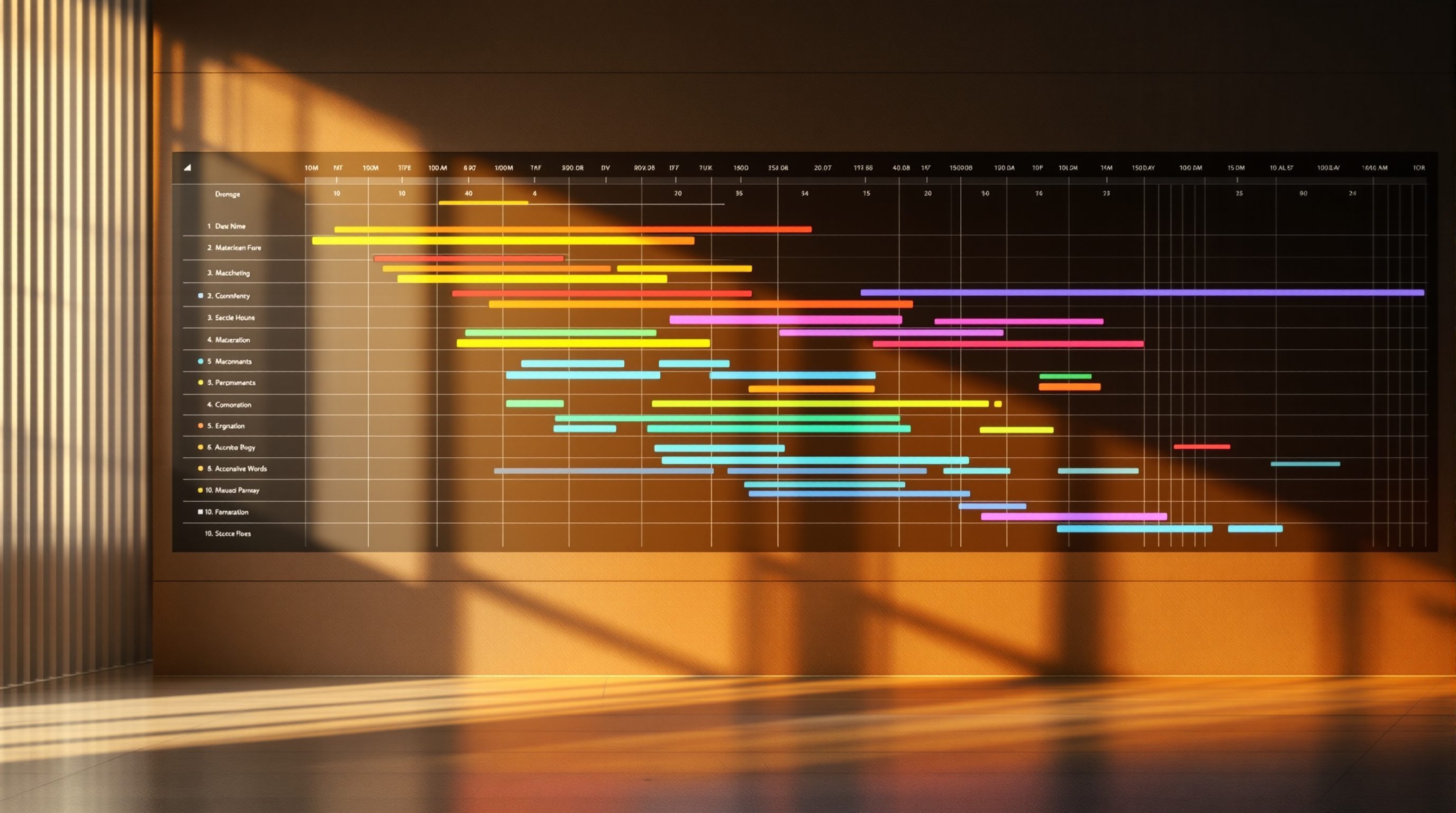
Once the work is broken down, planning turns it into a programme - a model of the project laid out in time. The universal way to draw a programme is the Gantt chart (or bar chart): a table of tasks down the left, a calendar across the top, and a horizontal bar for each task showing when it starts, how long it runs, and when it ends. Simple to read and quick to grasp, the Gantt chart has been the workhorse of construction planning for a century, and every scheduling tool from a spreadsheet to specialist software produces one.
But a row of bars is only a picture until you add the two things that make it a model. The first is duration - an honest estimate of how long each task really takes, drawn from experience, from similar past projects, or from the people who will actually do the work, not from wishful thinking or from working backwards from a deadline. The second, and more important, is the relationships between tasks - which we come to next. A Gantt chart whose bars are just placed by hope, with nothing connecting them, cannot tell you anything useful when reality shifts. A properly linked one recalculates: move one bar and everything that depends on it moves too, so the chart becomes a live instrument rather than a static poster.
In practice, keep two versions in your mind and your files. The baseline programme is the agreed plan, frozen at the start, against which progress is measured - the reference that lets you say, honestly, whether you are ahead or behind. The live or current programme is that baseline updated with what has actually happened and re-forecast forward. Comparing the two - baseline against actual - is the heart of programme control, and it is what turns 'I feel like we're behind' into 'we are eleven days behind on the critical path, here, and here is the recovery.'
Dependencies and the critical path
The reason some tasks cannot simply be done in parallel is dependency: you cannot build walls before foundations, cannot plaster before the services are in the walls, cannot paint before you plaster. The commonest dependency is finish-to-start - task B cannot start until task A finishes - but there are others: start-to-start, finish-to-finish, and lagged relationships where B starts a set time after A. Mapping these dependencies across the whole project produces a network, and running the logic through that network reveals the single most important concept in scheduling: the critical path.
The critical path is the longest chain of dependent tasks through the project - the sequence that determines the shortest possible overall duration. Its defining feature is that the tasks on it have zero float (also called slack): if any one of them slips by a day, the whole project finishes a day later. Tasks off the critical path have float - room to move without affecting the end date. This distinction is pure gold for a manager, because it tells you where to spend your attention. A delay to a task with two weeks of float is a shrug; a delay to a critical-path task is an emergency. The critical path method (CPM) is the technique for finding and tracking this chain, and even a rough, hand-drawn version of it changes how you run a job.
The practical wisdom is to know your critical path and guard it ferociously. Identify the handful of tasks that truly drive the end date - often the long-lead items (a bespoke facade, an imported lift, a slow statutory approval), the structural sequence, and the wet trades that must dry. Protect those with buffer, chase their inputs early, and never let a critical-path decision wait on someone's convenience. Meanwhile, do not waste anxiety on tasks with generous float. Managing by the critical path is how experienced planners stay calm: they are watching the few things that matter, not drowning in the many that do not.
A slip on the critical path moves the finish line. A slip on a floated task moves nothing. Know which is which.
Milestones: the dates everyone actually watches
Buried in every programme are a few dates that matter more than the rest - the ones the client, the bank, the authorities and the team genuinely care about. These are milestones: significant, zero-duration markers of a key achievement or decision point. Common building milestones include design freeze, submission for statutory approval, approval received, tender issued, contract signed, site possession, foundations complete, structure topped out, watertight (the building envelope closed), services commissioned, and practical completion or handover. A milestone has no duration of its own; it is a flag planted at a moment that says 'this must be true by now.'
Milestones do three useful jobs. They give the whole team a shared set of targets to steer by, cutting through the detail of hundreds of tasks to a handful of memorable dates. They are the natural points for reporting progress to the client and for triggering payments - contracts and cashflows are often structured around milestone achievement. And they are early-warning devices: missing an upstream milestone, or seeing it about to slip, is your earliest honest signal that the end date is at risk, long before the final bar moves. A programme with well-chosen milestones is far easier to communicate and to control than one that is just a thicket of tasks.
Choose them deliberately. Too few and the programme has no intermediate checkpoints, so problems hide until late; too many and they lose their meaning and nobody watches any of them. Aim for a manageable set - perhaps one or two per stage - that mark genuine transitions where something real must be complete before the next phase can safely begin. And tie each milestone to a clear, objective definition of done, so 'design freeze' or 'watertight' is a fact you can verify, not a matter of opinion that dissolves under pressure.
Milestones are the dates the client remembers. Miss one and they will remember that too.
Resource loading: a plan you can actually staff
A programme can be logically perfect and still be pure fantasy if it assumes more people, or more hours, than actually exist. Resource loading - assigning the people, hours, equipment and money each task needs, then summing them across the timeline - is the reality check that a schedule too often skips. Lay a programme out and load it, and you frequently discover an impossible peak: three tasks that each need your one detailer, all scheduled for the same fortnight. The logic said it was fine; the resources say it is not.
The fix is resource levelling: smoothing the peaks and troughs by shifting tasks within their float, resequencing, or accepting a longer duration so the work fits the people you have. This is where the abstract programme meets the human reality of a design studio or a site - a studio with four architects cannot draw as if it had ten, and a site with one crane cannot pour as if it had three. Good planners load the programme honestly and adjust it until the resource profile is achievable and reasonably even, because a lumpy profile - famine then a brutal crunch - burns people out and drives the errors that cause rework.
For an architectural practice this matters twice over, because the same people are usually spread across several projects at once. A programme that looks fine in isolation collides with the practice's other commitments; a task that has float on this job has none once you remember the same person is flat out on another. This is why programming a single project well requires a view of the whole studio's workload - a resourcing conversation as much as a scheduling one - and why the practice's overall resource plan and each project's programme have to be reconciled, not drawn in separate rooms.
Why programmes slip - and how to protect them
Programmes slip for reasons that are depressingly predictable, which is exactly why they can be defended. The first cause is optimism: durations estimated by hope rather than history, with no allowance for the friction of real life. The second is the missing dependency - work that could not start because something upstream was not ready, unforeseen because nobody mapped the link. The third is scope creep - the steady accretion of 'small' additions, each unpriced in time, that collectively push the finish out. The fourth is late decisions - the client, the authority or the design team not deciding when the programme needed them to, starving the critical path of its inputs. The fifth is the external shock - monsoon, a labour shortage, a delayed approval, a supply problem.
The defences follow directly from the causes. Estimate durations honestly, from experience and from the people doing the work, and add sensible buffer - not padding hidden in every task, which gets consumed by Parkinson's law, but a visible, protected contingency on the programme as a whole and around the critical path. Map dependencies properly so nothing is a surprise. Control scope through a formal change process (Lesson 6.4), so every addition is a conscious decision with its time cost named. Force decisions to happen on time by making the programme's need for them explicit and visible - a decision-required-by date is as real a deadline as any task. And build resilience for the shocks you cannot predict by keeping float on the critical path and long-lead items ordered early.
Above all, protect the programme by using it. A programme drawn once and filed is worthless; a programme reviewed every week - actual against baseline, critical path re-checked, next milestone in the crosshairs - is the single most powerful control tool a project has. Slippage caught early is recoverable with a small correction; slippage discovered late is a crisis. The whole discipline of programming comes down to that: build an honest model, then keep looking at it.
A programme in a drawer is decoration. A programme reviewed every Monday is a control system.
Work Breakdown Structure (WBS)
Hierarchical decomposition of the full scope into manageable, ownable tasks; governed by the hundred-percent rule
The foundation of the programme, the cost plan and the risk register - build it once, well, and get the team to agree it.
Critical Path Method (CPM) and the Gantt / bar chart
Techniques for modelling task dependencies to find the longest driving chain, and for drawing the schedule against a calendar
The critical path tells you which tasks actually drive the end date (zero float) and where you can afford to relax (tasks with float).
RIBA Plan of Work (2020) stages
A staged structure a programme can be organised around, from strategic definition through design to construction and handover
A natural top level for an architectural WBS and programme, aligning planning with how the design work itself is staged.
PMI / APM scheduling guidance
Established bodies of knowledge covering estimating, sequencing, resource management and schedule control
Reference them for rigorous definitions of dependencies, float, baselining and resource levelling.
Workshop - build a WBS and find the critical path
This exercise takes one project and walks it from an undifferentiated 'job' to a real programme with a critical path you can defend - the core move of planning, done by hand so you understand it before any software does it for you.
Paper and sticky notes (best for learning) or a spreadsheet; software optional and secondary.
Goal: turn a project into a work breakdown, a linked programme and an identified critical path
Inputs: one project (a small building, a fit-out, or a well-known type)
Time: ~75 minutes
- 1Build a work breakdown structure: start from the whole project and subdivide - by stage, then by package, then by task - until each bottom item is something one person could own and estimate. Check it against the hundred-percent rule: is all the scope captured, and nothing invented?
- 2For each bottom-level task, estimate an honest duration - ask yourself or a colleague who has done it, not what would fit a deadline. Note where you are least confident; those are your riskiest estimates.
- 3Map the dependencies: for each task, write what must finish before it can start. Draw arrows. You now have a network, not just a list.
- 4Trace the longest chain of dependent tasks from start to finish - that is your critical path and it sets the shortest possible duration. Mark which tasks have float (room to move) and which have none.
- 5Add three to five milestones at genuine transitions, each with an objective definition of done. Then stress-test: if your least-confident estimate is wrong by 50 percent, does it hit the critical path, and what is your buffer?
You’ll walk away with
A one-page WBS, a simple linked Gantt or network sketch, a clearly marked critical path, and a short list of milestones - plus a note on where the programme is most fragile.
Three altitudes on the same idea
Read the band that fits you — or all three.
Insist on a real programme for every project, however small, and make the design team's own deliverables part of it - your drawings are on somebody's critical path, and a late issue is your delay to own. Programme the studio's workload across all live projects, not just each job in isolation, because the same people are shared and a single-project plan that ignores that is fiction. Treat the decisions you owe the project - and the ones you must extract from the client - as hard-dated tasks, because starved decisions are the commonest cause of slippage you can actually control.
As the project lead you own the programme, so build it from a proper work breakdown, link the dependencies, and know your critical path cold - those are the few tasks whose slip moves the finish, and they deserve most of your attention. Load it against the resources you actually have, not the team you wish you had, and level the peaks before they become a crunch. Then run it live: compare actual to baseline every week, watch the next milestone, and act on small slips before they compound into a recovery you cannot make.
Learn the work breakdown structure and the critical path now - they are the two ideas that turn 'the project is late' into 'this specific task, on this chain, slipped, and here is why.' Practise on your own studio projects: break a design task into pieces, estimate honestly how long each takes, and notice how badly you underestimate at first. That gap between your estimate and reality is the single most valuable thing you can learn about planning before you ever run a real job.
“A programme is basically a promise to the client about the completion date - so the smart move is to draw the bars to hit the date they want, and then push everyone to make it happen.”
Do it yourself
Pressure-test your grasp of scheduling.
- 1A task on your programme slips by five days. What is the one question you must ask before deciding whether to panic?
- 2Name three likely long-lead items on a mid-sized building, and explain why each belongs on your critical-path watch list.
- 3Your programme is logically sound but assumes one person does three overlapping tasks at once. What is this problem called, and what are your options?
- 4Which is more dangerous to the end date: a two-week slip on a task with three weeks of float, or a one-day slip on a critical-path task? Why?
The one idea to carry out
Peer-reviewed journals & authoritative standards
- 01APM Body of Knowledge - scheduling, estimating and resource management — Association for Project Management (APM), 2019.
- 02PMBOK Guide - schedule management and the critical path method — Project Management Institute (PMI), 2021.
- 03Programme, critical path and work breakdown structure - knowledge articles — Designing Buildings Wiki, 2024.
- 04RIBA Plan of Work 2020 - staging design and construction — Royal Institute of British Architects (RIBA), 2020.
A programme tells you when the work happens; the cost plan tells you what it costs, and the two are joined at the hip - money is spent as the programme unfolds, which is why the cost curve traces the shape of the schedule. Next we turn to managing the money: cost plans, estimates, value engineering, and the S-curve that links spend to time.
The author
Amogh N P
Architect, interior designer, and creative polymath. Studio Matrx began in his notebooks — his vision of design made honest, useful, and open to everyone. Its Academy is written and taught in his memory, and free, forever.
More about Amogh →