
Kota Stone: the floor that takes a crowd
A familiar Indian floor deserves a more careful specification than 'use Kota.'
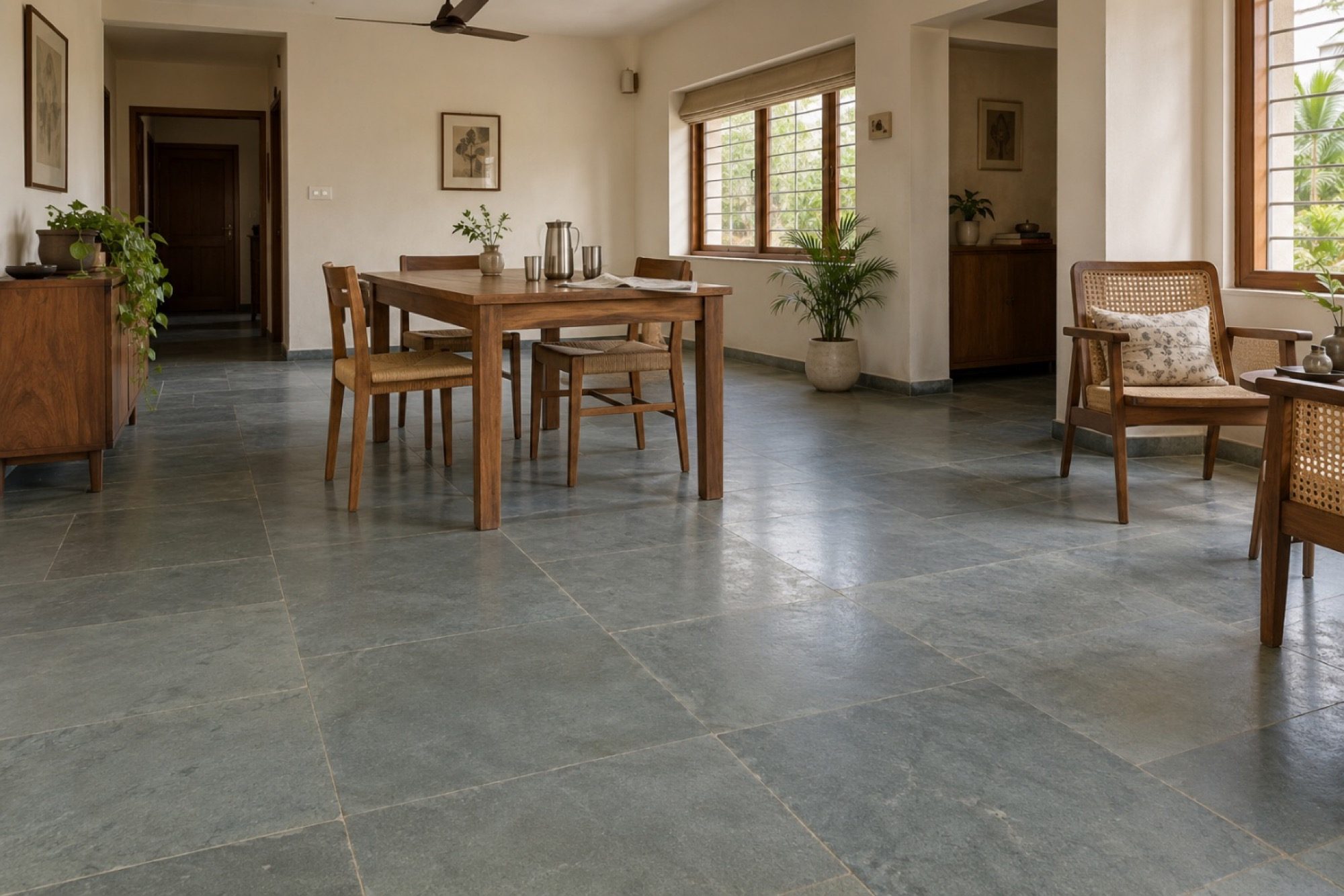
Kota stone holds an unusual place in Indian architecture. It is familiar enough to fade into the background — homes, institutions, corridors, verandas, staircases — without ever announcing itself as a luxury material. That familiarity makes specification seem deceptively simple: choose Kota, pick a shade, polish it, move on. But a Kota floor is not decided by the stone alone. Slab quality, thickness, surface finish, the bedding beneath, how joints and construction changes are handled, the workmanship during laying and polishing, and the conditions of use all decide whether it ages quietly or becomes a source of cracks, unevenness, staining and constant maintenance.
Geologically, Kota is a fine-grained limestone from the Ramganjmandi–Jhalawar–Kota belt of Rajasthan. The Indian Bureau of Mines records its use for interior flooring, wall cladding and exterior work; the Bureau of Indian Standards maintains IS 1128, the specification covering limestone slabs and tiles. Both are reminders that Kota is not a colour or a generic trade name — it is a natural stone whose individual pieces vary, and whose performance depends on selection.
Its appeal is not that it stays unchanged. 'Durable' should not be read as 'indestructible': natural stone can still crack if its support moves, chip at vulnerable edges, stain when substances sit on it, or develop a finish very different from day one. That ageing is part of why Kota works in a frequently occupied home — a high-gloss surface makes every scratch feel like damage, while Kota, with the right finish and realistic expectations, lets gradual wear become character rather than failure. Chairs move, children run, serving vessels are carried between kitchen and dining, furniture is rearranged when relatives visit.
Finish changes the material you actually experience. A photograph labelled 'Kota' tells you little about how the floor behaves underfoot: a naturally split surface, a honed surface and a highly polished surface produce very different results from the same stone family — in appearance, cleaning, tactile character and traction when wet. This matters most at entrances, verandas, kitchens and outdoor-to-indoor transitions. Do not assume 'natural stone' is slip-safe: the Bureau of Mines notes the slip resistance of the naturally split surface, but once processed and polished the surface changes. Test the proposed finish under real conditions.
The floor is more than the slab. A useful correction is to stop treating the visible stone as the whole floor — what happens beneath matters as much. CPWD's 2023 schedule, for example, describes one Kota assembly using 25 mm slabs over an average 20 mm cement-mortar base in a 1:4 mix, then jointing, rubbing and polishing — a documented government example, not a universal dimension to copy. This matters especially in renovation, where the floor build-up can collide with door thresholds, skirting and bathroom transitions if it is not coordinated before levels are fixed.
Joints are part of the design, not something to hide later. The slab module should coordinate with room dimensions, thresholds, columns and material changes; tiny perimeter cuts make an otherwise calm floor look unresolved. More importantly, do not confuse the joints between stones with movement joints in the building — bridging a required movement joint with continuous stone transfers stress to the finish and cracks it. Understand where movement must occur before setting out the stone.
Stone floors are often called 'cool,' but the word needs care. Stone draws heat from the body differently than timber, which is why it can feel cool to bare feet in the same room — but whether that is welcome depends on climate, season, orientation, air-conditioning and the occupants. In a warm climate that tactile coolness is often why stone is loved in living areas and semi-open spaces; in a strongly air-conditioned interior another household may feel it differently. This is where specification becomes household-specific.
And 'maintenance-free' is a myth. Routine care is simple — keep abrasive grit from under moving feet and furniture, address spills promptly, protect edges when moving heavy objects — but because Kota is limestone, aggressive acidic cleaners can react with the calcium-rich stone and change the finish. Repolishing should not be automatic either: two owners can look at the same ageing floor and disagree about whether it needs intervention. Maintenance is partly technical and partly a decision about how much age the household will accept.
This is also where a low material quote misleads. The completed cost may include slabs, sorting, cutting, edge treatment, transport, wastage, bedding, laying, jointing, rubbing, polishing, skirting, stair pieces, level correction and final cleaning. CPWD's 2023 Delhi Schedule of Rates listed its specified 25 mm Kota item at ₹1,948.25 per square metre — evidence of what one defined public-works item included at one point in time, not a 2026 retail price. The better question than 'what is the rate of Kota?' is 'what exactly is included in this rate?'
Kota's strength is not fashion or nostalgia. It is that, in the right conditions, a familiar natural stone becomes a durable, visually quiet part of everyday life — valuable in homes where floors support far more than staged occupation. But familiarity should make us more precise, not less. Specify the actual stone, understand its variation, choose a finish for the conditions rather than the photograph, coordinate the build-up before fixing levels, treat joints as construction, and compare complete quotations. A floor that takes a crowd is not simply one that survives being walked on — it is one whose material, construction and maintenance still make sense after the crowd has gone.
Source note — Geological identity and applications: Indian Minerals Yearbook 2021, Indian Bureau of Mines. Slab/tile specification reference: IS 1128, BIS (check current status/amendments with BIS). Construction and schedule-rate examples: CPWD Delhi Schedule of Rates 2023. Historic/public-works specifications explain principles here, not universal residential specs or current retail pricing. Verify stone thickness, assembly, movement-joint treatment, slip performance, structural suitability, cleaning system and installation details per project.