Studio Matrx Monthly · Volume 1 · Issue 5 · October 2026
Loading…
Tips on interior design, AI in home styling, and inspiration for Indian homes.
 02
02Explore how algorithmic façade design transforms building envelopes through parametric modelling, generative algorithms, environmental simulation and multi-objective optimisation—allowing architects to create responsive, performance-driven façades balancing daylight, energy, comfort, carbon, constructability and architectural expression.
 03
03Discover the essential Grasshopper workflows every young architect should master—from parametric geometry and data trees to environmental analysis, structural form-finding, optimization, digital fabrication, BIM interoperability and scripting—to build smarter, performance-driven and adaptable architectural design systems
 04
04Parametric architecture is far more than curved buildings. Discover how computational design uses relationships, performance data, optimisation, BIM and digital fabrication to create responsive, efficient and adaptable architecture—transforming parametric design from a tool for complex geometry into a powerful methodology for architectural decision-making.
 05
05Computational design is transforming architecture from drawing fixed forms to designing intelligent systems of parameters, algorithms, simulations and generative workflows. Discover how parametric design, generative design, optimisation, BIM and AI help architects explore possibilities, evaluate performance and make better-informed design decisions.
 06
06Architecture schools must move beyond teaching AI as an image-generation tool. This article proposes a future-ready framework integrating AI literacy, generative design, BIM, GIS, simulation, ethics, critical thinking and human judgement to prepare architecture students for an AI-augmented profession.
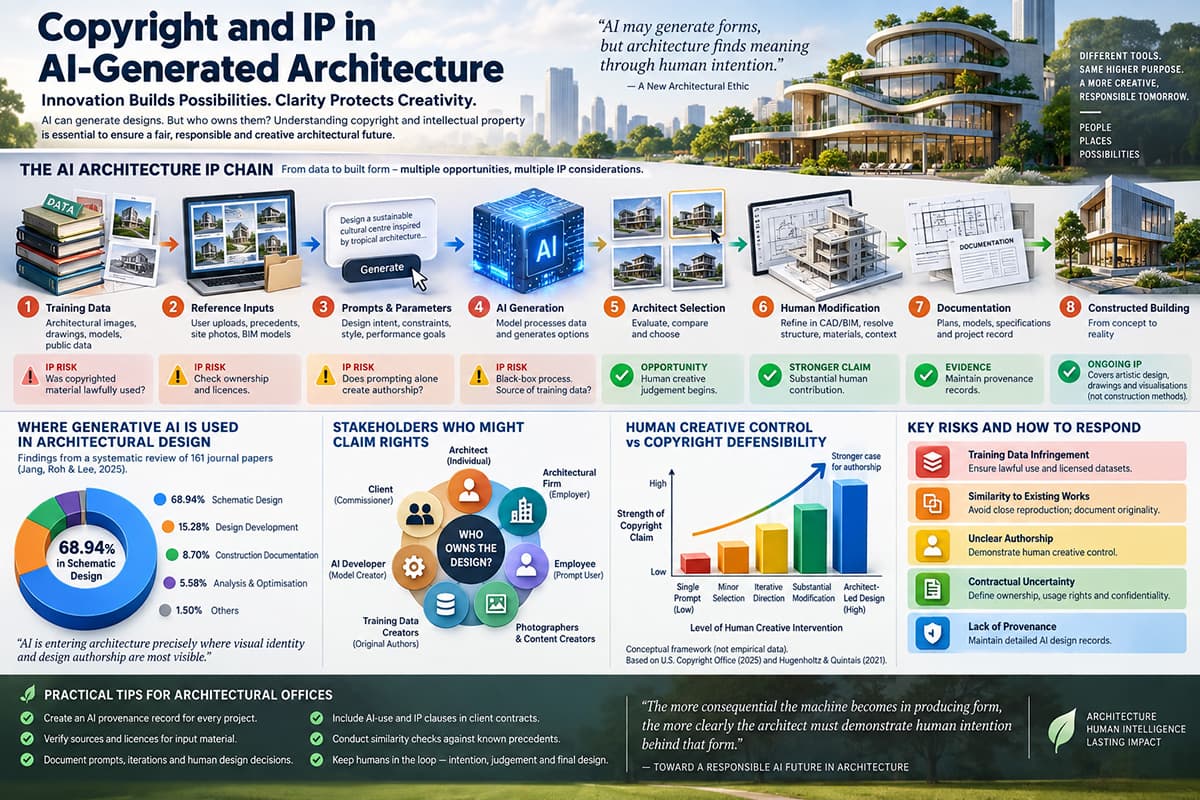 07
07AI-generated architecture is transforming design—and challenging traditional ideas of authorship, copyright and intellectual property. Explore who owns AI-assisted designs, how human creative control affects copyright, the risks of training data and stylistic imitation, and why architects need robust IP and provenance strategies.
 08
08Human-in-the-Loop Architecture offers a powerful alternative to autonomous AI design. By combining generative intelligence, simulation and optimisation with human creativity, contextual understanding, ethical judgement and professional accountability, architects can harness AI while remaining firmly in control of the decisions that shape our built environment.
 09
09AI hallucinations in architecture can transform convincing digital outputs into inaccurate designs, false code interpretations, impossible geometry and unreliable BIM decisions. This article examines architectural AI hallucinations, their risks, causes and consequences, and explains how RAG, simulation, BIM validation and human verification can create safer AI-assisted design workflows.
 10
10Can AI truly understand architectural context? Explore how artificial intelligence interprets climate, urban fabric, culture, history, vernacular architecture and human experience—and why the future of design may lie in architect-led, AI-augmented contextual intelligence.

