
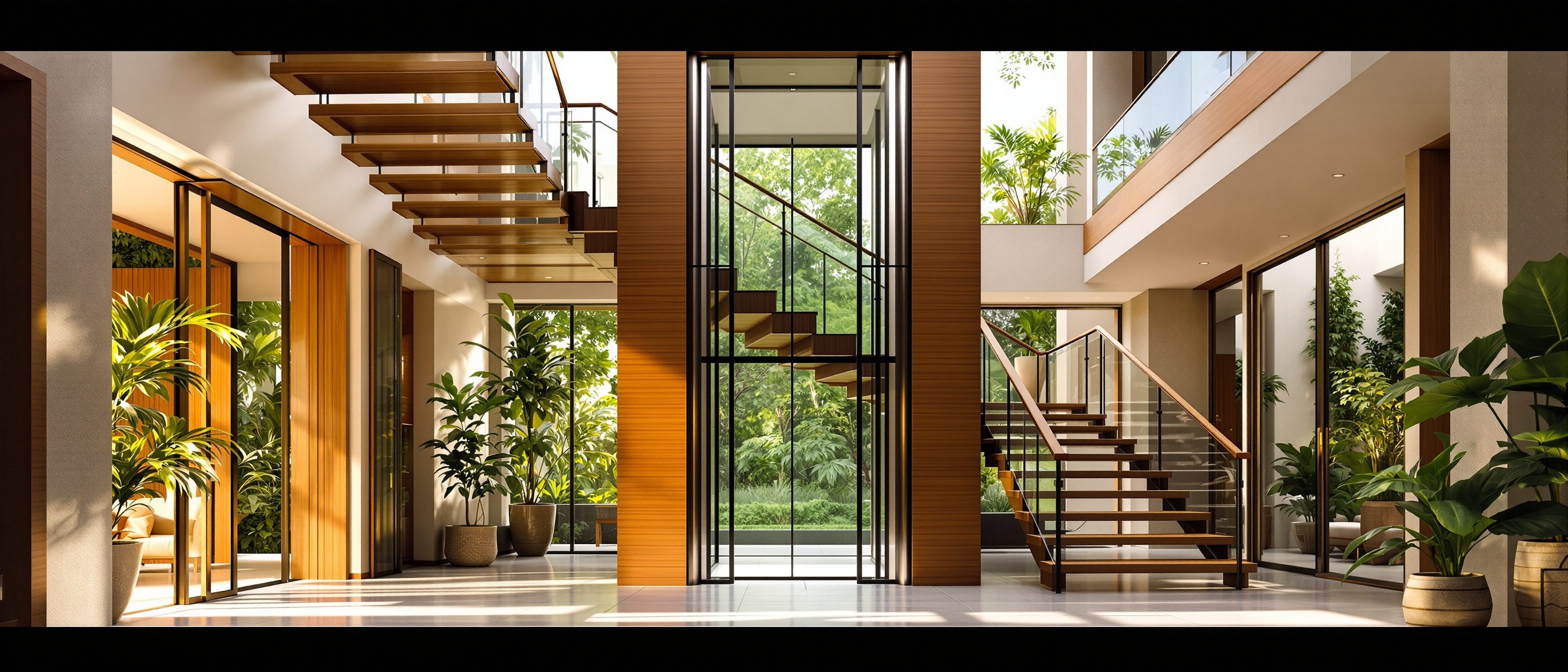
Lift Planning for Villas (India): Multi-Floor Bungalows and Independent Homes
Where to place the lift, which type to choose, and how to provision for future floors in a G+1 to G+3 villa or bungalow.
A villa gives you something an apartment never can: control over the section. You decide where the floors stack, how the stair turns, where light falls and — crucially — where the lift lives. That freedom is the whole point of this guide. In a G+1 to G+3 independent home or bungalow, the lift is not a code-forced afterthought squeezed into a service core; it is a deliberate piece of architecture you can wrap into the stair, hang in a courtyard, or float through a double-height living space.
This is the villa-specific spoke of the Architect's Residential Elevator Handbook (India). It assumes you already know the basics from the pillar — instead it goes deep on the three decisions that define a villa lift: where to put it (stair core versus statement), what type to choose (gearless MRL, hydraulic, or panoramic PVE), and how to provision for floors you have not built yet. For raw clearances see home lift space requirements; for the stair relationship see lift and staircase integration; for premium cabins see lifts for luxury residences.
A villa lift planned at the section stage costs a fraction of one cut into finished concrete later. The cheapest lift you will ever buy is the shaft you leave empty.
All dimensions, costs and regulatory triggers below are indicative — confirm them with your local municipal bye-laws, a licensed lift contractor and your structural engineer. Lifts are state-regulated in India and the numbers vary by vendor, model and year.
Why a villa lift is its own planning problem
Most lift-planning advice is written for apartment towers, where the lift is one of dozens, traffic is heavy, and the architect optimises for waiting time and core efficiency. A villa is the opposite case: one lift, light use, and a section you authored from scratch. That changes the priorities completely.
- Travel is short — typically G+1 to G+3, so two to four stops. Speed barely matters; smoothness, silence and reliability matter far more.
- Use is gentle but lifelong — the villa lift may carry two adults, a suitcase, or one day an ageing parent in a wheelchair. It must be planned for the household it will have in twenty years, not just today.
- It is visible — there is no anonymous service core to hide it in. In a villa the lift sits beside the stair, in the entrance, or in a glazed shaft you can see from the living room. It is part of the interior.
- You set the rules of the section — floor-to-floor heights, the stair geometry, the pit depth, the overhead. Nothing is fixed for you, which is freedom and responsibility in equal measure.
Because most independent homes sit below the heights that trigger a mandatory lift or a fireman's lift (a lift is generally expected only above roughly 13 m of building height; a fireman's lift only above 15 m, with some residential rules at 30 m — verify locally), the villa lift is usually a chosen convenience, not a forced one. That means every decision is yours to optimise for comfort, accessibility and beauty rather than minimum compliance.
Step one: locate the lift — core, statement, or both
Where the lift goes is the single most consequential decision, and in a villa you genuinely have options.
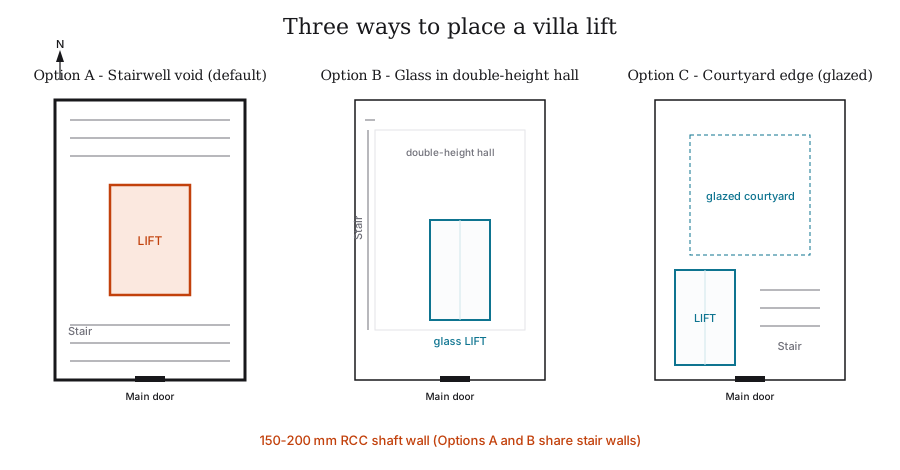
Option A — inside or beside the stair core
The default, and usually the right answer. Indian homes almost always have a stair, and traditional Vastu places the staircase in the south-west; the lift is conventionally kept adjacent to the stair (more on Vastu below). Co-locating the two has real architectural logic:
- One vertical service zone keeps the rest of the floor plate open and rentable.
- Structurally, the RCC stair core and the RCC lift shaft can share walls and brace each other — efficient and stiff.
- It reads naturally: people expect the lift where the stair is.
- The stair remains the everyday, healthy route; the lift is there for luggage, the elderly and bad knees.
The classic move is to wrap the lift inside the stairwell void — the open well in the middle of a dog-leg or spiral stair. This puts the lift at the heart of circulation with almost no extra floor area. See lift and staircase integration for the geometry, and the existing designing a staircase in India and staircase Vastu guides for the stair side of the equation.
Option B — the glass statement lift
When the villa has a double-height living room, a courtyard, or a generous entrance hall, the lift can become a feature object rather than a hidden utility. A panoramic glass car — most easily a pneumatic vacuum elevator (PVE) — rising through a double-height space is one of the most striking pieces a residential interior can hold. It signals quality, it borrows daylight, and it turns a functional necessity into sculpture. This is the territory of lifts for luxury residences and overlaps with the existing luxury villa architecture (India) guide.
Option C — courtyard / external integration
Many Indian villas are built around a courtyard or have a generous setback. A lift can sit at the edge of a double-height courtyard, glazed on the garden side, so the cabin offers a changing view as it rises. This works beautifully with panoramic or PVE cars. Two cautions: an externally-exposed shaft needs weatherproofing and good thermal/ventilation design (a glazed shaft in full sun gets hot), and you must respect plot setbacks — the shaft footprint counts. Coordinate early.
The Vastu overlay — honour it, but engineering wins
Many Indian villa clients hold strong Vastu preferences, and it is worth reconciling them with the plan early rather than fighting over them late. Traditional lift-Vastu guidance:
- Favoured: north or north-east; south-east or north-west are also acceptable in many readings.
- Avoid: the south-west corner (kept "heavy and grounding" — mechanical movement is said to disturb it), the exact centre (Brahmasthan), and a position directly opposite the main door.
- The pit is preferably to the north or east.
- Since the staircase is traditionally south-west and the lift is usually kept beside the stair, there is a built-in tension with the "avoid south-west" rule — a common compromise is to place the lift on the north-east edge of the stair zone.
Treat Vastu as a cultural preference to be accommodated where it does not conflict with structure, safety or sensible planning — where they clash, engineering and accessibility win. See lift placement and Vastu, staircase Vastu and Vastu house plans (India) for the full treatment.
Step two: choose the lift type for a villa
Three families dominate the villa segment. The right choice depends on travel height, whether the home is new or being retrofitted, and how much you want the lift to show.
Gearless traction MRL — the all-round default for new villas
Machine-room-less traction is the 2026 norm. The gearless machine sits inside the hoistway, so there is no separate machine room to find space for — a real advantage in a home. It is energy-efficient, smooth, quiet and handles G+2/G+3 comfortably. It needs a proper RCC shaft, a designed pit (often 1200–1500 mm for gearless types) and around 2600–3000 mm of overhead. If you are building new and want a conventional enclosed car, MRL is usually the answer. Cost is roughly ₹10–25 lakh and up before civil work and GST.
Hydraulic — quiet, low-pit, ideal for low-rise
A hydraulic lift uses a piston to push the car. It is smooth, very quiet, and needs only a shallow pit (≈150–300 mm) — attractive where digging deep is awkward (high water table, rock, or a slab already poured). The compact power pack can sit in a small adjacent cabinet rather than a full machine room. It suits two to four floors well, which covers almost every villa. It is slower and has oil/temperature considerations, but in a low-use home that rarely bites. Cost roughly ₹8–20 lakh. The companion code is IS 15259.
Panoramic pneumatic vacuum elevator (PVE) — the statement and the easy retrofit
A PVE lifts a cylindrical, panoramic glass cabin on an air-pressure differential. Its defining trait: no pit, no shaft, no machine room, fully self-supporting. That makes it the easiest lift to drop into an existing villa, and its 360-degree glass cabin makes it the natural choice for the "statement" placements above. The trade-offs are real: capacity is limited (around two to three persons), travel and speed are modest, and it draws more power on the ascent (it descends by controlled gravity). Cost roughly ₹11–22 lakh. Nibav is the best-known India-grown PVE brand; Elite Elevators and premium imports such as Aritco also serve this segment.
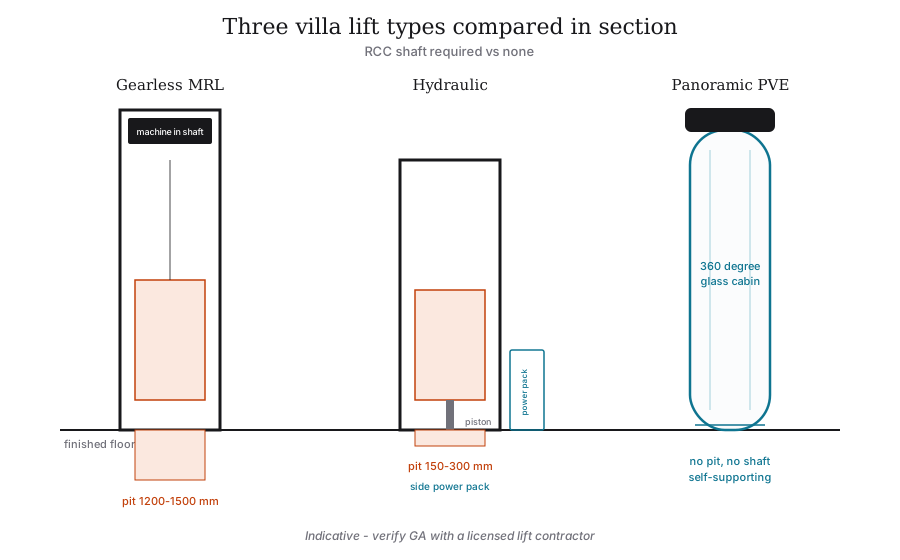
| Criterion | Gearless MRL traction | Hydraulic | Panoramic PVE |
|---|---|---|---|
| Best for | New-build G+1 to G+3 | New or retrofit, 2–4 floors | Retrofit / statement, 2–3 stops |
| Pit depth | ≈1200–1500 mm | ≈150–300 mm | None |
| Machine room | None (machine in shaft) | Small adjacent cabinet | None |
| Shaft | RCC shaft required | RCC shaft required | Self-supporting, no shaft |
| Look | Enclosed cabin | Enclosed cabin | 360° panoramic glass |
| Capacity | Up to ~8 persons | Up to ~8 persons | ~2–3 persons |
| Indicative cost | ₹10–25 lakh+ | ₹8–20 lakh | ₹11–22 lakh |
Whatever the type, insist on an Automatic Rescue Device (ARD) — a battery that brings the car to the nearest floor and opens the doors on a power cut. Given Indian outages this is non-negotiable. Pair it with door sensors / light curtain, an overspeed governor and safety gear, overload sensor, emergency alarm and intercom. The full list is in the lift specification checklist (India).
Step three: size it for the household, not the minimum
Villa lifts are easy to undersize because the everyday load is light. Resist that. The car has to work for the home's whole life, including the day someone needs a wheelchair. Use the accessible benchmark as your floor, not the 2-person micro-lift:
- Car ≈ 1100 × 1400 mm — fits a wheelchair plus an attendant, and takes a stretcher in an emergency.
- Clear door width ≥ 900 mm, and automatic telescopic/sliding doors — manual swing doors are cheapest but block wheelchairs and are awkward for the elderly.
- Handrail ≥ 600 mm long at 800–1000 mm height near the controls; automatic door dwell ≥ 5 seconds.
- Rear mirror to reverse a wheelchair out; Braille/tactile buttons; audio and visual floor indicators.
- A lift lobby of about 1800 × 1800 mm at each landing so a wheelchair can turn.
These come from the CPWD / MoHUA Harmonised Guidelines and the RPwD Act 2016 framework. Private homes are not legally bound by them, but they are the right best-practice benchmark — and they cost almost nothing to honour at the planning stage. See accessible home design (India) and senior-friendly lift planning. For exact clearances by car size, the space requirements and lift shaft design guides have the tables.
Step four: build the section — a multi-stop villa lift
In a villa you are drawing the lift in section as you draw the house. A few section-level rules:
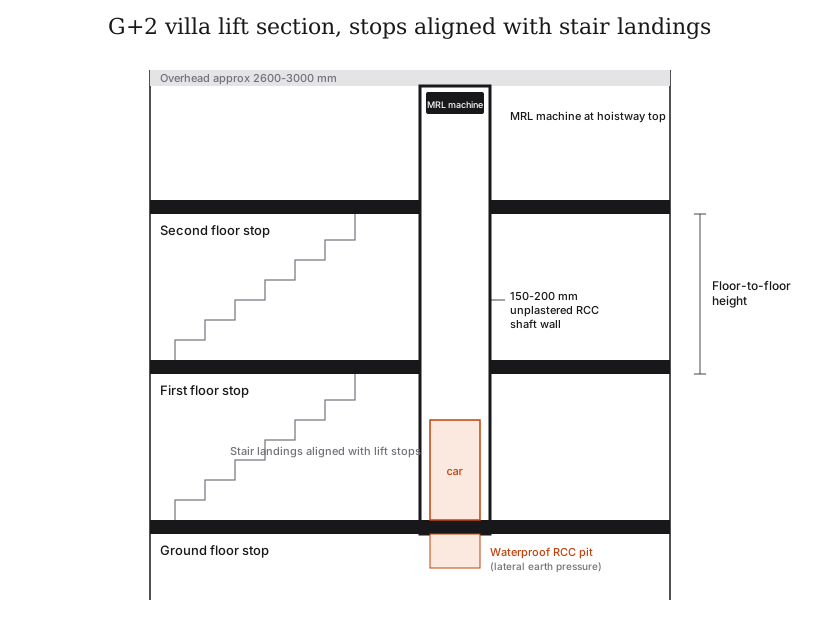
- Align the stops with the stair landings where possible, so the lift and stair arrive at the same level and the lobby is shared.
- Pit and overhead are designed to the vendor's general-arrangement (GA) drawing. Never finalise the shaft before the lift vendor's GA and reaction loads are fixed — pit and overhead slabs commonly crack when buffer/impact forces are underestimated. The structural design, shaft design and pit requirements guides cover the engineering; the machine room requirements guide covers MRL versus machine-room layouts.
- Shaft walls are typically 150–200 mm RCC; leave the internal face unplastered (plaster reduces clearances and can spall onto running gear) and design the walls for the guide-rail bracket reactions the supplier specifies.
- The pit is a waterproof RCC box designed for lateral earth pressure — vital in villas with high water tables or monsoon flooding risk.
Step five: provision for floors you have not built yet
This is the move that separates a well-planned villa from a regretful one. Many Indian families build G+1 now and add floors as the family grows or budgets allow. The time to plan the lift is now, even if you install it later.
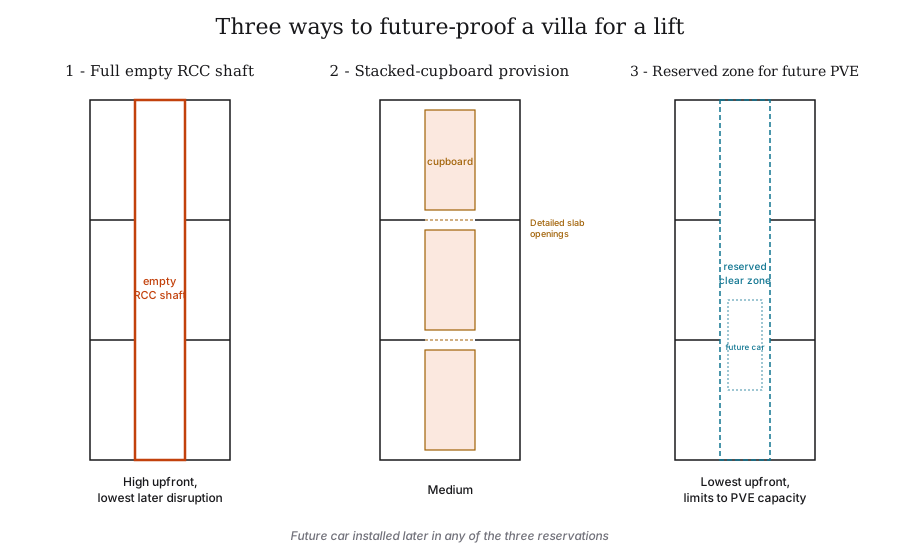
There are three levels of future-proofing, in rising order of commitment:
1. Full provision — build the complete RCC shaft, pit and overhead through all planned floors at construction, finish the openings, and simply leave the shaft empty until you install the car. This is the gold standard: the expensive civil work is done once, with the rest of the structure, at the lowest possible cost.
2. Stacked-cupboard provision — stack identically-sized cupboards or storage niches one above another in the exact lift footprint on each floor, with the slab openings already detailed (and temporarily slabbed over). When you are ready, you knock through aligned openings rather than cutting a random shaft.
3. Shaftless future — leave a clear two-to-three-floor vertical zone (a double-height corner, a wide stair void) where a self-supporting PVE can later be dropped in with minimal civil work. Lowest upfront cost, but limits you to PVE capacities.
Cutting a shaft into finished concrete later — see retrofitting a lift into an existing home — is disruptive and costly. Provisioning now is far cheaper. The lift-ready, future-proof home and designing a lift into a new house guides go deep on the provisioning detail; this guide's job is to make sure you decide before the slabs are poured.
Villa scenarios — a quick decision table
Use this to find your starting point, then confirm everything with a licensed lift contractor and your structural engineer.
| Villa type | Floors / stops | Recommended type | Placement | Notes |
|---|---|---|---|---|
| Compact G+1 bungalow | 2 stops | Hydraulic (shallow pit) or PVE | Beside stair core | Low travel; shallow pit avoids deep excavation |
| Standard G+2 family villa | 3 stops | Gearless MRL | Stairwell void | The all-round default; align stops with stair landings |
| G+3 large villa | 4 stops | Gearless MRL | Dedicated stair-core shaft | Larger travel rewards traction smoothness and speed |
| Courtyard / double-height villa | 2–3 stops | Panoramic PVE or glass MRL | Courtyard edge / double-height hall | Statement object; weatherproof an external shaft |
| Retrofit into existing villa | 2–3 stops | PVE (no pit/shaft) | Stair void / open corner | Easiest cut-in; see retrofitting guide |
| Build-now, extend-later villa | Build G+1, provision G+2/G+3 | MRL once installed | Full empty RCC shaft now | Provision the whole shaft at construction |
| Senior-occupant villa | Any | MRL/hydraulic with full accessibility kit | Near bedrooms and entry | 1100×1400 car, auto doors, handrail, ARD, low buttons |
For duplex-specific planning (a two-level home within one structure) see lift planning for duplex homes and the existing duplex house plans guide; for tight urban plots see lift design for narrow plots.
Costs, regulation and maintenance — the villa view
Budget the lift as car plus civil work plus installation plus 18% GST. The headline car costs above exclude the RCC shaft, pit and electricals, which in a villa you fold into the main construction contract. By floor count, a 2-floor/G+1 installation runs roughly ₹11.99–18 lakh and rises with each added stop.
On regulation: lifts are state-regulated, and roughly ten states (Maharashtra, Gujarat, Karnataka, Kerala, Tamil Nadu, Assam, West Bengal, Delhi, Haryana, Himachal Pradesh) require an installation licence before commissioning, an operation licence/registration, and periodic safety inspection by the state lift inspectorate — by a government inspector, not a private firm. Even where your state has no Act, IS 14665 and NBC 2016 Part 8 Section 5 remain best practice. Confirm your obligations before you commission.
On maintenance: take a written AMC. Non-comprehensive contracts cover routine service but bill major parts separately; comprehensive ("bumper-to-bumper") contracts cost roughly 60–70% more but cap surprise bills. Standard service is about twelve monthly preventive visits a year plus emergency calls; indicative small-residential cost is ₹20,000–38,500 a year. Read the fine print — many contracts exclude pit flooding (an "act of God"), motor, controller, rope and aesthetic modernisation. For full cost detail see home lift cost (India 2026) and the residential elevator buyer's guide.
The villa lift checklist
- Decide placement at section stage — stair core (default), glass statement, or courtyard edge.
- Reconcile Vastu preferences with structure early; engineering and accessibility win conflicts.
- Choose type by travel and intent: MRL for new-build, hydraulic for shallow-pit low-rise, PVE for retrofit/statement.
- Size for the household's whole life — 1100 × 1400 car, ≥900 mm automatic doors, handrail, mirror.
- Fix the vendor's GA and reaction loads before casting the shaft, pit and overhead.
- Build a waterproof RCC pit and unplastered shaft; design walls for guide-rail brackets.
- Specify ARD battery backup and the full safety kit — never skip it.
- Provision the full shaft now if you plan to add floors later.
- Sort your state licence/registration and a comprehensive AMC before commissioning.
A villa lift done right disappears into the architecture when you do not need it and becomes the most appreciated convenience in the house when you do. Plan it into the section, not onto it.
References
- IS 14665 — Electric Traction Lifts (BIS, committee ETD 25). Part 1, outline dimensions: https://law.resource.org/pub/in/bis/S05/is.14665.1.2000.pdf and Part 2, installation/operation/maintenance: https://law.resource.org/pub/in/bis/S05/is.14665.2.1-2.2000.pdf
- IS 15259 — Hydraulic Lifts (BIS companion code, by name).
- National Building Code of India 2016, Part 8 (Building Services), Section 5 — Installation of Lifts, Escalators and Moving Walks (BIS): https://www.bis.gov.in/standards/technical-department/national-building-code/ and the Guide for Using NBC 2016: https://www.bis.gov.in/wp-content/uploads/2022/08/Booklet-Guide-for-Using-NBC-2016.pdf
- Rights of Persons with Disabilities (RPwD) Act 2016 (full text): https://ssepd.odisha.gov.in/sites/default/files/2024-01/RPWD%20ACT.pdf and DEPwD FAQs: https://depwd.gov.in/en/faqs-4/
- CPWD / MoHUA Harmonised Guidelines and Space Standards for a Barrier-Free Built Environment (2016): https://www.cpwd.gov.in/Publication/Harmonisedguidelinesdreleasedon23rdMarch2016.pdf
- State Lift Acts (by name): Maharashtra Lifts, Escalators and Moving Walks Act 2017; Karnataka Lifts, Escalators and Passenger Conveyors Act 2015; Delhi Lifts and Escalators Act 2007; Tamil Nadu Lifts Act 1997. Maharashtra licence to operate a lift (Govt Services Portal): https://services.india.gov.in/service/detail/maharashtra-license-to-operate-lift
- Lift regulations overview (99acres): https://www.99acres.com/articles/know-all-about-the-lift-regulations-in-india.html
- Structural requirement for lifts and lift pits (Civilera): https://www.civilera.com/post/structural-requirement-for-lifts-and-lift-pits
- Lift Vastu guidance (NoBroker): https://www.nobroker.in/blog/lift-vastu/ and SubhaVaastu: https://www.subhavaastu.com/vastu-tips-lift.html
Export this guide
Related Guides — Deep-dive reading
Designing Adaptable & Universal-Design Homes
Accessibility, Aging-in-Place, and the Multi-Stage Family — Code, Anthropometrics, and Plan-Stage Discipline for Indian Residential Architects
Room PlanningBuilding Codes for Residential Elevators (India): NBC 2016 and Local Bye-Laws
How NBC 2016 Part 8 Section 5 and your municipal building bye-laws decide when a home lift is required, where its shaft goes, and how it must be built and fire-protected.
Home Lifts & AccessibilityHome Lift Planning Checklist (India): Everything to Decide Before You Buy
A printable, ten-stage checklist that takes you from the first family conversation to a signed handover.
Home Lifts & AccessibilityRelated Tools — Try Free
Cross-Ventilation Analyzer
Estimate airflow and air changes per hour (ACH) from room size, window areas, layout, and local wind — with NBC 2016 Part 8 compliance check.
Ventilation CalculatorAccessibility Compliance Calculator
Check a planned lift against the CPWD and RPwD accessible-lift benchmarks for a score.
Lift CheckerHome Lift Cost Calculator
All-in home lift cost by floors, type, capacity and city — equipment, civil, GST and AMC, with a drive-type comparison.
Lift Calculator