
Machine Room Requirements for Home Lifts (India): MRL vs Machine-Room, Space and Services
Why machine-room-less is the 2026 home default — and, when a separate machine room is still used, its size, location, ventilation, access, lighting and the supplier-given hoist-beam load.
For most Indian homes specified in 2026, the honest answer to "where does the machine room go?" is: there isn't one. The machine-room-less (MRL) traction lift, with its gearless motor tucked into the top of the hoistway, has become the residential default — and it quietly removes a whole room, a slab penalty and a coordination headache from the drawing set. But "MRL" is not a magic phrase that erases every machine. A hydraulic lift still wants a power-pack cabinet somewhere nearby; an MRL still imposes a concentrated hoist-beam load on the overhead structure; and a handful of installations — heavier cars, specific vendor models, or where a designer simply prefers serviceable plant — still carry a discrete machine room.
This guide is the machine-room spoke of the Residential Elevator Handbook for India. It goes narrow: when a separate machine room is still used, how big it is and where it sits; its ventilation, temperature, access and lighting; the hoist-beam load you must extract from the supplier; and the precise space and cost arithmetic that makes MRL the better choice for almost every home. For the shaft and slabs around it, lean on the Lift Shaft Design Guide, the Lift Pit Requirements guide and the Home Lift Structural Design guide.
One sentence to take into every client meeting: in 2026, specify MRL unless a concrete reason forces a machine room — and price the room, the slab and the ventilation if you do.
All dimensions, loads and costs here are indicative — confirm with your local municipal bye-laws, your structural engineer and a licensed lift contractor. Lifts are state-regulated in India; the machine arrangement you draw must match the vendor's approved general-arrangement (GA) drawing before any slab is cast.
What the standards actually say about machine rooms
IS 14665 Part 1 — the BIS standard for outline dimensions of electric traction lifts — covers the car, the well (hoistway), the pit, the headroom and the machine room as a set. It is the document your vendor's GA drawing answers to, and it is aligned with the European EN 81 family. Crucially, IS 14665 Part 1 was written when the machine room on top (or, less often, beside the shaft) was the norm; the MRL arrangement, where the machine lives inside the well, is the newer convention that the market has since standardised on for homes.
NBC 2016, Part 8 (Building Services), Section 5 — Installation of Lifts, Escalators and Moving Walks — governs lift installation at the building level. For hydraulic lifts specifically, IS 15259 is the companion code (cited here by name only). None of these mandate a separate room for a home lift; they set out the dimensions and safety rules that apply whichever arrangement you choose. The practical decision is yours and the vendor's.
Two framings matter for an architect:
- A machine room is a room — a usable, accessible enclosure with its own door, floor, ventilation and lighting, sized to let a technician stand and work around the machine. It eats plan area and adds a structural slab.
- A machine space is not a room — it is a defined volume (the top of an MRL hoistway, or a small cabinet for a hydraulic power pack) that houses plant but is not entered as a habitable space. It is serviced through hatches, the topmost landing or a cabinet door.
The whole MRL-versus-machine-room question is really: do you need a room, or will a space do? For homes, a space almost always does.
MRL: the 2026 norm, and why it wins for homes
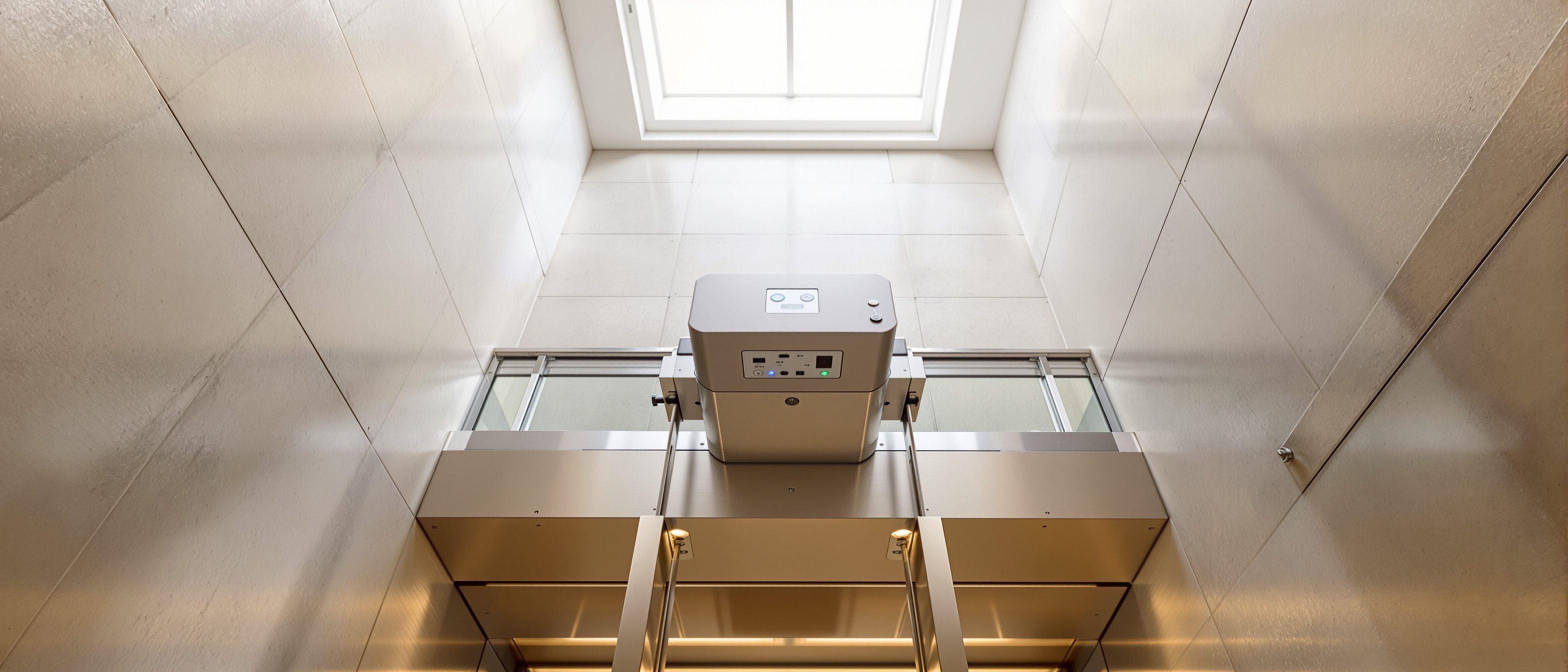
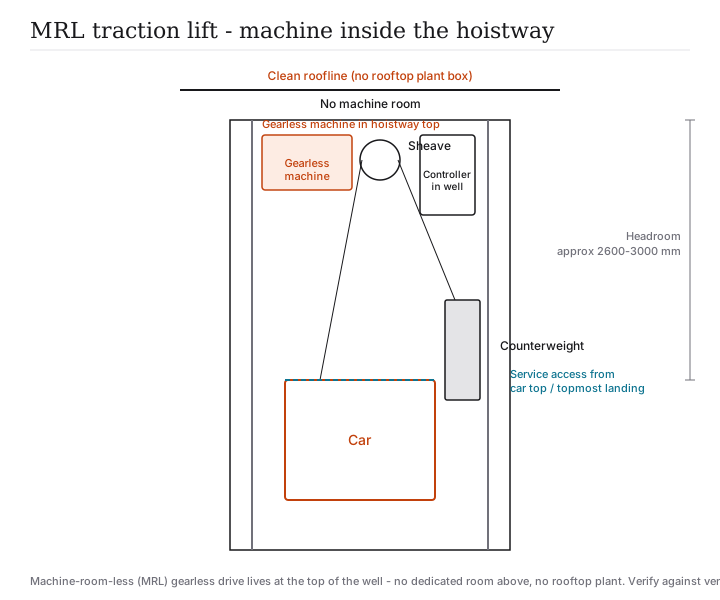
In a machine-room-less traction lift, the gearless motor and the controller sit inside the hoistway — typically at the top, on the guide rails or on a bracket off the well wall — and are reached for service from the car top or the topmost landing. There is no room above the shaft and no machine-room slab. As the fact base notes, MRL "is the 2026 norm: the machine sits inside the hoistway, no separate machine room," it is energy-efficient, faster and smooth, and it "needs a little more pit/headroom than hydraulic." Headroom for MRL home models runs roughly 2600–3000 mm depending on the model.
For a house, the advantages stack up fast:
- No room to build. You delete a 4–6 sq m enclosure plus its slab, door, ventilation louvres and lighting circuit from the design — and from the budget.
- No machine-room slab penalty. The overhead still carries a hoist-beam reaction (see below), but you are not pouring and finishing a separate floor a technician walks on.
- Cleaner roofline and Vastu options. Removing the rooftop machine room means no protruding plant box above the terrace — useful on small plots and for Vastu-led placement, where roof clutter and the lift's position are both sensitivities.
- Lower running cost. Gearless MRL machines are energy-efficient; the fact base flags running cost as "modest for MRL."
- Faster, smoother ride than hydraulic, with a small additional pit/headroom ask.
The trade is that the machine, controller and overspeed governor now live in the shaft, so the hoistway top and the overhead slab must be designed to carry and brace them — which is exactly where the hoist-beam load (below) comes in. Service access is from the car top, so the shaft and topmost landing must allow safe technician access. For new homes this is straightforward to provision; see Designing a Lift into a New House and Lift-Ready, Future-Proof Home.
When a separate machine room is still used
A discrete machine room has not vanished entirely. You may still draw one when:
- the vendor's chosen model for a heavier or larger car is supplied with a traditional geared/gearless machine that wants a room;
- the client or maintenance regime prefers plant that a technician can walk into and service at floor level rather than from the car top;
- a legacy or imported product line specifies it; or
- site constraints make in-hoistway service impractical.
Top versus side location
A machine room sits in one of two places:
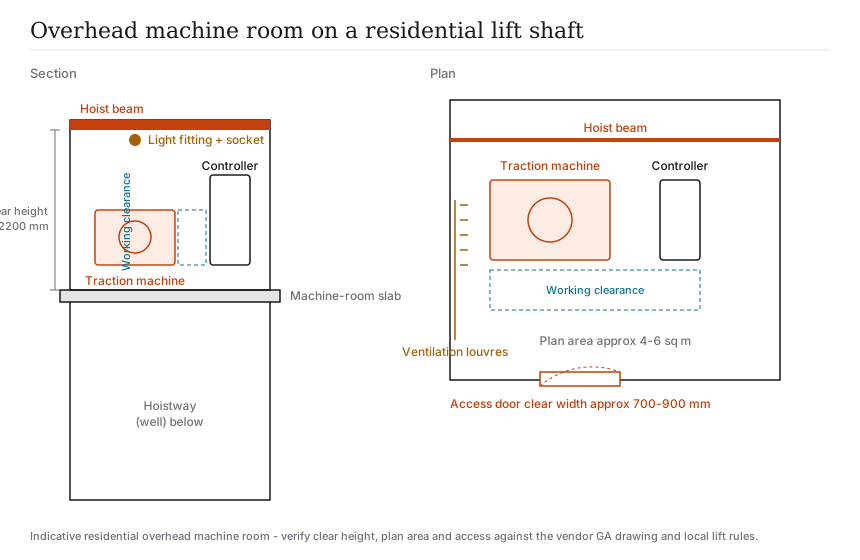
- Overhead (on top of the shaft) — the classic arrangement. The machine slab sits directly above the hoistway; ropes drop straight down to the car and counterweight. This is the most space-efficient in plan (it stacks over the shaft) but it puts a room on the roof and loads the overhead slab.
- Side / adjacent (at the lowest level or beside the well) — more common with hydraulic and some geared layouts, where the machinery does not need to be directly above the car. This keeps the roofline clean but consumes plan area on a floor.
Indicative machine-room dimensions and clearances
Treat these as starting points only — the vendor GA drawing governs:
| Machine-room attribute | Indicative figure (verify on GA) |
|---|---|
| Plan area (small home traction) | ≈ 4–6 sq m, larger than the shaft footprint |
| Clear height | ≈ 2000–2200 mm so a technician can stand and work |
| Plan extent | Usually exceeds the well so there is working space around the machine |
| Access door clear width | ≈ 700–900 mm, lockable, opening outward |
| Working clearance around machine | Maintain a clear path on the serviceable sides per GA |
| Floor | Level RCC slab able to carry machine plus hoist-beam reaction |
Ventilation and temperature control
Lift machinery and controllers generate heat and must not be allowed to cook. A machine room needs cross-ventilation — louvred openings or a small extract/exhaust fan — to keep the space within the controller's rated temperature band. In Indian summers this is not optional: an over-temperature controller will trip, stranding the car. Where natural ventilation cannot hold the temperature, a small dedicated cooling unit may be specified by the vendor. Keep the room dry; group it away from water tanks and plumbing routes.
Access, lighting and housekeeping
- Access must be safe and direct — a proper door (not a hatch the homeowner squeezes through), reachable without crossing a hazard, and lockable so children and untrained occupants cannot enter.
- Lighting — a permanent light fitting controlled at the door, plus at least one socket for service tools. A technician should never work by torchlight.
- Use only as a machine room — it is not storage. The fact base lists pit flooding and neglect among real-world failure modes; the same discipline applies to the machine room: keep it clean, dry, ventilated and clear.
The hoist-beam load: the number you must extract from the supplier
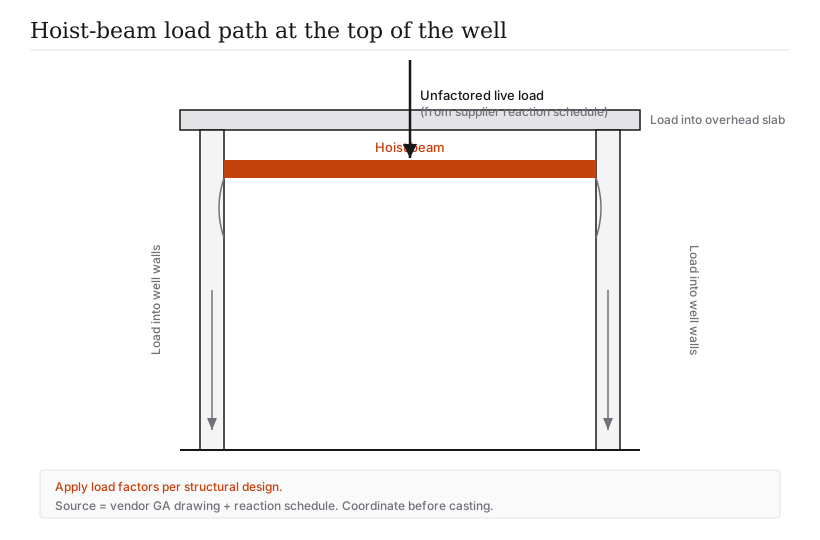
Whether you build a machine room or go MRL, there is almost always a hoist beam (or hook) at the top of the well, used to lift and rig the machine and heavy components during installation and major service. And in an MRL or overhead-machine arrangement, the overhead structure carries the running machine loads too.
The single most important rule from the structural fact base: the hoist-beam force is given as an unfactored live load by the supplier, and the overhead slab and any beam must be designed for it. You do not estimate this number — you request the vendor's reaction schedule and hand it to your structural engineer.
Pit and overhead slabs commonly crack when buffer or impact forces are underestimated. Get the supplier's reaction schedule, design to it, and never finalise the overhead before the GA is fixed.
What the architect and structural engineer must do:
- Coordinate before casting. As with guide-rail bracket reactions on the shaft walls, the overhead beam and slab are designed to the vendor's GA and reaction loads. The Home Lift Structural Design guide covers the full reaction-schedule workflow.
- Treat the hoist-beam figure as unfactored live load. Apply the appropriate load factors per the structural design; do not assume the supplier's number is already factored.
- Provide buffer/impact capacity at the bottom too — that belongs with the pit, but it is the same coordination discipline: the supplier's reaction schedule drives both the overhead and the pit slab design.
- Account for the machine-room slab as a separate working floor with its own load case if a room is built.
The hydraulic power pack: a small "machine space," not a room
Hydraulic home lifts deserve a special note because they sidestep the room question differently. A piston/ram pushes the car, and the power pack — the pump, motor, oil tank and valve block — sits in a small adjacent cabinet, not a full machine room. The fact base is explicit: for a hydraulic lift, "the power pack can sit in a small adjacent cabinet." Practically that means a ventilated enclosure a metre or so wide near the shaft, often at the lowest landing.
This is a machine space, not a habitable machine room. It still wants:
- Ventilation — hydraulic oil and the pump motor generate heat; keep the cabinet cool and the oil within its working temperature.
- A small footprint near the shaft — plan it into the lowest-floor layout early so it does not collide with a stair or a staircase-integrated lift.
- Access for service — a cabinet door, not a crawl space.
Hydraulic suits low-rise homes (2–4 floors), has a shallow pit (≈150–300 mm) and is cost-effective (≈₹8–20 lakh). The cabinet keeps the "machine" small and local — a sensible middle ground between a full machine room and a fully in-hoistway MRL. See the Residential Elevator Buyer's Guide for type selection and the Home Lift Cost guide for budgeting.
MRL versus machine-room: the comparison
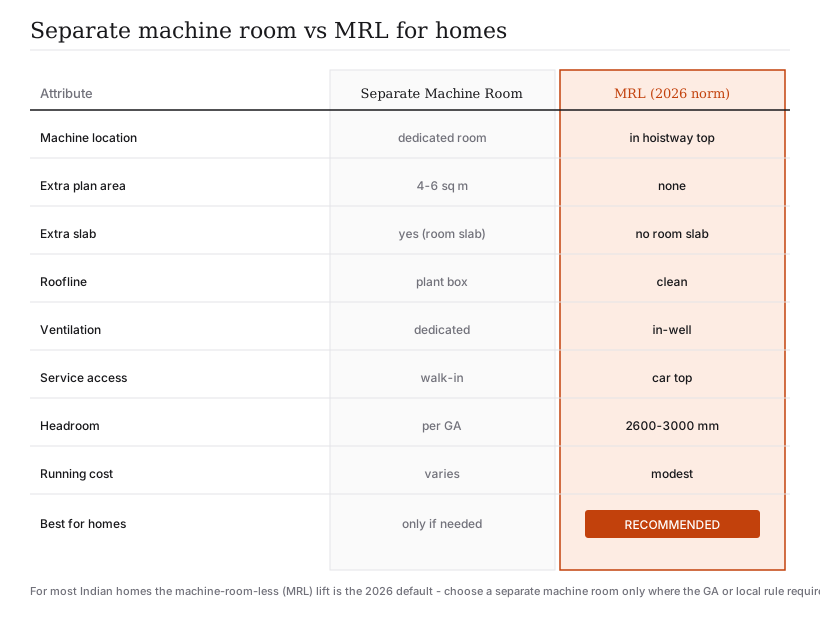
| Attribute | Separate machine room | MRL (machine-room-less) — 2026 norm |
|---|---|---|
| Where the machine sits | In a dedicated room, overhead or beside the shaft | Inside the hoistway, typically at the top |
| Extra plan area | ≈ 4–6 sq m room, plus working clearance | None beyond the shaft |
| Extra slab | Yes — a machine-room floor slab to design and finish | No room slab; overhead still carries hoist-beam reaction |
| Roofline impact | Plant box on the roof (overhead type) | Clean roofline, no protrusion |
| Ventilation/cooling | Dedicated cross-ventilation or cooling unit required | Heat managed within the well; controller temperature still to be respected |
| Service access | Walk-in, at floor level | From car top / topmost landing |
| Headroom | Per GA, plus the room above | ≈ 2600–3000 mm, a little more pit/headroom than hydraulic |
| Energy / running cost | Varies by machine type | Modest; gearless and energy-efficient |
| Typical cost band (lift) | Traction/gearless ≈ ₹10–25 lakh+ | Traction/gearless ≈ ₹10–25 lakh+, but no room civil cost |
| Best for homes? | Only when a model or maintenance regime needs it | Yes — the default recommendation |
The cost line deserves a caveat: the lift hardware band is similar, but a machine room adds civil cost — the room, its slab, door, louvres and lighting — which MRL avoids. The fact base reminds us that civil work and installation are usually extra to the headline lift price, and GST at 18% applies. For a home, deleting the room is real money and real plan area saved.
Coordination checklist for the architect
- Decide early: MRL by default; justify any machine room in writing.
- Get the GA drawing first. Never finalise the shaft, overhead or any machine room before the vendor's general-arrangement and reaction schedule are fixed.
- Hand the hoist-beam load (unfactored live load) to the structural engineer for the overhead beam and slab design; coordinate with pit buffer/impact loads and shaft bracket reactions.
- If a room is built: size it per GA (≈ 4–6 sq m, ≈ 2000–2200 mm clear), give it a lockable door, cross-ventilation or cooling, permanent lighting and a socket, and keep it for plant only.
- If hydraulic: plan the power-pack cabinet — a ventilated machine space — near the shaft at the lowest landing.
- Check state regulation. Lifts are state-regulated (Maharashtra, Karnataka, Delhi, Tamil Nadu and others); the installation must match the approved arrangement and pass inspection by the state lift inspectorate. See the Lift Specification Checklist.
For the wider workflow, return to the Residential Elevator Handbook pillar and the space-planning spoke, Home Lift Space Requirements. Where the home is being made accessible or future-proofed, pair this with Accessible Home Design and Lift-Ready, Future-Proof Home.
References
- IS 14665 (Part 1) — Electric Traction Lifts: Outline Dimensions (car, well, pit, headroom, machine room, door types), BIS: https://law.resource.org/pub/in/bis/S05/is.14665.1.2000.pdf
- IS 14665 (Part 2) — Code of Practice for Installation, Operation and Maintenance, BIS: https://law.resource.org/pub/in/bis/S05/is.14665.2.1-2.2000.pdf
- IS 15259 — Hydraulic Lifts (companion code for hydraulic installations and power packs) — cited by name.
- National Building Code of India 2016, Part 8 (Building Services), Section 5 — Installation of Lifts, Escalators and Moving Walks, BIS: https://www.bis.gov.in/standards/technical-department/national-building-code/
- Guide for Using NBC 2016, BIS: https://www.bis.gov.in/wp-content/uploads/2022/08/Booklet-Guide-for-Using-NBC-2016.pdf
- CPWD / MoHUA Harmonised Guidelines and Space Standards for a Barrier-Free Built Environment: https://www.cpwd.gov.in/Publication/Harmonisedguidelinesdreleasedon23rdMarch2016.pdf
- Structural requirement for lifts and lift pits (Civilera): https://www.civilera.com/post/structural-requirement-for-lifts-and-lift-pits
- Guidelines for structural design of a lift well/shaft (SketchUp 3D Construction): https://www.sketchup3dconstruction.com/const/guidelines-for-making-perfect-structural-design-of-a-lift.html
- State Lift Acts — Maharashtra Lifts, Escalators and Moving Walks Act 2017; Karnataka Lifts, Escalators and Passenger Conveyors Act 2015; Delhi Lifts and Escalators Act 2007; Tamil Nadu Lifts Act 1997. Maharashtra licence to operate a lift (National Govt Services Portal): https://services.india.gov.in/service/detail/maharashtra-license-to-operate-lift
- Lift regulations in India — overview (99acres): https://www.99acres.com/articles/know-all-about-the-lift-regulations-in-india.html
Figures are indicative and must be confirmed against your vendor's approved general-arrangement drawing, your structural engineer's design and your local municipal bye-laws.
Export this guide
Related Guides — Deep-dive reading
Architect's Residential Elevator Planning Handbook (India): Shaft, Loads, Code & Coordination
The plan-stage reference for carrying a home lift through the drawing board — shaft, structure, pit, code, licensing and accessibility.
Home Lifts & AccessibilityHome Lift Structural Design Considerations (India): Loads, Shaft and Coordination
The loads a home lift imposes, designing the shaft and pit as RCC elements, framed vs load-bearing implications, and the coordination workflow that ties structural design to the vendor's GA and reaction schedule.
Home Lifts & AccessibilityHome Lift Planning Checklist (India): Everything to Decide Before You Buy
A printable, ten-stage checklist that takes you from the first family conversation to a signed handover.
Home Lifts & AccessibilityRelated Tools — Try Free
Rainwater Tank Sizer
How big should your rainwater tank be? Computes annual harvest, recommended tank capacity in litres, water-bill savings, and payback — for 10 Indian cities.
RWH CalculatorLift Headroom Calculator
Required overhead clearance for a home lift, checked against your top-floor height.
Lift CalculatorLift Shaft Size Calculator
Required hoistway, pit and headroom dimensions for a home lift by capacity and drive type.
Lift Calculator