
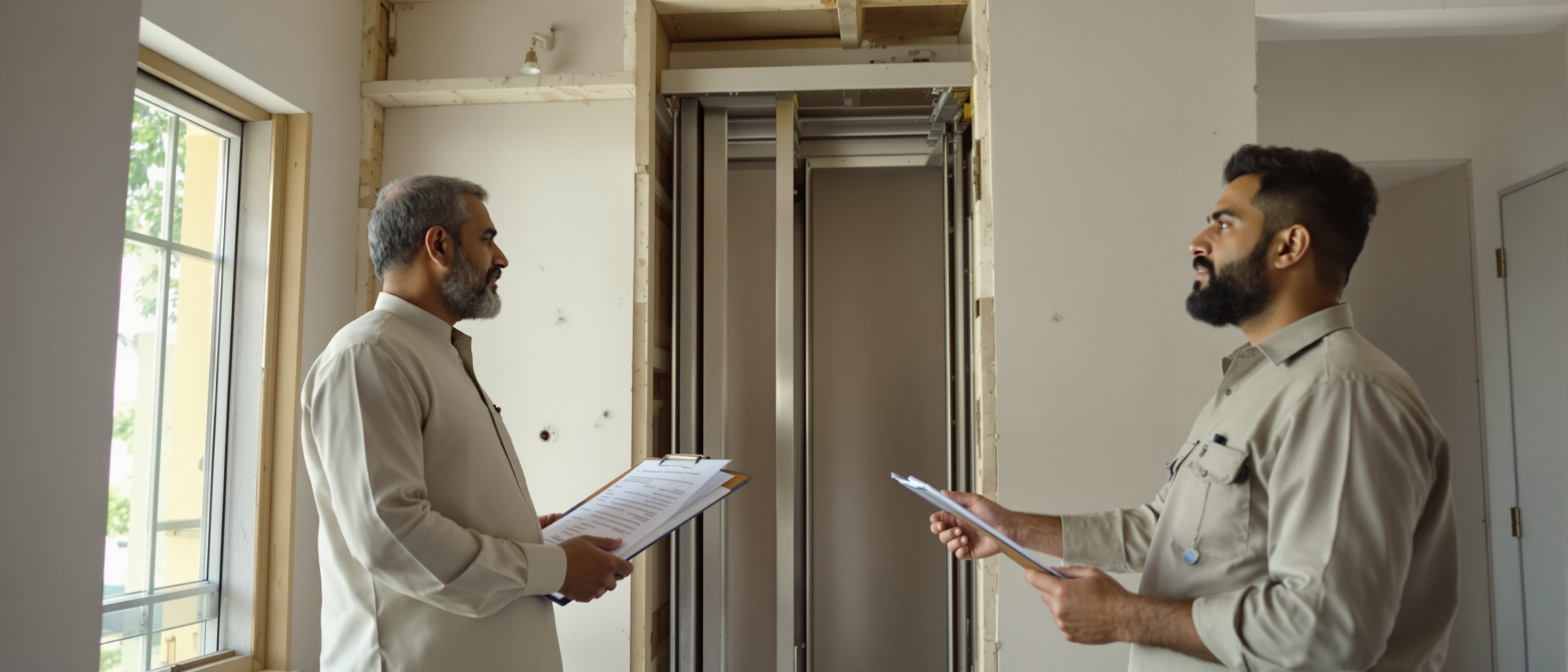
Lift Specification Checklist (India): The Spec Sheet to Hand Every Home-Lift Vendor
One fillable spec sheet that forces every vendor to quote like-for-like on your shaft, your stops, your safety features.
The single most useful thing you can do before talking to home-lift vendors is to hand each one the same filled specification sheet. Without it, one quote describes a 3-person hydraulic with manual swing doors, the next a 6-person MRL traction with automatic telescopic doors, and a third a panoramic pneumatic capsule — and you cannot tell whether you are comparing prices or comparing entirely different machines. A lift specification checklist fixes that. It forces every vendor to quote against your numbers, on your shaft, for your stops, with the safety features you have already decided are non-negotiable.
This guide gives you that sheet. The heart of it is a fillable technical specification table with three columns: the spec line, a worked example for a typical G+2 (ground + two upper floors) home, and a blank column you fill in and photocopy for each vendor. Every line is explained in plain language so you, not the salesperson, control the conversation. Numbers here are indicative and follow Indian practice (IS 14665, NBC 2016 Part 8 Section 5, the state Lift Acts and the CPWD Harmonised Guidelines) — confirm the final figures against your local municipal bye-laws and a licensed lift contractor.
This is the artifact spoke of our Residential Elevator Buyer's Guide for India. Use it alongside the home-lift planning checklist (which sequences the whole project) and the vendor comparison guide (which scores the companies once their quotes arrive).
How to use this sheet
Fill the You require column once, before you contact anyone. Take the building dimensions from your architect's drawings or a measured site survey, not from memory. Then issue the blank table to every shortlisted vendor and insist they return it completed and signed, line by line, attached to their commercial quote. A vendor who will not commit a number to paper is a vendor whose number will change later.
If a spec line is left blank or answered with "standard" or "as per site", treat it as unquoted. Vague specs are where cost over-runs and safety compromises hide.
Three rules make the comparison honest. First, dimensions are the constraint — the lift must fit the shaft you have, so the shaft figures (Section A) are inputs you give them, while the car and door figures are outputs they must prove fit. Second, safety features are not optional extras — Section E is a checklist of must-haves, and a missing tick is a reason to reject the quote, not negotiate it. Third, compliance is the vendor's job to evidence — Section H asks them to name the standards and the licensing they will handle.
The full specification table
Below is the complete sheet. The example column describes a realistic G+2 home installation: a 4-person MRL traction lift, three stops, automatic doors, single-phase where the model allows, with full accessibility and safety provisions. Your own numbers will differ — the point is that the shape of the answer is fixed, so every vendor fills the same boxes.
Section A — Building constraints (you supply these)
These are inputs. Measure them on site and give them to the vendor; do not let the vendor "assume" them.
| ☐ | Spec line | What it means | Example (G+2 home) | You require |
|---|---|---|---|---|
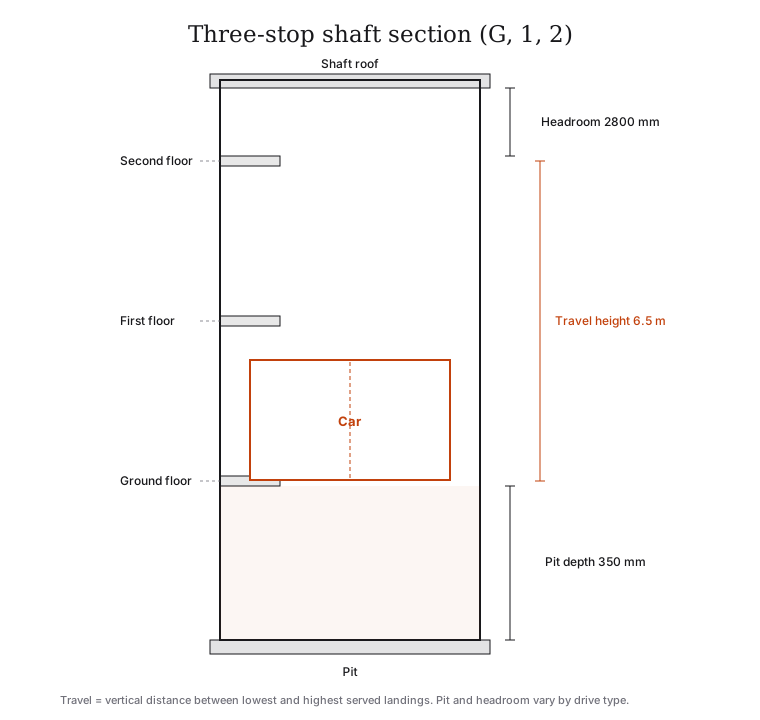
| ☐ | Travel height | Floor-to-floor total rise the car must climb, bottom landing to top landing | 6.5 m (3 stops) | __________ |
| ☐ | Number of stops / landings | How many floors the lift serves | 3 (G, 1, 2) | __________ |
| ☐ | Number of openings per floor | Doors on one side, or through-car (two sides) | 1 side | __________ |
| ☐ | Shaft / hoistway available (W × D) | Clear internal plan of the masonry or structural shaft | 1500 × 1600 mm | __________ |
| ☐ | Pit depth available | Distance from lowest floor to pit floor, below the bottom landing | 350 mm | __________ |
| ☐ | Headroom / overhead available | Clear height above the top landing to underside of shaft roof | 2800 mm | __________ |
| ☐ | Power supply available | Single-phase or three-phase at the lift location | Single-phase 230 V | __________ |
Section B — Capacity and car
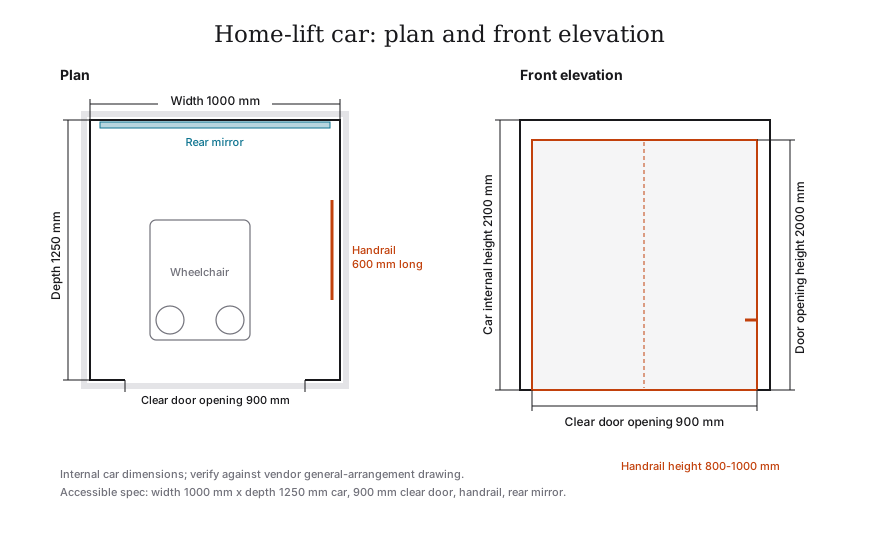
The rated load is the headline number; everything about comfort and wheelchair access flows from it. A 2-person car is roughly 150–204 kg — fine for an ambulant elderly couple but too small for a wheelchair plus attendant. For genuine accessibility, aim for a car around 1100 × 1400 mm internally so a wheelchair user can enter, turn or reverse out.
| ☐ | Spec line | What it means | Example (G+2 home) | You require |
|---|---|---|---|---|
| ☐ | Rated load (persons) | Stated passenger capacity | 4 persons | __________ |
| ☐ | Rated load (kg) | The same capacity in kilograms — the real engineering figure | 272 kg | __________ |
| ☐ | Car internal width × depth | Clear floor inside the cabin | 1000 × 1250 mm | __________ |
| ☐ | Car internal height | Clear ceiling height inside the cabin | 2100 mm | __________ |
| ☐ | Wheelchair-turning provision | Can a wheelchair enter and reverse out (rear mirror helps) | Yes, rear mirror | __________ |
Section C — Doors
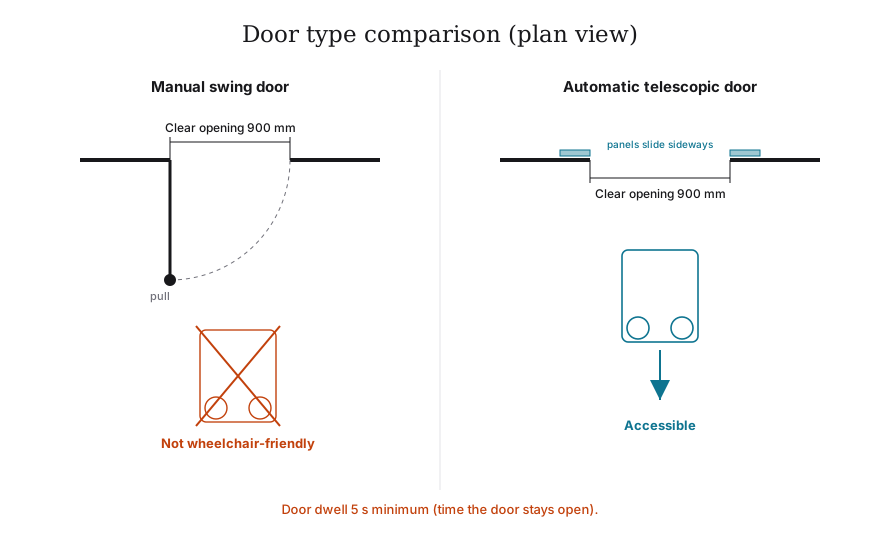
Doors decide accessibility more than any other single choice. Manual swing doors are the cheapest but you must pull them open — impossible from a wheelchair and awkward for a frail user, and they eat lobby space. Automatic telescopic / sliding doors open themselves, are smooth, and are the accessible choice. The CPWD Harmonised Guidelines call for a clear door opening of at least 900 mm for wheelchair access, with automatic doors staying open at least 5 seconds.
| ☐ | Spec line | What it means | Example (G+2 home) | You require |
|---|---|---|---|---|
| ☐ | Door type | Manual swing vs automatic telescopic/sliding | Automatic telescopic | __________ |
| ☐ | Clear door opening width | The actual gap you pass through, not the frame size | 900 mm | __________ |
| ☐ | Door opening height | Clear height of the doorway | 2000 mm | __________ |
| ☐ | Door dwell / open time | How long an automatic door stays open | ≥ 5 seconds | __________ |
| ☐ | Landing door / shaft door material | Finish and fire rating of the doors at each floor | MS powder-coated | __________ |
Section D — Drive, travel and power
The drive type sets cost, smoothness, pit and headroom needs, and energy use. Hydraulic is quiet and cheap for 2–4 floors with a shallow pit. MRL traction (machine-room-less) is the 2026 norm — efficient and smooth with the machine inside the hoistway. Screw / winding-drum is compact and low-maintenance. Pneumatic vacuum (PVE) needs no pit, shaft or machine room and is the easiest retrofit, but has limited capacity. Home-lift speeds are gentle, around 0.15–0.5 m/s.
| ☐ | Spec line | What it means | Example (G+2 home) | You require |
|---|---|---|---|---|
| ☐ | Drive type | Hydraulic / MRL traction / screw / pneumatic vacuum | MRL traction | __________ |
| ☐ | Machine-room requirement | Separate machine room needed, or MRL/self-supporting | MRL — none | __________ |
| ☐ | Rated speed (m/s) | How fast the car travels | 0.4 m/s | __________ |
| ☐ | Pit depth required | What the model needs (must be ≤ your available pit) | 300 mm | __________ |
| ☐ | Headroom required | What the model needs (must be ≤ your available overhead) | 2700 mm | __________ |
| ☐ | Shaft footprint required | Plan the model needs (must fit your shaft) | 1450 × 1550 mm | __________ |
| ☐ | Power supply required | Single-phase or three-phase | Single-phase | __________ |
| ☐ | Connected load (kW) | Peak electrical demand the lift draws | ~2.2 kW | __________ |
Section E — Safety features (every line must be Yes)
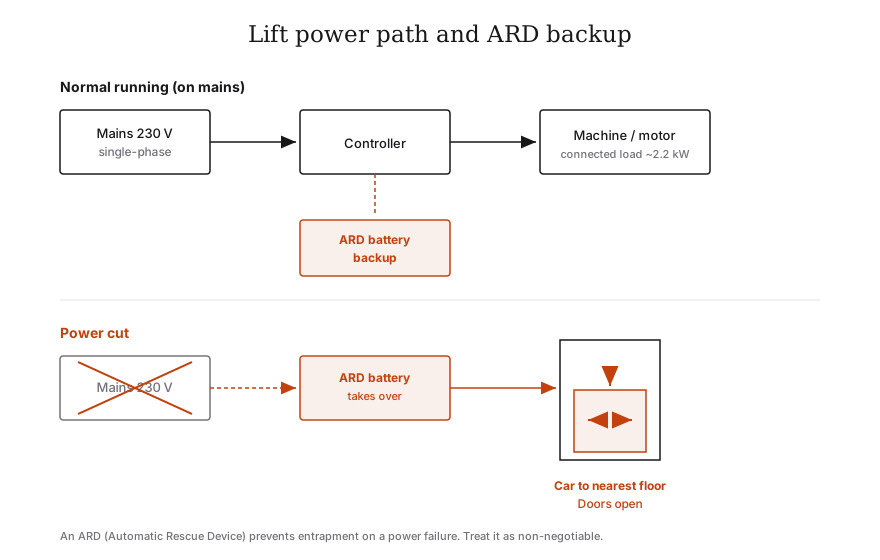
This section is a pass/fail gate. In India, the ARD (Automatic Rescue Device) is essential — on a power cut it runs the car to the nearest floor on battery and opens the doors. Do not buy a lift without it. The overspeed governor and safety gear are the mechanical fail-safes that grip the rails if the car descends too fast; light curtains stop the doors closing on a person; the overload sensor refuses to move an over-filled car.
| ☐ | Spec line | What it means | Example (G+2 home) | You require |
|---|---|---|---|---|
| ☐ | Overspeed governor + safety gear | Grips the guide rails if the car over-speeds | Yes | __________ |
| ☐ | Door light curtain / sensor | Reopens doors if anything is in the path | Yes | __________ |
| ☐ | Overload sensor | Refuses to move an overloaded car, with alarm | Yes | __________ |
| ☐ | ARD / battery backup | Lowers car to nearest floor and opens doors on power cut | Yes | __________ |
| ☐ | Emergency alarm + intercom | Two-way help call from inside the car | Yes | __________ |
| ☐ | Manual lowering provision | Trained release to bring car down by hand | Yes | __________ |
| ☐ | Fireman's switch | Recall function (required on taller buildings) | N/A (low rise) | __________ |
Section F — Controls and signalisation
For an accessible home, controls matter as much as the car. The CPWD guidelines ask for Braille / tactile buttons, audio and visual floor indicators, and a control panel reachable from a wheelchair. A handrail at least 600 mm long, mounted 800–1000 mm above the floor near the panel, gives a standing user support.
| ☐ | Spec line | What it means | Example (G+2 home) | You require |
|---|---|---|---|---|
| ☐ | Braille / tactile buttons | Raised, readable-by-touch floor buttons | Yes | __________ |
| ☐ | Audio-visual floor indicator | Voice announcement + lit display of floor/direction | Yes | __________ |
| ☐ | Control panel height | Reachable from seated/wheelchair position | 900–1100 mm | __________ |
| ☐ | Handrail | Length and mounting height | 600 mm at 900 mm | __________ |
| ☐ | Door open/close + alarm buttons | Clearly grouped and reachable | Yes | __________ |
Section G — Cabin finishes
Finishes are the part vendors love to up-sell, so pin them down. They do not affect safety but they do affect price and feel — and a non-slip floor and a rear mirror are functional, not cosmetic.
| ☐ | Spec line | What it means | Example (G+2 home) | You require |
|---|---|---|---|---|
| ☐ | Wall / panel finish | Cabin interior material | Brushed stainless steel | __________ |
| ☐ | Flooring | Cabin floor material (specify non-slip) | Non-slip vinyl | __________ |
| ☐ | Lighting | Cabin lighting type and level | LED, warm white | __________ |
| ☐ | Ceiling / fan / ventilation | Cabin ventilation provision | LED ceiling + fan | __________ |
| ☐ | Rear mirror | Helps a wheelchair user reverse out | Yes | __________ |
Section H — Compliance, warranty and AMC
Compliance is the vendor's responsibility to evidence. Ask them to name the standards they build to and to confirm who handles the state Lift Act registration where one applies — roughly ten states (Maharashtra, Gujarat, Karnataka, Kerala, Tamil Nadu, Assam, West Bengal, Delhi, Haryana, Himachal Pradesh) require an installation licence before commissioning and an operation licence or registration, with periodic inspection by the government Lift Inspectorate. In states without an Act, IS and NBC remain best practice.
| ☐ | Spec line | What it means | Example (G+2 home) | You require |
|---|---|---|---|---|
| ☐ | Standards compliance | IS 14665 (traction) / IS 15259 (hydraulic), NBC 2016 Part 8 §5 | IS 14665 + NBC 2016 | __________ |
| ☐ | Accessibility benchmark | CPWD Harmonised Guidelines met (≥900 mm door etc.) | Yes | __________ |
| ☐ | State Lift Act registration | Who files the installation + operation licence | Vendor files | __________ |
| ☐ | Equipment warranty | Years on equipment and on the controller/drive | 5 years | __________ |
| ☐ | AMC type offered | Comprehensive vs non-comprehensive, and price/yr | Comprehensive, ~₹35,000/yr | __________ |
| ☐ | Local service presence | Branch/engineer distance and breakdown response time | City branch, 4 hr | __________ |
| ☐ | Civil work + GST in scope? | Whether shaft/pit/electricals and 18% GST are included | Quoted separately | __________ |
The two lines that catch most buyers are the last two in Section D and the last line in Section H: the model's required pit/headroom must be less than or equal to the space you actually have, and the quote must state plainly whether civil work and 18% GST are inside or outside the price. Both are where a "₹12 lakh" lift quietly becomes ₹16 lakh.
Reading the filled sheets
Once vendors return the table, lay the columns side by side. Reject any quote where a Section E safety line is not "Yes". Flag any where the required pit, headroom or shaft footprint exceeds your available space — that lift does not fit, regardless of price. Then move the survivors into the vendor comparison guide, which scores company strength, service network and total cost, and pair it with the AMC evaluation guide before you sign the maintenance contract that will outlast the purchase by decades.
If you are still at the drawings stage, the smartest move is to design the shaft, pit and power to the spec now. Our architect's residential elevator handbook covers the structural and services coordination, and our guides on accessible home design and a lift-ready, future-proof home explain how to leave the provision even if you install the car years later. For the broader picture, see universal design for adaptable homes and future-proofing home design for Indian families.
Hand the same sheet to everyone. The vendor who fills every box honestly, and whose required dimensions fit your shaft, has already told you more than any glossy brochure.
References
- IS 14665 — Electric Traction Lifts (Bureau of Indian Standards): Part 1 outline dimensions (car, well, pit, headroom, door types); Part 2 installation, operation and maintenance; Part 3 safety rules; Part 4 components; Part 5 inspection.
- IS 15259 — Hydraulic lifts (companion code for hydraulic installations).
- NBC 2016, Part 8 (Building Services), Section 5 — Installation of Lifts, Escalators and Moving Walks.
- RPwD Act 2016 (Rights of Persons with Disabilities) — accessibility standards benchmark.
- CPWD / MoHUA Harmonised Guidelines and Space Standards for a Barrier-Free Built Environment (2016; Harmonised Guidelines 2021).
- State Lift Acts — e.g. Maharashtra Lifts, Escalators & Moving Walks Act 2017; Karnataka Lifts, Escalators & Passenger Conveyors Act 2015; Delhi Lifts & Escalators Act 2007; Tamil Nadu Lifts Act 1997.
Source documents:
- IS 14665 Part 1 (BIS): https://law.resource.org/pub/in/bis/S05/is.14665.1.2000.pdf
- IS 14665 Part 2 (BIS): https://law.resource.org/pub/in/bis/S05/is.14665.2.1-2.2000.pdf
- BIS National Building Code 2016: https://www.bis.gov.in/standards/technical-department/national-building-code/
- BIS Guide for Using NBC 2016: https://www.bis.gov.in/wp-content/uploads/2022/08/Booklet-Guide-for-Using-NBC-2016.pdf
- RPwD Act 2016 (full text, Odisha SSEPD): https://ssepd.odisha.gov.in/sites/default/files/2024-01/RPWD%20ACT.pdf
- DEPwD (Dept of Empowerment of Persons with Disabilities): https://depwd.gov.in/en/faqs-4/
- CPWD Harmonised Guidelines: https://www.cpwd.gov.in/Publication/Harmonisedguidelinesdreleasedon23rdMarch2016.pdf
- 99acres — lift regulations in India: https://www.99acres.com/articles/know-all-about-the-lift-regulations-in-india.html
- National Govt Services Portal — Maharashtra licence to operate lift: https://services.india.gov.in/service/detail/maharashtra-license-to-operate-lift
Export this guide
Related Guides — Deep-dive reading
Home Lift Planning Checklist (India): Everything to Decide Before You Buy
A printable, ten-stage checklist that takes you from the first family conversation to a signed handover.
Home Lifts & AccessibilityArchitect's Residential Elevator Planning Handbook (India): Shaft, Loads, Code & Coordination
The plan-stage reference for carrying a home lift through the drawing board — shaft, structure, pit, code, licensing and accessibility.
Home Lifts & AccessibilityBuilding Codes for Residential Elevators (India): NBC 2016 and Local Bye-Laws
How NBC 2016 Part 8 Section 5 and your municipal building bye-laws decide when a home lift is required, where its shaft goes, and how it must be built and fire-protected.
Home Lifts & AccessibilityRelated Tools — Try Free
Accessibility Compliance Calculator
Check a planned lift against the CPWD and RPwD accessible-lift benchmarks for a score.
Lift CheckerHome Lift Comparison Tool
Compare hydraulic, traction, pneumatic vacuum and screw lifts side by side for your home.
Lift ComparisonLift Headroom Calculator
Required overhead clearance for a home lift, checked against your top-floor height.
Lift Calculator