

Lift-Ready & Future-Proof (India): Provisioning Your Home Now to Add a Lift Later
Leave the right empty box, slab openings and spare wiring now so a home lift is a clean install later, not a demolition.
You are building or renovating a home in your forties or fifties. A lift feels like an extravagance you do not need yet — and you are probably right, today. But the single most expensive mistake Indian families make is to finish the house with no thought for the day, fifteen or twenty years out, when stairs become the enemy. The good news: you do not have to install a lift now. You only have to provision for one — to leave the right empty box, the right slab openings and the right spare electrical capacity so that a lift can be slotted in later without breaking the house apart.
This guide is narrowly about that physical provisioning. For the broader picture — convertible rooms, EV and solar readiness, general ageing-in-place — read our companion guide on future-proofing the home for Indian families. Here we focus on one thing: making your home lift-ready so adding a lift later is a clean install, not a demolition.
Provisioning is cheap insurance. Leaving a stacked void costs a few square feet of floor area now; cutting a shaft into a finished slab later costs lakhs and weeks of disruption.
The economics: provision now versus retrofit later
The whole case for lift-readiness rests on one asymmetry. An empty vertical box is almost free to leave; a shaft is brutally expensive to carve out of a finished, occupied house.
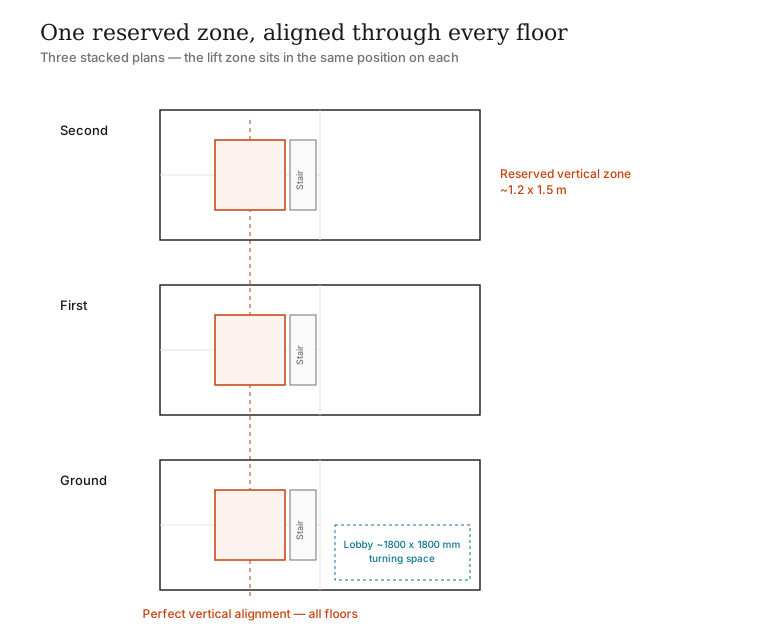
When you provision during construction, the only real "cost" is the floor area you reserve — typically a 1.2 m × 1.5 m footprint on each floor (about 18–20 sq ft) — plus a slightly deeper foundation pad if you want a pit. In the meantime that box does useful work: it is a stack of cupboards, a broom store, a stair-adjacent niche. You lose nothing.
Retrofitting a shaft into a built house is a different universe. You must core-cut structural slabs on every floor, temporarily prop the floors above, re-route the plumbing and electrical runs that almost always cross that zone, rebuild finishes, and live with weeks of dust and noise. In a framed (RCC column-beam) structure this is feasible but costly; in a load-bearing masonry house, cutting a continuous vertical opening can compromise the load path and may simply not be safe without major strengthening.
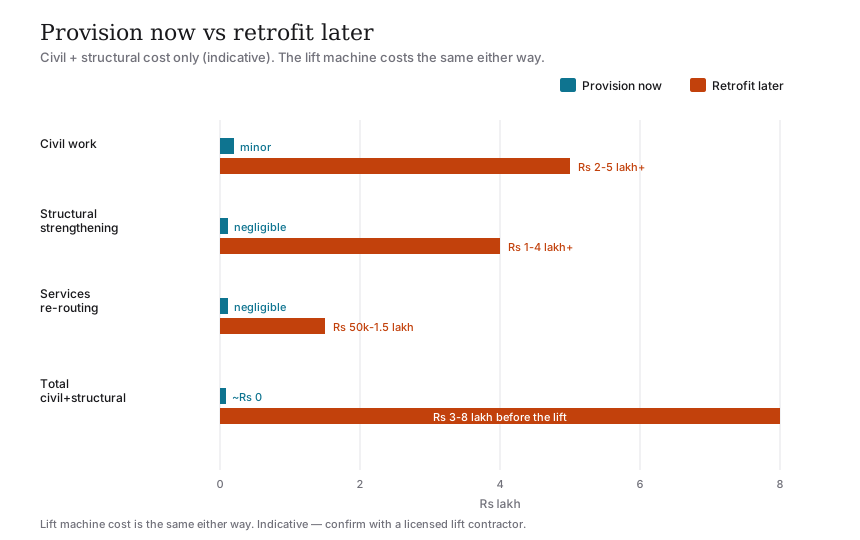
The table below is indicative — confirm against quotes from a licensed lift contractor and a structural engineer for your specific house.
| Item | Provision now (during build) | Retrofit shaft later (finished house) |
|---|---|---|
| Reserved floor area | ~18–20 sq ft/floor (used as cupboards meanwhile) | Same, but lost from a furnished room |
| Civil work | Slab openings cast/blocked out; minor | Core-cutting slabs, propping, making good: ₹2–5 lakh+ |
| Structural strengthening | Designed in (negligible extra) | Often needed; ₹1–4 lakh+ if load path affected |
| Services re-routing | Planned around the void: negligible | Re-route plumbing/wiring crossing the zone: ₹50k–1.5 lakh |
| Disruption | None — house not yet occupied | Weeks of dust, noise, partial vacating |
| Feasibility risk | None | High in load-bearing masonry homes |
Across these lines, a clean provision typically adds little beyond the reserved area, while the civil and structural portion of a true retrofit commonly runs ₹3–8 lakh before the lift itself — and that lift (hydraulic ₹8–20 lakh, traction/gearless ₹10–25 lakh+, screw ₹14–30 lakh, pneumatic vacuum ₹11–22 lakh; 18% GST extra) is the same price either way. You are not saving on the machine. You are saving the demolition.
The stacked-space strategy
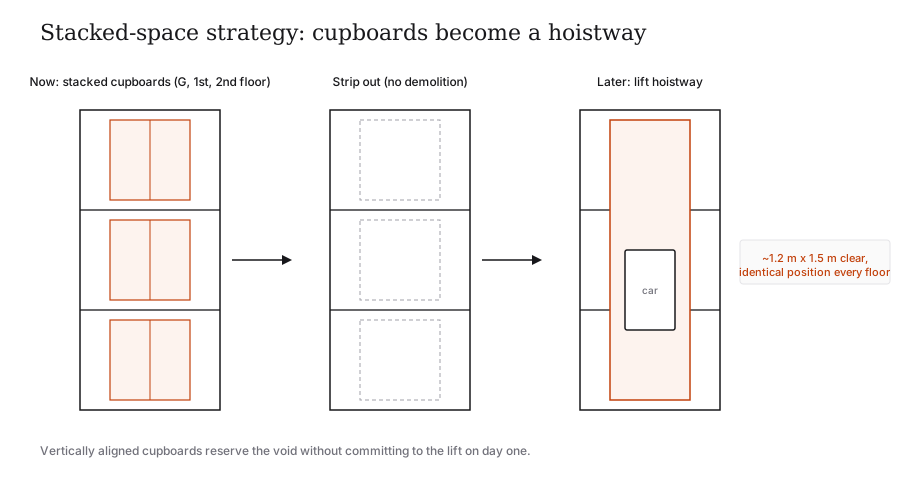
The elegant way to provision is what we call the stacked-space strategy: design a vertically aligned column of useful, expendable space that runs through every floor and lands exactly where a hoistway would go.
The classic candidates, in rough order of how easily they convert:
- Stacked cupboards / wardrobes — a full-height storage column placed identically on each floor. The most common and least wasteful choice: you use the storage for years, then strip it out and the empty box is your hoistway.
- A stacked store / utility niche — broom cupboard, linen store, or a small box room aligned floor to floor.
- An aligned void beside the staircase — the dead triangle next to a dog-leg stair is often the natural home for a future lift, keeping the lift and stair as one vertical circulation core.
The non-negotiable rules for this to work:
- Perfect vertical alignment. The footprint must sit in exactly the same plan position on every floor. A 100 mm drift between floors and your shaft is unbuildable.
- Size it to IS 14665 outline dimensions, plus margin. IS 14665 Part 1 sets the outline dimensions for the car, well/hoistway, pit and headroom. A small home car needs a hoistway from roughly 1219 × 1524 mm (4' × 5'), varying with capacity and door type. Reserve a clear internal box of about 1.2 m × 1.5 m at minimum; if you may want an accessible car later (≈1100 × 1400 mm clear inside, see below), reserve a little more.
- Keep it free of wet services and structure. No plumbing stack, no beam dropping through it, no electrical conduit you cannot move. Treat the box as if a lift were already there.
- Locate it for accessibility. Land the lift near the entrance and the stair, ideally with a flat, step-free approach from the front door so a wheelchair user can reach it. See our accessible-home design guide for the approach and lobby geometry.
Tell your architect on day one: "Leave me a vertically aligned 1.2 × 1.5 m box, used as cupboards now, that can become a lift shaft later." That one sentence is 80% of lift-readiness.
Reserving the slab opening and the load path
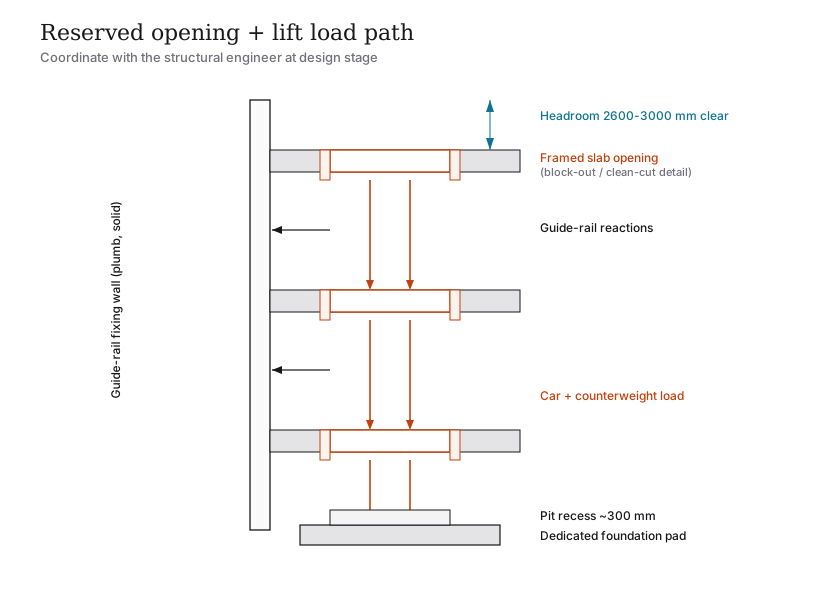
A stacked cupboard is only half the job. A lift needs a continuous vertical opening through every floor slab — and the structure around it has to carry the new loads. This is where you must coordinate with your structural engineer at the design stage.
There are two ways to handle the slab. The first is to cast the openings now (a "block-out" — a boxed-out hole left in each slab during pouring) and simply cover them with removable, load-rated lids or temporary infill while the cupboards are in use. The second, gentler on day-to-day life, is to design the slab so the opening can be cut cleanly later: place beams to frame the future opening, and detail the slab reinforcement so the panel can be removed without disturbing the surrounding structure.
Either way, ask the engineer to design for these from the start:
- A framed opening. Beams around the four sides of the void on each floor so the slab is already "edged" — this is the single biggest advantage of a framed RCC structure over load-bearing masonry, and the reason lift-readiness is far easier in a column-beam house.
- The lift's own load path. A lift imposes its weight and dynamic (moving, braking) loads onto the structure — guide-rail reactions onto the walls/columns and a car/counterweight load to the base. The engineer should carry these down to a dedicated foundation pad under the future pit. Provisioning this footing now is trivial; adding it later means breaking the ground floor.
- Guide-rail fixing surfaces. The two long sides of the hoistway need solid, plumb surfaces (RCC walls or a designed steel frame) to bolt the guide rails to. Decide now whether those walls are structural or infill.
If your home is load-bearing masonry rather than framed RCC, flag this early: a continuous vertical hole removes a chunk of load-bearing wall, and the load path above it must be picked up by a new frame. It is doable, but it is exactly the kind of work that turns "provision" into "major surgery" if left to later. Our architect's residential-elevator handbook covers the structural coordination in professional detail.
Pit, headroom and choosing a forgiving lift type
Two dimensions decide how invasive a future installation is: the pit (the dug-down space below the lowest floor, where the car rests and buffers sit) and the headroom / overhead (clear height above the top floor for the car to overrun safely).
Indicative requirements — confirm with the lift contractor for the model you eventually choose:
| Lift type | Pit depth | Headroom/overhead | Power | Pit/shaft demand |
|---|---|---|---|---|
| Hydraulic | ~150–300 mm | ~2600–3000 mm | Single or three-phase | Shallow pit — friendly to provision |
| Screw / winding-drum | ~150–300 mm | ~2600–3000 mm | Often single-phase | Low pit, compact, self-supporting |
| Traction / gearless (MRL) | ~300–610 mm (some gearless 1200–1500) | ~2600–3000 mm | Often three-phase | Deeper pit; machine inside hoistway (no machine room) |
| Pneumatic vacuum (PVE) | None | Self-contained | Single-phase | No pit, no shaft, no machine room |
For a provisioned shaft, the smart move is to reserve a shallow pit of ~300 mm under the future hoistway during construction — enough to suit hydraulic or screw lifts, which are the most pit-forgiving, and easily deepened if you later choose traction. Casting a 300 mm recess and a foundation pad now is nearly free; excavating a pit under a finished ground floor is messy and sometimes impossible if the water table or foundation is in the way. If you cannot provide any pit, plan around pitless / low-pit models or a PVE.
Headroom is the quieter trap. Reserve 2600–3000 mm of clear height above the future top landing. On the topmost floor this often means designing the roof/terrace slab so the lift can overrun — do not let a beam or a low parapet eat into that zone.
If you did not provision: the pneumatic vacuum escape hatch
Suppose the house is already built and you left no provision. The pneumatic vacuum elevator (PVE) is the closest thing to a true retrofit. A panoramic cylindrical cabin rides on an air-pressure differential inside a self-supporting tube. It needs no pit, no shaft and no machine room, runs on single-phase power, and stands free in a corner or a stairwell void. Nibav is the best-known India-grown PVE brand; pricing is roughly ₹11–22 lakh plus 18% GST.
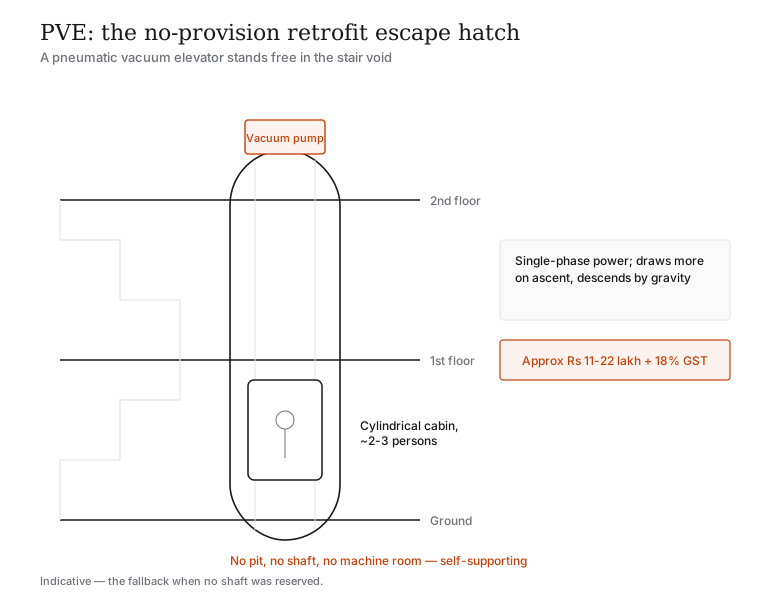
The trade-offs are real and worth stating plainly: PVEs have limited capacity (around 2–3 persons), limited travel, and draw more power on the ascent (they descend by controlled gravity). The capacity ceiling also makes a true wheelchair-plus-attendant car hard to achieve. A PVE is the retrofit answer; a properly provisioned conventional shaft is still the better answer if you plan ahead, because it lets you install a roomier, accessible car. This is precisely why provisioning now is worth the small effort — it keeps the better option on the table.
Electrical headroom and accessibility provisions
A lift is also an electrical load, and Indian power conditions add a few must-dos. Provision these in the consumer unit and conduiting now, even if no lift is fitted for years:
- A spare distribution-board way dedicated to the future lift, with the conduit run already stubbed to the shaft.
- Provision for single- or three-phase supply. Small hydraulic, screw and PVE lifts can run single-phase; larger traction lifts need three-phase. If a three-phase sanction is plausible later, leave space and a route for it.
- Provision for an ARD (Automatic Rescue Device). Given India's outages, an ARD — a battery that brings the car to the nearest floor and opens the doors on a power cut — is essential, not optional. Leave room near the shaft for its battery cabinet.
While the floors are open, make the cheap accessibility moves that a lift alone will not deliver:
- A step-free, ≥900 mm clear approach from the entrance to the future lift door (CPWD Harmonised Guidelines benchmark).
- A future lift lobby of ~1800 × 1800 mm so a wheelchair can turn — reserve it even if it is open circulation now.
- Plan for an accessible car (~1100 × 1400 mm clear inside) with an automatic sliding/telescopic door rather than a manual swing door, which blocks wheelchairs.
The professional reference for these dimensions is our universal-design and adaptable-homes guide.
The provision-now checklist
Hand this to your architect and structural engineer at the concept stage. Tick each item before the slab is cast.
| ☐ | Provision item | Target / note |
|---|---|---|
| ☐ | Vertically aligned void on every floor | ~1.2 × 1.5 m clear; identical plan position |
| ☐ | Interim use defined | Stacked cupboards / store, strip-out detailed |
| ☐ | Slab openings framed | Beams edge the void on each floor (block-out or clean-cut detail) |
| ☐ | Lift load path designed | Guide-rail reactions + car/counterweight load carried to a foundation pad |
| ☐ | Foundation pad / pit recess | ~300 mm pit recess + pad cast now |
| ☐ | Headroom reserved | 2600–3000 mm clear above top landing; no beams intruding |
| ☐ | No wet services in the box | Plumbing stacks and drains routed away from the void |
| ☐ | Guide-rail fixing walls | Two plumb, solid long-side surfaces (RCC or steel) |
| ☐ | Step-free approach | ≥900 mm clear, level path from entrance to lift door |
| ☐ | Lobby reserved | ~1800 × 1800 mm turning space at each landing |
| ☐ | Spare DB way + conduit | One dedicated way; conduit stubbed to shaft |
| ☐ | Phase provision | Route for single- or three-phase as needed |
| ☐ | ARD space | Room for battery cabinet near shaft |
| ☐ | Door type intent | Plan for automatic sliding/telescopic, ≥900 mm clear |
When you are ready to actually buy and install, our home-lift planning checklist and the lift specification checklist take you through model selection, sizing and the state licence/registration steps that apply in roughly ten Indian states. The residential-elevator buyer's guide is the pillar that ties the whole cluster together.
The bottom line
Provisioning for a lift is the highest-return future-proofing decision in a multi-storey Indian home, precisely because it costs so little now and saves so much later. Reserve a vertically aligned 1.2 × 1.5 m box used as cupboards today, frame the slab openings, carry the load path down to a foundation pad, cast a shallow pit recess, reserve the headroom, and stub a spare electrical way with ARD space. Do that, and the day stairs become a problem, fitting a lift is a clean install — not a demolition. And if a finished house caught you without a provision, a pneumatic vacuum elevator is the escape hatch that needs no pit and no shaft at all.
References
- IS 14665 — Electric Traction Lifts (BIS): Part 1, Outline dimensions (car, well/hoistway, pit, headroom): https://law.resource.org/pub/in/bis/S05/is.14665.1.2000.pdf
- IS 14665 — Part 2, Code of practice for installation, operation and maintenance (BIS): https://law.resource.org/pub/in/bis/S05/is.14665.2.1-2.2000.pdf
- National Building Code of India 2016, Part 8 (Building Services), Section 5 — Installation of Lifts, Escalators and Moving Walks (BIS): https://www.bis.gov.in/standards/technical-department/national-building-code/
- BIS Guide for Using NBC 2016: https://www.bis.gov.in/wp-content/uploads/2022/08/Booklet-Guide-for-Using-NBC-2016.pdf
- Rights of Persons with Disabilities (RPwD) Act 2016 — full text: https://ssepd.odisha.gov.in/sites/default/files/2024-01/RPWD%20ACT.pdf
- CPWD / MoHUA Harmonised Guidelines and Space Standards for a Barrier-Free Built Environment (2016): https://www.cpwd.gov.in/Publication/Harmonisedguidelinesdreleasedon23rdMarch2016.pdf
- Lift regulations in India (overview): https://www.99acres.com/articles/know-all-about-the-lift-regulations-in-india.html
Export this guide
Related Guides — Deep-dive reading
Designing Adaptable & Universal-Design Homes
Accessibility, Aging-in-Place, and the Multi-Stage Family — Code, Anthropometrics, and Plan-Stage Discipline for Indian Residential Architects
Room PlanningArchitect's Residential Elevator Planning Handbook (India): Shaft, Loads, Code & Coordination
The plan-stage reference for carrying a home lift through the drawing board — shaft, structure, pit, code, licensing and accessibility.
Home Lifts & AccessibilityDesigning a Lift into a New House (India): Getting It Right at the Plan Stage
Where to place the lift, which type to commit to early, what shell to reserve, and how to coordinate architect, structural engineer and vendor before a single column is cast.
Home Lifts & AccessibilityRelated Tools — Try Free
Home Lift Comparison Tool
Compare hydraulic, traction, pneumatic vacuum and screw lifts side by side for your home.
Lift ComparisonAccessibility Compliance Calculator
Check a planned lift against the CPWD and RPwD accessible-lift benchmarks for a score.
Lift CheckerLift Pit Depth Calculator
The pit depth a home lift needs by drive type — or the pitless and shaftless options.
Lift Calculator